
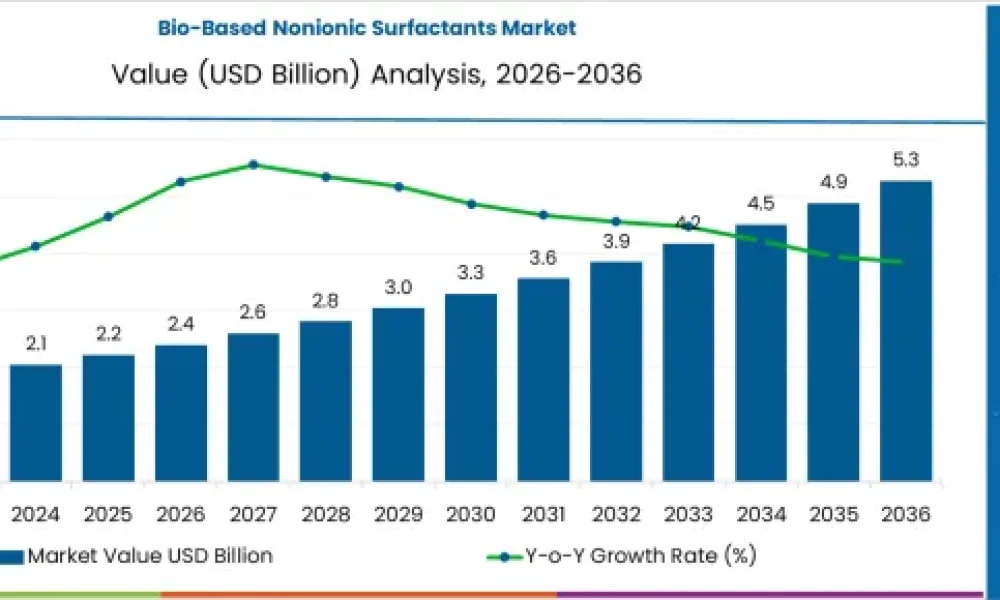
The global bio-based nonionic surfactants market is on a strong growth trajectory, projected to expand from approximately USD 2.4 billion in 2026 to nearly USD 5.3 billion by 2036, registering a healthy compound annual growth rate (CAGR) of about 8.2% over the forecast period. This expansion reflects a decisive shift across industries toward renewable, biodegradable, and low-toxicity chemical solutions as sustainability moves from a compliance requirement to a core business strategy.
Bio-based nonionic surfactants, produced from renewable raw materials such as plant oils, sugars, and natural fats, are increasingly replacing petroleum-based surfactants. Their superior performance in emulsification, detergency, and wetting, combined with improved skin compatibility and environmental safety, is driving widespread adoption across personal care, home care, institutional cleaning, agriculture, and industrial applications. Rising consumer demand for clean-label and eco-friendly products continues to reinforce this transition at a global scale.
Key Market Insights at a Glance
Market growth is being fueled by tightening environmental regulations, particularly in developed economies, that favor biodegradable and low-VOC ingredients. At the same time, multinational consumer goods companies are actively reformulating products to meet sustainability commitments and brand transparency goals. Advances in green chemistry and bio-refining technologies are improving yield efficiency and cost competitiveness, making bio-based nonionic surfactants more accessible to both large manufacturers and mid-scale formulators. The market is also benefiting from expanding applications in industrial and agricultural formulations, where performance requirements are becoming increasingly stringent.
Segment Overview
By product form, liquid bio-based nonionic surfactants account for the largest share of market value due to their ease of handling and widespread use in personal and home care formulations. Solid and paste formats are gaining momentum in industrial and institutional cleaning applications where concentration and storage efficiency are critical. From a feedstock perspective, surfactants derived from coconut and palm oils continue to dominate, supported by strong functional properties and established supply chains, while sugar-based alternatives are emerging as a high-growth segment due to their mildness and favorable environmental profile. Personal care and home care remain the leading end-use industries, with rising penetration in agrochemicals, textiles, and industrial cleaners.
Regional Overview
Asia-Pacific represents the fastest-growing regional market, led by China’s rapid industrialization and increasing emphasis on sustainable manufacturing practices. Strong growth is also observed in North America, where the United States is witnessing rising adoption of bio-based surfactants in eco-friendly detergents, cosmetics, and household products. Europe remains a mature yet influential market, driven by strict chemical safety regulations and early adoption of green chemistry principles. Other regions, including Japan, the UK, and Germany, are experiencing steady growth aligned with national sustainability and decarbonization initiatives.
Competitive Landscape
The bio-based nonionic surfactants market is moderately consolidated, with global chemical leaders and specialty ingredient manufacturers competing through innovation, scale, and sustainability credentials. Companies are focusing on expanding bio-based product portfolios, improving performance parity with synthetic alternatives, and securing renewable feedstock supplies. Strategic collaborations, long-term supply agreements, and investments in production capacity are shaping competitive dynamics as demand accelerates.
To access the complete data tables and in-depth insights — Request Your Sample Report Now
Market Outlook: Powering the Next Decade
Over the next decade, the market is expected to benefit from deeper integration of sustainability across value chains, from raw material sourcing to end-product labeling. Continuous innovation in surfactant chemistry will unlock new high-performance applications, particularly in industrial and technical uses. As consumers and regulators demand greater transparency, bio-based nonionic surfactants will play a pivotal role in enabling manufacturers to meet environmental targets without compromising functionality or cost efficiency.
Key Players of the Sustainable Label Industry
Leading companies driving innovation and market growth include BASF, Croda International, Evonik Industries, Clariant, Solvay, Kao Corporation, Stepan Company, Nouryon, Dow, and Sasol. These players are actively strengthening their sustainable product lines and investing in next-generation bio-based technologies.
Recent Strategic Developments
Recent developments across the industry highlight increased investment in renewable feedstock integration, expansion of bio-based surfactant manufacturing facilities, and partnerships with consumer goods brands to co-develop sustainable formulations. Product launches aligned with eco-certifications and clean-label standards continue to enhance market competitiveness.
As sustainability becomes a defining factor for chemical and consumer goods industries, the bio-based nonionic surfactants market stands at the forefront of transformation—delivering measurable environmental benefits while supporting long-term commercial growth.
Have a specific Requirements and Need Assistant on Report Pricing or Limited Budget please contact us – [email protected]
About Future Market Insights (FMI)
Future Market Insights, Inc. (FMI) is an ESOMAR-certified, ISO 9001:2015 market research and consulting organization, trusted by Fortune 500 clients and global enterprises. With operations in the U.S., UK, India, and Dubai, FMI provides data-backed insights and strategic intelligence across 30+ industries and 1200 markets worldwide.
Why Choose FMI: https://www.futuremarketinsights.com/why-fmi



