
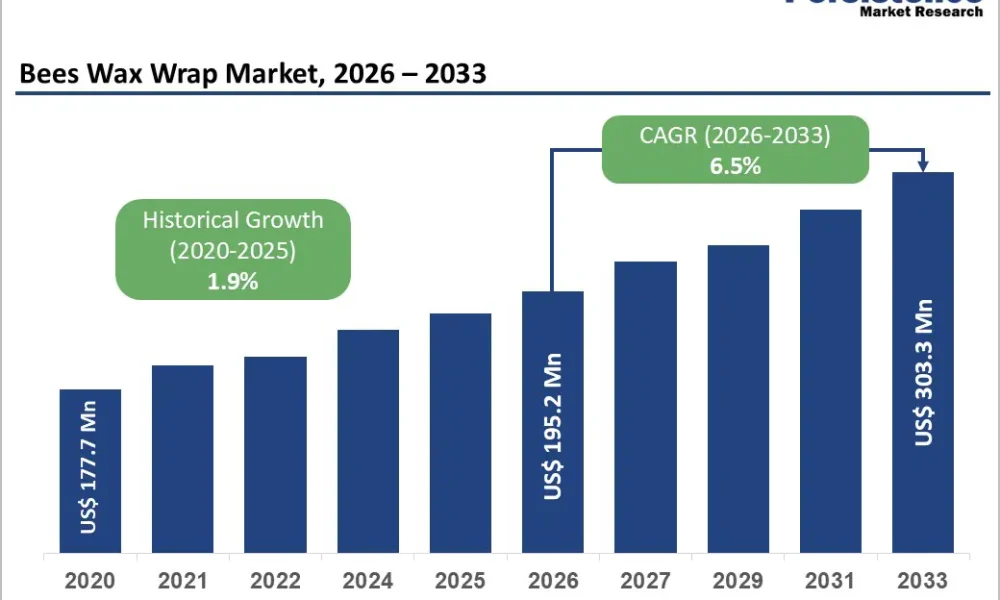
The beeswax wrap market has gained significant traction over recent years, driven by increasing awareness of environmental sustainability and the global shift away from single-use plastics. Beeswax wraps are reusable food wraps made from natural materials such as cotton infused with beeswax, jojoba oil, and tree resin. These wraps provide an eco-friendly alternative to plastic cling films and aluminum foils, offering consumers a biodegradable, sustainable, and hygienic option for food storage. The global beeswax wrap market is expected to reach US$ 195.2 million by 2026 and is projected to achieve US$ 303.3 million by 2033, growing at a CAGR of 6.5% during the forecast period from 2026 to 2033.
The growth of this market is driven primarily by regulatory measures targeting single-use plastics, growing consumer awareness of the environmental impact of packaging, and rising adoption of reusable kitchen solutions. Among product types, standard-sized wraps for household use dominate due to their convenience, affordability, and compatibility with a wide variety of food storage needs. Geographically, North America leads the market due to high environmental consciousness, widespread adoption of eco-friendly kitchen products, and strong penetration of e-commerce and direct-to-consumer (DTC) sales channels. Meanwhile, Europe is emerging as a rapidly growing region, spurred by stringent environmental regulations, such as the EU Single-Use Plastics Directive, and consumer preference for sustainable, high-quality kitchen products.
Key Highlights from the Report
• The global beeswax wrap market is projected to grow from US$ 195.2 million in 2026 to US$ 303.3 million by 2033.
• Standard household wraps dominate due to their convenience, affordability, and versatility.
• North America leads the market with high adoption rates of eco-friendly and reusable kitchen solutions.
• Europe is witnessing rapid growth due to stringent sustainability regulations and consumer eco-consciousness.
• Rising popularity of e-commerce and DTC distribution models is driving market accessibility and awareness.
• Innovations in biodegradable materials and wrap designs are expanding market applications and consumer appeal.
𝐆𝐞𝐭 𝐚 𝐒𝐧𝐞𝐚𝐤 𝐏𝐞𝐞𝐤, 𝐒𝐚𝐦𝐩𝐥𝐞 𝐏𝐃𝐅 𝐈𝐧𝐬𝐢𝐝𝐞: https://www.persistencemarketresearch.com/samples/36248
Market Segmentation
The beeswax wrap market can be segmented based on product type, end-use, and material composition. By product type, the market includes standard wraps, large wraps for covering containers, sandwich wraps, and specialty wraps. Standard wraps dominate as they provide multi-purpose usability for a range of household food storage needs. Large wraps are preferred for storing bigger items like cheese blocks, bowls, or baked goods, while sandwich wraps are ideal for packed lunches, school meals, and on-the-go consumption. Specialty wraps, such as printed designs or scented wraps, cater to consumer preferences for aesthetics, personalization, or novelty.
By material composition, the market includes beeswax-only wraps, blends with jojoba oil, and combinations with tree resin. Beeswax-only wraps are popular for their strong natural antibacterial properties and durability. Blends with jojoba oil enhance flexibility, moisture resistance, and reusability, while tree resin incorporation provides improved adhesion and protective barrier properties for longer-lasting wraps.
By end-use industry, the market is segmented into household, foodservice, and retail/gift applications. Households dominate the market as consumers increasingly seek sustainable, reusable alternatives for daily food storage. Foodservice establishments, including cafes, restaurants, and catering services, are adopting beeswax wraps as part of eco-conscious operations, reducing plastic consumption. Retail and gift applications are also growing, with specialty or designer wraps positioned as sustainable lifestyle products, often sold in kits or bundled packages for gifting occasions.
Regional Insights
North America is the leading region for beeswax wrap adoption, primarily due to strong consumer awareness of environmental issues, regulatory pressures to reduce plastic use, and the convenience of e-commerce and DTC channels. The U.S. and Canada have seen rapid uptake of reusable kitchen products in households and sustainable packaging solutions in small foodservice businesses.
Europe represents a high-growth market, driven by stringent environmental regulations and government initiatives promoting biodegradable and reusable alternatives. Countries such as Germany, France, and the U.K. are key contributors, with consumers actively seeking sustainable solutions for everyday food storage and reducing household plastic waste.
The Asia-Pacific region is emerging as a significant market opportunity due to increasing urbanization, rising disposable incomes, and growing awareness of eco-friendly products. Markets such as Japan, Australia, and China are witnessing a shift toward reusable and low-waste kitchen solutions, particularly among urban households and younger, environmentally conscious consumers. Latin America and the Middle East & Africa show moderate adoption, primarily influenced by rising awareness campaigns, limited regulatory initiatives, and increasing e-commerce penetration.
𝐆𝐞𝐭 𝐚 𝐂𝐮𝐬𝐭𝐨𝐦𝐢𝐳𝐞𝐝 𝐌𝐚𝐫𝐤𝐞𝐭 𝐕𝐢𝐞𝐰 𝐢𝐧 𝐎𝐧𝐞 𝐂𝐥𝐢𝐜𝐤 : https://www.persistencemarketresearch.com/request-customization/36248
Market Drivers
The beeswax wrap market is propelled by the growing global movement toward sustainable living and reduced plastic consumption. Regulatory measures banning or limiting single-use plastics have created a strong market pull for reusable alternatives. Additionally, consumer preference for eco-friendly kitchen solutions, rising awareness of environmental impact, and the appeal of low-waste lifestyles are key drivers. The expansion of e-commerce and direct-to-consumer sales has further enabled market growth by providing easy access to beeswax wrap products, often accompanied by educational content promoting sustainability. Furthermore, innovations in wrap designs, functionality, and materials, such as enhanced barrier properties and increased reusability, are making beeswax wraps a more attractive alternative for both households and commercial users.
Market Restraints
Despite strong growth potential, the market faces several challenges. The higher cost of beeswax wraps compared to conventional plastic wraps can deter price-sensitive consumers. Limited awareness in certain regions, particularly in developing markets, constrains adoption. The durability and performance of wraps, which can be impacted by improper use or washing, may also influence consumer perception. Additionally, availability of raw materials such as sustainably sourced beeswax can limit production scalability. In commercial applications, foodservice establishments may hesitate to adopt beeswax wraps due to hygiene concerns, sanitation requirements, or the need for frequent replacement.
Market Opportunities
The market offers significant opportunities for growth through product innovation, market expansion, and lifestyle branding. Companies investing in premium designs, multi-functional wraps, and kits for gift sets can tap into the rising demand for aesthetically appealing and sustainable products. Emerging markets in Asia-Pacific, Latin America, and Africa provide untapped potential due to rising environmental awareness, expanding middle-class populations, and increased access to e-commerce platforms. Additionally, collaborations with lifestyle brands, subscription models, and educational campaigns around sustainable living are expected to boost market penetration. Innovations in enhanced material blends and barrier properties provide opportunities to expand applications beyond household use into foodservice, retail, and commercial packaging sectors.
𝐁𝐮𝐲 𝐍𝐨𝐰 𝐭𝐡𝐞 𝐃𝐞𝐭𝐚𝐢𝐥𝐞𝐝 𝐑𝐞𝐩𝐨𝐫𝐭: https://www.persistencemarketresearch.com/checkout/36248
Company Insights
• Bee’s Wrap – A leading innovator of reusable beeswax wraps with a strong global presence.
• Abeego – Offers premium beeswax wrap solutions with enhanced flexibility and barrier properties.
• EcoBags – Provides sustainable and reusable beeswax wraps along with eco-friendly storage solutions.
• Yummy Wraps – Focuses on affordable and designer beeswax wraps for household use.
• Beeswax Wrap Co. – Specializes in organic and natural beeswax wraps with customizable designs.
• Onya Wraps – Offers multi-functional beeswax wraps designed for household and travel use.
• Mrs. D’s Wraps – Produces high-quality beeswax wraps with antibacterial properties.
• Little Bee Wraps – Focuses on artisanal and eco-conscious beeswax wrap products.
• Packit Green – Provides beeswax wraps integrated with innovative packaging and gifting solutions.
• The Beeswax Wrap Company – Develops premium eco-friendly wraps targeting retail and lifestyle segments.
Recent Developments
Bee’s Wrap launched a new line of large and multi-purpose wraps in 2025, catering to household and commercial food storage needs with enhanced barrier properties.
Abeego introduced designer beeswax wrap kits in 2024, targeting gift markets and promoting reusable packaging solutions through retail and e-commerce channels.
Conclusion
The global beeswax wrap market is set to experience strong growth through 2033, driven by regulatory restrictions on single-use plastics, rising consumer demand for sustainable kitchen solutions, and the rapid expansion of online and DTC distribution models. North America leads the market due to high environmental consciousness, e-commerce penetration, and adoption of reusable alternatives, while Europe is growing rapidly under stringent sustainability regulations and proactive consumer behavior. Asia-Pacific presents significant growth potential due to increasing urbanization, disposable incomes, and eco-conscious consumer trends. Innovations in product design, material blends, and multifunctional applications are broadening market appeal across households, foodservice, and retail sectors. The market is expected to grow from US$ 195.2 million in 2026 to US$ 303.3 million by 2033, at a CAGR of 6.5%, reflecting a strong shift toward low-waste, sustainable, and environmentally friendly food storage solutions globally.




