
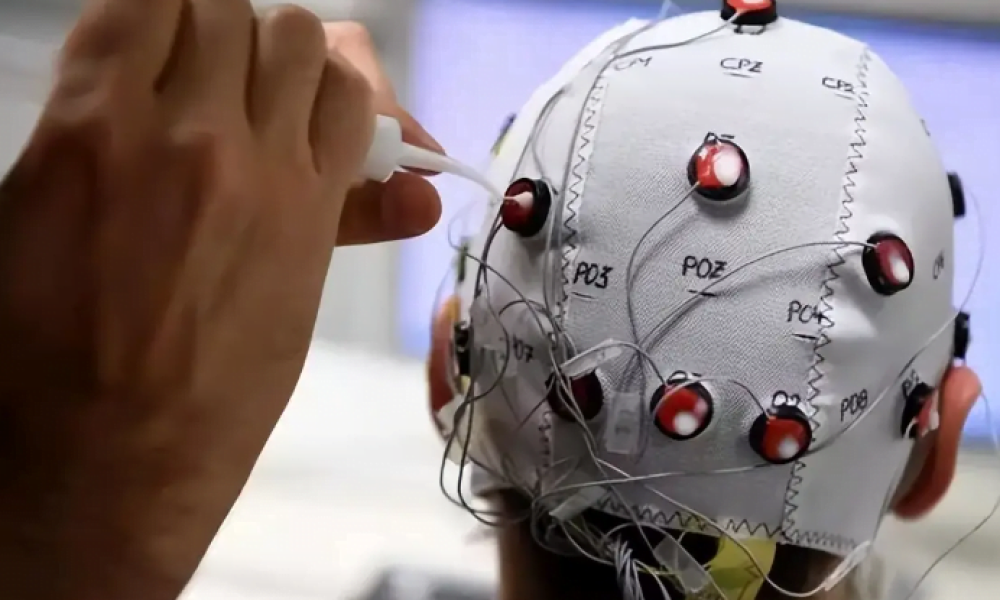
The New England Journal of Medicine introduced a new brain-computer interface technology, which successfully enabled a patient with amyotrophic lateral sclerosis (ALS), a neurodegenerative disease that has prevented him from speaking for five years, to communicate with his family members on a daily basis.
This was achieved through the development of a new brain-computer interface (BCI) at the UC Davis Health Center that converts brain signals into speech with 97 per cent accuracy. After activating the system, the man said what he wanted to say within minutes.
Interventional brain-computer interface experiment
The world’s first interventional brain-computer interface sensor endovascular removal trial was successfully conducted in Beijing, China. According to the introduction, the test for the first time the interventional brain-computer interface sensor and wireless transmission module were safely removed, marking the interventional brain-computer interface technology as an important improvement in the safety of the technology, for the clinical application of the technology to provide the corresponding protection.

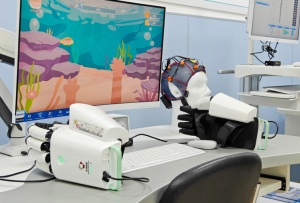
This test further demonstrates the great potential of interventional brain-computer interfaces in terms of safety and application. The application of wireless transmission technology will help the interventional brain-computer interface system to become more portable and easy to use. Together with the recognition of motor cortex EEG signals to control the work of the rehabilitation motor-assisted robots, it is expected to bring a blessing to patients with motor dysfunction, such as stroke, brain injury, paraplegia and so on.
Recently, brain-computer interface technology has continued to make significant progress with the addition of science and technology techniques. Brain-computer interface technology, as a cutting-edge field at the intersection of artificial intelligence and neuroscience, has been attracting a lot of attention. It can be simply understood as a technology that allows the brain to “talk” directly with external devices.
Standardization helps the brain-computer interface market
Brain-computer interface is a new productivity and future industrial development direction, brain-computer interface technology is expected to achieve breakthroughs shortly, bringing revolutionary changes to the field of human-computer interaction.
Brain-computer interface industry is developing rapidly, and the market space is expected to expand in the future. Precedence Statistics data shows that the global brain-computer interface market size was USD 2.35 billion in 2023, with a CAGR of 16.55% from 2024-2033.IMARCGroupe data shows that the global brain-computer interface market is expected to reach USD 2.35 billion in 2027, with a CAGR of 16.55% from 2024-2033. global brain-computer interface market size to reach $3.3 billion in 2027.
WiMi
At present, brain-computer interface technology is gradually moving from the laboratory to the market, the industrialization process is accelerating and is expected to become a key bridge connecting the real and virtual worlds. According to public information, WiMi Hologram Cloud (NASDAQ: WIMI), a brain-computer interface technology application manufacturer, focuses on brain-computer application exploration all year round, integrates the research and development of key technologies in brain science and the transformation of scientific and technological achievements, and comprehensively researches the possibility of applying brain-computer interface technology in different scenarios.
Up to now, WiMi has owned the invention patents of related technologies, set up a team of Microconsciousness Quantum Science Research Center, pioneered the in-depth exploration of the theoretical framework and practical path of the interactive fusion of consciousness and machines, closely integrated theoretical research and practical teaching, and developed the next-generation intelligent brain-computer interface system, which promotes the reconstruction of the neural pathway and realizes the restoration of the brain’s brainwave function.
Brain-computer interface, as an emerging technology industry, has huge development potential. Nowadays, the domestic policy strongly supports the development of brain science and brain-like research, while WiMi firmly serves the national strategy of brain science, facing the huge group base to drive the expansion of demand, and technically the industry, academia and self-research in close collaboration, superimposed on the leadership of excellent brain-computer interface technology, and is expected to be the first to enter the fast lane of development under the promotion of the brain-computer interface industry in the future.
Conclusion
In this era of ever-changing technology, every technological leap may change the fate of countless people. Although the current technology of brain-computer interface is mostly in the stage of experimental research, and its clinical application lacks systematic verification, however, the infinite possibilities of its future development have already existed in the cognition of industry insiders. Of course, while looking forward to technological progress, we must realize that perfecting the specification and standardization of brain-computer interface technology can truly benefit mankind and become an important force for social progress.




