
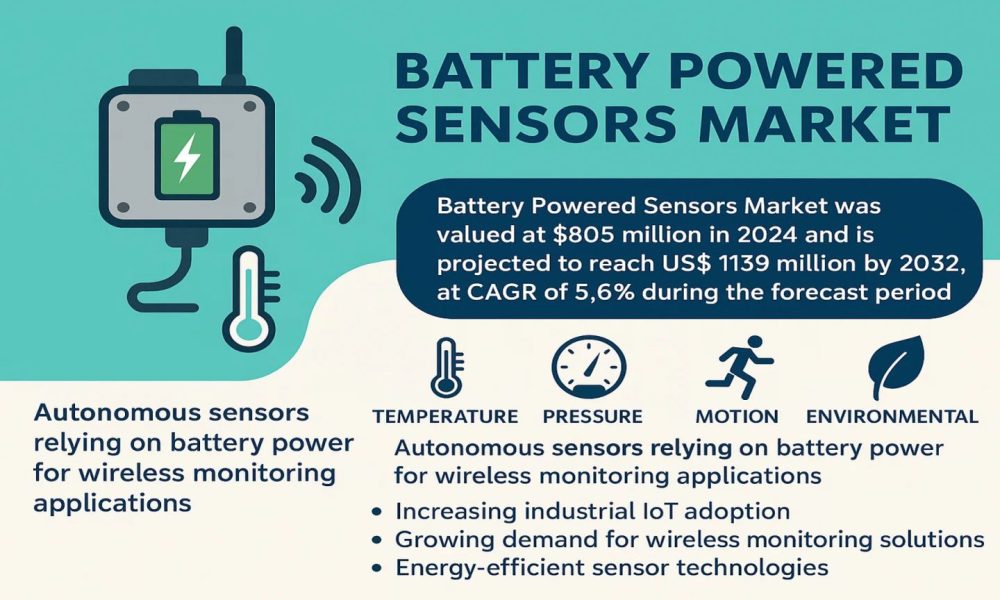
Battery Powered Sensors Market was valued at 805 million in 2024 and is projected to reach US$ 1139 million by 2032, at a CAGR of 5.6% during the forecast period.
Battery powered sensors are autonomous devices that rely on battery power rather than wired connections, enabling wireless data transmission for remote monitoring applications. These sensors include temperature, pressure, motion, and environmental detection variants, widely used in industrial automation, smart homes, and infrastructure monitoring. Their wireless capability allows deployment in hard-to-reach locations where continuous power supply is impractical.
The market growth is primarily driven by increasing industrial IoT adoption, growing demand for wireless monitoring solutions, and energy-efficient sensor technologies. The smart home segment is witnessing accelerated adoption due to rising consumer preference for automation and security systems. Key industry players like IFM, Banner Engineering, and Bosch Mobility are expanding their product portfolios with low-power consumption sensors, leveraging advancements in battery technology and wireless protocols such as LoRaWAN and Zigbee. However, battery lifespan limitations remain a key challenge affecting maintenance costs.
Claim Your Free Sample Report- https://semiconductorinsight.com/download-sample-report/?product_id=117909
MARKET DYNAMICS
MARKET DRIVERS
Growing Adoption of IoT and Smart Devices Fuels Demand for Battery-Powered Sensors
The proliferation of IoT devices and smart technologies is significantly accelerating the adoption of battery-powered sensors across various industries. With over 30 billion connected IoT devices expected by 2025, the demand for reliable, autonomous sensing solutions has never been higher. These sensors enable continuous monitoring in smart homes, industrial settings, and urban infrastructure without requiring wired power connections. The integration of low-power wireless technologies like Zigbee and LoRaWAN with battery-powered sensors has expanded their applications in environmental monitoring, asset tracking, and predictive maintenance systems. Manufacturers are increasingly focusing on developing energy-efficient sensor designs to extend battery life, with some advanced models now operating for up to 10 years on a single battery.
Increasing Need for Remote Monitoring Solutions Drives Market Expansion
Battery-powered sensors are becoming indispensable in remote monitoring applications across industries such as oil & gas, agriculture, and environmental science. In harsh or inaccessible environments where power infrastructure is unavailable, these sensors provide critical data collection capabilities. The global market for remote monitoring systems is projected to grow substantially due to increased investment in industrial automation and smart city initiatives. For oil pipelines stretching thousands of miles, battery-powered sensors offer reliable leak detection and pressure monitoring without the need for expensive wired installations. Similarly, in precision agriculture, soil moisture and crop health sensors powered by long-life batteries enable farmers to optimize irrigation and reduce water consumption by up to 30% in some applications.
Advancements in Energy Harvesting Technologies Extend Sensor Applications
The combination of battery-powered sensors with energy harvesting technologies is creating new opportunities across multiple sectors. Emerging solutions that integrate solar, thermal, or kinetic energy harvesting with rechargeable battery systems are significantly extending sensor operational lifetimes. Recent innovations in low-power electronics have reduced sensor energy consumption to micro-watt levels, enabling some models to operate indefinitely when paired with appropriate energy harvesting systems. These hybrid power solutions are particularly valuable in structural health monitoring of bridges and buildings, where they eliminate the need for periodic battery replacement while maintaining continuous data collection capabilities.
Recent Developments in the Battery Powered Sensors Market:
- Advancements in Low-Power IoT Devices (2024-2025):
Companies are focusing on ultra-low-power sensor designs that extend battery life for smart homes, industrial IoT, and healthcare wearables. This is driving adoption in connected devices that require long-term operation without frequent battery replacement. - Integration with Energy Harvesting Technologies (2025):
Manufacturers are increasingly integrating battery powered sensors with energy harvesting solutions such as solar, vibration, and thermal energy to reduce dependence on traditional batteries, ensuring sustainability and cost-efficiency. - Wireless Communication Enhancements:
Newer sensors are being developed with Bluetooth Low Energy (BLE), LoRaWAN, Zigbee, and 5G connectivity, enabling long-range, low-power communication suitable for applications in agriculture, logistics, and smart cities. - Healthcare & Wearables Expansion:
In 2025, battery powered sensors are gaining strong traction in medical wearables and remote patient monitoring systems, offering continuous health tracking with minimal charging requirements. - Miniaturization & Smart Packaging:
Sensor manufacturers are working on compact, lightweight, and battery-efficient designs that can be easily embedded into consumer electronics, automotive systems, and industrial monitoring equipment. - Strategic Partnerships & Investments:
Key players such as Bosch Sensortec, Honeywell, and STMicroelectronics are investing in collaborations with IoT platform providers to deliver end-to-end battery powered sensing solutions, enhancing efficiency in smart infrastructure.
MARKET OPPORTUNITIES
Expansion of Smart City Initiatives Creates New Application Areas
Urbanization trends and smart city development programs worldwide are generating substantial opportunities for battery-powered sensor providers. Municipal governments are increasingly deploying sensor networks for traffic monitoring, air quality measurement, waste management, and infrastructure monitoring. These applications benefit particularly from battery-powered solutions due to their ease of installation and maintenance in dense urban environments. Several major cities have already implemented large-scale deployments, with single projects sometimes incorporating thousands of sensors. The global smart city market growth is expected to drive significant demand for these sensing solutions, particularly in developing economies where infrastructure modernization is accelerating.
Emerging Industrial IoT Applications Offer Growth Potential
Industry 4.0 initiatives are creating new opportunities for battery-powered sensors in manufacturing environments. Wireless vibration sensors for predictive maintenance, environmental monitors for clean rooms, and condition monitoring systems for rotating equipment are seeing rapidly growing adoption. These applications benefit from the flexibility and scalability of battery-powered solutions compared to traditional wired systems. The ability to retrofit existing machinery with wireless sensors without costly wiring installations is particularly valuable for manufacturers seeking to implement digital transformation programs. As industrial facilities continue to prioritize operational efficiency and equipment uptime, demand for these sensing solutions is expected to grow substantially in coming years.
List of Key Battery Powered Sensor Companies
- ifm electronic GmbH (Germany)
- Banner Engineering Corp. (U.S.)
- PCB Piezotronics (U.S.)
- Optex Co. (Japan)
- BEA Sensors (Belgium)
- XY Sense (Australia)
- Radius Vision (U.S.)
- Willtec Messtechnik (Germany)
- Bosch Mobility Solutions (Germany)
- Titan Products Inc. (U.S.)
Claim Your Free Sample Report- https://semiconductorinsight.com/download-sample-report/?product_id=117909
Segment Analysis:
By Type
Temperature Sensors Lead the Battery Powered Sensors Market Due to Widespread Industrial and Environmental Monitoring Applications
The global battery powered sensors market is segmented based on type into:
- Temperature Sensor
- Subtypes: Thermocouples, RTDs, Thermistors, and others
- Pressure Sensor
- Subtypes: Piezoresistive, Capacitive, Optical, and others
- Motion Sensor
- Humidity Sensor
- Others
By Application
Industrial Detection Segment Dominates Due to Increasing Automation and Remote Monitoring Needs
The market is segmented based on application into:
- Smart Home
- Industrial Detection
- Environmental Monitoring
- Healthcare
- Others
By End User
Manufacturing Segment Holds Significant Share Due to Industry 4.0 Adoption
The market is segmented based on end user into:
- Manufacturing
- Healthcare
- Energy & Utilities
- Consumer Electronics
- Others
Other Topic- FZ NTD Silicon Wafer Market
CONTACT US:
City vista, 203A, Fountain Road, Ashoka Nagar, Kharadi, Pune, Maharashtra 411014
[+91 8087992013]




