
The global baby food maker market is gaining strong momentum as parents increasingly prioritize healthy, homemade meals for infants. Baby food makers are multifunctional kitchen appliances designed to steam, blend, chop, and warm food, enabling parents to prepare fresh baby meals quickly and conveniently. The rising awareness about infant nutrition, coupled with concerns about preservatives and additives in packaged baby foods, has significantly increased demand for home-based food preparation solutions. As modern lifestyles become busier, parents are seeking efficient appliances that simplify meal preparation while maintaining high nutritional quality for babies.
The market is also benefiting from the growing adoption of smart kitchen appliances and compact multifunctional devices. Parents prefer appliances that save time, reduce food waste, and allow better control over ingredients. In addition, the rising number of working parents and growing disposable incomes are encouraging consumers to invest in baby care appliances. The all-in-one baby food maker segment is emerging as a leading product category due to its convenience and multi-functionality. Geographically, North America holds a prominent share in the baby food maker market owing to high consumer awareness, strong purchasing power, and widespread adoption of advanced baby care products.
Download Your Free Sample & Explore Key Insights : https://www.persistencemarketresearch.com/samples/35430
Market Statistics and Growth Outlook
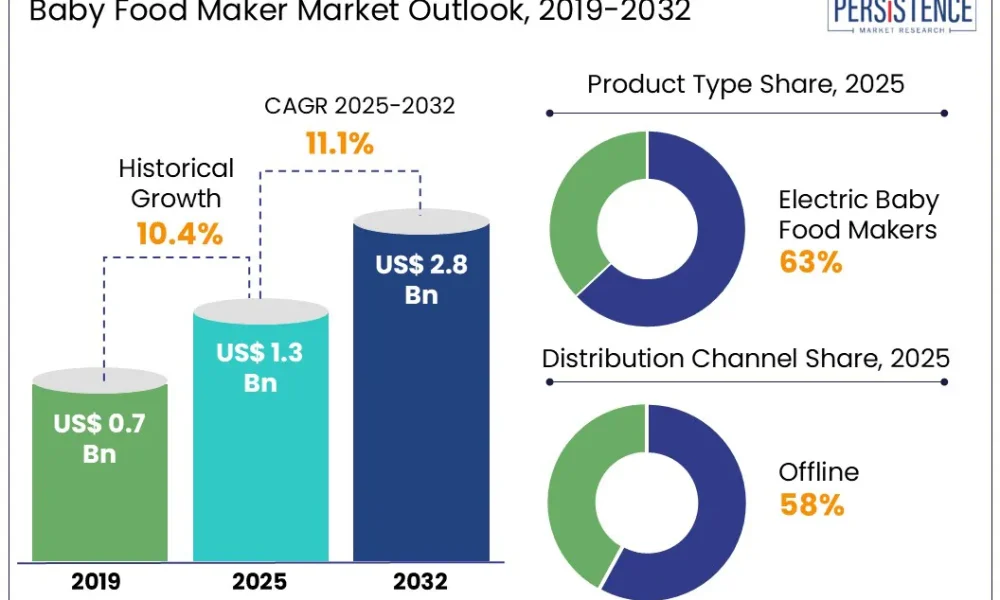
According to Persistence Market Research, the global baby food maker market size is anticipated to rise from US$ 1.3 Bn in 2025 to US$ 2.8 Bn by 2032. The market is projected to witness a CAGR of 11.1% from 2025 to 2032, reflecting strong growth potential in the coming years. The increasing emphasis on safe, nutritious, and homemade infant meals is a major factor supporting market expansion. Parents are becoming more cautious about packaged baby food products and are opting for appliances that help prepare fresh meals at home.
The rapid growth of online retail channels and baby product stores is also playing a crucial role in expanding market reach. E-commerce platforms allow consumers to explore a wide range of baby food maker products, compare features, and make informed purchase decisions. Additionally, technological advancements such as smart temperature control, automatic cooking functions, and compact designs are enhancing product appeal. These innovations are expected to drive continued adoption of baby food makers among modern households.
Key Highlights from the Report
➤ The global baby food maker market is projected to grow from US$ 1.3 Bn in 2025 to US$ 2.8 Bn by 2032.
➤ The market is expected to register a strong CAGR of 11.1% from 2025 to 2032.
➤ Increasing preference for homemade and preservative-free baby food is boosting product demand.
➤ All-in-one baby food makers are emerging as the leading product segment due to their multifunctionality.
➤ Expansion of online retail channels is improving accessibility of baby food preparation appliances.
➤ Rising awareness of infant nutrition and health-conscious parenting is supporting long-term market growth.
Customize This Report for Your Exact Requirements : https://www.persistencemarketresearch.com/request-customization/35430
Market Segmentation
The baby food maker market can be segmented based on product type, functionality, and distribution channel. Product categories include manual baby food preparation tools and electric baby food makers. Among these, electric baby food makers dominate the market due to their convenience, efficiency, and ability to perform multiple tasks such as steaming, blending, reheating, and defrosting. These appliances simplify the baby meal preparation process and reduce the time required to cook fresh meals for infants.
In terms of distribution channels, the market is divided into offline and online retail platforms. Traditional retail channels such as supermarkets, baby product stores, and specialty appliance stores remain significant sales outlets. However, online platforms are gaining rapid popularity as parents prefer the convenience of home delivery and product comparisons. E-commerce platforms also allow manufacturers to showcase detailed product specifications and customer reviews, helping buyers make informed decisions.
Regional Insights
North America represents a major share of the baby food maker market due to high consumer awareness about infant nutrition and the widespread adoption of advanced baby care products. Parents in the region are highly focused on providing healthy, homemade meals to infants, which has boosted demand for multifunctional baby food makers. In addition, the presence of leading manufacturers and well-developed retail networks supports product availability across the region.
Europe also represents a significant market due to strong consumer interest in premium baby care appliances. Countries such as Germany, France, and the United Kingdom are witnessing increased adoption of baby food makers as parents focus on healthier feeding practices. Meanwhile, the Asia-Pacific region is emerging as a rapidly growing market driven by rising birth rates, increasing urbanization, and improving household incomes. The expansion of modern retail infrastructure and e-commerce platforms in countries such as China and India is further supporting market growth.
Market Drivers
One of the primary drivers of the baby food maker market is the increasing awareness of infant nutrition and food safety. Parents are becoming more conscious about the ingredients used in packaged baby food products and are actively seeking healthier alternatives. Baby food makers allow parents to prepare meals using fresh fruits, vegetables, and grains, ensuring higher nutritional value and better quality control. This growing focus on natural and preservative-free foods is significantly contributing to the market’s growth.
Another important factor driving the market is the rising number of working parents seeking convenient kitchen solutions. Preparing baby food manually can be time-consuming, especially for busy families. Baby food makers simplify the process by combining multiple cooking functions into a single appliance. These devices help parents save time while ensuring that babies receive freshly prepared meals. As modern lifestyles become increasingly fast-paced, demand for such convenient appliances is expected to continue rising.
Market Restraints
Despite its growth potential, the baby food maker market faces certain challenges. One of the major restraints is the relatively high cost of advanced baby food maker appliances. Multifunctional devices equipped with steaming, blending, and smart features can be expensive, making them less accessible to price-sensitive consumers. In many developing regions, parents may prefer traditional food preparation methods instead of investing in specialized appliances.
Another challenge is the limited awareness of baby food makers in some emerging markets. While the concept of preparing homemade baby food is gaining popularity, many consumers are still unfamiliar with the benefits of dedicated baby food preparation appliances. Lack of product awareness and limited distribution networks in certain regions may slow market penetration and restrict growth opportunities for manufacturers.
Market Opportunities
The growing trend of smart kitchen appliances and connected devices presents significant opportunities for baby food maker manufacturers. Incorporating features such as digital controls, automated cooking programs, and smartphone connectivity can enhance the functionality of these appliances. Smart baby food makers that provide guided cooking instructions or nutritional tracking could attract tech-savvy parents looking for advanced solutions.
Another promising opportunity lies in product innovation and compact multifunctional designs. Manufacturers are focusing on developing portable, space-saving appliances that are easy to clean and store. Introducing eco-friendly materials, energy-efficient designs, and advanced safety features can further improve product appeal. Additionally, expanding distribution through e-commerce platforms and baby care specialty stores can help companies reach a broader consumer base.
Unlock Complete Insights – Buy the Full Report : https://www.persistencemarketresearch.com/checkout/35430
Company Insights
Key players operating in the baby food maker market include:
Philips Avent
BEABA
Cuisinart
Babymoov
Nuk
Evla’s Baby
Baby Brezza
Oster
Munchkin
Hamilton Beach
Recent Developments
- March 2024: Baby Brezza launched an upgraded baby food maker with enhanced blending and steaming functionality for convenient home baby meal preparation.
- September 2023: BEABA introduced a new compact baby food maker designed for modern kitchens with improved safety and energy-efficient features.
Future Opportunities and Growth Prospects
The baby food maker market is expected to witness strong growth in the coming years as parents increasingly prioritize healthy and convenient feeding solutions for infants. Rising awareness of nutrition, coupled with growing demand for homemade baby meals, will continue to drive product adoption. Technological advancements and multifunctional product designs will further enhance the value proposition of baby food makers.
In addition, expanding retail networks, increasing online product availability, and growing consumer interest in smart kitchen appliances are likely to create new opportunities for manufacturers. Companies that focus on innovation, affordability, and user-friendly designs will be well-positioned to capitalize on the expanding global demand for baby food makers.




