
Global Automotive Steering System Market Projected to Undergo Transformative Growth Through 2036 Driven by Electrification and Steer-by-Wire Adoption
The global automotive steering system market is entering a pivotal decade of technological reconfiguration. According to recent industry analysis, the sector is projected to maintain a robust trajectory from 2026 to 2036, fundamentally reshaped by the transition toward software-defined vehicles (SDVs), the phasing out of traditional hydraulic linkages, and the rapid integration of autonomous driving architectures.
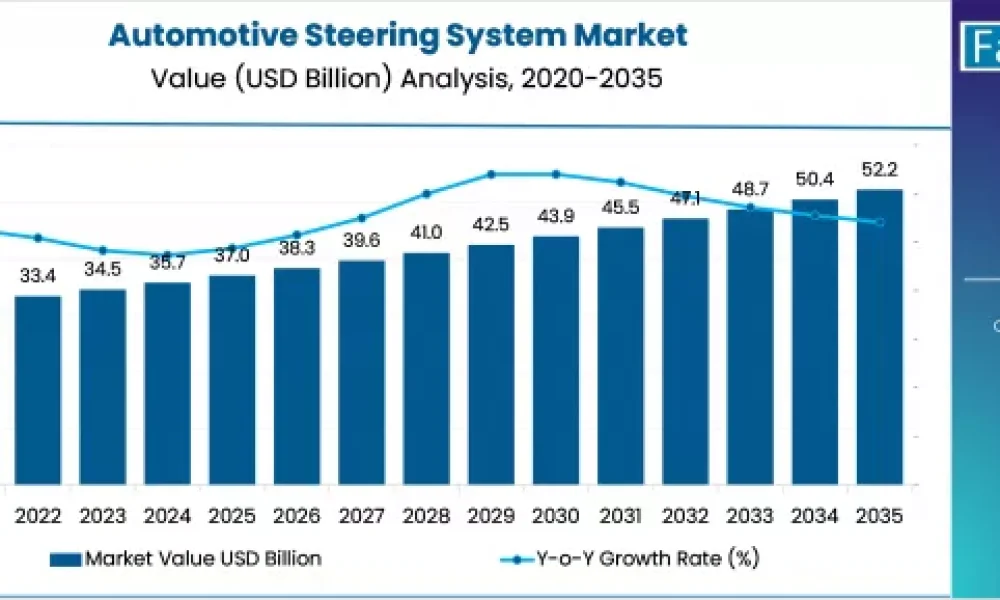
As of early 2026, the market valuation stands at approximately $31.9 billion, with conservative estimates forecasting a rise to over $53 billion by 2035. This growth is underpinned by a global compound annual growth rate (CAGR) of 5.7%, fueled by the mass adoption of Electric Power Steering (EPS) and the emergence of fail-operational steer-by-wire systems.
Request for Sample Report | Customize Report |purchase Full Report – https://www.factmr.com/connectus/sample?flag=S&rep_id=43
Strategic Market Highlights: 2026–2036 Outlook
Dominant Technology: Electronic Power Steering (EPS) currently commands over 71% of the market share, favored for its fuel efficiency and ADAS compatibility.
Emerging Frontier: Steer-by-Wire technology is projected to grow at a 7.95% CAGR, eliminating mechanical steering columns to enable flexible cabin designs.
Regional Leadership: The Asia-Pacific region is expected to capture nearly 45% of the global market by 2035, driven by high production volumes in China and India.
Vehicle Segment: Passenger cars remain the primary revenue driver, while Light Commercial Vehicles (LCVs) show the highest growth potential due to last-mile delivery electrification.
The 5 Ws of the Steering Evolution
Who: Leading Tier-1 suppliers, including Robert Bosch GmbH, ZF Friedrichshafen AG, JTEKT Corporation, and Nexteer Automotive, are pivoting from mechanical hardware to modular, software-centric steering platforms.
What: A comprehensive shift from passive mechanical steering to active, electronically controlled systems that integrate with Advanced Driver Assistance Systems (ADAS).
When: The forecast period of 2026–2036 marks the transition from SAE Level 2 to Level 4 autonomy, requiring steering systems with high-level redundancy and cyber-secure ECUs.
Where: While North America remains a value-driven leader in the SUV and pickup segments, the growth epicenter has shifted to the Asia-Pacific manufacturing hubs.
Why: Stringent carbon emission mandates (such as Euro 7) and consumer demand for Safety-First technologies are making lightweight, energy-efficient steering non-negotiable for OEMs.
Driving Forces: Electrification and Autonomous Readiness
The primary catalyst for the market’s expansion is the global surge in Electric Vehicle (EV) production. Traditional hydraulic systems are incompatible with EV architectures; consequently, EPS has become the industry standard. Furthermore, as vehicles move toward higher levels of autonomy, the steering wheel is undergoing a total redesign—becoming retractable or multifunctional.
The next decade will not be defined by the mere mechanical movement of wheels, but by the precision of the software-driven deployment, noted a senior industry analyst. Suppliers who can offer ‘fail-operational’ architectures—systems that remain functional even if an electronic component fails—will lead the market through 2036.
Market Challenges and Resilience
Despite the positive outlook, the industry faces headwinds. Volatility in the pricing of rare-earth magnets (used in EPS motors) and the ongoing maturation of steering-feel in digital systems remain critical hurdles. However, the rise of OTA (Over-the-Air) software updates is creating new revenue streams for manufacturers, allowing them to refine steering torque and responsiveness long after the vehicle has left the showroom.
Competitive Landscape
The market remains moderately concentrated, with established leaders focusing on vertical integration and R&D. Key players currently shaping the landscape include:
JTEKT Corporation (Global leader in EPS)
ZF Friedrichshafen AG (Pioneering steer-by-wire platforms)
Nexteer Automotive (Focusing on modular global EV platforms)
Hyundai Mobis (Expanding smart driving-assist tech)
About the Automotive Steering Industry Report This press release is based on a comprehensive analysis of the global steering ecosystem, evaluating technological shifts, regulatory mandates, and regional production data for the forecast period of 2026–2036.
Related Reports
Automotive Control Arm Assemblies Market
Automotive Wheel Locks Market
Automotive Massage Seats Market
Automotive Relays and Fuses Market
“



