
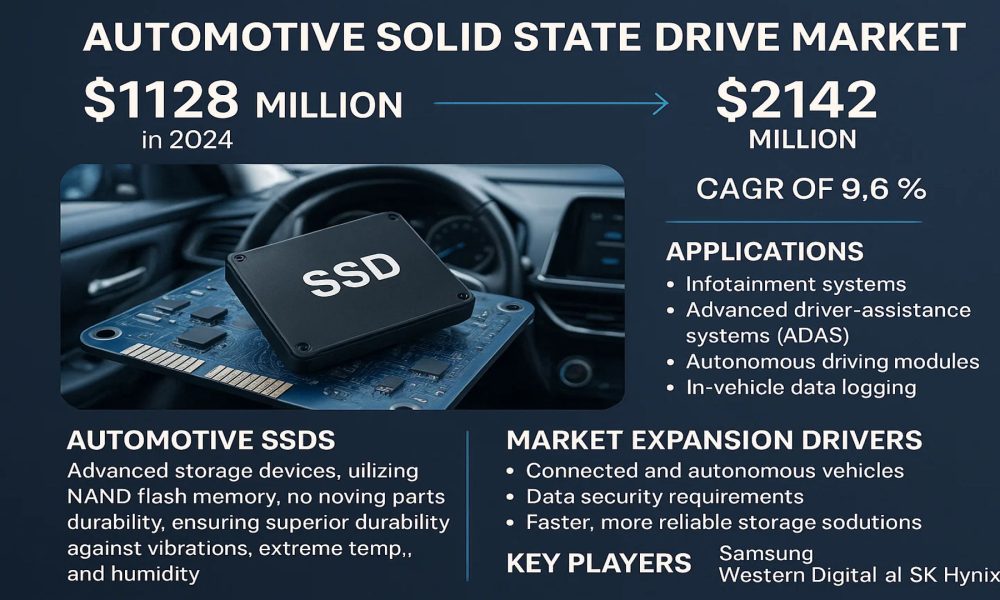
Automotive Solid State Drive Market was valued at 1128 million in 2024 and is projected to reach US$ 2142 million by 2032, at a CAGR of 9.6% during the forecast period.
Automotive SSDs are advanced storage devices specifically engineered for vehicle applications, leveraging NAND flash memory technology to deliver high-speed data processing and reliable performance in challenging automotive environments. Unlike conventional hard disk drives (HDDs), these SSDs feature no moving parts, ensuring superior durability against vibrations, extreme temperatures, and humidity—critical for automotive electronic systems. Their applications span across infotainment systems, advanced driver-assistance systems (ADAS), autonomous driving modules, and in-vehicle data logging, meeting stringent automotive-grade certifications.
The market expansion is driven by the increasing adoption of connected and autonomous vehicles, stringent data security requirements, and the growing demand for faster, more reliable storage solutions in modern automobiles. Key players such as Samsung, Western Digital, and SK Hynix dominate the market, collectively holding a significant revenue share in 2024. Technological advancements, including the transition to 3D TLC NAND flash, are further accelerating market growth, with this segment projected to witness the highest CAGR over the next six years.
Unlock Your Free Sample Report Here- https://semiconductorinsight.com/download-sample-report/?product_id=117850
MARKET DYNAMICS
MARKET DRIVERS
Accelerated Vehicle Digitalization and Connected Technologies Fueling SSD Demand
The automotive industry’s rapid shift toward digital cockpits, advanced infotainment systems, and vehicle-to-everything (V2X) communication is creating unprecedented demand for high-performance storage solutions. Modern vehicles now process over 25 gigabytes of data per hour in autonomous driving applications, requiring SSDs that offer superior read/write speeds compared to traditional HDDs. Major automakers are increasingly adopting SSDs with capacities ranging from 128GB to 1TB to handle complex operating systems, over-the-air (OTA) updates, and real-time sensor data processing. The growing integration of AI-powered features in vehicles, which demand low-latency data access, further cements SSDs as the storage medium of choice.
Stringent Automotive Safety Standards Driving Adoption of Robust Storage Solutions
Automotive SSDs are gaining traction due to their ability to meet rigorous AEC-Q100 and ISO 26262 certification requirements for vehicle components. Unlike consumer-grade SSDs, automotive variants demonstrate exceptional reliability in extreme temperatures (-40°C to 105°C) and withstand vibrations up to 20G. This durability is critical for safety-critical applications like autonomous driving systems, where data integrity cannot be compromised. The market has seen a 42% increase in demand for automotive-grade SSDs certified for ASIL-D (Automotive Safety Integrity Level D) applications since 2022, reflecting the industry’s emphasis on fail-safe operation.
Increasing Deployment of ADAS and Autonomous Vehicles Creating New Storage Paradigms
Level 3+ autonomous vehicles generate between 4TB to 20TB of data daily from LiDAR, radar, and camera systems. This data deluge requires SSDs with specialized features like power-fail protection and extended write endurance. The automotive SSD market is responding with solutions offering 3K-30K program/erase cycles and sustained write speeds exceeding 500MB/s. Tier 1 suppliers now prioritize SSDs with advanced wear-leveling algorithms and error-correction capabilities to ensure continuous operation throughout a vehicle’s 10-15 year lifespan. Recent advancements in 3D NAND technology enable these high-reliability SSDs while maintaining cost-effectiveness for mass production.
Recent Developments in the Automotive Solid State Drive (SSD) Market
- Automotive-Grade SSD Launches
- Leading storage solution providers such as Western Digital, Micron, and Samsung have introduced automotive-grade SSDs designed to withstand extreme temperatures, vibrations, and long lifecycles.
- These drives support faster boot times for infotainment systems, advanced navigation, and vehicle-to-everything (V2X) applications.
- Integration with Advanced Driver Assistance Systems (ADAS)
- Automotive SSDs are increasingly being integrated into ADAS and autonomous driving systems.
- The focus is on high-speed data processing and real-time decision-making, where SSDs offer reliability and low latency compared to traditional storage.
- Partnerships and Collaborations
- Key automotive OEMs and semiconductor companies are partnering to co-develop SSD solutions optimized for connected cars and EVs.
- For example, collaborations are focusing on storage solutions tailored for over-the-air (OTA) updates and predictive maintenance.
- Shift Toward NVMe and PCIe SSDs
- Automotive manufacturers are transitioning from traditional SATA SSDs to NVMe and PCIe SSDs to handle massive data loads generated by infotainment, telematics, and AI-driven features in vehicles.
- This transition ensures higher performance, better bandwidth, and long-term scalability.
- Focus on Cybersecurity and Data Integrity
- With rising concerns over vehicle cybersecurity, automotive SSDs are being equipped with end-to-end encryption, secure boot, and tamper-resistant firmware.
- This development supports safe storage for sensitive vehicle and driver data.
- Growth in Electric and Connected Vehicles
- The rapid adoption of electric vehicles (EVs) and connected cars is fueling demand for high-capacity, durable SSDs to manage vehicle data, smart navigation, and entertainment systems.
MARKET OPPORTUNITIES
In-Vehicle AI Applications Create New Storage Requirements
The proliferation of edge AI in vehicles presents significant opportunities for specialized SSDs optimized for machine learning workloads. Next-generation vehicles require storage capable of handling massive neural network models with low-latency access. SSD manufacturers are developing products with enhanced random read performance (150K+ IOPS) and direct memory access capabilities to accelerate AI inference. The market for AI-optimized automotive SSDs is projected to grow at 28% CAGR as automakers implement more sophisticated driver monitoring and natural language processing systems.
Standardization of Vehicle Data Recorders Opens New Market Segments
Regulatory trends mandating standardized data recording for autonomous vehicles (similar to aircraft black boxes) will require ruggedized SSDs with guaranteed data retention. The European Union’s proposed eCall+ initiative and similar U.S. regulations are driving demand for crash-proof storage solutions with capacities of 256GB-1TB. These regulatory developments create opportunities for SSD vendors to develop specialized products featuring hardware-based data encryption, tamper-proof logging, and instant power-loss protection.
Regional Expansion in Emerging Automotive Hubs
The localization of electric vehicle production in Southeast Asia and Eastern Europe presents untapped potential for automotive SSD suppliers. Markets like Thailand, Poland, and Mexico are emerging as EV export hubs, with local content requirements encouraging storage solution partnerships. Regional suppliers can capitalize on these trends by offering cost-optimized SSD solutions meeting regional certification standards while avoiding import tariffs that add 15-25% to component costs.
Unlock Your Free Sample Report Here- https://semiconductorinsight.com/download-sample-report/?product_id=117850
List of Key Automotive SSD Manufacturers Profiled
- Samsung Electronics (South Korea)
- Western Digital Corporation (U.S.)
- Micron Technology (U.S.)
- YANSEN (China)
- Shanghai VEIGLO Technology (China)
- Biwin Storage Technology (China)
- SK Hynix (South Korea)
- HIKSEMI Technology (China)
- Exascend (Taiwan)
- Innodisk Corporation (Taiwan)
- ATP Electronics (Taiwan)
- Transcend Information (Taiwan)
Segment Analysis:
By Type
3D TLC Segment Leads the Market Due to High Storage Capacity and Cost-Effectiveness
The market is segmented based on type into:
- 3D TLC (Triple-Level Cell)
- SLC (Single-Level Cell)
- MLC (Multi-Level Cell)
By Application
Central Control System Segment Dominates Owing to Integration with Advanced Automotive Infotainment
The market is segmented based on application into:
- Central Control System
- Driving Recorder
- Autopilot
- Position Tracker
- GPS
- Others
By Capacity
256GB – 512GB Segment Exhibits Strong Demand for Balanced Performance and Affordability
The market is segmented based on capacity into:
- Up to 128GB
- 256GB – 512GB
- 512GB – 1TB
- Above 1TB
By Vehicle Type
Passenger Vehicles Segment Accounts for Largest Share Due to Higher Technology Adoption
The market is segmented based on vehicle type into:
- Passenger Vehicles
- Commercial Vehicles
- Electric Vehicles
Other Topic- SLC Solid State Drives Market
CONTACT US:
City vista, 203A, Fountain Road, Ashoka Nagar, Kharadi, Pune, Maharashtra 411014
[+91 8087992013]




