
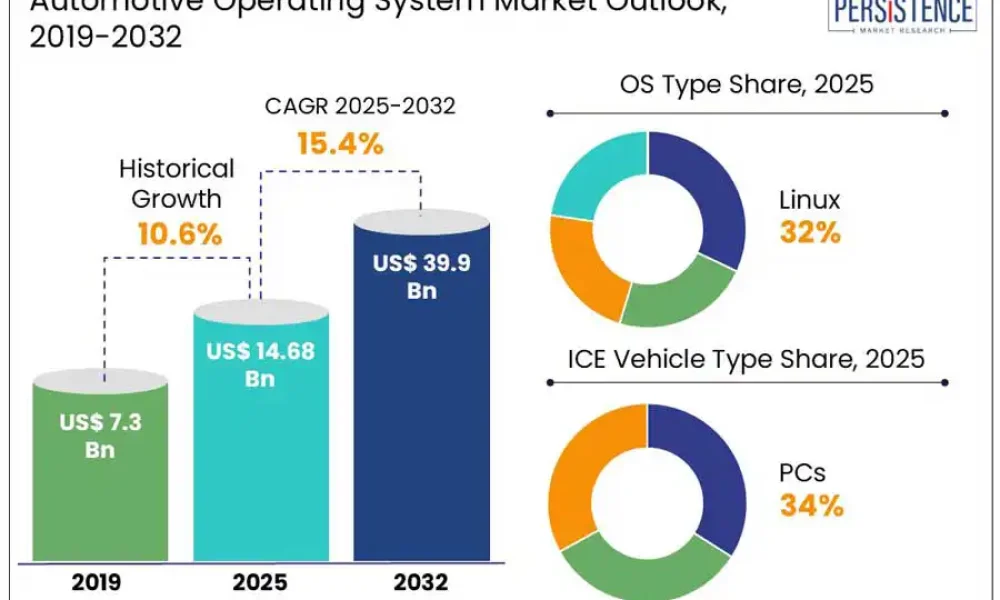
The global automotive operating system market is entering a phase of rapid transformation, driven by the convergence of advanced software architectures, connected vehicle ecosystems, and evolving regulatory frameworks. According to recent market research insights, the market is projected to reach US$ 14.68 billion in 2025 and is anticipated to expand significantly to US$ 39.90 billion by 2032, registering a robust compound annual growth rate (CAGR) of 15.4% during the forecast period.
This substantial growth trajectory is underpinned by the automotive industry’s transition toward software-defined vehicles (SDVs), where operating systems act as the central backbone for vehicle functionality, user experience, and safety features. Automakers are increasingly integrating sophisticated operating systems to support advanced driver assistance systems (ADAS), infotainment platforms, autonomous driving capabilities, and real-time vehicle diagnostics.
Key growth drivers include stringent global vehicle safety regulations, rising concerns around cybersecurity, and the increasing adoption of open-source operating systems that enable scalability and interoperability. Furthermore, the proliferation of connected vehicles and the growing demand for seamless digital experiences are compelling automotive manufacturers and technology providers to invest heavily in advanced software ecosystems.
Get Your FREE Sample Report Instantly Click Now: https://www.persistencemarketresearch.com/samples/35273
Key Highlights from the Report
➤ The automotive operating system market is projected to grow from US$ 14.68 Bn in 2025 to US$ 39.90 Bn by 2032, at a CAGR of 15.4%.
➤ Increasing adoption of software-defined vehicles is transforming automotive system architectures.
➤ Rising cybersecurity threats are accelerating demand for secure and resilient operating systems.
➤ Open-source platforms are gaining traction due to flexibility, cost efficiency, and faster innovation cycles.
➤ Growing integration of advanced technologies such as AI, IoT, and cloud computing in vehicles.
➤ Expanding partnerships between automakers and technology firms to develop next-generation automotive software ecosystems.
Segmentation Analysis
By Type
The automotive operating system market is segmented into real-time operating systems (RTOS), general-purpose operating systems (GPOS), and safety-critical operating systems. Among these, RTOS currently dominates the market due to its ability to handle time-sensitive operations required for safety-critical applications such as braking systems, engine control, and ADAS functionalities. These systems are designed to process data with minimal latency, ensuring high reliability and performance.
However, the fastest-growing segment is general-purpose operating systems, driven by the increasing demand for advanced infotainment systems, in-vehicle connectivity, and user-centric applications. GPOS platforms enable seamless integration of multimedia, navigation, and third-party applications, enhancing the overall driving experience. Safety-critical operating systems are also gaining prominence as regulatory bodies enforce stricter safety compliance standards globally.
By Vehicle/Product/Service Type
In terms of vehicle type, the market is segmented into passenger vehicles, commercial vehicles, and electric vehicles (EVs). Passenger vehicles account for the largest market share, driven by high production volumes and increasing consumer demand for connected and intelligent vehicle features. The integration of operating systems in passenger vehicles supports functionalities such as voice assistants, navigation, infotainment, and driver assistance systems.
Electric vehicles represent a rapidly growing segment, as they rely heavily on advanced software systems for battery management, energy optimization, and connectivity. The transition toward electrification is significantly boosting demand for sophisticated automotive operating systems capable of managing complex vehicle architectures. Commercial vehicles are also adopting operating systems to enhance fleet management, telematics, and predictive maintenance capabilities.
By Propulsion/Technology/Channel
From a technology perspective, the market is influenced by advancements in connected vehicle technologies, autonomous driving systems, and cloud-based platforms. Connected vehicle solutions dominate the segment, enabling real-time data exchange between vehicles, infrastructure, and external networks. Autonomous driving technologies are emerging as a key growth driver, requiring highly advanced operating systems to process vast amounts of sensor data and ensure safe vehicle operation.
Additionally, the adoption of cloud-based operating systems is gaining momentum, allowing automakers to deploy over-the-air (OTA) updates, enhance cybersecurity, and deliver continuous feature improvements. The integration of edge computing further strengthens system performance by reducing latency and enabling real-time decision-making.
Customize This Report for Your Exact Requirements: https://www.persistencemarketresearch.com/request-customization/35273
Regional Insights
Regionally, North America leads the automotive operating system market, supported by the presence of major technology companies, strong R&D investments, and early adoption of connected and autonomous vehicle technologies. The region’s well-established automotive ecosystem and regulatory emphasis on vehicle safety and cybersecurity further contribute to its dominance.
Europe follows closely, driven by stringent regulatory frameworks, strong automotive manufacturing capabilities, and increasing focus on electric mobility. The region’s emphasis on sustainability and innovation is fostering the adoption of advanced operating systems across vehicle segments.
The Asia-Pacific region is expected to be the fastest-growing market, fueled by rapid industrialization, rising vehicle production, and increasing demand for connected and electric vehicles. Countries such as China, India, Japan, and South Korea are witnessing significant investments in automotive technology and infrastructure. Additionally, the growing middle-class population and rising disposable incomes are driving demand for technologically advanced vehicles, further boosting market growth in the region.
Unique Features and Innovations in the Market
The automotive operating system market is characterized by continuous innovation and technological advancements. Modern operating systems are designed to support modular architectures, enabling seamless integration of various vehicle components and applications. This modularity enhances flexibility, scalability, and ease of updates, allowing automakers to introduce new features without significant hardware modifications.
Technologies such as artificial intelligence (AI) are playing a crucial role in enhancing vehicle intelligence, enabling features such as predictive maintenance, personalized user experiences, and advanced driver assistance systems. The integration of Internet of Things (IoT) technologies facilitates real-time data exchange, improving vehicle performance and connectivity.
Furthermore, the adoption of 5G connectivity is revolutionizing automotive operating systems by enabling ultra-fast data transmission, low latency, and reliable communication. This advancement supports applications such as autonomous driving, vehicle-to-everything (V2X) communication, and remote diagnostics. Cybersecurity innovations are also a key focus area, with operating systems incorporating advanced encryption, intrusion detection, and secure boot mechanisms to protect against potential threats.
Market Highlights
The adoption of automotive operating systems is being driven by several key factors, including the increasing complexity of vehicle architectures and the need for centralized control systems. Automakers are leveraging operating systems to streamline vehicle functionalities, reduce development costs, and enhance overall efficiency.
Regulatory requirements related to vehicle safety, emissions, and cybersecurity are also playing a significant role in shaping the market. Governments and regulatory bodies are mandating the implementation of advanced safety features and secure communication protocols, compelling manufacturers to adopt robust operating systems.
Cost optimization is another critical factor, as software-based solutions enable automakers to reduce reliance on hardware components and simplify vehicle design. Additionally, the growing emphasis on sustainability is encouraging the development of energy-efficient operating systems that optimize resource utilization and support electric mobility.
Key Players and Competitive Landscape
The automotive operating system market is highly competitive, with a mix of traditional automotive manufacturers and leading technology companies actively participating in the ecosystem. Key players are focusing on innovation, strategic partnerships, and global expansion to strengthen their market position.
✦ BlackBerry Limited (QNX) – Known for its robust real-time operating systems, the company focuses on safety-critical applications and has established strong partnerships with leading automakers.
✦ Google LLC (Android Automotive) – Leveraging its open-source platform to provide scalable and customizable operating systems, enabling seamless integration of apps and services.
✦ Microsoft Corporation – Investing in cloud-based automotive solutions and connected vehicle platforms, emphasizing data analytics and AI integration.
✦ Apple Inc. – Expanding its automotive ecosystem with advanced infotainment and connectivity solutions, focusing on user experience and seamless device integration.
✦ Bosch GmbH – Developing integrated software platforms and operating systems to support autonomous driving and connected vehicle technologies.
✦ NVIDIA Corporation – Specializing in AI-driven automotive platforms, enabling advanced computing capabilities for autonomous and connected vehicles.
These companies are adopting strategies such as collaborations with automakers, acquisitions of technology startups, and continuous investment in R&D to drive innovation. The competitive landscape is further shaped by the increasing adoption of open-source platforms, which are enabling faster development cycles and fostering collaboration across the industry.
Ready to Dive Deep? Buy Full Report Today: https://www.persistencemarketresearch.com/checkout/35273
Recent Developments
- Strategic collaborations between automotive manufacturers and technology firms to develop open-source automotive operating systems, enhancing interoperability and reducing development time.
- Introduction of over-the-air (OTA) update platforms enabling continuous software upgrades, improved cybersecurity, and enhanced vehicle performance.
Future Opportunities and Growth Prospects
The future of the automotive operating system market is closely tied to the evolution of connected, autonomous, and electric vehicles. As the industry moves toward fully software-defined vehicles, operating systems will play an increasingly critical role in enabling advanced functionalities and ensuring seamless integration across vehicle components.
Emerging opportunities include the development of AI-powered operating systems, enhanced cybersecurity solutions, and advanced cloud-based platforms. The growing adoption of autonomous driving technologies is expected to create significant demand for high-performance operating systems capable of processing complex data in real time.
Regulatory developments related to vehicle safety, data privacy, and cybersecurity will continue to influence market dynamics, encouraging the adoption of standardized and secure operating systems. Additionally, the expansion of smart city initiatives and connected infrastructure will further drive demand for advanced automotive software solutions.
In conclusion, the automotive operating system market is poised for substantial growth, driven by technological advancements, regulatory requirements, and evolving consumer expectations. Companies that prioritize innovation, collaboration, and scalability are well-positioned to capitalize on the opportunities presented by this rapidly evolving market landscape.




