
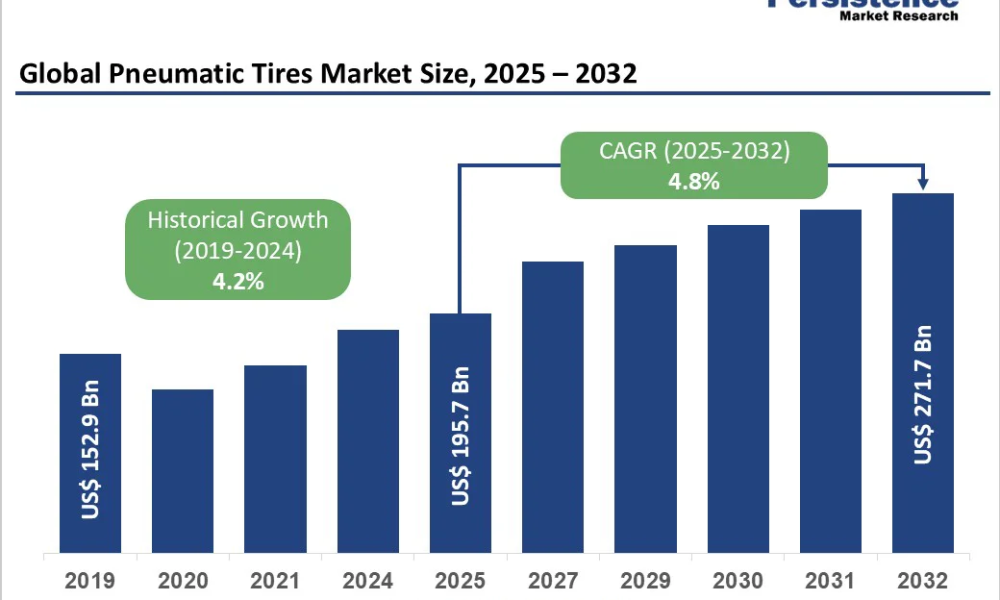
The global pneumatic tires market is witnessing steady and sustained growth, driven by expanding automotive production, rising vehicle ownership, and continuous innovation in tire technologies. The market is projected to be valued at US$ 195.7 billion in 2025 and is expected to reach US$ 271.7 billion by 2032, registering a compound annual growth rate (CAGR) of 4.8% during the forecast period from 2025 to 2032.
Pneumatic tires, which use compressed air to provide flexibility, durability, and improved traction, remain a critical component across passenger vehicles, commercial vehicles, and two-wheelers. The growth of the automotive sector, particularly in emerging economies, is a major driver of market expansion. Increasing urbanization, improved road infrastructure, and rising disposable incomes are fueling vehicle sales globally, thereby boosting demand for replacement and original equipment manufacturer (OEM) tires.
Furthermore, technological advancements such as smart tires, eco-friendly materials, and enhanced tread designs are contributing to improved fuel efficiency, safety, and performance. Regulatory requirements related to fuel economy, emissions reduction, and safety standards are also encouraging manufacturers to develop advanced pneumatic tire solutions. The rise of electric vehicles (EVs) is another significant factor reshaping the market, as EV-specific tire designs are required to accommodate higher torque and reduce rolling resistance.
Get Your FREE Sample Report Instantly Click Now: https://www.persistencemarketresearch.com/samples/35268
Key Highlights from the Report
➤ The pneumatic tires market is projected to grow from US$ 195.7 billion in 2025 to US$ 271.7 billion by 2032, at a CAGR of 4.8%.
➤ Increasing global vehicle production and ownership is driving consistent demand for both OEM and replacement tires.
➤ Rising adoption of electric vehicles is influencing the development of specialized tire technologies.
➤ Growing emphasis on fuel efficiency and low rolling resistance is shaping product innovation.
➤ Expansion of aftermarket sales channels and digital platforms is enhancing accessibility and distribution.
➤ Stringent safety and environmental regulations are accelerating the adoption of advanced and sustainable tire solutions.
Segmentation Analysis
By Type
The pneumatic tires market is segmented into radial tires and bias tires, with radial tires dominating the market due to their superior performance characteristics, including better fuel efficiency, improved traction, and longer lifespan. Radial tires are widely adopted across passenger and commercial vehicles, making them the preferred choice for OEMs and consumers alike. Bias tires, although less prevalent, continue to find applications in off-road and heavy-duty environments due to their robustness and cost-effectiveness. The radial segment is expected to maintain its dominance, while niche applications will support steady demand for bias tires.
By Vehicle/Product/Service Type
Based on vehicle type, the market is categorized into passenger cars, commercial vehicles, and two-wheelers. Passenger cars represent the largest segment due to high global ownership rates and continuous demand for replacement tires. Commercial vehicles, including trucks and buses, are also witnessing significant growth, driven by expanding logistics, e-commerce, and transportation industries. The two-wheeler segment remains particularly strong in Asia-Pacific, where motorcycles and scooters are widely used for daily commuting. Each segment is influenced by factors such as mileage requirements, load capacity, and terrain conditions, shaping the design and adoption of pneumatic tires.
By Propulsion/Technology/Channel
The market is evolving with the increasing adoption of electric and hybrid vehicles, which require specialized tires designed to handle higher torque, reduced noise, and enhanced durability. Technological advancements such as IoT-enabled smart tires and sensor-based monitoring systems are gaining traction, enabling real-time tracking of tire pressure, temperature, and wear. Additionally, the growing importance of online sales channels and digital platforms is transforming the distribution landscape, allowing manufacturers to reach a broader consumer base and streamline supply chains.
Customize This Report for Your Exact Requirements: https://www.persistencemarketresearch.com/request-customization/35268
Regional Insights
Asia-Pacific holds the largest share of the global pneumatic tires market, driven by strong automotive production in countries such as China, India, and Japan. The region benefits from a large consumer base, increasing urbanization, and rapid industrialization, which collectively contribute to high demand for both OEM and replacement tires.
North America and Europe represent mature markets characterized by technological innovation, stringent safety standards, and a strong focus on sustainability. These regions are witnessing increased adoption of premium and performance-oriented tires, particularly in the passenger and luxury vehicle segments.
The fastest-growing region is expected to be Asia-Pacific, supported by rising vehicle ownership, expanding infrastructure, and growing demand for two-wheelers and commercial vehicles. Government initiatives aimed at improving road safety and promoting electric mobility are further boosting the adoption of advanced pneumatic tire solutions in the region.
Unique Features and Innovations in the Market
The pneumatic tires market is undergoing a transformation driven by innovation and technological integration. Modern tires are increasingly equipped with smart sensors and IoT connectivity, enabling real-time monitoring of tire conditions and enhancing vehicle safety. These smart tires can provide data on pressure, temperature, and tread wear, allowing predictive maintenance and reducing the risk of accidents.
Artificial intelligence is also playing a role in optimizing tire performance and design. AI-driven analytics help manufacturers develop tires with improved durability, fuel efficiency, and performance characteristics. Additionally, the integration of 5G connectivity in connected vehicles is enabling seamless communication between tires and onboard systems, enhancing overall vehicle intelligence.
Sustainability is another key area of innovation, with manufacturers focusing on eco-friendly materials such as bio-based rubber, recycled components, and energy-efficient production processes. These innovations are not only reducing environmental impact but also aligning with global regulatory requirements and consumer preferences.
Market Highlights
The adoption of pneumatic tires continues to grow due to their ability to provide superior comfort, traction, and efficiency compared to solid tires. Businesses and industries are increasingly investing in advanced tire solutions to improve vehicle performance, reduce operational costs, and comply with regulatory standards.
Regulations related to fuel efficiency, emissions, and safety are playing a significant role in shaping the market. Governments worldwide are implementing stringent standards that require manufacturers to develop tires with lower rolling resistance and improved durability. These regulations are driving innovation and encouraging the adoption of sustainable materials and technologies.
Cost reduction is another critical factor influencing the market, as manufacturers strive to optimize production processes and supply chains. The use of advanced materials and manufacturing techniques is helping reduce costs while maintaining high performance and quality standards. Sustainability initiatives, including recycling programs and eco-friendly production methods, are also gaining traction, further supporting market growth.
Key Players and Competitive Landscape
The global pneumatic tires market is highly competitive, with several leading companies focusing on innovation, strategic partnerships, and geographic expansion to strengthen their market position. Key players include:
✦ Michelin Group – A global leader in tire innovation, focusing on sustainable materials and smart tire technologies to enhance performance and safety.
✦ Bridgestone Corporation – Known for its extensive product portfolio and investment in digital tire solutions, including IoT-enabled monitoring systems.
✦ The Goodyear Tire & Rubber Company – Emphasizing advanced tire technologies and expanding its presence in emerging markets through strategic partnerships.
✦ Continental AG – A pioneer in smart tire solutions, leveraging AI and sensor technologies to improve tire performance and vehicle safety.
✦ Pirelli & C. S.p.A. – Specializing in high-performance and premium tires, particularly for luxury and sports vehicles.
✦ Sumitomo Rubber Industries, Ltd. – Focused on expanding its global footprint and developing eco-friendly tire solutions.
These companies are actively investing in research and development to introduce innovative products and maintain a competitive edge. Strategies such as mergers, acquisitions, and collaborations are being employed to enhance market reach and technological capabilities.
Ready to Dive Deep? Buy Full Report Today: https://www.persistencemarketresearch.com/checkout/35268
Recent Developments
- Leading manufacturers have introduced next-generation smart tires equipped with embedded sensors for real-time monitoring and predictive maintenance.
- Expansion of sustainable tire production initiatives, including the use of renewable materials and circular economy practices, by major industry players.
Future Opportunities and Growth Prospects
The future of the pneumatic tires market is characterized by significant opportunities driven by technological advancements, evolving consumer preferences, and regulatory developments. The growing adoption of electric vehicles is expected to create new demand for specialized tire solutions, while advancements in smart technologies will continue to enhance tire performance and safety.
Emerging markets present substantial growth potential, supported by increasing vehicle ownership, infrastructure development, and economic growth. Manufacturers that focus on innovation, sustainability, and digital transformation are likely to capitalize on these opportunities and achieve long-term success.
Evolving regulations related to emissions, fuel efficiency, and safety will continue to shape the market, encouraging the development of advanced and environmentally friendly tire solutions. As the industry moves toward a more connected and sustainable future, pneumatic tires will remain a critical component of the global transportation ecosystem, driving efficiency, safety, and performance across all vehicle segments.




