
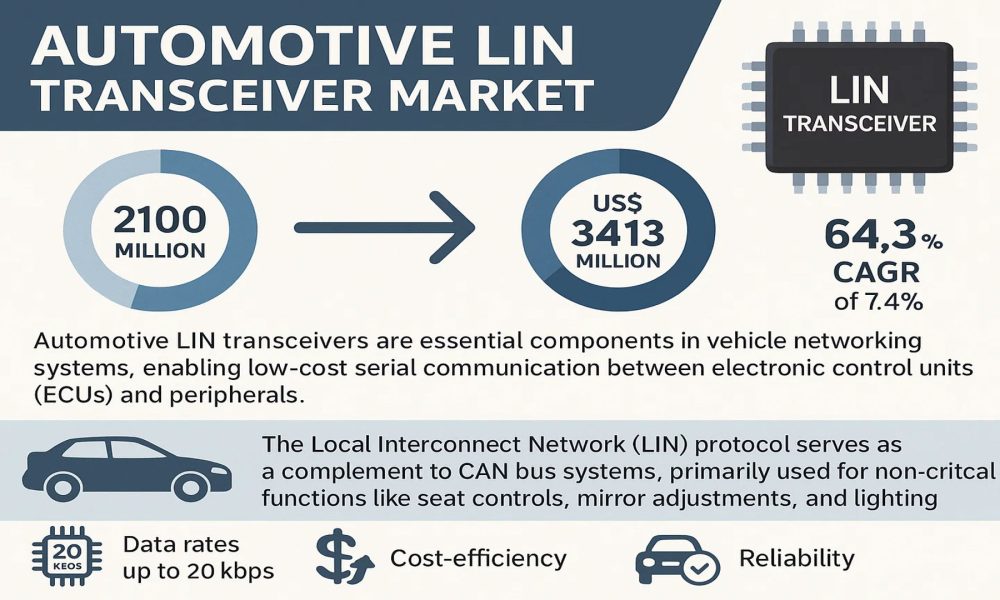
Automotive LIN Transceiver Market was valued at 2100 million in 2024 and is projected to reach US$ 3413 million by 2032, at a CAGR of 7.4% during the forecast period.
Automotive LIN transceivers are essential components in vehicle networking systems, enabling low-cost serial communication between electronic control units (ECUs) and peripherals. The Local Interconnect Network (LIN) protocol serves as a complement to CAN bus systems, primarily used for non-critical functions like seat controls, mirror adjustments, and lighting systems. These transceivers support data rates up to 20 kbps and are increasingly adopted due to their cost-efficiency and reliability in automotive applications.
The market growth is driven by increasing vehicle electrification, rising demand for advanced driver assistance systems (ADAS), and expanding automotive production in emerging economies. However, the shift towards higher-speed communication protocols like CAN FD and Ethernet poses a challenge to LIN’s long-term growth. Key industry players including NXP Semiconductors, Infineon Technologies, and STMicroelectronics are investing in next-generation LIN solutions to maintain competitiveness in the evolving automotive electronics landscape.
Get Your Free Sample Report Today-https://semiconductorinsight.com/download-sample-report/?product_id=107366
MARKET DYNAMICS
MARKET DRIVERS
Increasing Vehicle Electrification and Smart Features Fueling LIN Transceiver Demand
The automotive industry is undergoing a radical transformation with the rapid adoption of electrical and electronic systems in vehicles. Modern cars now incorporate over 150 electronic control units (ECUs) communicating through various bus systems, with LIN networks handling simpler sub-systems. The global automotive electronics market is projected to grow at 6.8% CAGR through 2030, directly driving demand for cost-effective LIN transceivers used in power windows, seat controls, and lighting systems. Major automakers are increasingly adopting LIN-based architectures to reduce wiring complexity while maintaining reliability for these applications.
Regulatory Push for Advanced Driver Assistance Systems (ADAS)
Government safety mandates across key automotive markets are accelerating ADAS adoption, creating secondary demand for LIN networks in sensor and actuator subsystems. While LIN doesn’t handle safety-critical functions, it plays a crucial role in connecting peripheral components to main ECUs. Over 25 countries now mandate basic ADAS features like automatic emergency braking, with Europe’s NCAP and US NHTSA regulations being particularly influential. This regulatory environment compels OEMs to standardize communication architectures, with LIN serving as an economical solution for non-critical applications.
Rising Automotive Production in Emerging Economies
Asia-Pacific has emerged as the dominant force in global automotive manufacturing, accounting for over 50% of production. Countries like China and India continue to expand their automotive output, with China producing approximately 27 million vehicles annually. The localization of vehicle production in these regions favors LIN technology adoption due to its cost-effectiveness compared to CAN. Additionally, the growing middle class in developing nations drives demand for affordable vehicles with enhanced comfort features – exactly the segment where LIN networks excel.
➤ For instance, leading semiconductor companies are introducing new AEC-Q100 qualified LIN transceivers specifically targeting budget vehicle segments in emerging markets.
Recent Developments:
- Rising Integration with Advanced Driver Assistance Systems (ADAS): Leading automotive OEMs are increasingly integrating LIN (Local Interconnect Network) transceivers in vehicles to enhance communication between sensors, actuators, and ECUs, boosting safety and efficiency.
- Shift Towards Electric and Hybrid Vehicles: The growing adoption of EVs and hybrid vehicles is driving demand for LIN transceivers for battery management systems, climate control, and body electronics.
- Collaborations and Partnerships: Companies like NXP Semiconductors, Infineon Technologies, and Texas Instruments are partnering with automotive manufacturers to develop high-speed, low-power LIN transceivers suitable for modern vehicle networks.
- Technological Innovations: New LIN transceivers with features like fault tolerance, low electromagnetic interference (EMI), and energy efficiency are being introduced to meet stringent automotive standards.
- Market Expansion in Asia-Pacific: Increasing vehicle production in China, Japan, and India is boosting the demand for automotive LIN transceivers in the APAC region.
MARKET OPPORTUNITIES
Expansion of LIN Applications in Electric Vehicles
The rapid growth of electric vehicles presents new opportunities for LIN technology adoption. EV architectures require numerous low-speed control systems for battery management, thermal controls, and auxiliary functions where LIN excels. Industry experts estimate each EV contains 20-30% more electronic components than conventional vehicles, creating additional demand for simple, reliable bus networks. LIN transceivers are particularly well-suited for managing peripheral systems in EVs while minimizing power consumption – a critical factor in electric vehicle design.
Integration with Next-Generation Vehicle Architectures
Automotive OEMs are transitioning to domain-based architectures where LIN will continue to play a vital role in connecting simple actuators to domain controllers. The development of mixed-signal LIN transceivers with enhanced diagnostic capabilities enables better integration with centralized computing platforms. Furthermore, the automotive aftermarket presents significant growth potential as older vehicles retrofit modern convenience features requiring LIN-based control systems.
Get Your Free Sample Report Today-https://semiconductorinsight.com/download-sample-report/?product_id=107366
List of Key Automotive LIN Transceiver Companies Profiled
- NXP Semiconductors (Netherlands)
- Infineon Technologies (Germany)
- STMicroelectronics (Switzerland)
- Texas Instruments (U.S.)
- Rohm Semiconductor (Japan)
- Analog Devices (U.S.)
- ON Semiconductor (U.S.)
- Microchip Technology (U.S.)
- Elmos Semiconductor (Germany)
- Renesas Electronics (Japan)
Segment Analysis:
By Type
Single Channel LIN Transceivers Lead the Market Owing to Cost-Effective Implementation in Entry-Level Vehicles
The market is segmented based on type into:
- Single Channel LIN Transceivers
- Subtypes: LIN 1.x, LIN 2.x, and others
- Multi-Channel LIN Transceivers
- Subtypes: Dual-channel, Quad-channel, and others
By Application
Passenger Vehicles Hold Largest Share Due to Increasing Electronic Component Integration
The market is segmented based on application into:
- Passenger Vehicles
- Subcategories: Sedans, SUVs, Hatchbacks, and others
- Commercial Vehicles
- Subcategories: Light Commercial Vehicles, Heavy Commercial Vehicles
By Vehicle System
Body Electronics Segment Dominates with Growing Demand for Comfort Features
The market is segmented based on vehicle system into:
- Body Electronics
- Subsystems: Door modules, Seat control, Mirror control
- Powertrain
- Infotainment
- Safety Systems
By Communication Protocol
LIN 2.x Protocol Gains Traction with Improved Data Rate Capabilities
The market is segmented based on communication protocol into:
- LIN 1.x
- LIN 2.x
- LIN 3.x
- SAE J2602
Other Topic-Performing Arts Lighting Equipment Market
CONTACT US:
City vista, 203A, Fountain Road, Ashoka Nagar, Kharadi, Pune, Maharashtra 411014
[+91 8087992013]




