
The global automotive engine cradle market is witnessing sustained growth as vehicle manufacturers increasingly focus on structural efficiency, ride comfort, safety, and modular vehicle platforms. An engine cradle, also known as a subframe or engine mounting frame, plays a critical role in supporting the engine and transmission system while isolating vibrations and improving vehicle handling characteristics. Its importance has increased significantly with the rising complexity of powertrains and the transition toward electrified mobility.
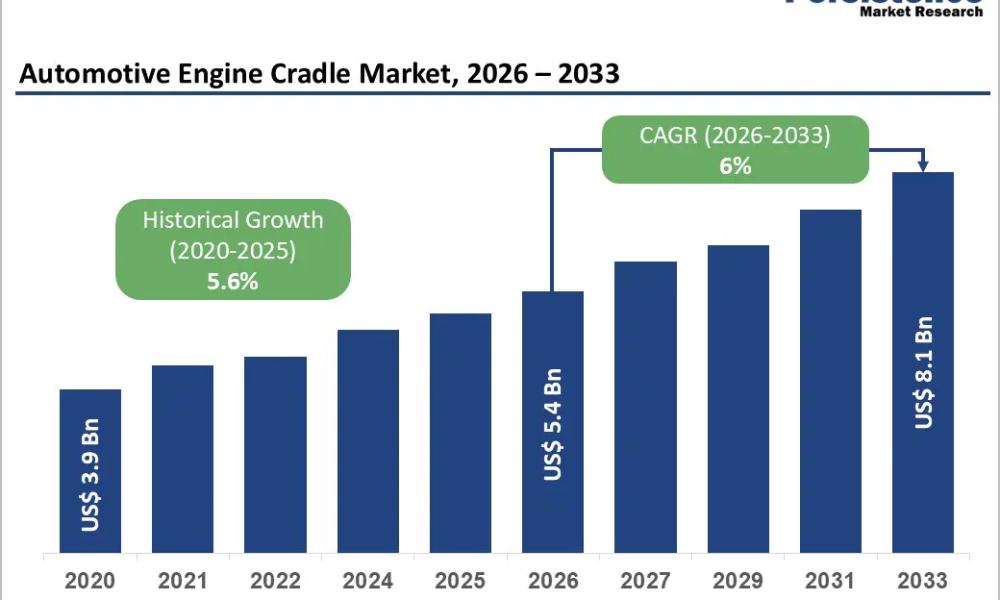
In 2026, the global automotive engine cradle market size is estimated to be valued at US$ 5.4 billion. Over the forecast period from 2026 to 2033, the market is projected to reach approximately US$ 8.1 billion, expanding at a compound annual growth rate (CAGR) of 6.0%. This growth trajectory reflects a strong demand outlook from both passenger and commercial vehicle segments, supported by evolving vehicle architectures and regulatory mandates for improved safety and emissions performance.
Several factors are driving market expansion. The increasing adoption of lightweight materials to improve fuel efficiency and extend electric vehicle range is a primary growth catalyst. Automotive manufacturers are replacing traditional heavy steel subframes with aluminum alloys, high-strength steel, and composite materials to reduce overall vehicle weight without compromising structural integrity. Additionally, the global shift toward electric and hybrid vehicles is reshaping engine cradle design, as new platforms require reengineered mounting systems to accommodate batteries, electric motors, and integrated power electronics.
Rising vehicle production volumes in emerging economies, coupled with growing consumer demand for enhanced driving comfort and reduced noise, vibration, and harshness (NVH), are also contributing to the steady expansion of the automotive engine cradle market. Furthermore, stringent safety regulations and crash performance standards are compelling manufacturers to adopt advanced cradle designs that enhance energy absorption and structural rigidity during collisions.
Get Your FREE Sample Report Instantly Click Now:
Segmentation Analysis
By Material Type
- Metallic
- Non-Metallic
By Vehicle Type
- Passenger Cars
- Light Commercial Vehicles (LCVs)
- Heavy Commercial Vehicles (HCVs)
By Sales Channel
- Original Equipment Manufacturers (OEMs)
- Aftermarket
Geographical Coverage
- North America
- Europe
- East Asia
- South Asia & Oceania
- Latin America
- Middle East & Africa
Regional Insights
From a regional standpoint, Asia Pacific holds the leading position in the global automotive engine cradle market. The region benefits from high vehicle production volumes, a strong presence of automotive OEMs and component suppliers, and expanding manufacturing capabilities in countries such as China, Japan, South Korea, and India. Government initiatives supporting electric mobility and fuel efficiency improvements further reinforce market growth across the region.
North America represents a mature yet technologically advanced market, driven by demand for lightweight vehicles, stringent safety regulations, and the rapid adoption of electric and hybrid models. The presence of major automotive manufacturers and a strong focus on research and development contribute to steady market expansion.
Europe continues to be a significant market due to its leadership in automotive engineering, emissions regulations, and sustainability initiatives. European automakers are at the forefront of adopting aluminum and advanced material engine cradles to comply with strict CO₂ emission standards and improve vehicle efficiency.
Among all regions, Asia Pacific is also expected to be the fastest-growing market during the forecast period. Rising disposable incomes, urbanization, increasing vehicle ownership, and the rapid electrification of transportation systems are key factors driving accelerated growth. Additionally, the localization of automotive component manufacturing and investments in advanced production technologies are strengthening the regional supply chain.
Customize This Report for Your Exact Requirements:
Unique Features and Innovations in the Market
Modern automotive engine cradle solutions are increasingly differentiated by advanced materials, optimized structural designs, and integration with digital engineering tools. Manufacturers are leveraging computer-aided engineering, simulation, and topology optimization to design cradles that deliver superior strength-to-weight ratios while minimizing material usage.
Technological advancements such as artificial intelligence (AI) and machine learning are being applied during the design and testing phases to predict stress distribution, fatigue life, and crash performance more accurately. These tools enable faster development cycles and improved product reliability. Additionally, IoT-enabled manufacturing systems are enhancing quality control and production efficiency by enabling real-time monitoring of fabrication processes and component performance.
The emergence of smart factories and Industry 4.0 practices is also influencing the market, allowing engine cradle manufacturers to achieve greater customization, traceability, and cost optimization. While technologies such as 5G play a more indirect role, enhanced connectivity is supporting faster data exchange across manufacturing and supply chain networks, thereby improving operational efficiency.
Market Highlights
One of the key reasons automotive OEMs are adopting advanced engine cradle solutions is the growing emphasis on vehicle lightweighting, which directly contributes to improved fuel economy and extended driving range for electric vehicles. Engine cradles also play a vital role in enhancing NVH performance, which is increasingly important as electric vehicles eliminate engine noise, making structural vibrations more noticeable.
Regulatory frameworks focused on vehicle safety and emissions reduction are further accelerating adoption. Compliance with crash safety standards requires robust subframe designs capable of absorbing and distributing impact energy effectively. At the same time, sustainability goals are encouraging the use of recyclable materials such as aluminum and the reduction of overall material consumption.
Cost reduction through modular platform strategies is another important driver. Standardized engine cradle architectures allow automakers to share components across multiple vehicle models, reducing development and production costs while maintaining flexibility.
Key Players and Competitive Landscape
The automotive engine cradle market is characterized by the presence of global Tier 1 suppliers and specialized component manufacturers competing on the basis of technology, material expertise, and long-term OEM partnerships. Key players include:
✦ Magna International Inc., which focuses on lightweight subframe solutions and leverages advanced material technologies to support electrified vehicle platforms.
✦ Gestamp Automoción, known for its expertise in high-strength steel and aluminum structures, with a strong emphasis on safety and weight reduction.
✦ Benteler International AG, which offers modular engine cradle systems and invests heavily in research and development to support next-generation vehicle architectures.
✦ ZF Friedrichshafen AG, integrating chassis and subframe solutions with advanced vehicle dynamics and electrification strategies.
✦ Martinrea International Inc., specializing in lightweight structural components and expanding its aluminum and hybrid material capabilities.
These companies are pursuing strategies such as product innovation, geographic expansion, and strategic collaborations with OEMs to strengthen their competitive positions. Investments in advanced manufacturing technologies and sustainable materials are central to maintaining long-term growth.
Recent Developments
- Several leading manufacturers have announced the expansion of aluminum engine cradle production capacities to meet rising demand from electric vehicle OEMs, particularly in Asia Pacific and Europe.
- Industry players are increasingly entering into collaborative development agreements with automakers to design propulsion-specific engine cradle systems optimized for dedicated electric vehicle platforms.
Ready to Dive Deep? Buy Full Report Today: https://www.persistencemarketresearch.com/checkout/29029
Future Opportunities and Growth Prospects
Looking ahead, the automotive engine cradle market is expected to benefit from continued advancements in vehicle electrification, autonomous driving technologies, and modular platform strategies. The increasing complexity of vehicle architectures presents significant opportunities for suppliers capable of delivering lightweight, high-performance, and cost-effective cradle solutions.
Evolving regulations related to emissions, safety, and sustainability will continue to shape product development priorities. Manufacturers that invest in recyclable materials, energy-efficient production processes, and digital engineering capabilities are likely to gain a competitive advantage. As the global automotive industry transitions toward cleaner and smarter mobility, the automotive engine cradle market is well positioned to experience sustained growth and innovation over the coming decade.




