
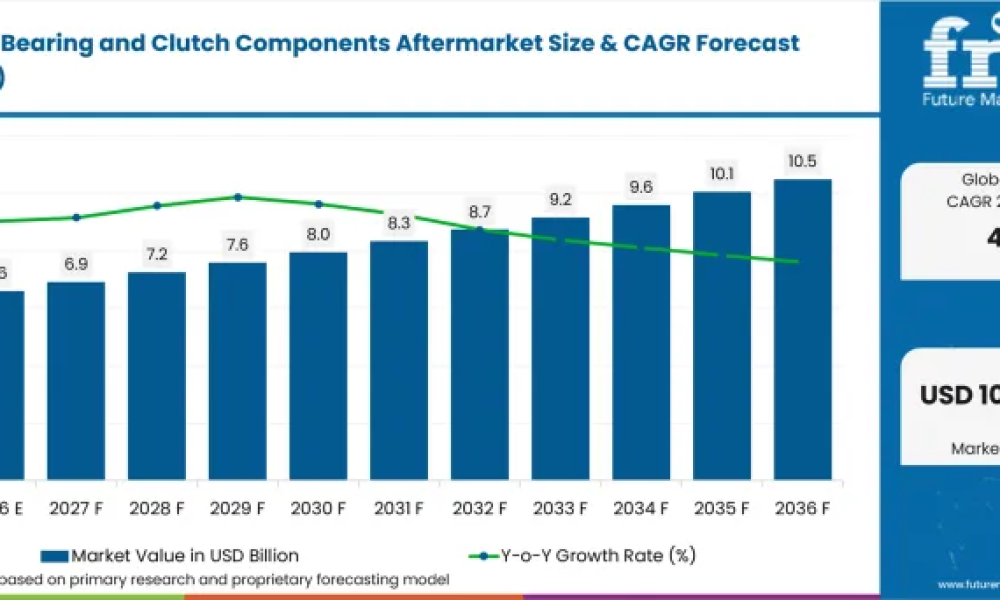
The global automotive bearing and clutch components aftermarket is projected to grow from USD 6.6 billion in 2026 to USD 10.5 billion by 2036, registering a 4.8% CAGR during the forecast period. Demand is being supported by the age of vehicles already in operation, intensive commercial vehicle utilization, and recurring replacement requirements for wheel-end bearings, clutch assemblies, transmission bearings, and related driveline components.
The aftermarket benefits from the fact that bearings and clutch components experience progressive wear throughout the vehicle ownership cycle. As vehicles remain in service for longer periods, owners and fleet operators increasingly rely on repair and replacement rather than vehicle replacement to maintain operating availability.
The Auto Care Association reported in June 2025 that the average age of vehicles in the United States had exceeded 12.8 years. Older vehicles create an extended repair window for bearing and clutch-related components, particularly when driveline noise, vibration, clutch slip, or other wear symptoms affect vehicle operation.
Commercial vehicle fleets provide another important source of demand. ACEA reported in January 2026 that approximately 31.1 million vans and 6.2 million trucks were operating on EU roads during 2024. This installed base creates continuing replacement opportunities for wheel bearings and drivetrain components as vehicles accumulate mileage and undergo repeated service cycles.
What Are the Key Segments in the Automotive Bearing and Clutch Components Aftermarket?
- Clutch Kit Components — 44.4%: Clutch kit components are estimated to hold 44.4% of the market in 2026, supported by the preference for matched replacement of wear components during a single teardown.
- Vans — 27.6%: Vans are expected to lead the vehicle type segment with 27.6% share in 2026 as route-intensive commercial operation creates frequent, uptime-sensitive repair requirements.
- Auto Repair Shops — 45.5%: Auto repair shops are forecast to account for 45.5% of sales channel demand in 2026 because workshops control diagnosis, component selection, and installation.
- Replacement-Driven Demand: Bearing and clutch components generate recurring aftermarket demand as wear accumulates across vehicle ownership cycles.
- Fitment and Repair Information: Access to accurate application information remains critical because incorrect component selection can increase returns, repeat labor, and workshop downtime.
Get detailed market forecasts, competitive benchmarking, and pricing trends:
https://www.futuremarketinsights.com/reports/sample/rep-gb-18829
Which Countries Are Showing the Strongest Growth in the Automotive Bearing and Clutch Components Aftermarket?
Japan is projected to record the fastest growth among the profiled countries, with a 5.7% CAGR through 2036. Demand is supported by an established vehicle parc and continued requirements for reliable replacement components. Suppliers must provide accurate fitment and repair information as workshops maintain aging applications.
Mexico is expected to expand at a 5.5% CAGR. Commercial vehicle activity and the growing aftermarket distribution network create opportunities for bearing and clutch component suppliers. Local stock availability can help distributors respond quickly when vehicles require urgent repairs.
Germany is projected to register a 4.8% CAGR, in line with the global market. Its large installed vehicle base and established automotive service infrastructure support replacement demand, while workshop buyers place emphasis on component quality, fitment accuracy, and repair reliability.
Canada is expected to grow at a 4.6% CAGR. Vehicle utilization and extended ownership periods provide recurring replacement opportunities for bearings and clutch components across passenger and commercial applications.
The United States is projected to record a 3.9% CAGR. Although its percentage growth is lower than Japan and Mexico, the country’s large and aging vehicle population provides a substantial installed base for replacement demand. Workshop and distributor networks remain central to aftermarket conversion.
How Is Regional Demand Shaping the Aftermarket?
Regional demand is increasingly determined by the size, age, and utilization of the vehicle parc rather than by new vehicle registrations alone. Mature markets can generate significant replacement volumes because older vehicles remain operational for longer periods and require additional repair interventions.
Commercial fleets amplify this effect. Vans and trucks often accumulate mileage faster than private vehicles, making bearing and clutch wear more closely connected to operating schedules. Suppliers that combine broad application coverage with local inventory can respond to these uptime-sensitive repair requirements.
What Is Changing the Competitive Landscape?
Competition is centered on product quality, application coverage, distributor availability, and workshop support. The Timken Company, SKF, NSK Ltd., NTN Corporation, Schaeffler Group, BorgWarner Inc., Valeo, and Eaton Corporation Plc are among the key companies participating in the market.
Bearing suppliers compete through wheel-end, transmission, and differential applications, while clutch-related suppliers address wear components and actuation requirements. The ability to supply matched components can reduce installation uncertainty and support first-visit repair completion.
Aftermarket distributors also play a critical role by maintaining inventory across vehicle generations. Excessively broad inventory can create slow-moving stock, making application forecasting and catalog accuracy important to commercial performance.
What Does the Analyst Say About the Automotive Bearing and Clutch Components Aftermarket?
“Profit comes from finishing a bearing or clutch repair correctly during the first workshop visit because repeat teardown quickly erases a low part price. The stronger aftermarket offer pairs broad fitment coverage with local stock and repair information that lets technicians choose the right component before labor begins.”
— Nikhil Kaitwade, Principal Consultant, Future Market Insights
What Is Driving Demand for Automotive Bearing and Clutch Components?
Aging Vehicle Fleets
Longer vehicle ownership periods create additional opportunities for replacement components. As vehicles accumulate mileage, bearings and clutch assemblies become more likely to require inspection, repair, or replacement.
Commercial Vehicle Utilization
Vans and trucks often operate under demanding schedules, making driveline reliability directly connected to fleet productivity. Wear-related repairs can become urgent when vehicles are needed for daily routes.
Workshop-Led Diagnosis
Auto repair shops account for 45.5% of the sales channel in 2026. Their control over diagnosis and installation makes them an important point of influence for component selection.
Matched Component Replacement
Clutch kit components lead the product segment because replacing related wear components during one teardown can reduce the likelihood of repeat labor. This favors suppliers that can provide complete and compatible repair solutions.
What Are the Key Market Restraints?
Fitment complexity remains a significant challenge. Different vehicle generations and drivetrain configurations can require specific bearing dimensions, clutch specifications, and installation procedures. Incorrect selection can result in returns and additional workshop labor.
Limited access to accurate repair information can further increase the risk of incorrect component selection. Suppliers and distributors therefore need reliable catalogs and application data to help technicians confirm compatibility before beginning repairs.
What Opportunities Exist for Aftermarket Suppliers?
The aging global vehicle fleet provides a continuing opportunity for suppliers with strong replacement coverage. Manufacturers can strengthen their position by expanding fitment databases, improving local inventory, and supporting workshops with application-specific repair information.
Commercial fleets also provide opportunities for suppliers that can support recurring maintenance programs. Predictable delivery and broad product availability can become important differentiators when vehicle downtime directly affects fleet revenue.
Drive Your Business Growth Strategy: Checkout the Report for Key Insights!
https://www.futuremarketinsights.com/checkout/18829
How Is the Automotive Bearing and Clutch Components Aftermarket Segmented?
The automotive bearing and clutch components aftermarket is segmented by product type, vehicle type, sales channel, and region.
By Product Type: Clutch Kit Components, Differential Bearings, Transmission Bearings, Wheel Bearing, and Clutch Actuators.
By Vehicle Type: Vans, Pickup Trucks, Minivans, Trucks, and Buses.
By Sales Channel: Auto Repair Shops, Authorized Dealerships, Distributors and Wholesalers, Automotive Parts Retailers, and Online Retail.
By Region: North America, Latin America, Europe, Asia Pacific, and the Middle East & Africa.
What Are the Drivers, Restraints and Opportunities?
The aftermarket is being shaped by vehicle aging, commercial utilization, recurring driveline wear, and the need for accurate component selection during workshop repairs.
- Drivers: Aging vehicles, high mileage, commercial fleet utilization, clutch wear, and recurring bearing replacement.
- Restraints: Fitment complexity, restricted repair information, inventory management challenges, and repeat-labor risk.
- Opportunities: Local stock availability, digital fitment information, matched repair kits, and fleet-focused aftermarket programs.
What Is the Demand Outlook?
The automotive bearing and clutch components aftermarket is expected to benefit from the continued operation of older vehicles and the growing maintenance requirements associated with high-mileage fleets. Replacement demand can remain resilient even where new vehicle sales moderate because components are purchased in response to wear events rather than initial vehicle production.
Commercial vans and trucks will remain important demand contributors as intensive route use accelerates component wear. Workshop networks and aftermarket distributors will continue to influence purchasing decisions through diagnosis, inventory availability, and installation capability.
How Fast Are Key Countries Growing?
Japan is projected to lead the profiled countries with a 5.7% CAGR, followed by Mexico at 5.5%, Germany at 4.8%, Canada at 4.6%, and the United States at 3.9% through 2036. These growth rates reflect differences in vehicle parc age, commercial utilization, replacement cycles, and aftermarket service structures.
About Future Market Insights
Future Market Insights (FMI) is a global market intelligence and consulting firm providing syndicated research, consulting, and competitive intelligence across automotive, transportation, industrial, technology, chemicals, and other sectors. FMI research helps manufacturers, suppliers, distributors, investors, and industry stakeholders evaluate market opportunities, competitive dynamics, technology adoption, and evolving demand patterns.



