Guam Charity Fraud Defendant Sentenced to Nearly 22 Years While Absent
Michael Marasigan received a 262-month federal prison sentence in absentia on May 18, 2026, following convictions involving an illegal gambling business, money laundering, and a


Michael Marasigan received a 262-month federal prison sentence in absentia on May 18, 2026, following convictions involving an illegal gambling business, money laundering, and a

Federal authorities are seeking information leading to Michael Lizaso Marasigan’s arrest and conviction after he failed to return from court-approved medical travel to the Philippines

The Pacific Daily News reportedly photographed the convicted Guam bingo fraud defendant outside a Manila café on March 15, providing a potential investigative lead in

A typical case can advance from a valid arrest warrant and financial investigation to international alerts, provisional arrest, Extradition proceedings, and eventual transfer, after which

After an Asian government authorizes extradition and any applicable barriers to surrender are resolved, officials coordinate the defendant’s handover and secure transportation, frequently involving the

A wanted person may challenge identity, evidence, treaty coverage, procedural fairness, or relevant human-rights conditions, but the availability and strength of those arguments depend heavily

Foreign authorities may place a wanted fraud defendant in provisional detention before courts or government officials examine identity, dual criminality, evidentiary sufficiency, treaty compliance, and

Fraud Extradition cases can slow down because of extensive financial documentation, disputed identity evidence, treaty interpretation, required translations, foreign court hearings, government decisions, and legal

Mutual legal assistance procedures allow American prosecutors to request bank records, corporate documents, telecommunications information, and other evidence held abroad. However, translations, judicial approvals, document

Although an INTERPOL alert can lead to identification or arrest, the country where a defendant is found must still assess an American Extradition request under

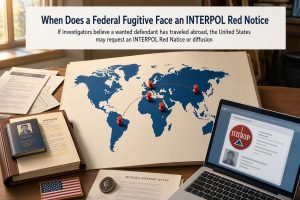
An INTERPOL Red Notice or wanted-person diffusion can alert foreign authorities to a defendant sought by American prosecutors, helping police establish identity and location. In

American authorities may confirm the status of an arrest warrant, review lawfully obtained financial and travel information, seek assistance from foreign partners, and prepare Extradition

An international federal fugitive case can move from an outstanding warrant and police database alerts through an overseas search, provisional detention, and Extradition proceedings, then

The arresting country may detain a wanted defendant. At the same time, authorities examine the American Extradition request, consider legal objections, and determine whether national

A federal fugitive case can span years of uncertain location, evidence collection, international communication, and contested Extradition proceedings because identifying a wanted person abroad does

American prosecutors generally must supply judicial records, a clear account of the alleged conduct, reliable identifying information, and supporting material that satisfies the applicable treaty

An INTERPOL alert can help authorities locate a wanted person and consider provisional arrest. Still, Extradition requires a separate legal basis, an authorized government

Federal authorities may seek an INTERPOL Red Notice when they believe a wanted person is abroad. Still, publication requires an appropriate judicial basis, compliance with

When a person wanted in a federal case may be abroad, American authorities can seek an INTERPOL Red Notice or wanted-person diffusion, provided the request

Family members, friends, employers, and other contacts can provide investigative leads when a wanted person relies on familiar relationships for money, accommodation, communications, or transportation.

After several months in hiding in Sinaloa and a brief detention by Mexican authorities, Fritsch reached Munich on October 6, 2025, continuing an extraordinary international

The discovery of false identification led to Fritsch’s detention in Mexico. Yet, he never entered American custody and departed for Munich after being released under

Mexican authorities found Fritsch carrying false identification in September 2025, but an immigration-related release requiring regular court check-ins gave the convicted technology founder an opportunity

Fritsch crossed into Mexico by car on June 2, 2025, instead of attending a hearing that could have revoked his bond and immediately placed him

The newly announced reward marks a significant escalation in the search for Fritsch, whose journey from a Malibu mansion to a Mexican hideout and ultimately