
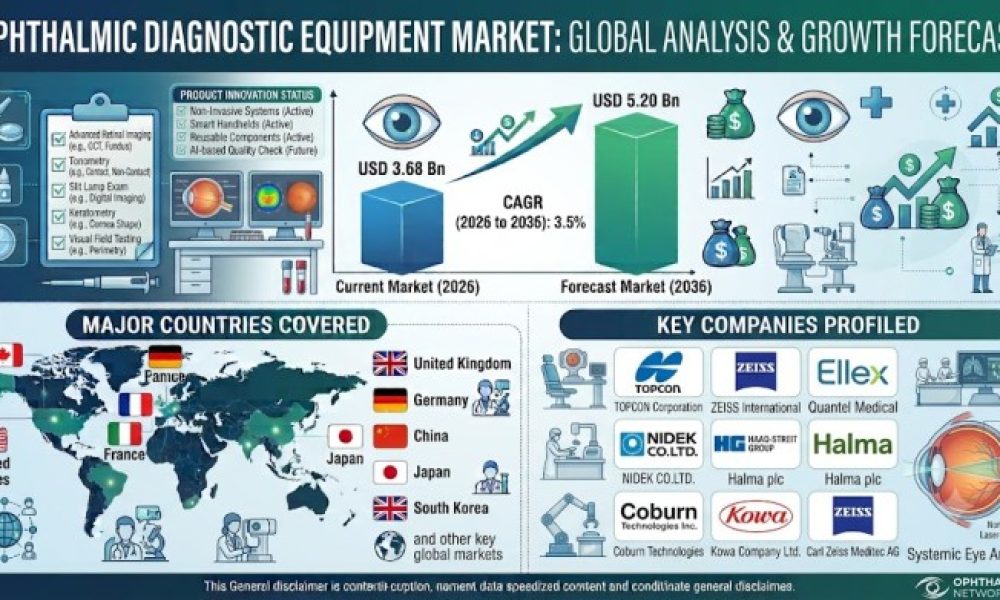
NEWARK, Del. — According to Future Market Insights (FMI), the global ophthalmic diagnostic equipment market is projected to expand from USD 3.68 billion in 2026 to USD 5.20 billion by 2036, registering a 3.5% CAGR during the forecast period. Demand is being supported by aging populations, rising chronic and age-related eye disorders, diabetes-related retinal complications, and increasing adoption of AI-enabled imaging technologies.
Optical coherence tomography (OCT) remains the leading product category, accounting for approximately 25.0% of global demand, as healthcare providers increasingly rely on non-invasive, high-resolution imaging for early detection and monitoring of retinal diseases. Hospitals represent the largest end-use segment, holding approximately 45.0% share, supported by their specialist ophthalmology teams, high diagnostic volumes, and investment in advanced imaging platforms.
👉 Get Detailed Market Forecasts, Competitive Benchmarking, and Pricing Trends:
https://www.futuremarketinsights.com/reports/sample/rep-gb-771
Key Market Highlights
- Market Size (2026): USD 3.68 billion
- Forecast Value (2036): USD 5.20 billion
- CAGR (2026–2036):5%
- Leading Product: Optical Coherence Tomography, with approximately 25.0% share
- Leading End User: Hospitals, with approximately 45.0% share
- Fastest-Growing Country: France, at 7.2% CAGR
- Slowest-Growing Country: Japan, at 2.0% CAGR
- Key Growth Regions: North America, Europe, and Asia Pacific
Global Segment Leaders
Optical Coherence Tomography: OCT accounts for approximately 25.0% of global demand. Its non-invasive, high-resolution imaging capabilities make it central to the diagnosis and monitoring of macular degeneration, diabetic retinopathy, glaucoma, and other retinal disorders. Integration with AI-based image analysis is further supporting its adoption.
Hospitals: Hospitals represent approximately 45.0% of global demand. Their large patient volumes, specialist ophthalmology units, and need for high-precision diagnostics support investment in OCT, fundus cameras, perimetry systems, and other advanced equipment.
Country-Level Market Performance
- France – 7.2% CAGR (2026–2036): Government support, visual-health awareness, digital medical-device adoption, and expanding glaucoma screening.
- Germany – 6.1% CAGR (2026–2036): AI-integrated imaging and tele-ophthalmology adoption.
- United States – 5.4% CAGR (2026–2036): Chronic eye disease burden, early-stage diagnostics, AI-integrated imaging, and strong device distribution.
- United Kingdom – 4.5% CAGR (2026–2036): Aging population, NHS screening programs, reimbursement support, and portable imaging.
- Japan – 2.0% CAGR (2026–2036): Aging population and gradual adoption of advanced diagnostic systems.
France is expected to record the highest growth among the countries profiled by FMI, with a 7.2% CAGR through 2036. Government-backed health modernization initiatives and growing adoption of digital medical devices are supporting investment in ophthalmic diagnostics. OCT remains prominent, while tonometers are emerging as a faster-growing category as glaucoma screening expands.
Germany follows with a 6.1% CAGR, while the United States is projected to grow at 5.4%. In the United States, demand is being supported by chronic eye disorders, early diagnostic requirements, AI-enabled imaging investment, and the continued use of OCT, fundus cameras, and perimetry systems across hospitals, specialty clinics, and outpatient centers.
The United Kingdom is forecast to grow at 4.5%, supported by an aging population, community screening programs, reimbursement policies, and increasing use of portable OCT and fundus imaging systems. Japan is expected to expand at 2.0%, reflecting its mature market, although aging-related eye conditions and interest in AI-integrated OCT and portable retinal imaging continue to create demand.
Aging Population and Chronic Eye Disease Drive Diagnostic Demand
The rising prevalence of glaucoma, cataracts, diabetic retinopathy, and other age-related eye conditions is increasing the need for regular screening and diagnostic imaging. Aging populations in developed markets are particularly important to equipment demand, while diabetes-related retinal disorders are increasing imaging requirements across healthcare systems.
OCT and fundus cameras are benefiting from the emphasis on early disease detection. Their ability to generate detailed images supports disease monitoring and clinical decision-making, while AI-enabled platforms are being incorporated to accelerate image interpretation and improve workflow efficiency.
AI, Tele-ophthalmology and Portable Devices Expand Adoption
AI integration is becoming an important differentiator for ophthalmic diagnostic equipment. AI-enhanced imaging systems can support real-time image analysis and help clinicians identify abnormalities more efficiently. The shift toward value-based healthcare is also encouraging providers to invest in non-invasive technologies capable of detecting disease at earlier stages.
Tele-ophthalmology and mobile diagnostic units are expanding the potential reach of ophthalmic equipment. Portable and cloud-connected systems can support remote diagnostics in rural and underserved areas where specialist availability is limited.
High Equipment Costs and Training Gaps Remain Constraints
The high capital expenditure associated with advanced systems such as OCT equipment remains a barrier, particularly for smaller clinics and healthcare facilities in underserved markets. Regulatory requirements in major markets can also extend product approval timelines and increase operating costs.
A shortage of trained ophthalmic professionals presents another challenge, especially in low- and middle-income countries where healthcare infrastructure may not be sufficient to support advanced diagnostic technologies. These factors can restrict the broader deployment of sophisticated ophthalmic equipment.
👉 Access the Complete Report in PDF Format:
https://www.futuremarketinsights.com/reports/brochure/rep-gb-771
Competitive Landscape
The ophthalmic diagnostic equipment market is moderately consolidated, with established manufacturers competing alongside specialized technology providers. Carl Zeiss Meditec AG, Topcon Corporation, and NIDEK Co., Ltd. are identified among the leading participants, with portfolios spanning OCT systems, fundus cameras, tonometers, and visual field analyzers.
Carl Zeiss Meditec offers diagnostic platforms such as CIRRUS HD-OCT and FORUM, incorporating AI-powered analysis and cloud-based capabilities. Topcon’s portfolio includes the Triton swept-source OCT and Harmony software, while NIDEK maintains a strong presence in Asia and Latin America with diagnostic equipment aimed at mid-sized clinics and outpatient centers.
Other companies identified in the competitive landscape include Optovue, Canon Inc., Haag-Streit AG, Optos, iCare, and Remidio. These participants are pursuing compact imaging systems, portable diagnostic devices, and solutions suited to smaller clinics and tele-ophthalmology applications.
Analyst Perspective
“Ophthalmic diagnostic equipment demand is shaped by early detection of retinal and age-related eye disorders. Optical coherence tomography remains central because clinicians need high-resolution imaging. Hospitals lead due to specialist teams and diagnostic capacity. AI integration can improve interpretation speed and workflow efficiency. Suppliers with reliable imaging platforms and clinical training can strengthen adoption.”
— Anurag Sharma, Principal Consultant at Future Market Insights
Report Scope
The ophthalmic diagnostic equipment market is segmented as follows:
- By Product: Fundus Cameras, Retinal Ultrasound Imaging Systems, Refractors, Slit Lamps, Perimeters, Ophthalmoscopes, Tonometers, Optical Coherence Tomography (OCT), and Corneal Topography Systems
- By End User: Hospitals, Clinics, and Ambulatory Surgical Centers
- By Region: North America, Latin America, Western Europe, Eastern Europe, South Asia and Pacific, East Asia, and Middle East & Africa
- Countries Covered: United States, United Kingdom, France, Germany, and Japan
- Key Players: TOPCON CORPORATION, ZEISS International, Ellex, Quantel Medical, NIDEK CO. LTD., HAAG-STREIT GROUP, Halma plc, Coburn Technologies Inc., Kowa Company Ltd., and Carl Zeiss Meditec AG
Access Full Report: https://www.futuremarketinsights.com/reports/ophthalmic-diagnostic-equipment-market
About Future Market Insights (FMI)
Future Market Insights (FMI) is a global market intelligence and consulting firm providing comprehensive market research, competitive intelligence, and strategic business insights across industries. The firm delivers detailed forecasts, technology analysis, and data-driven recommendations that support informed decision-making for manufacturers, investors, distributors, and policymakers worldwide.
For Press & Corporate Inquiries
Rahul Singh
AVP – Marketing and Growth Strategy
Future Market Insights, Inc.
+91 8600020075



