
Overview
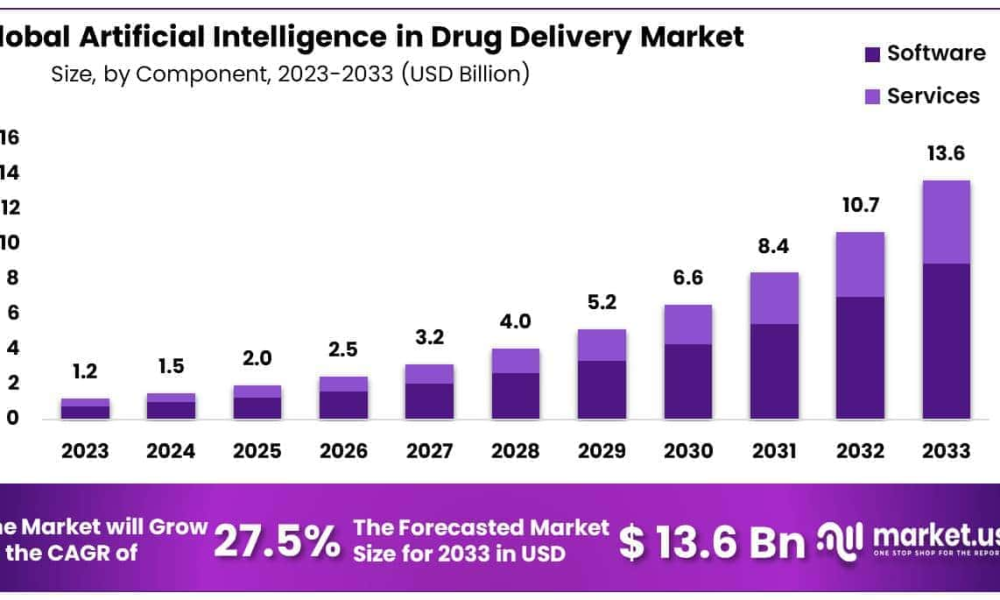
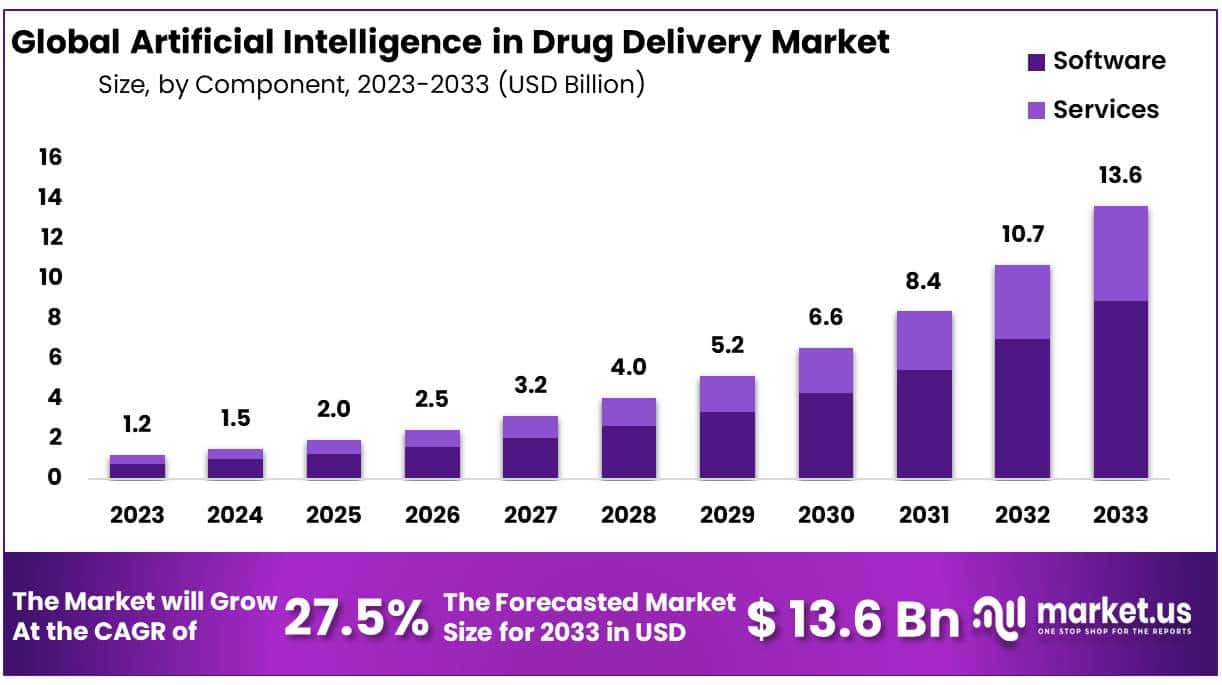
In 2023, the Global Artificial Intelligence In Drug Discovery Market was valued at USD 1.2 billion. The market is projected to grow at a compound annual growth rate (CAGR) of 27.5% between 2024 and 2033. By the end of this forecast period, the market is expected to reach USD 13.6 billion. This growth is driven by the increasing adoption of AI technologies in pharmaceutical research and development to accelerate and optimize drug discovery processes.
AI is now widely used in drug discovery for various tasks such as identifying lead and hit compounds, validating drug targets, and designing optimal molecular structures. Additional applications include drug repurposing, polypharmacology, and high-throughput screening. These capabilities enable faster, data-driven decision-making and improve the efficiency of preclinical and clinical development. As the demand for novel therapies grows, AI helps reduce the time and cost associated with traditional drug discovery methods.
Rising R&D costs in the pharmaceutical and biotechnology industries are a major growth driver. Traditional methods are expensive and time-consuming. AI platforms can reduce these burdens by offering early-stage screening, predictive modeling, and automated compound analysis. The ability of AI to uncover non-obvious drug-target interactions supports research in areas such as oncology, rare diseases, and complex neurological conditions, expanding the possibilities of precision medicine.
The increasing availability of big biomedical and genomic datasets has further enabled Artificial Intelligence in Drug Discovery Market. Large-scale omics data (genomics, proteomics) and electronic health records provide a rich foundation for AI-driven insights. Machine learning and deep learning algorithms, including generative adversarial networks (GANs), are being used to design novel drug candidates, predict toxicity, and identify potential biomarkers. These technological advancements have increased the accuracy and scalability of drug discovery operations.
Strategic partnerships between pharmaceutical companies and AI startups are also driving the market. Collaborations such as Pfizer with IBM Watson and GSK with Exscientia have validated AI use in real-world settings. These alliances help scale AI adoption and provide access to proprietary compound libraries. In addition, supportive regulatory frameworks and innovation initiatives by authorities like the U.S. FDA are encouraging the integration of AI into clinical trial design, precision medicine, and patient stratification.
The rise of cloud computing and high-performance computing (HPC) infrastructure has enabled the real-time application of AI tools across various phases of drug discovery. Cloud-based platforms now offer scalable and secure environments for running complex simulations, including molecular docking and structure modeling. The pandemic has also played a pivotal role in accelerating AI use in drug repurposing and virtual screening. These developments, along with increased venture capital investment, continue to fuel the global AI in drug discovery market.
Key Takeaways
- The global artificial intelligence in drug discovery market was valued at USD 1.2 billion as of 2024, reflecting significant growth potential in the sector.
- The market is projected to grow at a robust CAGR of 27.5%, reaching approximately USD 13.6 billion by the end of 2033.
- Software solutions hold the leading position in this market, accounting for 65.4% of the overall AI-based drug discovery segment.
- Among the technologies, machine learning dominates with a 52.7% share due to its high accuracy and effectiveness in data-driven drug development.
- Neurodegenerative diseases emerged as the top therapeutic area in 2023, capturing 43.8% of the market owing to rising disease prevalence.
- Pharmaceutical and biotechnology companies collectively account for 68.4% of the market, driven by increased R&D and AI integration across drug pipelines.
- North America remains the dominant region in the Artificial Intelligence in Drug Discovery Market, securing 60.1% of the global market share due to advanced infrastructure and strong investment in AI research.
- AI is being actively used in pharmaceutical R&D to enhance target validation, lead compound identification, and drug molecular structure design.
- Major applications of AI in drug discovery include drug repurposing, polypharmacology, chemical synthesis, and high-throughput screening for emerging disease therapies.
Get Sample: https://market.us/report/artificial-intelligence-in-drug-discovery-market/request-sample/
Regional Analysis
North America holds the leading position in the global artificial intelligence in drug discovery market, with a significant revenue share of 60.1%. This dominance is driven by the region’s advanced infrastructure and strong integration of AI in drug discovery processes. Countries like the United States and Canada have a high concentration of AI-driven pharmaceutical companies. These nations also invest heavily in research and development. Such factors support market growth. As a result, North America is expected to maintain its lead throughout the forecast period.
The Asia Pacific region is projected to be the fastest-growing market for artificial intelligence in drug discovery. This growth is supported by the rising use of AI across the healthcare and pharmaceutical sectors. Countries such as China, India, Japan, and Australia are accelerating AI adoption to improve efficiency and reduce manual workloads. Government support and increasing investment in technology also boost this trend. These developments are expected to drive rapid market expansion in Asia Pacific over the forecast period.
Segmentation Analysis
Component Analysis
The artificial intelligence in drug discovery market is segmented into software and services. Among these, the software segment holds the dominant position, accounting for 65.4% of the market share. This growth is primarily driven by the widespread adoption of AI-powered software tools across the globe. These tools offer advantages such as faster processing, cost efficiency, and improved accuracy in drug discovery processes. As pharmaceutical companies increasingly adopt digital solutions, the software component continues to outperform services in this segment, strengthening its position in the overall market landscape.
Technology Analysis
By technology, the market is categorized into machine learning, deep learning, and other advanced technologies. Machine learning leads this segment with a 52.7% share due to its strong capabilities in predictive modeling and data analysis. It supports researchers by enhancing decision-making using high-quality datasets and targeted algorithms. Machine learning also helps reduce failure rates and accelerates the overall drug development timeline. Although machine learning currently dominates, deep learning is anticipated to grow at the fastest rate, offering more sophisticated modeling for complex biological structures in future drug discovery projects.
Application Analysis
In terms of application, AI in drug discovery is applied to neurodegenerative diseases, cardiovascular diseases, metabolic disorders, immuno-oncology, and more. Among these, neurodegenerative diseases lead with a 43.8% share. AI’s strength in handling complex neurological data structures contributes to its dominance in this area. The technology supports the development of treatments for conditions like Alzheimer’s and Parkinson’s disease. The growing demand for advanced solutions in neurodegenerative therapeutics continues to drive AI adoption, establishing it as a key application area within the overall AI drug discovery market.
End-User Analysis
The market, based on end users, includes pharmaceutical and biotechnological companies, academic institutions, and others. Pharmaceutical and biotechnological companies dominate the segment with a 68.4% market share. This is due to their significant investments in AI tools to enhance efficiency in drug discovery. These organizations benefit from AI’s ability to screen large compound libraries and predict therapeutic outcomes. The need for faster time-to-market and reduced R&D costs has accelerated the integration of AI, solidifying these companies as the largest end users in the drug discovery value chain.
Component
- Software
- Service
Technology
- Machine Learning
- Deep Learning
- Other Technologies
Application
- Neurodegenerative Diseases
- Cardiovascular Diseases
- Metabolic Diseases
- Immuno-Oncology
- Other Applications
End-User
- Pharmaceutical and Biotechnological Companies
- Academic and Research Institutes
- Other End-Users
Key Players Analysis
The artificial intelligence in drug discovery market is highly fragmented, with numerous players operating across the globe. Leading companies are adopting strategies such as mergers, partnerships, and collaborations to expand their market presence. These moves are helping them strengthen their foothold in various regional markets. This strategic approach is also enabling faster innovation and broader access to AI-driven drug discovery platforms. The demand for AI-based solutions continues to rise due to their potential to reduce R&D costs and shorten drug development timelines.
Key players in the market include NVIDIA Corporation, Microsoft Corporation, Cloud Pharmaceuticals, TOMWISE INC., Schrödinger, and EXSCIENTIA.AI. Other prominent companies are BioSymetrics, Cyclica Inc., IBM Watson, and Benevolent AI. These companies focus on advanced analytics, machine learning, and deep learning technologies to support drug design and discovery. Their platforms offer predictive modeling, target identification, and lead optimization capabilities. In addition to the listed firms, several other players are actively contributing to market growth through innovation and regional expansion efforts.
Conclusion
In conclusion, the artificial intelligence in drug discovery market is growing rapidly due to the increasing use of advanced technologies in the pharmaceutical sector. AI tools are helping researchers find new drugs faster, reduce research costs, and improve decision-making in early drug development. Companies are using AI to design better drug compounds and target complex diseases more effectively. With growing support from governments, rising investments, and improved digital infrastructure, AI adoption is expected to expand further. The strong involvement of pharmaceutical firms and strategic partnerships with AI startups are making this market more competitive. As technology continues to improve, AI will play a key role in shaping the future of drug discovery.
Get in Touch with Us:
Market.us (Powered By Prudour Pvt. Ltd.)
Address: 420 Lexington Avenue, Suite 300, New York City, NY 10170, United States.
Contact No: +1 718 874 1545 (International), +91 78878 22626 (Asia).
Email: [email protected]
View More
Drug Discovery Informatics Market
Medical Image Analysis Software Market



