FOR IMMEDIATE RELEASE
The Wall That Thinks Back: Why Art-Driven Interiors Are Replacing Décor in Europe’s Most Conscious Homes
Nova Scotia symbolist Claude Edwin Theriault emerges as the defining voice of the art-driven interior movement—the Western world’s answer to Feng Shui for the philosophically serious collector.
Something has shifted in Art-Driven Interiors and how Europe’s most thoughtful home-dwellers relate to their walls. It is not a gentle drift. It is a reckoning. Across the design studios of Berlin, the conscious living spaces of Copenhagen, the private libraries of Amsterdam, and the salons of Lyon and Ghent, a generation of collectors is methodically replacing everything on their walls that was chosen for its palette, its proportion, or its capacity to complement a sofa—and replacing it with work that means something. Work that earns its place. Work that speaks back.
The data confirm what the instinct already knows. Every major 2026 interior design trend report—from Decorilla and 2Modern to Living Etc.—uses the same language. “Art sets the mood, anchors the room, and reflects the individuality of those who live there.” “Art-driven interiors,” they are calling this: spaces where the artwork is the conceptual anchor and everything else is arranged around it. Not the other way around. This is not a minor stylistic correction. It is a complete inversion of how the relationship between art and interior design has functioned for the past thirty years.
And in the middle of this inversion, quietly and without institutional announcement, a French Canadian symbolist working from Digby County, Nova Scotia, has assembled the precise body of work this moment was waiting for.
Art-Driven Interiors and the Death of the Matching Print
The decorative interior had a good run. For three decades, the art market served the collector who wanted to demonstrate cultural sophistication through visual décor coordination—a print chosen because it pulled the teal from a cushion, an abstract canvas selected because its neutrals left the room undisturbed. The gallery system loved this collector. The interior design press loved this collector. And the collector, over time, grew quietly miserable in rooms that looked exactly right and felt exactly empty.
The shift now underway in European art-driven interiors is a direct response to that emptiness. Designers are not simply recommending more interesting art choices. They are restructuring their entire approach to space around the artwork first—its symbolic weight, its philosophical depth, its capacity to sustain attention across years and decades rather than seasons. The Livingetc design press noted in early 2026 that the most compelling interiors of this year “treat rooms as unified forms and blur the boundaries between architecture and art.” ” The Feng Shui tradition—which has guided intentional interior design across Asian cultures for millennia—understood this instinctively: a space is not a neutral container for objects but an active environment that shapes the consciousness of those who inhabit it. What you live with determines how you think. The art on your wall is not decoration. It is instruction.
This is exactly the claim that Claude Edwin Theriault has been making through five decades of symbolist work—and it is precisely why his collection, which spans sacred geometry, mythological male archetypes, Akkadian cultural identity, Hermetic philosophy, and Zeitgeist political commentary, is landing with unusual force among European collectors who have grown too serious for surfaces that say nothing.
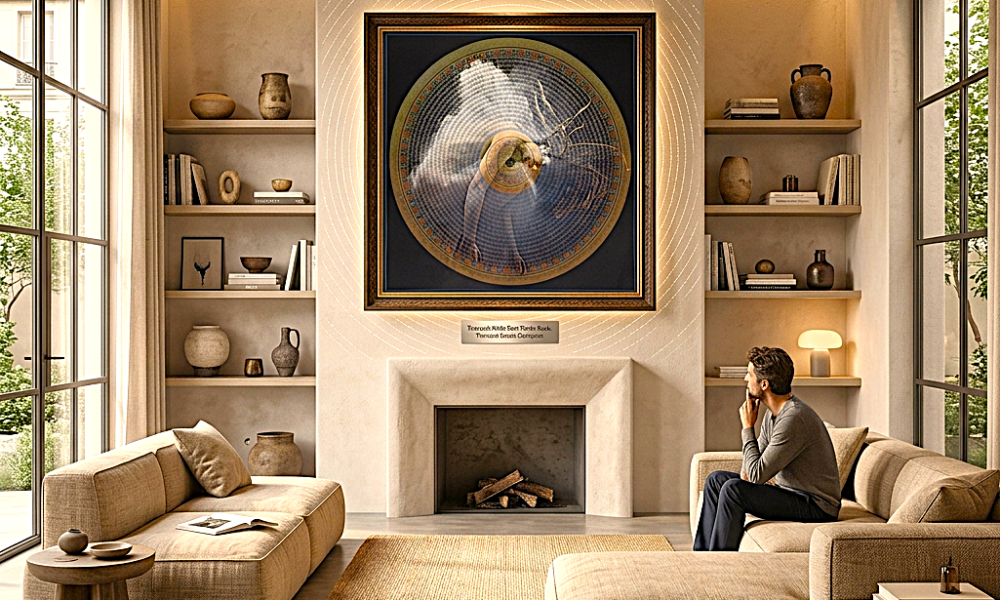
Theriault’s symbolist narrative functions the way Feng Shui does at its most sophisticated: not as a set of placement rules but as an orienting system, a visual philosophy that reshapes how a room is experienced from the inside. Stand in front of his sacred geometry mandala, and the composition organizes the room around a still center. Live with his Akashic Records series, and the walls begin to hold the sense that everything that has happened and everything that will happen is present simultaneously. Hang his Vitruvian Man. Scaffolding on a bare white wall, and the space becomes a philosophical statement about what it means to be human at this particular, turbulent, historically unprecedented moment. In a design landscape drowning in dull botanical prints and algorithmically generated abstracts, this is not a modest proposition. It is a complete alternative.
The European Art-Driven Interiors Hunger for Symbolic Depth
The European collector arriving at this shift brings specific cultural resources that make Theriault’s work legible in ways it might not be elsewhere. The French intellectual tradition—with its deep roots in Symbolisme, Hermeticism, and the esoteric philosophical underground that runs from Baudelaire through Moreau through the Theosophical movement and into the present—has always understood that a wall is not a neutral surface. The Dutch collector, shaped by a culture that has produced some of the Western world’s most rigorous still-life tradition, knows that every object in a composition carries encoded meaning. The German and Scandinavian collector, formed by design traditions that treat the home as a philosophical project rather than a lifestyle statement, is looking for art that reflects the same level of seriousness they bring to everything else in their environment.
What all of these European interior sensibilities share, in 2026, is a hunger that the mainstream art market is not feeding. Search volumes across France, Germany, Belgium, the Netherlands, and Scandinavia for sacred geometry art, esoteric wall art, mythological figure prints, and symbolist contemporary work have grown consistently for three years running. This is not a niche. It is a civilizational appetite, and it is precisely the appetite that Theriault’s five-decade body of work was built to satisfy.
Modern Feng Shui, as practitioners have framed it for the 2026 design moment, is not about superstition. It is about intentionality—creating environments that “foster positive energy flow” and “support whatever you’re doing.” Moving away, as one designer put it recently in Homes and Gardens, from “visual noise and toward spaces that support rejuvenation: layered lighting, meaningful objects instead of clutter, and layouts that enable quiet rituals.” ” Theriault’s symbolist work does all of this at the level of the image itself, without requiring any furniture repositioning. His sacred geometry anchors. His mythological figures orient. His Akashic Records compositions open the room vertically, introducing the sense of depth and temporal scale that the most sophisticated European interiors are now explicitly seeking.
The art-driven interiors of today need art that is genuinely doing something. In 2026, across the most conscious living spaces in Europe, that art is increasingly coming from Nova Scotia.
Claude Edwin Theriault’s full collection of over 660 works is available internationally at pixels.com/profiles/claude-theriault, with canvas, metal, acrylic, framed, and wood print formats shipping directly to Europe.
About Claude Edwin Theriault: Claude Edwin Theriault is a French Canadian Zeitgeist artist and contemporary symbolist working from Digby County, Nova Scotia. His five-decade body of work spans oil painting, digital art, and mixed media, connecting the sacred geometry, Hermetic, and Symboliste traditions with Acadian cultural identity, mythological archetypes, and contemporary political and economic commentary for a global collector audience.