
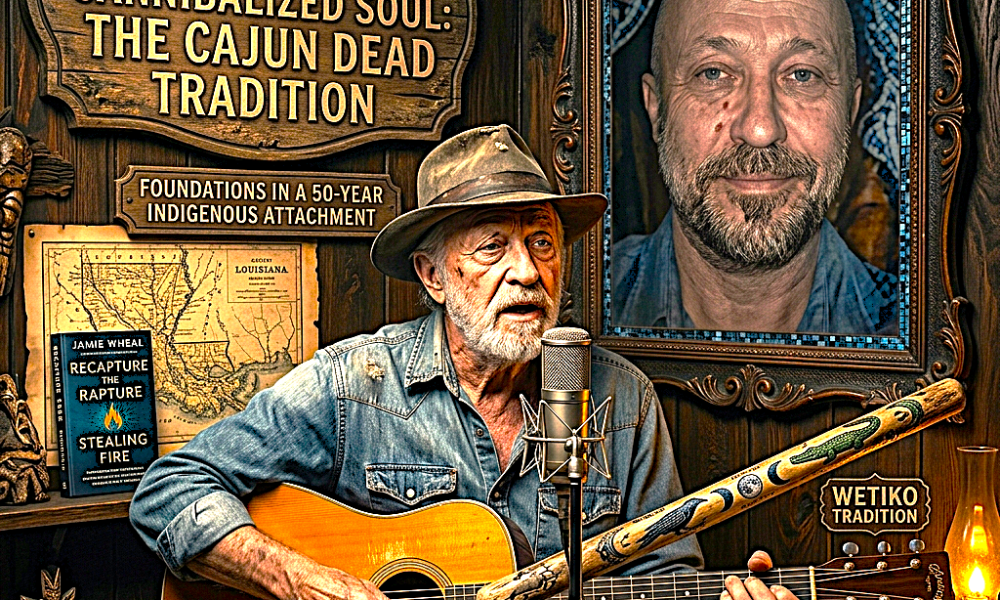
Wetiko and the Cannibalized Soul: How a 50-Year Indigenous Attachment and a Jamie Wheal Discovery Became the Philosophical Foundation of the Cajun Dead et le Talkin’ Stick Appalachian music Catalogue
By Claude Edwin Theriault | Claregyle, Nova Scotia
There is a concept in Algonquin and Cree Indigenous tradition that names, with a precision that Western philosophy has spent centuries failing to achieve, the specific spiritual sickness that runs through the dominant culture’s relationship to everything it encounters. The concept is wetiko—the cannibalistic spirit, as the Theosophical Society’s documentation of the tradition confirms, that embodies greed and excess and can possess human beings, transforming the individual from a member of a community into a predatory entity that consumes the life force of others—human and nonhuman—for private purpose or profit without giving back anything of real value.
The wetiko was once a human being. Its greed and selfishness transformed it into something that destroys the very organism of which it is a part—like a cancer cell that, in trying to replicate itself endlessly, destroys the body that sustains it. Indigenous thinkers have been naming this pattern for centuries. The mainstream culture has been living it without a name, producing its symptoms in every institution it builds, for just as long.
Fifty Years of Indigenous Attachment — and the Word That Finally Arrived
Claude Edwin Theriault has carried a profound attachment to Indigenous cultures and Indigenous ways of seeing for fifty years—not as an academic interest, not as a political alignment, and not as the appropriative aestheticism that too many non-Indigenous artists bring to Indigenous frameworks. It is a lived orientation—the specific resonance that a neurodivergent queer Acadian visual symbolist feels when encountering a cosmological framework that describes the power undercurrents of the dominant culture with more precision than the dominant culture’s own self-description has ever managed. The Acadian community shares with the Indigenous peoples of Turtle Island the specific experience of colonial dispossession—the 1755 Grand Dérangement as the Acadian equivalent of forced removal and the suppression of the French language as the Acadian equivalent of residential school linguistic erasure—and fifty years of living at the intersection of these parallel histories produces a specific and irreversible orientation toward the Indigenous intellectual tradition as the most honest available description of the forces that produced both.
The wetiko concept arrived specifically through Jamie Wheal’s Homegrown Humans, the neuroanthropology and culture architecture framework that Wheal has built around the intersection of the timely and the timeless, the immediate political crisis, and the deep philosophical structure that produced it. Wheal’s synthesis draws on Jack Forbes’s foundational Columbus and Other Cannibals—the primary Indigenous scholarly text on wetiko as a civilizational pathology—and Paul Levy’s Dispelling Wetiko, which extends the framework into the specific psychological mechanisms of collective possession by the cannibalistic pattern. Reading Wheal’s synthesis, Theriault recognized the word for what the symbolist visual art had always been drawing: the cannibalized soul of everyone formed inside a honky media culture that consumes without acknowledgment, accumulates without return, and generates wars and displacements and cultural suppressions as the natural output of a system that has mistaken the destruction of everything around it for the growth of itself.
The Songs That Name the Pattern Beneath the Headline
The song Blood on Their Hands uses the wetiko framework directly—not as a metaphor borrowed for poetic effect but as the precise diagnostic for what the song is describing: the specific spiritual sickness that produces the war machine, the political administration that sends weapons while calling it security assistance, and the media apparatus that frames the systematic destruction of civilian populations as a conflict between parties rather than the wetiko act of consumption it actually is. The lyric Borrowing from the Past to Pay for the Fall uses the same logic in a different register—the wetiko economy that consumes the cultural inheritance of the past, the oral traditions, the modal music, and the complainte memory carried forward across generations to sustain the present moment’s unsustainable consumption, leaving nothing for the future it claims to be building. As the complete Cajun Dead song catalogue documents, the wetiko framework is not a single song’s argument. It is the structural logic underneath the entire archive — the recognition that the forces producing the Acadian deportation of 1755, the displacement of 1.9 million Palestinians, the ICE killings in Minneapolis, and the institutional suppression of the queer Acadian creative voice are not separate events requiring separate political explanations. They are the same spirit wearing different clothes across different centuries and different geographies, consuming what they encounter without acknowledgment of the cost, calling the consumption security or progress or heritage preservation depending on the decade.
The Western protest song tradition has always struggled with this specific distinction — the difference between protesting a specific bad actor and naming the specific spiritual condition that produces bad actors as its systemic output. The protest song that targets a president or a policy expires when the president leaves and the policy changes. The testimony that names the wetiko condition does not expire because the condition does not expire. It simply finds a new host, a new administration, a new war, a new displacement, and continues. The Cajun Dead griot and complainte tradition has always carried its testimony at this deeper level—not the headline but the pattern beneath the headline, not the specific injustice but the specific spiritual architecture that makes injustice structurally inevitable in a wetiko-invested culture. Fifty years of Indigenous attachment made that structural vision possible. Jamie Wheal gave it a name. The songs had already been singing the name before they knew what to call it. Now they do—and the nearly 200 songs in this archive, each one a specific testimony to a specific instance of the same ancient pattern, are the most sustained available application of the wetiko intellectual framework to the Acadian and global experience in the entire body of contemporary folk music.
Claude Edwin Theriault is the founder of counterculture. Cajun Dead et le Talkin’ Stick is a nearly 200-song lyric archive rooted in a 50-year profound attachment to Indigenous cultures and the wetiko intellectual tradition of Algonquin and Cree cosmology. Claregyle, Nova Scotia. Streams on Spotify, Boomplay, and YouTube. Full archive at moderncontemporaryartworktrends.com.