
Aluminum Cans Market Overview:
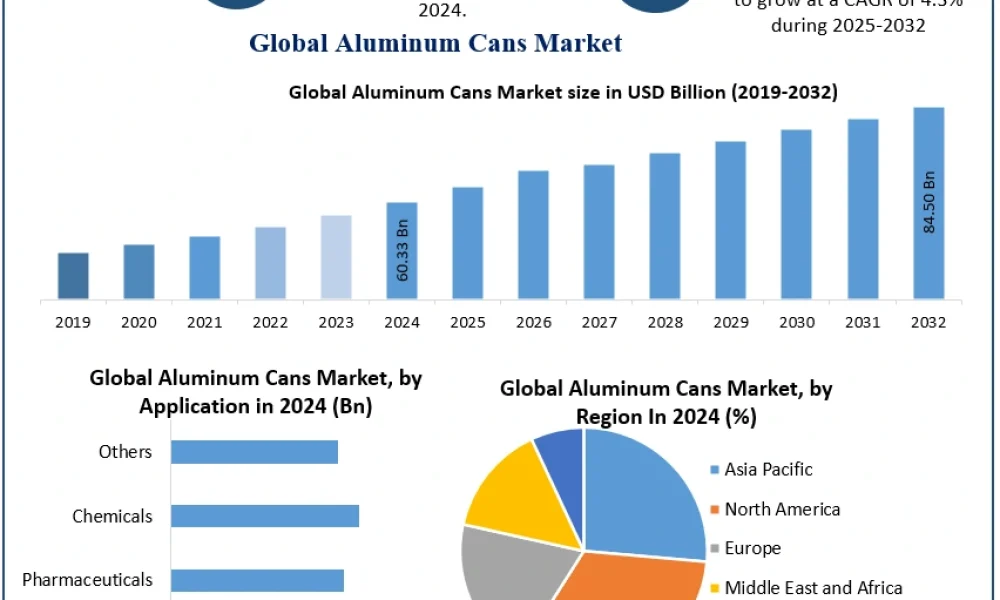
Aluminum Cans Market was valued at USD 60.33 billion in 2024 and is forecast to grow at a CAGR of 4.3% from 2025 to 2032, reaching nearly USD 84.50 billion. The surge in demand is driven by growing consumer preference for sustainable packaging, expanding beverage consumption, and increasing regulatory measures promoting recycling. North America leads the market, leveraging a mature beverage industry and widespread recycling infrastructure.
Key Highlights & Insights
Market Growth: Expected to grow from USD 60.33 billion in 2024 to USD 84.50 billion by 2032, at a CAGR of 4.3%.
Dominating Region: North America commands the largest market share, supported by its well-developed beverage sector, strong aluminum recycling programs, and consumer preference for sustainable packaging formats.
Leading Segment: Beverage cans represent the largest application segment, especially for carbonated soft drinks, beer, energy drinks, and ready-to-drink beverages.
Key Driver: The recyclable nature of aluminum, combined with its lightweight and protective qualities, drives its extensive use in beverage packaging, thereby accelerating market demand.
► Get a sample of the report:https://www.maximizemarketresearch.com/request-sample/24759/
Recent Developments
2024-2025: Ball Corporation expanded partnerships with entertainment venues to introduce recyclable aluminum beverage cups, enhancing sustainability in large-scale events across North America.
Amcor and industry partners committed $6 million over five years to tackle plastic waste and promote circular economy initiatives.
Major players like Crown Holdings, CCL Industries, and Toyo Seikan Co. continue to invest in production capacity enhancements and innovation in lightweight, durable aluminum cans.
Innovations in printing and coating technologies enable premium branding opportunities and improved product shelf life.
Market Dynamics
Growth Drivers:
Increasing environmental regulations and consumer demand for sustainable packaging solutions.
Rising consumption of packaged beverages globally and shift from plastic bottles and glass to aluminum cans.
Convenience factors such as portability, recyclability, and rapid cooling of aluminum cans.
Expansion of e-commerce and on-the-go consumption trends.
Challenges:
Volatility in aluminum prices and energy costs may impact production expenses.
Competition from alternative packaging types including PET bottles and glass containers.
Consumer misconceptions regarding aluminum can safety and taste impact adoption in certain markets.
Regional Analysis
North America: Market leader with strong aluminum can production and recycling infrastructure, dominant in the beverage sector, especially the U.S. and Canada.
Europe: Mature market driven by stringent recycling regulations and high consumer environmental awareness, with substantial demand in Germany, the UK, and France.
Asia Pacific: Fastest-growing region fueled by urbanization, rapidly increasing packaged beverage consumption, and investments in manufacturing capacity, notably in China and India.
Rest of World: Latin America, Middle East, and Africa show emerging growth through increasing consumer adoption and regulatory encouragement.
Product Segmentation
Structure: Two-piece cans (body and end) and three-piece cans (body, bottom, and top). Two-piece cans dominate due to simplicity and cost-effectiveness.
Type: Standard, slim, sleek, and specialty cans catering to various beverage categories including energy drinks and premium products.
Application: Food & beverage (soft drinks, beer, ready-to-drink), pharmaceuticals, chemicals, and other industrial uses.
Key Trends
Increased focus on incorporating recycled aluminum content.
Development of custom and premium aluminum cans with enhanced graphic capabilities.
Growing adoption in alternative packaging applications beyond beverages.
Strategic collaborations promoting recyclability and circular economy practices.
Influence of e-commerce and direct-to-consumer packaging trends.
Frequently Asked Questions
What is the current size of the global aluminum cans market?
The market was valued at USD 60.33 billion in 2024.Which region leads the aluminum cans market?
North America leads, owing to its mature beverage industry and extensive recycling infrastructure.What are the key benefits of aluminum cans?
Aluminum cans are lightweight, recyclable without loss of quality, corrosion-resistant, and effectively preserve product freshness.Which industry segment consumes the most aluminum cans?
The beverage industry, particularly carbonated soft drinks, beer, and energy drinks.
Conclusion
With sustainability at the forefront of consumer and regulatory demands, the aluminum cans market is positioned for steady growth globally. North America’s leadership in recycling and beverage production, combined with expanding opportunities in emerging regions like Asia Pacific, underscore the evolving landscape for recyclable packaging solutions. Innovations in lightweighting, branding, and production efficiency will further unlock value and support the transition toward a circular economy in packaging.
◉ Get Market Research Latest Trends
♦ Maximize Market Research is launching a subscription model for data and analysis in the MMR Statistics
Contact Maximize Market Research:
3rd Floor, Navale IT Park, Phase 2
Pune Bangalore Highway, Narhe,
Pune, Maharashtra 411041, India
[email protected]
+91 96071 95908, +91 9607365656
About Maximize Market Research:
Maximize Market Research is a multifaceted market research and consulting company with professionals from several industries. Some of the industries we cover include medical devices, pharmaceutical manufacturers, science and engineering, electronic components, industrial equipment, technology and communication, cars and automobiles, chemical products and substances, general merchandise, beverages, personal care, and automated systems. To mention a few, we provide market-verified industry estimations, technical trend analysis, crucial market research, strategic advice, competition analysis, production and demand analysis, and client impact studies.




