
Overview
AI in Precision Medicine refers to the use of artificial intelligence technologies, including machine learning, deep learning, and natural language processing (NLP), to customize healthcare treatments. This approach leverages individual patient data—such as genetic makeup, lifestyle habits, and environmental exposures—to create personalized treatment plans. AI enhances the speed and accuracy of this customization by analyzing vast datasets, including genomic sequences, medical imaging, and electronic health records (EHRs).
This growing field is reshaping healthcare by improving the precision of disease diagnosis, risk prediction, and therapeutic decision-making. AI-based algorithms detect subtle patterns in complex datasets that may be missed by human analysis. This capability leads to better clinical outcomes and reduced errors in diagnosis and treatment.
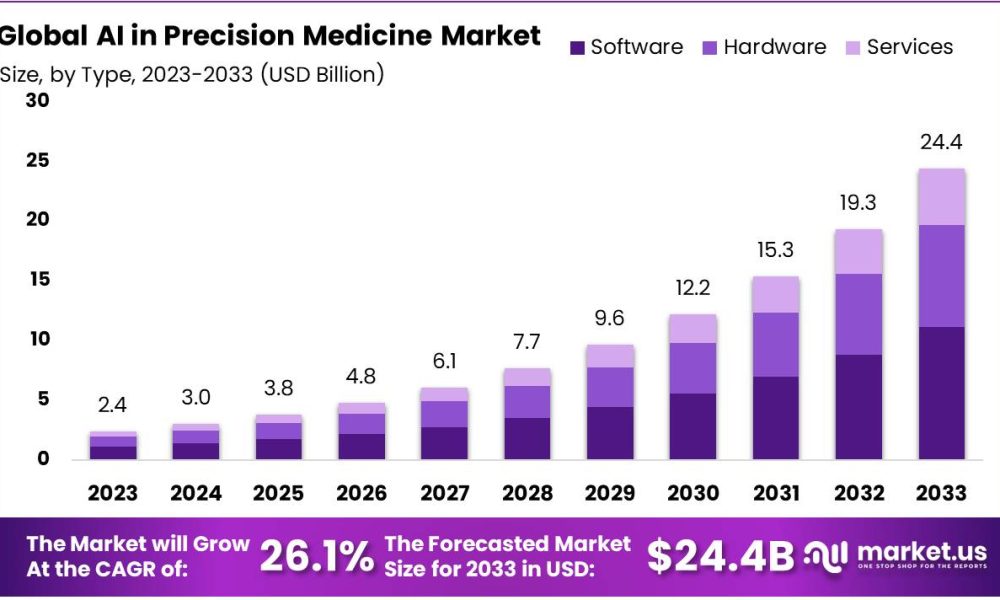
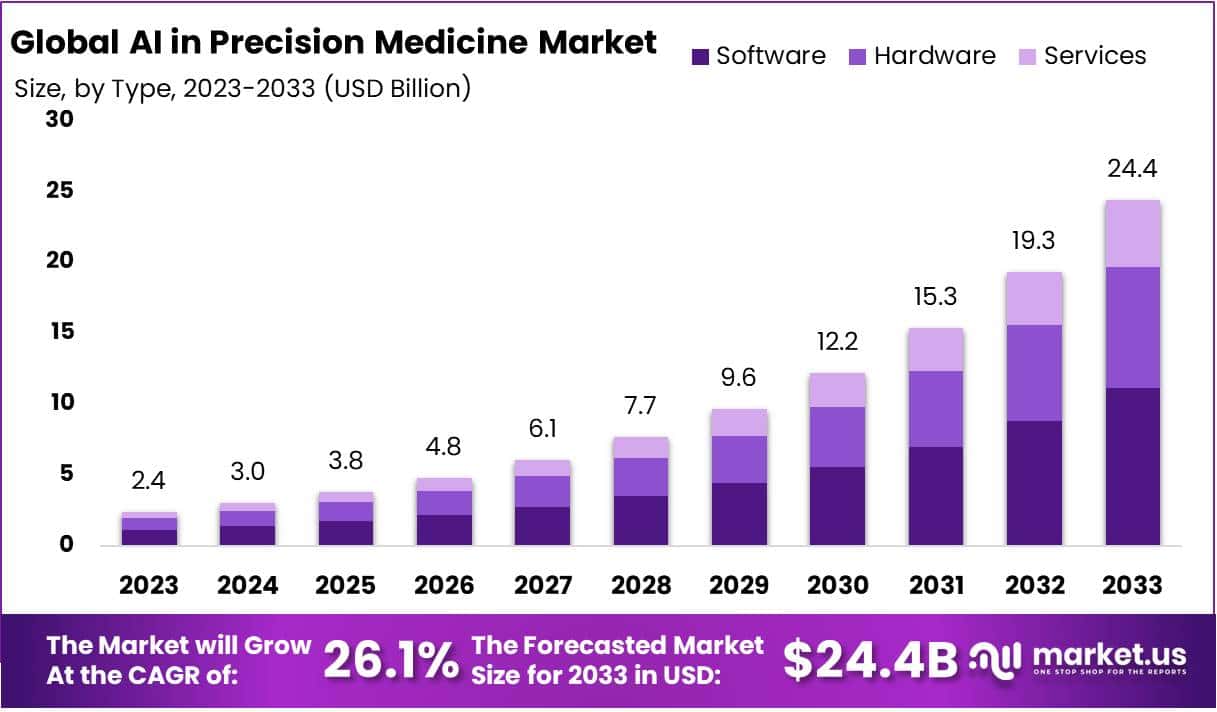
The global AI in Precision Medicine market was valued at USD 2.4 billion in 2023 and is expected to reach USD 24.4 billion by 2033, expanding at a CAGR of 26.1%. The market is driven by the rising demand for personalized treatments, increased genomic data availability, and improvements in AI algorithms. Applications span oncology, cardiology, neurology, and rare diseases.
Key stakeholders in the market include pharmaceutical companies, AI technology firms, healthcare institutions, and research organizations. The sector also benefits from rising public awareness, supportive government initiatives, and strategic collaborations between healthcare and tech companies.
Growth Factors in AI in Precision Medicine
The rising demand for personalized treatments is one of the primary growth drivers for AI in Precision Medicine. Patients and clinicians are increasingly turning to AI tools to design care strategies that reflect each person’s genetic, environmental, and lifestyle characteristics. This shift is leading to better patient outcomes and optimized use of healthcare resources.
The growing availability of genomic data is fueling AI adoption. Falling costs of genome sequencing and large-scale initiatives such as the “1+ Million Genomes” project in Europe are producing vast datasets. AI is critical in decoding this data to identify disease risks and develop personalized therapies.
Rapid advancements in AI algorithms and computing infrastructure further support market expansion. Innovations in deep learning and natural language processing allow faster, more precise analysis of clinical and biomedical datasets. These technologies assist in risk prediction, patient stratification, and treatment matching.
The increasing incidence of chronic and genetic disorders is also accelerating market growth. Conditions such as cancer, cardiovascular diseases, and rare genetic syndromes require tailored therapies. AI enables early diagnosis and helps in selecting the most effective interventions.
Government and institutional support is another key factor. Programs like the U.S. Precision Medicine Initiative encourage the integration of AI into clinical care. Funding and policy support provide a strong foundation for research and implementation of AI-driven tools.
The proliferation of biomedical databases also contributes to the market’s momentum. Structured and unstructured data from EHRs, diagnostic imaging, and biobanks demand advanced AI systems for real-time integration and insight generation. AI transforms this complex information into actionable intelligence.
Companion diagnostics is a growing application area. AI is being used to guide drug selection and dosing tailored to individual patients. This ensures better treatment results and supports regulatory compliance in precision therapies.
Collaborations between pharmaceutical companies and AI startups are significantly boosting innovation. Joint ventures like Enlitic and GE Healthcare aim to optimize imaging workflows and enhance decision-making. These partnerships speed up AI integration in drug discovery, clinical trials, and biomarker identification.
Key Takeaways
- The AI in Precision Medicine Market is forecasted to grow from USD 2.4 Billion in 2023 to USD 24.4 Billion by 2033, at a CAGR of 26.1%.
- Recent advancements show that AI-based software tools are significantly improving disease diagnosis, thereby accelerating growth within the software segment of the market.
- Deep learning technologies command a strong market presence, currently accounting for 36.2% of the overall share in AI-driven precision medicine applications.
- AI solutions are widely used in oncology, enhancing cancer diagnostics and treatment planning, which is helping to broaden the market’s scope and impact.
- The increasing global elderly population is driving demand for AI applications that help manage chronic and age-related diseases, improving clinical outcomes.
- Data privacy and security concerns, particularly with patient records, are emerging as key challenges that could restrict broader AI adoption in this field.
Request Sample: https://market.us/report/ai-in-precision-medicine-market/request-sample/
Regional Analysis
North America is projected to witness notable growth during the forecast period, maintaining a stronghold in the global market. The region’s dominance is attributed to the strategic presence of key players such as Mead Johnson and Company and Abbott Laboratories. In 2023, North America accounted for a substantial market share of 32.4%. The continuous support from major pharmaceutical and healthcare corporations has played a key role in expanding the region’s capabilities. Additionally, multiple stakeholder collaborations have further enhanced the competitive edge.
The region is witnessing growing demand for innovative treatment solutions due to demographic and lifestyle shifts. A rising elderly population, along with sedentary behavior, has increased the prevalence of chronic diseases. This trend has encouraged stakeholders to invest in advanced healthcare solutions. North America also benefits from the rapid digitization of health-related datasets, which contributes to drug development and improved patient outcomes through data-driven insights.
According to projections from a U.S.-based intergovernmental body released in May 2023, chronic diseases such as cardiovascular disorders, diabetes, cancer, and respiratory ailments are expected to account for 86% of the 90 million global deaths by 2050. This highlights the urgent need for early intervention, preventive care, and continued innovation in therapeutic development.
In a notable development, Certara, Inc. announced a two-year partnership with Memorial Sloan Kettering Cancer Center. This initiative aims to create a bio-simulation platform for CAR-T cell therapy. The partnership illustrates the region’s ongoing commitment to advancing personalized and precision-based medical solutions to meet the rising demand for effective, targeted treatments.
Segmentation Analysis
In 2023, the AI in precision medicine market was segmented into hardware, software, and services. Among these, AI-based software solutions gained a notable market share of 45.6%. These solutions offer accurate diagnostics and efficient analysis of medical records. Their adoption is increasing across healthcare providers and research institutions. Key applications include reducing medication errors, enabling robotic surgeries, and improving telemedicine. Strategic partnerships, such as GE Healthcare’s collaboration with 12 Sigma Technologies and others, have further boosted the development of the Edison AI platform, strengthening the segment’s position.
The technology segment of the market includes Machine Learning, Deep Learning, Context Aware Processing, Querying Method, and Natural Language Processing. In 2023, Deep Learning held the largest share at 36.2%. This is credited to its strong data processing abilities and automation capabilities. Deep learning systems can model complex patient data across various formats and timelines. They enhance diagnostic speed and precision, enabling personalized treatments. Their role in streamlining healthcare workflows has made them a preferred choice in AI-driven medical solutions.
Meanwhile, Natural Language Processing (NLP) is projected to witness the fastest CAGR of 37.4%. This surge is driven by its utility in clinical decision-making and administrative automation. NLP helps extract key insights from unstructured data such as physician notes and pathology reports. This functionality enables faster, more accurate clinical decisions. As a result, physicians can spend more time on patient-centric tasks. The growing demand for real-time data interpretation continues to expand NLP’s relevance in healthcare applications.
In terms of therapeutic areas, oncology emerged as the leading segment, accounting for 47.6% market share in 2023. AI technologies have been instrumental in enhancing cancer diagnostics and outcomes. Rising cancer incidence, supported by WHO data showing 10.3 million cancer deaths in 2020, underscores the segment’s importance. Additionally, the neurology segment is expected to grow at a CAGR of 34.8% in the coming years. This growth is attributed to increasing cases of neurological disorders, such as Alzheimer’s, epilepsy, and migraines, which demand AI-driven diagnostic and treatment solutions.
By Component
- Hardware
- Software
- Services
By Technology
- Machine Learning
- Querying Method
- Deep Learning
- Context Aware Processing
- Natural Language Processing
By Therapeutic Area
- Oncology
- Neurology
- Cardiology
- Respiratory
- Others
Key Players Analysis
In 2023, the AI in precision medicine market was segmented into hardware, software, and services. Among these, AI-based software solutions gained a notable market share of 45.6%. These solutions offer accurate diagnostics and efficient analysis of medical records. Their adoption is increasing across healthcare providers and research institutions. Key applications include reducing medication errors, enabling robotic surgeries, and improving telemedicine. Strategic partnerships, such as GE Healthcare’s collaboration with 12 Sigma Technologies and others, have further boosted the development of the Edison AI platform, strengthening the segment’s position.
The technology segment of the market includes Machine Learning, Deep Learning, Context Aware Processing, Querying Method, and Natural Language Processing. In 2023, Deep Learning held the largest share at 36.2%. This is credited to its strong data processing abilities and automation capabilities. Deep learning systems can model complex patient data across various formats and timelines. They enhance diagnostic speed and precision, enabling personalized treatments. Their role in streamlining healthcare workflows has made them a preferred choice in AI-driven medical solutions.
Meanwhile, Natural Language Processing (NLP) is projected to witness the fastest CAGR of 37.4%. This surge is driven by its utility in clinical decision-making and administrative automation. NLP helps extract key insights from unstructured data such as physician notes and pathology reports. This functionality enables faster, more accurate clinical decisions. As a result, physicians can spend more time on patient-centric tasks. The growing demand for real-time data interpretation continues to expand NLP’s relevance in healthcare applications.
In terms of therapeutic areas, oncology emerged as the leading segment, accounting for 47.6% market share in 2023. AI technologies have been instrumental in enhancing cancer diagnostics and outcomes. Rising cancer incidence, supported by WHO data showing 10.3 million cancer deaths in 2020, underscores the segment’s importance. Additionally, the neurology segment is expected to grow at a CAGR of 34.8% in the coming years. This growth is attributed to increasing cases of neurological disorders, such as Alzheimer’s, epilepsy, and migraines, which demand AI-driven diagnostic and treatment solutions.
Get in Touch with Us:
Market.us (Powered By Prudour Pvt. Ltd.)
Address: 420 Lexington Avenue, Suite 300, New York City, NY 10170, United States.
Contact No: +1 718 874 1545 (International), +91 78878 22626 (Asia).
Email: [email protected]
View More



