
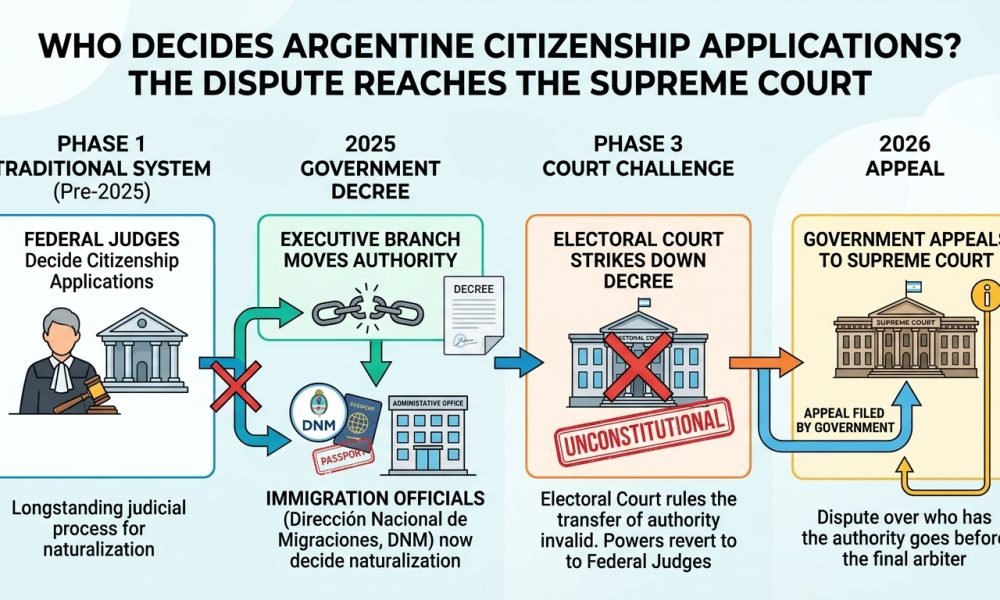
Argentina’s 2025 immigration decree transferred naturalization decisions from federal judges to immigration officials. Still, a June 2026 electoral court ruling invalidated that change, prompting a government appeal that reached the Supreme Court in September.
WASHINGTON, D.C., November 25, 2026
Argentina’s Supreme Court faces a consequential dispute over who has the authority to grant citizenship to foreign residents, following a lower court ruling that challenged President Javier Milei’s attempt to transfer naturalization decisions from federal judges to immigration officials.
The controversy has introduced uncertainty for immigrants seeking Argentine nationality, including Mexican citizens considering a second passport, because the final resolution could determine which institution reviews applications, how eligibility is interpreted, and which procedures applicants must follow.
Argentina’s Citizenship Dispute Reaches the Supreme Court
The central legal controversy concerns Decree of Necessity and Urgency 366/2025, signed in May 2025, which amended Argentina’s naturalization framework and assigned responsibility for granting citizenship to the National Directorate of Migration, commonly known as DNM.
For decades, federal courts handled Argentine naturalization applications, so the government’s decision to move the process into the executive administration was a major institutional shift rather than a routine adjustment to application forms.
On June 30, 2026, Argentina’s National Electoral Chamber ruled against the decree’s citizenship provisions, concluding that the executive branch had exceeded constitutional limits when using emergency decree powers to regulate matters connected with political rights.
The government challenged the ruling, and on September 24, 2026, the electoral chamber allowed an extraordinary federal appeal, moving the dispute to the Supreme Court to consider the constitutional questions raised by the reform.
The Government’s 2025 Decree Changed the Decision-Maker
Decree 366/2025 sought to centralize naturalization decisions within the National Directorate of Migration, giving an immigration agency responsibility for evaluating applicants and granting citizenship certificates instead of leaving those decisions primarily with federal judges.
The administration presented the change as part of a wider immigration reform intended to strengthen documentary controls, verify lawful residence, and improve coordination between immigration authorities and the national population registry responsible for Identification records.
Under the proposed framework, immigration officials would review naturalization applications through administrative procedures. At the same time, applicants facing unfavorable decisions could pursue the administrative appeals and judicial remedies established by the amended legislation.
The decree also introduced stricter residence language and addressed immigration enforcement, making its consequences potentially significant for applicants whose personal histories include extended travel, irregular status, or unresolved disputes with government authorities.
The Judiciary Previously Controlled Naturalization
Argentina’s traditional approach centered on Citizenship Law 346, under which federal judges determined whether foreign applicants met the legal conditions to obtain an Argentine certificate of naturalization.
That judicial system reflected the historical treatment of citizenship as a legal status connected to constitutional rights, rather than merely an immigration benefit that executive officials could approve or deny through ordinary administrative discretion.
The dispute therefore concerns more than which government building receives an application, because transferring authority can affect evidentiary standards, available appeals, and how courts interpret constitutional protections for foreign residents seeking citizenship.
The Yang Liping Case Became the Constitutional Test
The litigation arose from the citizenship application of Liping Yang, a Chinese national residing in Argentina’s Entre Ríos province, whose naturalization request became entangled with an immigration expulsion order and the government’s revised citizenship procedures.According to court reporting,
Yang had established a business and family life in Argentina. Still, an earlier expulsion decision complicated his citizenship claim, even though authorities had not carried out the removal.
The federal electoral court initially rejected the application, leading to an appeal that required higher judges to examine both the applicant’s circumstances and the constitutionality of transferring naturalization powers to immigration authorities.
In the resulting decision, the National Electoral Chamber addressed the institutional question directly, declaring the contested decree invalid and emphasizing the constitutional importance of judicial authority in matters involving nationality and political rights.
The June 2026 Ruling Rejected the Transfer
Judges Alberto Dalla Vía and Daniel Bejas concluded that the executive’s emergency decree mechanism could not lawfully accomplish the disputed transfer of citizenship authority, particularly because the constitutional framework restricts emergency decrees concerning electoral matters.
The chamber’s reasoning connected nationality decisions to the broader exercise of political rights, explaining why a change in the institution granting citizenship could not be evaluated solely as an administrative immigration reorganization.
The ruling also reversed the rejection of Yang’s application. Still, that procedural development should not be represented as an automatic citizenship grant or proof that every applicant with an immigration dispute necessarily qualifies for Argentine nationality.
The Government Defended Its Immigration Reform
The Milei administration maintained that immigration officials should have the authority to assess applications because the agency already manages residence records, verifies lawful immigration status, and coordinates key information relevant to naturalization eligibility.
Supporters of the administrative approach can point to the practical advantages of centralized documentation and access to government databases. At the same time, critics emphasize the constitutional limits on executive decrees and the importance of independent judicial review.
Those competing institutional arguments do not establish that every administrative decision would be improper or that judicial processing necessarily produces better results, since the constitutional dispute concerns the lawful allocation of governmental authority.
September’s Appeal Moved the Dispute Forward
The government’s extraordinary appeal was accepted for Supreme Court consideration on September 24, 2026, after it challenged the electoral chamber’s June ruling on the constitutional validity of Decree 366/2025.
An October 2026 Infobae report on the Supreme Court appeal described the case’s progression and identified the Ministry of National Security and National Directorate of Migration as the government bodies challenging the electoral decision.
As of November 25, 2026, the verified procedural record shows the appeal reached the Supreme Court, but it does not show a final Supreme Court judgment conclusively resolving the nationwide institutional dispute.
That distinction matters for prospective applicants, because accepting an appeal for consideration does not mean the Supreme Court has endorsed the decree, overturned the lower court, or definitively assigned all future naturalization applications to immigration officials.
The Supreme Court Must Address Constitutional Authority
The Supreme Court’s eventual decision could clarify whether citizenship decisions must remain within the judiciary or whether Congress could authorize a different arrangement, while examining the restrictions placed on presidential emergency decrees under Argentina’s constitutional system.
A ruling focused on emergency decree powers might leave separate questions about future legislative reforms unresolved, so applicants should distinguish the present constitutional challenge from predictions about every possible naturalization system Argentina might adopt.
Existing Applications Require Individual Assessment
Applicants whose proceedings began before the decree’s introduction may occupy a different procedural position from people attempting to file afterward, because the original decree included transitional rules preserving certain previously initiated judicial cases.
Foreign residents should preserve filing receipts, court notifications, and immigration correspondence, rather than assume every application has automatically transferred between institutions or that the lower-court judgment eliminated all administrative uncertainty.
The Two-Year Residence Requirement Remains Important
Argentina’s traditional naturalization framework provides a pathway based on two years of qualifying residence, while the contested 2025 changes introduced more restrictive language concerning lawful and continuous residence immediately preceding an application.
The distinction can matter for individuals whose residency histories include temporary absences or immigration complications, because determining which legal provisions govern an application may affect how residence evidence is evaluated.
No applicant should interpret the constitutional dispute as automatic permission to disregard residence requirements, identity verification, or criminal-history screening, since challenging the institution responsible for decisions differs from eliminating the substantive conditions for citizenship.
Mexican Applicants Should Examine the Broader Implications
Mexican nationals considering Argentine citizenship may find the country’s residence-based naturalization framework relevant to their mobility planning. Still, they should first determine how Mexican law treats their existing nationality and any subsequent foreign naturalization.
Mexicans by birth benefit from constitutional protections against deprivation of Mexican nationality, whereas people who became Mexican through naturalization face distinct provisions concerning voluntary acquisition of another citizenship and prolonged residence abroad.
Those differences make legal sequencing important, particularly when someone already possesses multiple passports and is considering Argentina as another potential residence destination without first establishing how each country’s nationality laws interact.
An Argentine Passport Does Not Resolve Every Travel Obligation
Argentine citizenship may provide additional international travel opportunities. Still, passport privileges depend on destination-country rules, security screening, and the traveler’s full legal identity, not an automatic exemption from immigration controls.
The U.S. State Department’s guidance on dual nationality illustrates how countries independently regulate their nationals’ travel documents and continuing obligations, even when individuals lawfully hold several citizenships.
Criminal and Immigration Histories Remain Relevant
Applicants with prior removal orders, pending proceedings, or disputed immigration status should obtain qualified Argentine legal advice, because the Yang litigation does not establish that every immigration violation becomes irrelevant during naturalization proceedings.
Similarly, a successful challenge to an administrative procedure does not prevent authorities from examining authentic court records, personal Identification, and the applicant’s actual compliance with the substantive law applicable to their case.
Identity Documentation Must Remain Consistent
Applicants who have legally changed names or obtained additional citizenships should preserve documents linking earlier and current identities, since the receiving institution may require reliable evidence that all records concern the same individual.
Readers exploring Amicus International Consulting’s new identity services should distinguish legitimate privacy arrangements from concealing previous identities or presenting fabricated records, because lawful naturalization depends on truthful evidence and authorized government documents.
Investment Citizenship Creates a Separate Legal Question
Argentina also introduced an investment-related citizenship framework during 2025. Still, that initiative should not be conflated with ordinary residence-based naturalization or treated as conclusively validated by the appellate proceedings involving Yang.
Prospective investors should verify whether the applicable program has operational rules and a lawful approval mechanism before paying substantial fees, especially while the constitutional boundaries of executive citizenship authority remain disputed.
Legal Uncertainty Complicates Relocation Planning
Families considering relocation should separate obtaining lawful residence from acquiring citizenship, because residence permits, financial arrangements and nationality applications can involve different agencies and eligibility rules even when they concern the same person.
A prudent budget should account for housing, documentation and professional advice without assuming that judicial uncertainty will necessarily disappear before a planned move or that a favorable decision will arrive within a fixed period.
The Outcome Could Influence Future Applications
A final Supreme Court ruling could clarify institutional competence and the constitutional limits of executive action. However, its exact consequences will depend on the judgment’s reasoning and operative terms.
Applicants should therefore monitor authoritative court developments and obtain individualized advice before filing, rather than rely on commercial claims that one particular institution has permanently secured exclusive authority while the dispute remains unresolved.
A Second Citizenship Requires More Than Procedural Access
Families examining Amicus International Consulting’s second passport services may compare Argentina with other lawful nationality pathways. Still, no private intermediary can guarantee a judicial decision or override constitutional requirements governing official citizenship approval.
The right approach starts with verified residence eligibility, authentic documentation, and a clear understanding of the available legal process, followed by realistic expectations about administrative processing, possible appeals, and final government recognition.
Argentina’s Supreme Court Faces a Defining Nationality Question
The dispute over Decree 366/2025 illustrates how a seemingly administrative change can raise fundamental constitutional questions, particularly when decisions about naturalization determine whether foreign residents obtain political membership in their adopted country.
Until the Supreme Court resolves the appeal, the central distinction remains between the government’s attempted transfer of authority and the electoral chamber’s decision rejecting that transfer, and applicants need to pay close attention to current procedures.
For Mexican citizens and other prospective applicants, the most reliable plan is grounded in lawful residence, transparent records, and qualified legal guidance, rather than assumptions about how an unresolved constitutional challenge will ultimately be decided.




