
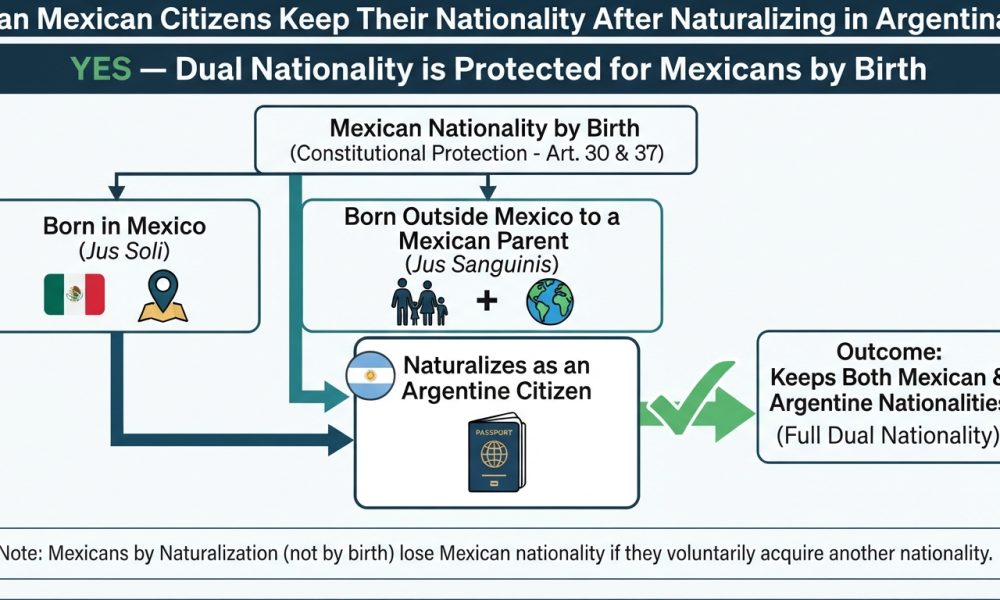
Mexico protects nationality acquired by birth, including through a Mexican parent abroad. In contrast, a person who became Mexican through naturalization faces a different rule when deciding whether to acquire Argentine citizenship after settling there.
WASHINGTON, DC (November 25, 2026)
A Mexican by birth who becomes an Argentine citizen can keep both nationalities, whether born in Guadalajara or born overseas to a Mexican parent and has never held a Mexican passport.
Article 37 of Mexico’s Constitution protects every Mexican by birth against deprivation of nationality. It lists voluntary acquisition of a foreign nationality as grounds for loss of Mexican nationality by someone who naturalized in Mexico.
Argentina permits its nationals to hold other nationalities, as its consular service explains, so a Mexican by birth deciding whether to naturalize in Argentina can assess the Argentine application on its merits without choosing between the two countries.
For families spread across the Americas, the harder question is often which rule applies to a particular person, especially when parents and children were born in different countries or obtained their first Mexican documents many years apart.
What Mexico means by nationality at birth
Article 30 starts with the familiar case of a child born on Mexican territory, who is Mexican by birth regardless of the parents’ nationality, then extends that same classification to people born abroad to a Mexican mother or father.
Consider a mother from Puebla who gives birth to one daughter in Mexico and another in Santiago, Chile, then moves to Argentina, where both daughters grow up and eventually qualify to apply for Argentine citizenship. The sisters can each retain Mexican nationality when they become Argentine. However, the younger sister may have to produce her Chilean birth certificate and evidence of her mother’s Mexican nationality to obtain the Mexican birth record her sister already has.
A parent’s own place of birth once presented a barrier for some families. Still, a constitutional amendment published on May 17, 2021, removed the requirement in Article 30 that the Mexican parent described in that provision have been born on Mexican soil. In October of that year, Mexico’s Foreign Ministry brought together its embassies and consulates in Latin America and the Caribbean to explain the change, expressly identifying children of Mexicans born abroad as beneficiaries of the reform.
For a family tracing its connection to Mexico through a grandparent, the intervening generation still matters, because a grandparent’s Mexican birth certificate can establish where the family history begins while leaving the consulate to determine the applicant’s parent’s Mexican nationality.
When the parent became Mexican through naturalization
Article 30 also expressly covers a child born abroad to a naturalized Mexican mother or father, and the Mexican Embassy in Argentina explains that the parent must already have acquired Mexican nationality at the time of the child’s birth.
Imagine a woman who became Mexican in 2000 and gave birth in Chile in 2002, then moved to Argentina with her daughter, who eventually decided as an adult to apply for Argentine citizenship after establishing a life there. The daughter is Mexican by birth through her mother. She can keep that nationality if she naturalizes in Argentina. In contrast, the mother’s Mexican nationality remains subject to the rules governing naturalized Mexicans if she chooses to make the same application.
If the dates were reversed and the mother became Mexican only after the delivery, her later naturalization would not establish that the child was born to a Mexican mother. However, a qualifying connection through the other parent could establish nationality independently.
The risk for naturalized Mexican citizens
For someone who became Mexican by obtaining a naturalization letter, known as a carta de naturalización, from Mexico’s Foreign Ministry, Article 37 places voluntary acquisition of another nationality among the specified grounds for losing Mexican nationality, making this a consequential decision before an Argentine application proceeds.
Article 37 also identifies five continuous years of residence abroad as grounds for loss, a rule that can matter to a naturalized Mexican who has lived in Argentina for years and has never applied for Argentine citizenship. Article 37 also lists use of a foreign passport as another ground for a naturalized Mexican, giving someone in that position reason to seek advice about an existing passport and the consequences of acquiring Argentine nationality.
Mexico’s Nationality Law gives the person concerned a hearing before the Foreign Ministry revokes a naturalization letter, and Article 29 limits the effect of a loss decision to the individual it names, so relatives who hold Mexican nationality in their own right retain it.
Why some families remember an older rule
The date March 20, 1998, matters for Mexican families whose older relatives acquired another nationality decades ago, because Mexico’s Foreign Ministry maintains a declaration procedure for qualifying adults who voluntarily took a foreign nationality before that date.
A Mexican grandmother who became Argentine in 1995 and her Mexican-born granddaughter applying today can offer accurate accounts of different experiences, especially if the grandmother remembers having to obtain a Mexican nationality declaration when she sought documentation later in life.
For the older case, the ministry asks for evidence showing when foreign nationality was acquired, which explains why a dated Argentine naturalization record may matter more to that inquiry than the issue date printed on the relative’s most recent Argentine passport.
How a family documents a birth abroad
In Buenos Aires, the Mexican Embassy’s civil registry instructions tell families how to register an overseas birth, what nationality they must establish, and how to use the resulting Mexican birth record to apply for a passport. The embassy asks for proof of Mexican nationality from at least one parent, and the foreign birth record establishes the parent’s relationship to the person seeking registration, two distinct facts that a family photograph or an account of childhood in Mexico cannot establish.
Adults can appear on their own behalf without bringing their parents to the appointment, for which the embassy also lists two adult witnesses, a detail that matters to people whose parents live in Mexico, have limited mobility, or died before the family assembled its records.
An adult registering a birth should distinguish the date the civil registry records it from the date on which the birth occurred, because a first Mexican birth certificate obtained in middle age can document nationality held since childhood. Mexico’s Nationality Law recognizes several forms of evidence, including a Mexican birth certificate issued under the applicable rules, a naturalization letter and a passport. Still, someone assessing the consequences of Argentine naturalization may need to look beyond the passport to the underlying record.
Amicus International Consulting describes its private identity documentation services. At the same time, an official correction to a birth entry or confirmation that two certificates refer to the same parent belongs with the civil registry or consular authority responsible for the records in question.
What Argentina decides when a Mexican resident applies
Argentina’s Citizenship Law and Constitution govern a resident’s eligibility to become Argentine, and the country’s published naturalization instructions for foreign adults seeking citizenship by residence require evidence that can include a legalized birth certificate, proof of lawful means of support, and criminal record documentation.
The government’s administrative guide describes two years of legal, continuous residence immediately before the application, with no departures during that period, and directs applicants to begin online through the National Migration Directorate. This arrangement has prompted litigation in Argentina.
In October 2026, the Argentine news outlet Chequeado reported on two challenges to the citizenship decree, including a case in which a federal appeals court rejected the transfer of authority over naturalization to the migration agency and another involving the National Electoral Chamber. Argentina’s federal prosecutors said the electoral chamber overturned the lower-court decision and upheld judicial authority over citizenship in the second case. In September, the chamber allowed an appeal raising the federal question to proceed.
For a Mexican resident with an application pending or a trip home during the relevant period, the date of filing, the record of departures, and the authority handling the case matter when assessing eligibility under Argentine law.
What changes at the border with two passports
Mexico’s Nationality Law requires Mexicans by birth to identify themselves as Mexican when entering or leaving the country, including after they acquire another nationality. This rule becomes relevant on the first visit home after receiving an Argentine passport.
The U.S. State Department’s travel information for Mexico acknowledges that Mexico permits dual nationality. At the same time, Mexico’s own Foreign Ministry directs Mexican families to use Mexican passports for their children’s entries and departures even when those children also hold another nationality. For a Mexican parent flying from Buenos Aires to visit relatives in Mexico with an Argentine-born child, obtaining the child’s Mexican birth record and then applying for a Mexican passport can be part of preparing for the same journey.
On the Argentine side, the National Migration Directorate publishes different travel instructions based on a dual national’s residence and whether Argentina has a nationality agreement with the other country, so a relative living overseas may describe different border formalities. Mexico does not appear on Argentina’s published list of countries with those agreements. Still, the list addresses the treatment of travelers in specified circumstances, and Mexico’s constitutional Protection for a Mexican by birth operates independently of a bilateral agreement.
Private guides, including Amicus International Consulting’s description of second passport services, discuss an additional travel document as a benefit of citizenship. In contrast, the document a traveler can actually present depends on whether the issuing government has approved the application and whether the passport is still valid.
What Argentine identity records show
From 2013 through August 7, 2023, Argentina’s National Registry of Persons counted 46,026 applications from people born abroad who had naturalized and were applying for a national identity document for the first time as Argentine citizens.
Researchers counted separately the people who obtained nationality by option through an Argentine parent, identifying 1,584 people born in Mexico in that group, or about four in every hundred of the 42,928 first identity document applications in that category. Among people born in Mexico who obtained the document through a parent, nearly 43% were younger than five, indicating how often families documented a child’s Argentine nationality well before adult naturalization would have become possible.
Those numbers capture a particular moment in a family’s dealings with the government, since the registry counted first identity documents and had no way to include applicants still waiting for a citizenship decision when researchers compiled the figures.
When parents and children take different paths
A child born in Argentina to a Mexican parent generally acquires Argentine nationality at birth under Argentina’s Citizenship Law, which makes an exception for children of certain foreign diplomats, and can also be Mexican by birth through the parent. That child may already hold both nationalities before the parent applies for Argentine naturalization, making it quite possible for the youngest member of a household to be the first Argentine citizen in a family that moved from Mexico.
For a sibling born outside Argentina, the analysis starts elsewhere, because Argentine consular instructions for nationality by option identify a native Argentine mother or father as the qualifying parent, a distinction worth checking when the parent became Argentine through naturalization. Parents tracing both nationalities for their children therefore need to identify where each child was born, which nationalities each parent held at that time, and how the parent acquired them before deciding which application belongs with which government.
What happens when a dual national turns 18
Turning 18 does not require a child who holds Argentine and Mexican nationality by birth to choose between them. However, Mexico’s Constitution treats adulthood as a condition for exercising citizenship rights, including the right to vote. A teenager born in Rosario to a Mexican father can therefore hold a Mexican passport before reaching voting age, and an older sibling can renew that passport after turning 18 without making a new claim to nationality through the father.
Some government jobs carry an additional qualification, because Article 32 of Mexico’s Constitution reserves certain public offices and functions for Mexicans by birth who have not acquired another nationality, even though Article 37 protects their Mexican nationality itself. Someone considering a position subject to that restriction has a specific question for the appointing authority about the post’s qualifications, while a brother or sister deciding whether to renew a Mexican passport faces an ordinary question about proof of nationality.
When the sisters from Puebla and Santiago return to Mexico after becoming Argentine, each can present herself as Mexican, even though one can trace that right to the place of her birth and the other to their mother. For the family member holding a Mexican naturalization letter, that same Argentine decision carries a genuine risk of loss, which is why the most revealing document in the family file may be the one showing how each person originally became Mexican.