
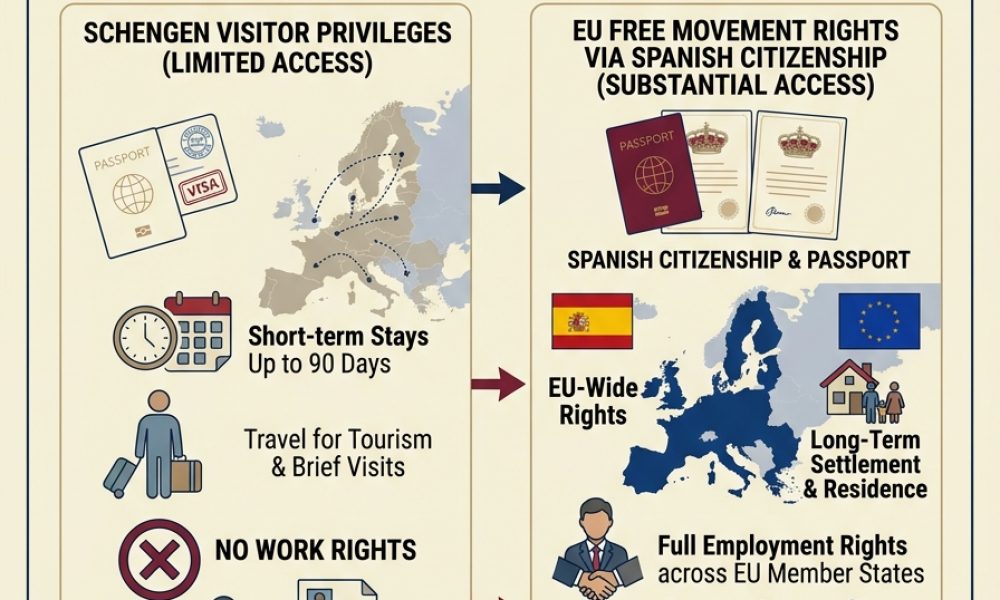
New Spanish citizens gain European Union free movement rights extending beyond ordinary Schengen visitor privileges, creating broader opportunities for residence, employment, education, and long-term settlement across member states and certain associated European countries.
WASHINGTON, D.C., November 24, 2026
Mexican and Filipino nationals who acquire Spanish citizenship gain legal opportunities extending substantially beyond the Schengen travel area, because European Union nationality provides residence and employment rights that ordinary short-term visitor permissions cannot offer to foreign travelers.
For families considering international relocation, the distinction between Schengen border arrangements and European citizenship is essential, since a Spanish passport can document rights involving employment, retirement, education, and family reunification under separate European legal frameworks.
European Union Citizenship Is Different From Schengen Access
The Schengen area primarily establishes common external border arrangements. It facilitates travel without routine internal border controls, while European Union citizenship creates a broader legal relationship between individuals and member states through treaty-based rights.
A Mexican or Filipino tourist holding an eligible Schengen visa may visit participating countries within permitted limits. Still, that authorization does not independently confer permission to establish permanent residence, accept ordinary employment or pursue unrestricted economic activity.
A naturalized Spanish citizen occupies a different legal position, because Union citizenship allows movement to another member state under Directive 2004/38, subject to the conditions governing longer residence and other applicable national requirements.
Schengen and EU Membership Are Not Identical
As of November 2026, the Schengen area comprises 29 countries, including 25 European Union members and four associated non-EU countries, while Ireland and Cyprus remain outside the fully participating Schengen border-free arrangements.
Iceland, Norway, Switzerland, and Liechtenstein participate in Schengen despite not belonging to the European Union, showing that participation in a common border arrangement does not automatically confer EU citizenship or identical treaty rights.
Conversely, Ireland and Cyprus belong to the European Union while remaining outside Schengen, making them important examples of destinations where a Spanish citizen’s European mobility rights can extend beyond the familiar border-free travel zone.
Ireland Provides an Important Example
A naturalized Spanish citizen can generally move to Ireland to seek work or establish residence under European free movement rules, even though Ireland maintains separate border controls and does not issue Schengen visas.
That opportunity differs substantially from the position of many Mexican or Filipino passport holders traveling independently without European citizenship, because permission to visit Ireland and permission to live and work there involve separate legal criteria.
Spanish citizens relocating to Ireland must still observe applicable residence conditions and ordinary administrative requirements. At the same time,e non-EU family members may need documentation establishing their derivative rights under the relevant Irish implementation of European law.
Cyprus Also Demonstrates the Distinction
Cyprus participates in European Union free movement arrangements despite maintaining border controls outside the fully operational Schengen area, allowing qualifying Spanish citizens to explore employment, business, and residence opportunities under EU law.
The island’s separate border arrangements mean travelers should verify entry documentation and applicable procedures, rather than assume every EU destination uses identical airport processes simply because Union citizenship underpins the journey.
Schengen Expansion Does Not Change Citizenship Rules
A Reuters report on Bulgaria and Romania joining Schengen fully described the removal of remaining internal land-border controls on January 1, 2025, illustrating how border arrangements can change without creating a new category of European citizenship.
Both countries were already European Union members before full Schengen accession, meaning Spanish citizens possessed relevant free movement rights there independently of the later removal of routine internal land-border checks.
The example demonstrates why travelers should distinguish developments involving border convenience from the underlying legal right to establish residence, seek employment or operate a business in another European Union country.
Short Visits and Long-Term Residence Follow Different Rules
Directive 2004/38 generally allows EU citizens to enter another member state and remain for up to three months with a valid passport or national identity card, subject to limited exceptions.
During this initial period, ordinary residence documentation generally cannot be imposed as a condition of the right itself. However, host countries may require travelers to report their presence under applicable administrative arrangements.
Staying beyond three months introduces additional considerations, including employment, self-employment, qualifying studies, or sufficient financial resources and comprehensive sickness insurance for economically inactive residents under the governing European legal framework.
Workers Gain Rights Beyond Tourist Permissions
A naturalized Spanish citizen generally may accept employment in another EU member state without obtaining an ordinary third-country work permit, making professional mobility significantly different from the limited activities permitted under Schengen visitor arrangements.
Employers must still comply with applicable labor laws. At the same time, candidates may face professional licensing, language requirements, and qualification-recognition procedures when the destination country’s legislation regulates the intended occupation.
A Filipino nurse considering Germany or a Mexican engineer considering Ireland should therefore assess professional recognition separately from immigration permission, because the right to seek work does not automatically authorize every regulated occupational activity.
Entrepreneurs Can Establish Commercial Activities
EU citizenship can support self-employment and business establishment across member states, creating opportunities for consultants, technology founders and other professionals who previously depended on immigration sponsorship or national entrepreneur visa categories.
Business registration, professional authorization, taxation, and beneficial ownership requirements remain applicable; however, a Spanish passport does not exempt commercial operators from ordinary financial reporting or licensing rules imposed by their destination country.
Retirement Rights Extend Beyond Schengen Tourism
Spanish citizens who wish to retire elsewhere in the European Union may benefit from residence rights unavailable through an ordinary short-term tourist visa. However,h economically inactive residents generally must satisfy financial-resource and healthcare requirements.
Retirees should evaluate the destination’s insurance framework, pension arrangements, housing costs, and registration procedures, rather than assume EU citizenship automatically provides unconditional access to publicly funded healthcare and financial benefits everywhere.
Students Receive Broader Educational Opportunities
Naturalized Spanish citizens can investigate educational institutions throughout the European Union under relevant equal-treatment protections. However, universities retain legitimate admissions criteria and may impose language, qualification, and enrollment requirements.
Students residing beyond three months may also need qualifying health insurance and sufficient resources, making advance financial planning essential even when the student no longer requires the conventional immigration permission imposed on many third-country nationals.
European Family Rights Can Be Substantial
Qualifying spouses, dependent children and certain other family members may obtain derivative residence rights when accompanying or joining an EU citizen exercising free movement, subject to documentary evidence and the conditions prescribed by European legislation.
A Mexican or Filipino spouse who has not become Spanish may therefore have a family residence pathway in another EU country. However,h marriage certificates, dependency documentation, and residence-card procedures may still be required.
These provisions do not automatically make relatives European citizens, and families should distinguish permission to reside with an eligible EU national from separate nationality-by-descent, naturalization, or citizenship-by-option procedures.
Permanent Residence Can Follow Five Years
Under the applicable European framework, an EU citizen generally acquires permanent residence in another member state after five years of continuous lawful residence there, subject to rules governing qualifying status and permitted absences.
Permanent residence strengthens the person’s legal position in that host country. Still, it does not amount to acquiring that country’s citizenship or automatically entitle the person to a second European national passport.
Associated European Countries Require Separate Analysis
Iceland, Norway and Liechtenstein participate in the European Economic Area, whose arrangements extend important internal-market and movement rights beyond EU membership. At the same time, Switzerland operates under distinct bilateral agreements concerning movement with the Union.
A Spanish citizen considering employment or relocation in these countries should verify the corresponding agreement and national registration requirements, rather than assume that Schengen participation alone establishes the applicable right to settle permanently.
The United Kingdom Operates Under Different Rules
The United Kingdom’s departure from the European Union ended the general application of EU free movement rights to new arrivals, meaning Spanish nationality does not independently authorize unrestricted British employment or residence.
Spanish citizens may qualify under specific British immigration categories or protected arrangements arising from earlier residence. Still, ordinary travel permissions should not be confused with the separate legal authorization needed for long-term settlement.
European Citizenship Does Not Erase National Borders
Schengen countries may temporarily reintroduce internal border controls under prescribed circumstances. At the same time, Ireland and Cyprus maintain their own border arrangements, making valid Identification and accurate travel documentation important for all international journeys.
A Spanish citizen must also follow the entry requirements of countries outside the applicable European mobility frameworks, because EU citizenship does not grant unrestricted access to every destination on the European continent.
Existing Nationalities Carry Separate Obligations
Mexican citizens by birth enjoy constitutional Protection against deprivation of Mexican nationality. At the same time, naturalized Mexicans face distinct legal provisions that deserve particular attention before voluntarily acquiring another citizenship or residing abroad for prolonged periods.
Philippine nationality similarly requires examining whether citizenship was held from birth, lost through foreign naturalization, or reacquired under Republic Act 9225, because those circumstances can affect the consequences of further nationality acquisition.
American Dual Nationals Have Additional Duties
For individuals who also hold American citizenship, the U.S. State Department’s dual-nationality guidance explains that American citizens must use American passports when entering and departing the United States, regardless of any additional nationality.
American taxation and financial reporting obligations may also continue after Spanish naturalization, requiring separate professional advice rather than assuming that relocation to the European Union automatically ends existing legal responsibilities.
Spanish Naturalization Remains the Essential First Stage
Mexican and Filipino nationals by origin may qualify for Spanish nationality after two years of continuous legal residence immediately before submission, provided they meet the applicable statutory eligibility and documentary requirements.
That reduced period creates an opportunity to apply, not guaranteed citizenship, with government review, required declarations, civil registration, and later passport issuance remaining separate procedural stages before the individual can reliably document Spanish nationality.
Authentic Identity Records Support European Mobility
Families considering Amicus International Consulting’s new identity services should distinguish lawful privacy planning from attempts to conceal previous names or create unsupported nationality records during official Spanish naturalization and registration procedures.
Reliable birth certificates, immigration documents, and legally recorded name changes help establish continuity between earlier identities and new Spanish documentation, especially when banks, employers, or public agencies request proof of an applicant’s historical records.
Mobility Planning Must Remain Legally Grounded
Individuals exploring Amicus International Consulting’s second passport services may compare international residence and employment options. Still, private advisers cannot confer Spanish nationality or guarantee eligibility for regulated activities in another European country.
A practical plan should identify the applicable nationality status, confirm destination-specific rights, and calculate employment, housing, healthcare, and financial obligations before committing to a permanent move or acquiring property in another European jurisdiction.
European Citizenship Offers More Than Border Convenience
For qualifying Mexican and Filipino nationals, Spanish citizenship can provide a meaningful foundation for long-term European mobility, extending beyond the convenience of crossing Schengen borders to legally protected opportunities in employment, residence,ce and family life.
Its enduring advantage lies in the distinction between temporary visitor access and substantive citizenship rights, provided individuals complete Spanish naturalization lawfully and continue meeting the specific conditions governing their activities throughout Europe.