
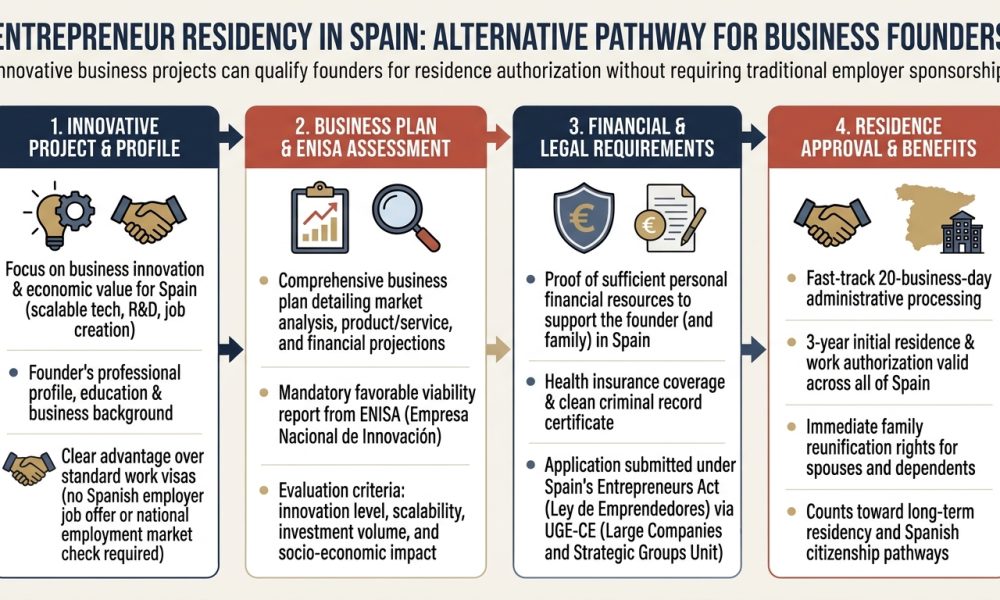
Applicants developing innovative business projects may explore Spanish entrepreneur residence provisions, subject to project assessment, financial documentation, professional qualifications, and immigration approval requirements; qualifying Mexican founders may also establish residence relevant to eventual Spanish citizenship.
WASHINGTON, DC, November 21, 2026 — Mexican entrepreneurs and international business founders seeking to establish companies in Spain can pursue a specialized residence authorization designed for innovative projects, providing an alternative to conventional employer-sponsored work permits and passive-income immigration programs.
Spain’s entrepreneur residence framework allows qualifying non-European Union nationals to establish, develop, or manage business activities considered innovative or economically beneficial, provided government authorities approve the proposed project and the applicant satisfies the applicable immigration requirements.
For Mexican founders considering relocation to Madrid, Barcelona, Valencia, or other Spanish business centers, the program can provide a lawful basis for professional activity while potentially supporting the residency history needed for future naturalization.
Spain’s Entrepreneur Residence Program Operates Under Law 14/2013
Spain’s Law 14/2013 on support for entrepreneurs and internationalization establishes a specialized immigration framework for foreign founders, recognizing qualifying innovative business activities and projects presenting particular economic interest to the Spanish economy.
Articles 68 through 70 provide the legal foundation for the entrepreneur provisions, distinguishing entrepreneurial residence from ordinary employment authorization and from immigration categories intended for retirees, investors or international remote workers.
The framework remains operational in November 2026, although prospective applicants must show more than a general intention to start a business, because the proposed activity must meet the government’s innovation or economic-interest assessment.
Inclusión y Migraciones+1
Innovation and Economic Interest Determine Project Eligibility
Spain’s entrepreneur residence category focuses on businesses demonstrating innovation or particular economic value, making the substance of the proposed commercial activity central to the government’s eligibility determination.
A Mexican technology entrepreneur proposing a scalable healthcare platform may present a different immigration case from someone seeking to operate a conventional retail shop, even when both activities constitute legitimate businesses.
The relevant assessment considers the project’s characteristics, economic contribution, and the founder’s ability to implement the proposal, rather than automatically granting residence to every foreign national who registers a Spanish company.
ENISA Evaluates the Entrepreneurial Project
Spain’s National Innovation Company, known as ENISA, issues the favorable project assessment required under the current entrepreneur residence framework, examining whether the business demonstrates sufficient innovation or special economic interest.
The evaluation includes the applicant’s professional profile, involvement in the enterprise, business plan, financing arrangements, and proposed value for Spain’s economy, including innovation, investment opportunities, and potential commercial development.
Applicants should therefore prepare comprehensive evidence explaining the business model and their role in its implementation, recognizing that company registration alone cannot substitute for a favorable governmental project assessment.
There Is No Fixed Minimum Investment Requirement
Unlike investment migration programs that require a prescribed property purchase or financial contribution, Spain’s entrepreneur residence category does not set a universal minimum capital investment for every qualifying business.
The government’s official entrepreneur guidance also confirms that no project must create a minimum number of jobs. However, job creation and economic contribution can remain relevant assessment factors.
However, the absence of a fixed investment threshold does not eliminate the need for credible financing, because applicants must demonstrate sufficient resources to develop the proposed business and support themselves during residence.
A Credible Business Plan Is Essential
A qualifying entrepreneur application ordinarily requires a detailed business plan describing the proposed product or service, target market, commercial strategy, financing structure, and anticipated contribution to Spain’s economic development.
The plan should explain how the business differs from competitors, identify realistic customers, and show why the proposed activity involves innovation or another recognized element of significant economic interest.
Mexican applicants should support projected revenue and investment figures with reasonable evidence rather than relying exclusively upon ambitious forecasts, because officials must assess whether the project is credible and capable of implementation.
The Founder’s Experience Can Influence the Assessment
ENISA considers the founder’s education, professional background, business experience, and expected participation in the proposed enterprise, making individual qualifications important even when the company presents an innovative concept.
An experienced Mexican engineer developing specialized manufacturing technology may demonstrate direct professional expertise, while an applicant entering an unfamiliar industry may need stronger evidence of qualified partners and operational support.
Where several founders participate, the assessment can examine each person’s responsibilities and contribution, including partners who do not independently require Spanish residence authorization.
Spain Has Shifted Away From Property-Based Investor Residence
Spain discontinued new Golden Visa investor applications effective April 3, 2025, ending a program that previously allowed qualifying non-European Union investors to obtain residence through substantial property or financial investments.
A June 21, 2026, El País report on Spain’s specialized immigration permits described the expanding role of entrepreneurs, skilled professionals and international teleworkers following the elimination of the former investment residence route.
For Mexican investors, this change makes genuine entrepreneurial activity more relevant than passive property acquisition when evaluating business-related immigration options. However, ordinary property ownership remains permissible under applicable Spanish law.
Entrepreneur Residence Differs From Ordinary Self-Employment
Spain also offers conventional self-employment residence authorization for eligible foreigners who intend to operate their own businesses. However, that procedure differs from the specialized innovative entrepreneur framework established under Law 14/2013.
An ordinary self-employment application may focus on business viability, required professional qualifications, licensing, and available financial resources without requiring the same favorable innovative-project assessment administered through ENISA.
A Mexican applicant planning a conventional restaurant, retail establishment, or local service business should therefore determine whether ordinary self-employment authorization is more appropriate than an entrepreneur application requiring demonstrable innovation or special economic interest.
The Specialized Residence Permit Can Last Three Years
Spain’s government entrepreneurship platform describes an initial residence authorization lasting three years, giving successful founders a substantial period to establish their businesses and develop commercial operations in the country.
The authorization allows qualifying holders to reside and undertake permitted professional activity throughout Spain, subject to the conditions governing the approved project and any other relevant business or immigration obligations.
Renewal eligibility depends upon continued compliance with applicable requirements, making the initial three-year permission an important foundation rather than an unconditional guarantee of permanent residence.
Plataforma One
Visa and Residence Authorization Procedures Must Be Distinguished
Foreign entrepreneurs living outside Spain may need an appropriate consular visa to enter the country, while qualifying individuals already lawfully present may be eligible to pursue residence authorization through the specialized governmental procedure.
The exact application sequence depends on the applicant’s location and immigration circumstances, with some procedures requiring preliminary entrepreneurial preparation and others relying on an approved residence authorization before consular visa issuance.
Mexican founders should therefore confirm the proper filing route before traveling, rather than assuming that short-stay entry automatically authorizes residence, company management, or employment.
UGE-CE Administers the Specialized Residence Procedure
Spain’s Large Companies and Strategic Groups Unit, commonly known as UGE-CE, manages the residence authorization process for qualifying entrepreneurs under the international mobility provisions of Law 14/2013.
The applicant submits the relevant documentation through designated electronic procedures, while the competent authorities obtain or review the necessary entrepreneurial project evaluation before deciding whether to grant immigration authorization.
A favorable business assessment is an essential component of the process. Still, it does not independently eliminate identity checks, financial requirements, immigration eligibility, or other conditions reviewed during the residence application.
Processing Arrangements Are Designed for Specialized Applicants
Spain’s international mobility framework establishes expedited administrative arrangements for certain residence authorizations, creating a potentially more streamlined route than conventional immigration procedures involving multiple employment and labor market assessments.
However, government processing periods should not be mistaken for guaranteed approval dates, because incomplete documentation, additional evidence requests, or project assessment questions can affect when an application receives a final decision.
Applicants should avoid signing irreversible commercial leases or committing substantial capital solely upon an advertised processing estimate, particularly where the business cannot operate without the appropriate professional or regulatory permissions.
Applicants Must Demonstrate Financial Capacity
Entrepreneur residence applicants must generally establish sufficient resources to support themselves and qualifying family members, while separately demonstrating credible financing for the proposed business activities described within their entrepreneurial plans.
This requirement raises two related financial questions, because money sufficient to cover personal living expenses does not necessarily show that the startup can fund product development, staffing, and commercial operations.
A Mexican founder should therefore prepare personal banking records and business financing documentation independently, ensuring that projected company expenditure does not depend entirely upon funds reserved for essential family living expenses.
Healthcare Coverage Forms Part of Immigration Eligibility
Qualifying applicants generally must maintain appropriate public or private health coverage under the conditions established by Spanish immigration legislation, creating another requirement separate from the commercial merits of the proposed enterprise.
A founder relocating with a spouse and children should confirm whether family members need additional insurance documentation, especially before the business establishes any employment or social security arrangements that provide recognized healthcare coverage.
Proof of substantial investment capital cannot automatically substitute for compliant health insurance, making personal immigration documentation as important as the proposed company’s financial statements.
Criminal Background Documentation Remains Important
Spain’s entrepreneur residence framework includes general eligibility requirements concerning criminal history and public security, meaning even commercially promising applicants must satisfy the relevant governmental screening and documentary conditions.
Depending on the applicable application procedure, Mexican founders may need official criminal record certificates from countries where they previously resided, along with translations, apostilles, or other legally recognized forms of authentication.
Business experience, substantial financial resources, and a favorable innovation report do not eliminate these obligations, making accurate personal-history disclosure essential throughout the immigration process.
Foreign Documents May Require Spanish Translations
Mexican civil records, professional qualifications, company documents, and criminal background certificates may need appropriate translation or authentication before Spanish authorities can accept them as evidence supporting a residence application.
Applicants should verify the required treatment for each document, because a translation prepared for ordinary commercial negotiations may not meet the formal standards for an immigration or nationality proceeding.
Consistent names, dates, and legal identities across Mexican and Spanish records can reduce unnecessary administrative questions, particularly when founders previously operated businesses under different legally recognized corporate structures.
Company Registration Does Not Guarantee Immigration Approval
Spain allows qualifying foreign nationals to participate in business ownership under applicable commercial legislation, but registering or purchasing a company does not automatically entitle them to entrepreneur residence authorization.
A Mexican investor who acquires an existing Spanish business must still demonstrate that the proposed entrepreneurial activity satisfies the relevant innovation or economic-interest conditions when applying under the specialized residence provisions.
Therefore, evaluate the enterprise’s legal structure, the founder’sparticipation, and the business’s operational plans before selecting an immigration pathway.
Real Economic Activity Matters More Than a Corporate Shell
Entrepreneur residence is intended to support genuine business development, making empty corporate registrations or purely nominal ownership arrangements unsuitable substitutes for documented innovative or economically significant activity.
Government authorities can examine whether the founder intends to develop and direct the proposed project, including the extent to which its financing, commercial operations and management arrangements support the submitted business plan.
Applicants should not rely upon arrangements promising guaranteed residence through the purchase of an inactive company, because such transactions may fail the substantive conditions governing entrepreneurial authorization.
Technology Businesses May Present Relevant Projects
Mexican founders developing software, cybersecurity services, industrial technology, or other innovative products may explore the entrepreneur residence framework when their business proposals offer clear technical or commercial improvements.
However, operating within a fashionable industry does not automatically establish innovation, since the assessment considers the actual product, competitive advantages, financing, and potential contribution to Spain’s economy.
A well-supported project should therefore explain the specific problem being addressed and the proposed solution, rather than relying entirely upon broad descriptions involving artificial intelligence, digital transformation or financial technology.
Healthcare and Environmental Innovation Offer Other Possibilities
Entrepreneurial projects involving medical technology, energy efficiency, biotechnology or environmental services may also warrant consideration when the proposed activity demonstrates genuine innovation and commercially credible economic value.
Professional regulation can introduce separate requirements, particularly where a product or service involves clinical activity, medical devices, financial services, or another sector subject to specialized licensing and oversight.
Receiving immigration authorization does not remove the obligation to obtain relevant business permissions, so coordinated legal, technical, and regulatory preparation is important before commencing operations.
Regional Business Opportunities Require Market Research
Spain’s major business centers offer different commercial environments, labor markets, and operating expenses, so a startup’s location can affect financing needs and its ability to recruit staff.
Mexican entrepreneurs should evaluate customer demand, industry networks, local professional services and housing costs before committing to a particular region, particularly when the business relies upon specialized employees or proximity to customers.
Although the residence authorization generally permits activity throughout Spain, a specific enterprise’s commercial success depends on market conditions rather than immigration approval alone.
Family Members May Qualify for Accompanying Residence
Spain’s entrepreneur residence framework recognizes qualifying spouses, partners, dependent children and certain dependent relatives, allowing families to coordinate immigration arrangements around a genuine entrepreneurial relocation project.
However, each accompanying person must meet applicable identity, relationship, and immigration requirements, and additional financial resources may be needed to show the household can support itself during residence.
Mexican founders planning to relocate with relatives should assess family eligibility before committing to the business move, especially when adult children or dependent parents create more complex documentary circumstances.
Renewal Requires Continued Compliance With the Approved Activity
A founder whose project changes significantly after residence approval should examine whether the revised commercial activity remains compatible with the authorization and whether the competent authorities require notification or further documentation.
Startup businesses often modify products, financing arrangements, and commercial strategies, but these ordinary business developments do not grant unrestricted permission to disregard the conditions under which immigration authorization was granted.
Keeping company records and evidence of genuine operations can help show continued compliance, especially when the founder later seeks renewal, a different residence classification, or long-term immigration status.
Spanish Residence Can Support Long-Term Citizenship Planning
Qualifying Mexican nationals by origin may seek Spanish citizenship after two years of legal, continuous residence immediately preceding their applications, under the preferential naturalization provisions established by Article 22 of Spain’s Civil Code.
An entrepreneur residence authorization can potentially contribute to that qualifying history when the applicant genuinely resides in Spain and satisfies the applicable statutory conditions throughout the relevant period.
However, an entrepreneur permit does not automatically grant Spanish citizenship after two years, because nationality approval requires an independent assessment of residence continuity, good civic conduct, integration, and other legal requirements.
Naturalized Mexican Citizens Require Different Eligibility Analysis
Spain’s preferential two-year naturalization provision generally applies to qualifying Mexican nationals by origin, making the applicant’s original nationality classification important when evaluating the potential benefit of entrepreneur residence.
Individuals who acquired Mexican nationality through naturalization should not assume their Mexican passports alone establish eligibility for this shortened period, even if they hold valid residence authorization and own Spanish businesses.
Such applicants may need to examine the ordinary residence period or another applicable statutory exception, depending upon their complete nationality histories and legally recognized circumstances.
International Travel Can Affect Nationality Eligibility
Mexican founders frequently travel for investors, customers, conferences, and overseas business operations, but extended international absences can create questions about the continuous Spanish residence required for naturalization.
A valid entrepreneur residence card does not, by itself, prove that every overseas journey preserves citizenship eligibility, particularly when the applicant spends long periods managing business activities outside Spanish territory.
Applicants pursuing nationality should keep accurate travel records and establish genuine residence in Spain, rather than assuming the commercial success of their startup overrides the residence conditions imposed by citizenship legislation.
Business Income Creates Separate Tax Obligations
Establishing a Spanish company can introduce corporate income tax, accounting, value-added tax and social security obligations, while the founder’s own residence circumstances may create additional personal tax responsibilities.
Spain’s startup legislation provides certain benefits for qualifying emerging companies, but those incentives have independent eligibility requirements and should not be treated as automatic benefits of obtaining entrepreneur residence authorization.
Mexican founders should therefore seek professional tax and accounting advice before restructuring their business interests, particularly when existing companies, shareholders, or intellectual property remain outside Spain.
American-Mexican Founders Face Additional Reporting Responsibilities
Some Mexican entrepreneurs also hold American citizenship, creating circumstances in which relocating to Spain and establishing a foreign company can introduce continuing United States tax and financial reporting obligations.
The U.S. Department of State’s guidance on dual nationality explains that American citizens may possess additional nationalities while retaining applicable legal obligations, making cross-border planning relevant when an entrepreneur eventually seeks Spanish citizenship.
Applicants should distinguish immigration permission from personal tax residence and corporate reporting, recognizing that an additional Spanish residence card does not independently terminate existing foreign legal responsibilities.
Entrepreneur Residence Does Not Confer Immediate European Citizenship
A Spanish entrepreneur residence permit provides qualifying immigration status within Spain but does not confer European Union citizenship or grant unrestricted employment rights across the bloc.
Successful Spanish naturalization can eventually create European Union citizenship rights, although the nationality procedure remains separate from business registration, residence authorization, and the government’s assessment of the entrepreneurial project.
Investors should therefore evaluate the practical benefits of lawful Spanish residence independently of potential future passport acquisition, especially when business operations require immediate access to other European markets.
Amicus International Consulting and Entrepreneur Relocation Planning
Amicus International Consulting discusses lawful cross-border mobility through its international relocation and citizenship services, providing a broader framework for founders evaluating business residence, family mobility and potential long-term nationality objectives.
The company’s second-citizenship planning analysis also addresses the importance of evaluating nationality strategies within the applicant’s wider personal circumstances. At the same time, Spanish immigration and citizenship approvals remain exclusively within the authority of the competent government institutions.
For Mexican entrepreneurs, an effective preliminary assessment should distinguish the proposed business’s commercial viability from immigration eligibility, ensuring that both the project and the founder satisfy independently applicable requirements.
Conclusion: Innovative Business Activity Can Establish a Lawful Residence Pathway
Spain’s entrepreneur residence provisions offer Mexican founders an alternative to traditional employer-sponsored work visas by recognizing qualifying innovative business projects with demonstrable economic interest, rather than requiring every applicant to secure a conventional Spanish employment contract.
The program does not set a universal minimum investment or job-creation threshold. Still, applicants must obtain the required project assessment and meet financial, immigration, identity, and documentary requirements before receiving authorization.
For qualifying Mexican nationals by origin, lawful entrepreneur residence may also support a future Spanish citizenship application after two years, provided residence remains continuous, and the individual satisfies the other requirements established under nationality legislation.
Ultimately, the most sustainable strategy combines a genuine commercial project with accurate immigration documentation, credible financial planning and realistic citizenship expectations, ensuring that Spanish residence is secured through legitimate entrepreneurial activity rather than unsupported promises of automatic approval.




