
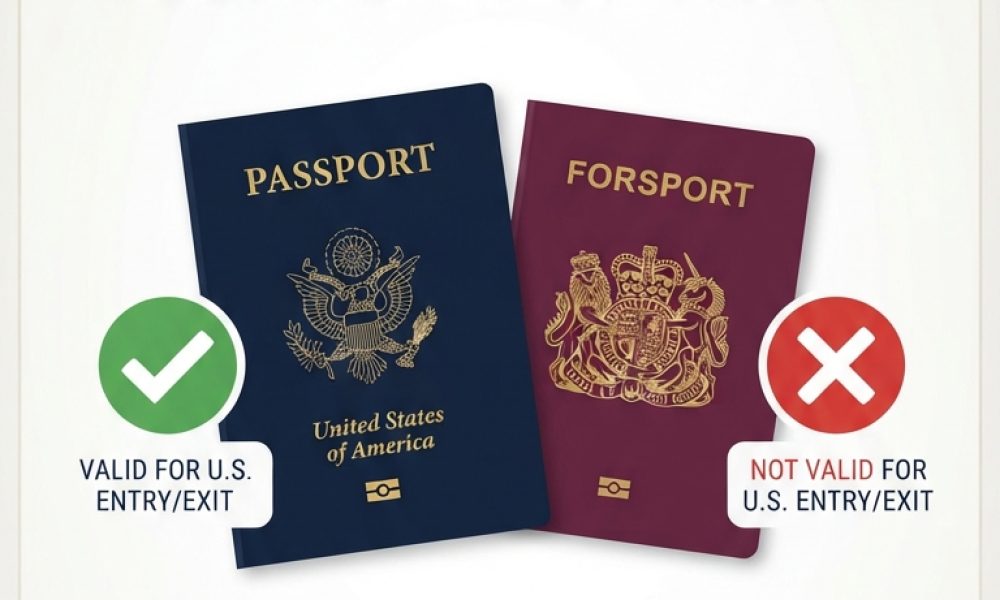
Federal travel rules require American citizens to enter and leave the United States using U.S. passports, even when they possess valid passports from another country, making proper documentation essential for lawful international travel.
WASHINGTON, DC, November 17, 2026 — Americans who acquire second citizenship through ancestry, marriage, naturalization, or investment must understand that having another country’s passport does not eliminate their obligation to use a valid United States passport when entering or leaving American territory.
Although dual citizenship can provide additional residence rights, expanded international mobility, and greater flexibility when planning overseas relocation, federal immigration law still recognizes American citizens as United States nationals regardless of their additional citizenship status.
This distinction has important consequences for travelers who mistakenly believe a foreign passport lets them choose which Nationality they present to American border authorities or airlines operating international flights.
For individuals exploring second citizenship as part of a broader relocation or contingency strategy, understanding the relationship between Nationality, passport requirements, and government Identification systems is essential to avoiding preventable travel complications.
Federal Law Establishes the U.S. Passport Requirement
Section 215(b) of the Immigration and Nationality Act, codified at 8 U.S.C. 1185(b), establishes the general requirement that American citizens carry valid United States passports when entering or departing the country, subject to specific exceptions.
The State Department reinforces this requirement through its official guidance on dual Nationality and international travel, explaining that Americans holding citizenship in another country remain subject to the same United States passport obligations as citizens possessing only American Nationality.
The requirement applies regardless of whether the second citizenship was acquired at birth, inherited through parents or grandparents, obtained through marriage-related naturalization, or granted after satisfying another country’s residence or investment requirements.
Consequently, an American citizen who subsequently receives a Mexican, Canadian, Italian, Irish, or Caribbean passport cannot ordinarily substitute that foreign travel document for an American passport when traveling internationally into or out of the United States.
Importantly, federal regulations recognize limited exceptions involving certain land and maritime crossings, approved alternative Identification documents, and specifically authorized circumstances, meaning the general passport requirement should not be interpreted as an absolute prohibition against every alternative document.
Why Dual Citizenship Does Not Change American Nationality
United States nationality law generally permits Americans to acquire foreign citizenship without automatically losing their American citizenship. However, circumstances involving voluntary relinquishment and the intention to surrender Nationality may require separate legal review.
A person born in the United States who later becomes a citizen of another country ordinarily retains American citizenship unless they voluntarily perform an expatriating act with the legally required intention to relinquish that citizenship.
Similarly, an individual born overseas who acquired American Nationality through a qualifying parent may also possess citizenship in the country of birth, creating dual Nationality without requiring a subsequent naturalization application.
These circumstances show that dual citizenship means holding two legally recognized nationalities at the same time, not an arrangement that lets individuals choose whichever citizenship is most convenient when dealing with their own governments.
For American dual nationals, their foreign passport may establish valuable rights abroad. Still, it does not transform them into foreign visitors when they approach a United States immigration checkpoint or seek admission to their country of citizenship.
Which Passport Should Be Presented During International Travel?
Consider an American citizen who has legally acquired Mexican citizenship and plans to travel from Los Angeles to Mexico City before returning to the United States several weeks later.
When departing the United States by air, that traveler should carry a valid American passport and use it as required for the American portion of the journey, while also presenting Mexican documentation when required by Mexican authorities.
Upon entering Mexico, Mexican nationality rules may require the individual to identify as a Mexican citizen, potentially making the Mexican passport the appropriate document for immigration inspection within that country.
When returning to Los Angeles, however, the traveler must establish American citizenship using the appropriate United States travel document rather than attempting to enter as a Mexican visitor under foreign-nationality privileges.
This dual-document approach reflects the fundamental principle that each government determines how its citizens must establish Nationality when crossing its borders, even when another government simultaneously recognizes those individuals as citizens.
Airlines Create an Additional Layer of Passport Verification
International airlines routinely review passenger travel documents before boarding because carriers must comply with destination-country admission requirements, verify relevant travel authorizations, and manage potential financial or operational consequences when transporting improperly documented passengers.
For American dual citizens traveling on foreign passports, complications may arise when an airline’s reservation or document-verification system incorrectly identifies the individual as a foreign national requiring an American visa or electronic travel authorization.
The Electronic System for Travel Authorization, commonly called ESTA, is intended for eligible travelers entering under the Visa Waiver Program and is not an alternative admission mechanism for United States citizens holding foreign passports.
An American citizen who also possesses a passport from a Visa Waiver Program country therefore cannot properly rely on ESTA to avoid presenting the required American passport when returning to the United States.
Travelers can reduce unnecessary airline complications by carrying both passports, keeping their booking information consistent with their identity documents, and presenting the appropriate nationality evidence when requested at check-in and boarding.
Travel Restrictions Can Affect Foreign Nationals Differently From American Citizens
The practical distinction between American citizenship and foreign Nationality became particularly relevant during discussions of United States travel restrictions in 2025, when travelers holding multiple nationalities encountered questions about whether additional passports affected their admission rights.
In June 2025, The Associated Press reported on exceptions for dual citizens under newly announced American travel restrictions, illustrating how nationality classifications can materially influence border procedures, eligibility determinations, and the application of immigration policies.
Although restrictions directed at foreign nationals can include exemptions for certain dual citizens, an American citizen’s entitlement to seek admission to the United States arises from American Nationality rather than from the immigration privileges associated with another passport.
Travelers should therefore distinguish between nationality-based immigration restrictions, ordinary passport-presentation requirements, and exceptional government measures, because these operate under different legal authorities and may produce substantially different consequences for people with multiple citizenships.
What Happens When an American Citizen Arrives Without a U.S. Passport?
An American citizen arriving at a United States border without a valid American passport may face additional questioning, identity verification, and administrative processing. Border officials will determine the individual’s nationality and the circumstances surrounding the missing documentation.
Citizenship itself does not disappear because a passport has expired, been misplaced, or become unavailable, and a person who establishes United States citizenship cannot ordinarily be denied admission merely for lacking the preferred travel document.
Nevertheless, the distinction between possessing an underlying right of admission and satisfying statutory documentation requirements remains important, particularly because airlines may refuse boarding before a passenger reaches an American immigration officer.
Travelers experiencing passport emergencies abroad should contact the nearest United States embassy or consulate to discuss replacement documents, emergency passport issuance, or the limited circumstances in which an authorized passport waiver may be available.
Attempting to overcome missing documentation by presenting oneself as a foreign visitor, withholding material nationality information, or submitting an inappropriate electronic travel authorization can create additional complications rather than resolve the original passport problem.
Limited Exceptions Apply at Certain Land and Maritime Borders
Although the standard rule requires American citizens to travel internationally with valid United States passports, federal regulations recognize limited alternatives for certain travelers entering through qualifying land and sea ports of entry.
For example, American passport cards may serve as acceptable citizenship and identity documentation for qualifying land or maritime travel involving Canada, Mexico, Bermuda, and certain Caribbean destinations. Still, they cannot replace passport books for international air travel.
Additional exceptions can apply to specific trusted traveler arrangements, designated Identification combinations, military travel circumstances, and certain categories of children. However, eligibility depends upon the precise provisions governing the relevant border crossing.
Americans should not assume that a foreign passport qualifies as an alternative document simply because a particular crossing permits certain United States citizens to present passport cards or other specifically recognized Identification.
These exceptions underscore the importance of reviewing the applicable travel rules before departure, especially when an itinerary combines commercial flights, international road travel, maritime transportation, and entry into countries with different nationality requirements.
Second Citizenship Offers Benefits Beyond American Border Procedures
The continuing American passport requirement does not eliminate the legitimate advantages of acquiring second citizenship, particularly for individuals seeking additional residence opportunities, family mobility, educational access, or greater flexibility during international relocation.
A qualifying European Union citizenship, for example, can provide substantial rights to live and work within other European Union member states, subject to applicable European law and administrative registration requirements.
Similarly, citizenship in a Latin American or Caribbean country may offer residence rights, regional travel advantages, or opportunities to establish longer-term personal and commercial connections that differ from those available exclusively through American nationality. Prospective applicants must evaluate the actual legal privileges attached to each foreign nationality rather than assuming every second passport provides unrestricted residence, guaranteed admission, or identical treatment across international borders.
As outlined in the Amicus International Consulting second-passport services overview, citizenship planning is best considered within a broader evaluation of lawful residency, documentation, personal circumstances, and the practical requirements associated with international mobility.
Second Passports Do Not Automatically Create New Legal Identities
A second citizenship generally gives an individual another recognized nationality. Still, it does not automatically erase previously established identity records, replace historical biographical information, or terminate obligations associated with existing citizenship.
Where a person has completed a lawful name change, that change must be accurately reflected across relevant documentation through the procedures established by the responsible issuing authorities and the jurisdictions recognizing the change.
Modern passport systems incorporate photographs, machine-readable information, electronic chips, and other security features designed to support document inspection and establish a reliable connection between the travel document and its lawful holder.
As international Identification technology develops, travelers should expect border authorities to use available biometric records, travel histories, and other lawful verification processes to examine identity information across different national documents.
Accordingly, possessing two legitimate passports should be understood as maintaining two official records of citizenship, not as acquiring permission to conceal material identity facts or disregard the documentary requirements of either government.
Children With Dual Citizenship Face Similar Travel Obligations
Children who acquire American nationality at birth in the United States or through qualifying citizenship transmission from an American parent may also possess foreign citizenship through their other parent, their birthplace, or another country’s nationality legislation.
Parents sometimes overlook the American passport requirement when a child already has a valid foreign passport, especially when the family lives overseas and routinely uses local citizenship documents for domestic administrative purposes.
Nevertheless, the State Department explains that the United States passport requirement extends to American dual-national children, making citizenship documentation an essential consideration before arranging international flights involving minors.
Families should also review parental consent rules, custody orders, foreign exit requirements, and any applicable restrictions on international travel with children, because a child’s dual citizenship does not override these separate legal obligations.
Where citizenship status remains uncertain, parents should seek an official determination from the appropriate authorities rather than relying solely on assumptions about birthplace, parental nationality, or documents issued by another government.
Foreign NationalNationalityReplace an Expired American Passport.
An American dual citizen whose United States passport expires while residing abroad may reasonably believe a valid second passport provides a convenient way to return home without filing another renewal application.
That assumption can prove costly because the traveler’s American citizenship remains legally relevant. At the same time, a foreign passport does not ordinarily satisfy the United States documentation requirements for American citizens returning from international destinations.
A person who discovers an expired American passport shortly before departure should review the State Department’s renewal and emergency-document procedures and allow enough time for consular appointments and any required supporting documentation.
Although limited exceptions and emergency arrangements exist, they should not be treated as routine alternatives to maintaining valid American travel documents, particularly when departure dates, airline reservations, and onward connections are difficult to change.
Keeping both passports valid provides a more dependable approach for frequent international travelers, especially those whose employment, family responsibilities, or residence arrangements require repeated crossings between countries that recognize different citizenship documents.
Tax Obligations Continue Despite Foreign Citizenship
Americans pursuing second citizenship must also distinguish international travel privileges from tax residency and citizenship-based reporting obligations, because obtaining another passport does not automatically end the responsibilities imposed on United States citizens under applicable federal tax legislation.
An individual who becomes a citizen of another country while maintaining U.S. citizenship generally remains subject to U.S. income tax rules covering worldwide income. However, credits, exclusions, treaties, and other provisions may affect the ultimate tax liability.
Amicus International Consulting’s analysis of second passports and continuing United States tax obligations explores why foreign citizenship alone does not eliminate American tax exposure.
Foreign bank accounts, overseas investments, corporate interests, and international trusts may also create separate reporting considerations, making coordinated professional advice important for individuals pursuing relocation strategies that involve substantial financial arrangements across multiple jurisdictions.
For Americans considering a permanent change in nationality status, the legal process of relinquishing United States citizenship involves distinct requirements and potential consequences that should never be confused with simply acquiring and using another country’s passport.
Professional Citizenship Planning Requires Document Consistency
Individuals considering citizenship through ancestry, long-term residence, marriage, or qualifying investment should begin by identifying their actual nationality status, because eligibility for another country’s passport does not necessarily mean citizenship has already been legally recognized.
Once an additional nationality is established, travelers should maintain accurate documentation linking their legal names, dates of birth, citizenship records, and passport details, especially when those documents come from different government registration systems.
Planning should also address visa requirements, consular assistance, passport renewal procedures, residence obligations, and potential restrictions in countries that do not recognize dual nationality or impose additional conditions when citizens acquire another nationality.
For families relocating internationally, these considerations become especially important when spouses and children hold different combinations of citizenship, creating overlapping obligations that must be evaluated individually rather than through a single family travel assumption.
The central objective should be a legally consistent international mobility strategy that preserves legitimate citizenship benefits while ensuring that every government document is authentic, properly issued, and used according to the requirements of the relevant jurisdiction.
Understanding the Limits of a Second Passport Protects Its Value
The increasing accessibility of ancestry-based nationality recognition and international citizenship programs has created additional opportunities for Americans to establish lawful connections abroad. Still, those opportunities do not diminish the authority of United States travel-document legislation.
For an American dual citizen, a second passport can provide meaningful additional choices concerning international residence, business activities, family mobility, and destination-country admission without replacing the American passport required for ordinary international departures and returns.
Travelers who understand these distinctions are better positioned to avoid unnecessary airline disruptions, answer immigration questions accurately, maintain reliable documentation, and benefit from the lawful privileges associated with citizenship in more than one country.
Ultimately, the strongest second-citizenship strategy is not one that attempts to bypass existing nationality requirements, but one that recognizes the legal responsibilities attached to each citizenship while using the additional rights to support legitimate international opportunities.
For American citizens considering a second passport in 2026 and beyond, the governing principle remains straightforward: foreign citizenship can expand personal mobility and international options, but it does not replace the United States passport obligations that continue while American citizenship is retained.




