
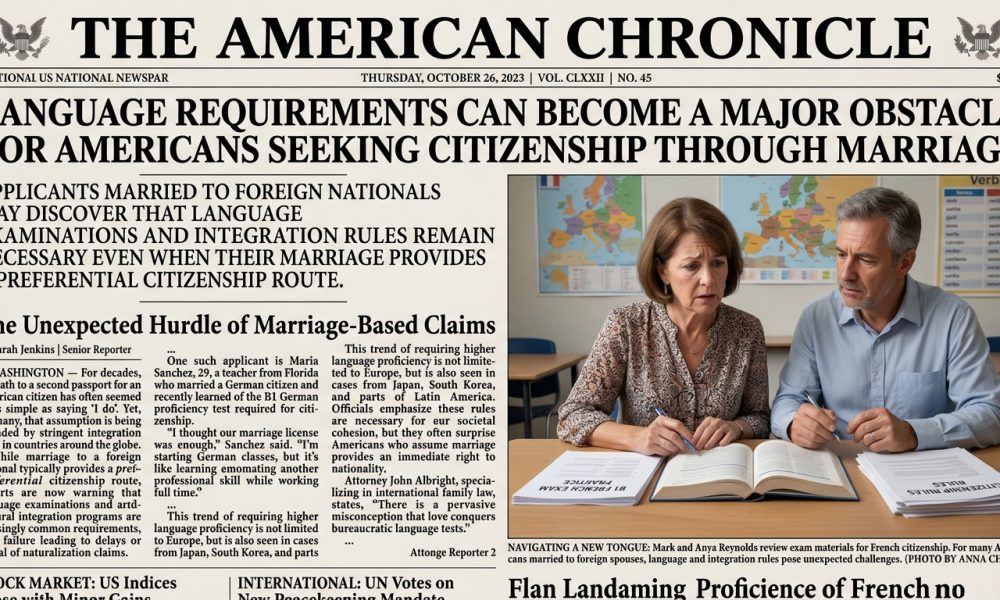
Applicants married to foreign nationals may find that language exams and integration rules still apply, even when their marriage provides a preferential citizenship route.
WASHINGTON, DC, November 16, 2026 — Americans married to citizens of European countries may qualify for shortened citizenship procedures, but language proficiency and civic integration standards can complicate applications long after a wedding has been legally registered and a family residence plan established.
The challenge has become especially visible in France, where a higher language threshold took effect in 2026, while Italy, Spain and Germany maintain their own tests that require applicants to demonstrate more than a genuine marriage.
For couples comparing second citizenship options, these differences can affect years of preparation, exam costs, and the eventual filing date, making language planning a substantive legal consideration rather than an optional cultural benefit of relocation.
Marriage Changes Some Timelines but Rarely Eliminates Testing
A spouse-based citizenship provision may shorten a residence period or establish a nationality declaration route. Yet, governments can still demand language evidence, proof of integration, background checks, and documents confirming that the underlying marriage remains valid.
Because nationality law differs from immigration law, a foreign spouse who receives a residence card through family sponsorship should not assume that approval also settles the examinations required later for naturalization or acquisition by declaration.
American citizenship also does not create a general exemption from European language rules, even though English is widely spoken and the applicant may have a citizen partner who handles most official communication in the destination country.
France Raised the Bar to B2 in January 2026
French rules effective for marriage-based nationality declarations submitted from January 1, 2026, require oral and written French at level B2 of the Common European Framework of Reference for Languages, rather than the former B1 standard.
Level B2 ordinarily requires the ability to understand more complex communication, express positions clearly, and handle extended discussion, making the revised threshold materially different from the elementary conversation skills developed during vacations or everyday shopping.
The change applies to applicants using the marriage declaration procedure as well as those seeking nationality through ordinary naturalization, although the separate new civic examination for naturalization should not automatically be described as mandatory for marriage declarations.
French Applicants Have Reported Transition Problems
A February 2026 report by The Local on applicants affected by the higher French language standard described families encountering documentary problems near the January implementation date, including questions involving applications originally prepared under the previous standard.
That reporting illustrates the importance of confirming which rules apply when a declaration is actually accepted as complete, rather than assuming that preparation, payment or mailing before a legal change permanently protects an earlier requirement.
An American spouse considering French citizenship should therefore check examination validity, accepted diplomas and current administrative instructions before booking a test, particularly if an earlier certificate documents only the lower B1 level and cannot demonstrate the higher competency now demanded.
A French Marriage Declaration Has Other Conditions
The ordinary French marriage route generally requires four years of marriage, with five years applying in certain overseas residence circumstances. At the same time, the citizen spouse must retain French nationality,y and the couple’s shared life must continue.
A marriage celebrated outside France may need transcription into French civil records, and officials can request evidence of common life and background information, along with the prescribed language proof, before recording a favorable nationality declaration.
A couple living in the United States may qualify under certain circumstances without following the same residence process as an ordinary French naturalization applicant. Still, that flexibility does not waive the substantive B2 language requirement.
Italy Requires Recognized B1 Italian Certification
Italy generally requires citizenship applicants through marriage or civil union to demonstrate at least B1 Italian under the European proficiency framework, using an accepted diploma or certificate unless a specifically recognized exemption applies to their circumstances.
The Italian foreign ministry identifies accepted certifications including CILS, CELI and PLIDA. At the same time, consular guidance cautions that a generic language-school attendance record may not substitute for the formally recognized evidence requested with the application.
The marriage route ordinarily becomes available after two years of eligible residence in Italy or three years of marriage while living abroad, with statutory reductions for families with children. Still, eligibility timing does not remove the language requirement.
Italian Testing Can Create a Scheduling Problem
Recognized examination sessions may be offered only at specific times and authorized centers, which means an American living far from a testing location may need extra travel and preparation before gathering all required citizenship documents.
Parents with young children or demanding professional schedules should plan for the possibility of retaking an examination, since registration closing dates, certificate issuance, and nationality filing timelines do not necessarily align with a wedding anniversary.
Certain exemptions can apply through recognized education, residence status,s or serious medically documented limitations. Still, applicants should verify the particular legal basis with consular officials rather than assume their spouse’s nationality automatically removes testing obligations.
Spain Offers a Shorter Spousal Period, Not an Automatic Waiver
Under Spain’s Civil Code, a qualifying foreign spouse married to a Spanish citizen for at least one year may seek nationality after one year of legal, continuous residence, provided the spouses are neither legally nor actually separated.
Spain’s ordinary nationality process generally requires a DELE Spanish examination at level A2 or higher together with the CCSE assessment of constitutional and sociocultural knowledge. However, exemptions and recognized alternatives can apply in defined circumstances.
An American married to a Spanish citizen who speaks only English should therefore expect to address basic Spanish proficiency and civic knowledge, even if they meet a shortened residence threshold that may seem attractive compared with longer naturalization pathways elsewhere.
Spanish-Language Exemptions Depend on Nationality and Records
Spain exempts qualifying nationals by origin from Spanish-speaking countries from the DELE. Still, an applicant with only United States citizenship cannot rely on a Spanish-speaking spouse or previous vacations to claim the same exemption.
An American who also holds Mexican nationality by birth may have a different examination position, depending on authentic nationality records and other applicable rules. At the same time, the separate CCSE assessment may still be necessary.
Conversational fluency alone should not be treated as a formal exemption unless accepted under the applicable procedure, so it is important to distinguish a recognized diploma, an examination pass, and a government-approved waiver before filing.
Germany Retains a B1 German Integration Standard
German federal guidance provides a shortened naturalization route for certain spouses of German citizens after three years of lawful residence and two years of marriage, subject to the remaining statutory naturalization requirements and individual circumstances.
Applicants ordinarily need German proficiency around B1 and the required knowledge of Germany’s legal and social order, so a long marriage or comfortable English-speaking household does not independently satisfy the applicable integration standards.
Language evidence may arise through accepted educational credentials or qualifying tests. Still, the applicant should identify the competent local authority’s documentary expectations rather than assume any online certificate or informal class record is adequate for a legally binding nationality determination.
Britain Is Different for Most American Applicants
British nationality guidance recognizes United States citizens as nationals of a majority English-speaking country for the purpose of proving language ability, so an otherwise eligible American spouse generally does not need a separate English proficiency examination.
However, marriage to a British citizen does not waive the Life in LifeUK test, and naturalization ordinarily still requires at least three years of qualifying residence together with settled status or another appropriate unrestricted immigration position.
The language exemption therefore should not be confused with an exemption from British civic knowledge, travel limits, a good-character review, or the separate process of obtaining settlement before applying for citizenship through the spousal provision.
Portugal Does Not Use One Universal Spousal Language Test
Portuguese nationality through marriage generally becomes available by declaration after more than three years of marriage to a Portuguese citizen, with separate recognition requirements for certain qualifying de facto partnerships and other statutory conditions.
Evidence of Portuguese-language ability can help demonstrate effective ties to the national community in relevant cases. Still, official guidance recognizes other circumstances that establish or presume those ties, so Portuguese proficiency should not be characterized as a mandatory examination for every spouse.
Recognized considerations include longer marriages, shared Portuguese children, and qualifying residence, making an individualized assessment more accurate than treating Portugal as either completely language-free or identical to France’s formal B2 declaration requirement.
Integration Tests Measure More Than Vocabulary
Language proficiency examinations and civic knowledge assessments serve different legal functions, since the first usually measures communication. In contrast, the second may test constitutional principles, public institutions, history, or everyday social responsibilities within the relevant destination country.
A person who speaks the destination language comfortably may still need to study for a separate knowledge exam. In contrast, a candidate with an accepted language certificate may face additional questions about their marriage and residence history.
Families planning an application should therefore distinguish the content, validity, and timing of each examination, because passing one required test does not mean the government has completed its broader nationality assessment or approved the applicant’s underlying marital eligibility.
Daily Family Life Is Not Always Enough Preparation
An English-speaking American married to a French or Italian citizen may communicate successfully at home without practicing the formal writing, listening comprehension, or structured discussion required by an official examination.
Conversely, partners who live in the destination country and regularly use its language at work or in local services may develop strong practical skills. However, they must still document those abilities through recognized routes where required.
A sustainable preparation plan can combine structured lessons, authentic reading, speaking practice, and exam familiarization, while allowing extra time for candidates with limited experience with formal language testing or limited access to instructors.
Recognized Certificates Have Specific Validity Rules
An accepted language diploma may remain valid under one country’s rules. At the same time, a recent standardized test result may expire under another’s rules, making the document’s exact category and date essential to the citizenship application.
France’s rules distinguish qualifying diplomas from test attestations that must have been issued within the prescribed period, so candidates should check evidence validity at filing rather than rely on a language examination passed years earlier.
Italy likewise accepts designated certifying institutions and certain recognized educational qualifications, while a candidate presenting a certificate from an otherwise reputable but unrecognized provider may be asked for compliant proof before a marriage-based file can advance.
Age, Disability and Qualifications Can Affect Exemptions
Some nationality systems provide exemptions, accommodations or alternative evidence for applicants with specified medical conditions, disabilities or recognized educational backgrounds. Still, the relevant standards and documentation differ and should not be assumed to be universal.
British guidance generally exempts applicants aged sixty-five or older from both language and Life in UK knowledge requirements, while French and Italian rules include narrower provisions that depend on the specific legal procedure.
Applicants seeking accommodations should obtain authentic medical evidence from recognized professionals where required and request official instructions before registering, rather than assuming that an informal explanation or an older examination certificate will secure an exemption.
Residence and Language Deadlines Need Coordination
A spouse may complete the statutory marriage period before obtaining lawful residence or recognized language evidence, creating a filing delay that a couple could have avoided by reviewing the full nationality requirements earlier in its relocation plan.
For Spain and Germany, physical residence and immigration status matter most, while France and Portugal offer marriage-related procedures that can sometimes be pursued from abroad under their own distinct conditions and documentary rules.
Before paying for examinations, couples should confirm which citizenship route is actually available and when they can apply, because an expensive certificate may expire or become inadequate before the remaining legal conditions are satisfied.
Dual Citizenship Adds Another Legal Layer
The United States Department of State’s guidance on dual nationality explains that Americans may acquire another citizenship without necessarily relinquishing their original nationality, while remaining responsible for obligations arising under both countries’ laws and applicable travel rules.
A successful foreign naturalization does not remove the need to comply with United States passport requirements, and the other country may impose its own procedures for citizenship registration and issuance of the resulting passport.
Couples should also assess tax residence, foreign accounts and related reporting independently, because a language qualification or a marriage-based citizenship grant does not determine every financial consequence of moving or holding multiple nationalities.
Second-Passport Advice Should Include Realistic Testing Costs
Amicus International Consulting describes second-passport planning and advisory services for people considering additional nationality options. Still, government citizenship decisions remain independent of any commercial recommendation and must satisfy the applicable statutory language and integration rules.
Applicants should request an itemized plan covering recognized examinations, translations, civil registration, residence conditions and possible retesting, rather than accept an advertising promise that marriage alone ensures a second passport within a fixed period.
The firm’s discussion of second passports and ongoing United States tax obligations also helps separate citizenship planning from tax assumptions, since language success and a new passport do not automatically extinguish financial duties attached to American citizenship.
Couples Should Compare Realistic Preparation Timelines
An American married to a French citizen who has studied French only casually may need considerably more preparation for B2 than an American married to an Italian citizen who already communicates comfortably near the B1 standard.
A third couple relocating to Britain could face a different obstacle, because the American partner’s nationality generally resolves formal English-language evidence but does not eliminate the separate Life in LifeUK examination or settlement requirements.
Those differences are why you should compare each family’s actual circumstances against current official guidance rather than rank citizenship programs solely by marriage duration, examination labels, or the number of years printed on an immigration brochure.
Language Preparation Should Begin Before Filing
Americans pursuing citizenship through a foreign spouse should first identify the governing nationality procedure, then verify the applicable proficiency level, approved certificates, exemptions and civic examination requirements directly with the appropriate authority before committing to examination fees or a planned citizenship filing date.
A careful strategy also preserves authentic marriage records, residence documentation and travel histories while treating language learning as a practical milestone alongside immigration compliance, rather than a problem to address only after the application is otherwise complete.
The central lesson for international couples is that marriage can provide an important nationality opportunity. Still, a successful second-passport application often depends on demonstrating meaningful language skills and fully satisfying the remaining government requirements.




