
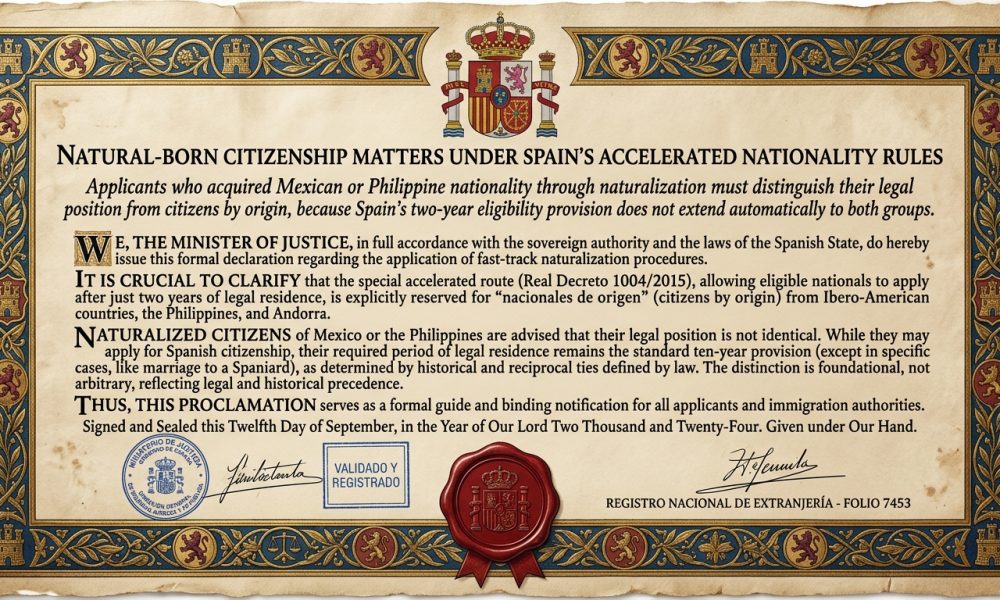
Applicants who acquired Mexican or Philippine nationality through naturalization must distinguish their legal status from citizens by origin, because Spain’s two-year eligibility provision does not automatically extend to both groups.
WASHINGTON, November 14, 2026: Americans holding Mexican or Philippine passports may see Spain’s two-year citizenship residence rule as a pathway to European Union nationality, but the applicant’s original citizenship status can matter more than the passport presented at the start of the process.
Spain’s Civil Code grants a reduced qualifying residence period to nationals of origin from specified countries, meaning an individual who acquired Mexican or Filipino nationality at birth can occupy a different legal position from someone who became a citizen through subsequent naturalization.
That distinction affects the earliest potential filing date, the records an applicant should collect, and whether a family can sensibly commit to relocation expenses. However, every successful application still requires legal residence, government review, and completion of formal nationality procedures.
Article 22 Establishes a Preferential Residence Threshold
Article 22 of Spain’s Civil Code ordinarily requires ten years of legal residence before naturalization. Still, it reduces that period to two years for qualifying nationals of origin from Ibero-American countries, Andorra, the Philippines, Equatorial Guinea, and Portugal, as well as specified Sephardic applicants.
The shortened period represents an 80 percent reduction in time before a qualifying application can be filed, not a promise that nationality will be granted two years after arriving or that an immigration permit can be skipped.
Spain also requires the relevant residence to be legal, continuous, and immediately before the application. At the same time,e the Ministry of Justice must consider good civic conduct and sufficient integration into Spanish society regardless of the applicant’s historical nationality connections.
Nationality of Origin Describes How Citizenship Was Acquired
For this provision, the expression national of origin refers to the applicant’s legal nationality history rather than appearance, ethnicity, language, ancestry estimates, or the mere existence of a currently valid passport issued by an eligible country.
A person who was Mexican by birth ordinarily has a stronger starting basis for the preference than someone who acquired Mexican nationality after being born a foreign national exclusively. However, Spanish officials must examine the documents and applicable law.
The same analysis applies to Philippine nationality, with the additional complication that natural-born Filipinos may later lose and lawfully reacquire citizenship, a process that should not be confused with an unrelated foreigner’s initial naturalization as a Filipino citizen.
Mexico’s Constitution Separates Birth and Naturalization
Article 30 of Mexico’s Constitution identifies Mexicans by birth separately from Mexicans by naturalization, recognizing birth on Mexican territory and certain overseas births to Mexican parents, including specified cases involving a parent who acquired Mexican nationality through naturalization.
That distinction means an individual born outside Mexico can still be Mexican by birth under the constitutional rules, so investigators should not reject a claim solely because the applicant’s actual birthplace appears on an American or another foreign birth certificate.
Conversely, an American who obtained a Mexican naturalization certificate later in adulthood generally should not present that event as making the person Mexican from birth, since the legal category of acquisition matters when presenting a proposed Spanish application.
A Mexican Passport Does Not Resolve the Original-Status Question
Mexican passports establish current travel-document status but ordinarily do not tell the full story of how nationality arose, so birth registration, a certified birth record, and any relevant nationality documents are more useful for determining whether Article 22’s original-nationality preference applies.
A dual American and Mexican citizen should check that names, birth dates, and parental details align across Mexican civil records, United States Identification, and Spanish immigration paperwork, particularly when the applicant’s nationality was documented well after the original birth.
Where the records are incomplete or contain discrepancies, the appropriate response is to obtain authentic supporting documents and a qualified interpretation of the governing law rather than assume that the most recently issued passport establishes every historical fact.
Philippine Law Recognizes Natural-Born Status at Birth
Under Philippine constitutional law, natural-born citizenship generally refers to people who were Philippine citizens from birth without needing to perform an act to acquire or perfect that citizenship, including many individuals born abroad to a qualifying Filipino parent.
An American-born individual with Philippine citizenship through a parent may therefore be natural-born Filipino even if a Philippine passport was requested many years after birth, provided the applicable rules and parentage evidence establish the status.
A foreign national who later obtained Philippine nationality through ordinary naturalization has a different legal history and should not be treated as having inherited citizenship at birth merely because both individuals ultimately possess Philippine passports.
Reacquisition Under Philippine Law Requires Special Care
Republic Act 9225 permits qualifying natural-born Filipinos who acquired foreign citizenship through naturalization to retain or reacquire Philippine citizenship through the prescribed oath and administrative process, creating a category distinct from foreigners first becoming Filipino through ordinary naturalization.
The Philippine Supreme Court has explained that lawful reacquisition under this statute does not erase the person’s natural-born character, because citizenship at birth is distinct from later changes in whether citizenship is actively held.
For Spanish applications, however, a former natural-born Filipino should submit records documenting birth status, any foreign naturalization, and lawful Philippine reacquisition, and obtain an individual assessment rather than assuming the Spanish authority must automatically accept every domestic Philippine classification.
Examples Show Why Similar Passports Produce Different Questions
Consider a hypothetical applicant born in Mexico who later became an American citizen while retaining Mexican nationality, compared with another American who first secured Mexican nationality by naturalization in middle age after a prolonged period overseas.
Both might hold genuine Mexican passports and establish legal residence in Spain. Still, the first applicant’s original nationality could support the shortened filing period, while the second must identify another valid statutory basis or confront the general rule.
A separate example involves a natural-born Filipino who later became American and completed lawful reacquisition of Philippine citizenship, whose documentary history should be distinguished from that of someone born solely American who later naturalized in the Philippines.
Spain’s Rule Is Not a New Mass-Citizenship Program
Misleading online claims have occasionally portrayed the Philippine preference as a recent government decision to grant nationality to millions of people, even though Article 22 establishes a longstanding application route with individual legal and procedural requirements.
In a September 2026 fact-check, the Spanish news agency EFE rejected claims of an announced mass grant of Spanish citizenship to three million Filipinos, explaining that existing procedures still govern lawful nationality acquisition.
The report reminds readers that the two-year period is a threshold for eligible residents to apply, not a waiver of immigration controls, identity verification, or the separate government decision required before anyone becomes Spanish.
The Residence Clock Requires Genuine Immigration Status
Even an unquestionably natural-born Mexican or Filipino citizen must obtain lawful Spanish residence under an appropriate immigration category, because tourist admission, a property purchase, or a registered address alone cannot safely be counted as the qualifying residence contemplated by Article 22.
Depending on personal circumstances, the route might involve authorized employment, family-based residence, non-lucrative permission supported by adequate resources, or another qualifying category, with different rules governing work, insurance, dependents, renewals, and the ability to sustain a genuine household in Spain.
A student authorization or other temporary stay should not automatically be treated as nationality-qualifying residence without reviewing its legal classification, because the distinction may alter the period an applicant needs before submitting a naturalization file.
A person who does not qualify for the two-year preference may still consider the ordinary ten-year route or another available statutory exception. Still, neither alternative should be presented as an automatic substitute for nationality of origin.
Continuity Depends on Real Life in Spain
Applicants with professional or family obligations in the United States, Mexico, or the Philippines should assess how extended travel could affect the continuous residence requirement, rather than assuming a residence card remains sufficient regardless of actual presence.
Spanish authorities may examine travel histories, immigration renewals, and the reality of an applicant’s home in Spain; reliable records of residence and a clear explanation of unavoidable absence can help during the eventual nationality review.
Someone who principally resides abroad while maintaining a Spanish lease cannot safely treat the arrangement as equivalent to a genuine two-year residence history, especially when entries and departures reveal substantial absences from the country.
Language Exemptions Depend on a Different Classification
Spain’s integration process ordinarily includes the DELE A2 Spanish-language examination and a separate CCSE assessment of constitutional and sociocultural knowledge, with officially recognized exemptions or dispensations available to applicants who meet specified conditions and provide the required supporting evidence.
Instituto Cervantes generally exempts nationals of origin from Spanish-speaking countries from the DELE requirement, which can help qualifying Mexican applicants. Still, the exemption does not automatically excuse the separate CCSE examination for adults.
Filipino applicants ordinarily should anticipate the DELE language assessment despite the two-year residence preference, showing why being named in Article 22 and receiving a language-test exemption are legally distinct benefits with different requirements.
Civil Records Must Tell a Consistent Nationality Story
An organized application should include the appropriate birth certificate, Identification, and proof of original nationality, along with lawful residence records and any required evidence of marriage, name changes, adoption, foreign naturalization, or citizenship reacquisition.
For dual nationals, inconsistencies between American, Mexican, or Philippine documents can raise questions about identity and nationality history, so obtain translations, apostilles, and official corrections according to the receiving authority’s precise requirements.
An especially useful chronology identifies the nationality actually held on the date of birth, subsequent naturalizations, any recognized loss or reacquisition, and the dates on which Spanish residence authorization began or was renewed.
Applicants should not rewrite certificates or omit an inconvenient prior nationality event, because accurate disclosure and traceable civil records are more defensible than an apparently simplified narrative that fails when the Spanish government compares underlying documents.
Good Conduct and Integration Still Require Independent Review
The preferential residence period does not remove the statutory good-conduct requirement, and applicants may need criminal-history certificates and other records demonstrating circumstances relevant to the Ministry of Justice’s consideration of an individual naturalization request.
People who have lived in several countries should confirm which official background documents are required, disclose material matters accurately, and avoid treating a successful immigration approval as proof that a later nationality decision is guaranteed.
Similarly, applicants must obtain examination certificates or authorized exemptions as prescribed by Spain, because fluency in Spanish or a documented family connection cannot substitute for every part of the government’s integration assessment.
American Dual Nationals Face Separate Responsibilities
An American who also qualifies as a Mexican or Philippine national of origin should consider the laws of every country involved, since obtaining Spanish citizenship does not terminate existing American nationality or eliminate ongoing legal responsibilities.
The U.S. State Department’s guidance on dual nationality explains that American citizens holding another nationality must use their United States passports when entering and departing the country, even when they possess valid foreign travel documents.
Applicants should also assess applicable taxation, reporting requirements, and consular Protection limitations independently, rather than assume a Spanish passport automatically resolves cross-border financial obligations or guarantees unrestricted residence for relatives who are not Spanish citizens.
Spain’s Renunciation Exception Requires Separate Attention
Article 23 of Spain’s Civil Code sets out nationality-conferral formalities, including the ordinary declaration concerning previous nationality, while exempting specified categories associated with Ibero-American countries, the Philippines, and other named states from that declaration.
The exemption deserves careful review for individuals holding three nationalities because Spanish law and the legal consequences imposed by other countries are not identical, and no single government controls every aspect of nationality retention.
A Filipino who regained Philippine citizenship through Republic Act 9225 should therefore assess both the Spanish paperwork and Philippine legal consequences. At the same time, a Mexican-American applicant should distinguish Spanish registration requirements from obligations under Mexican and United States law.
Approval Follows the Filing Threshold Rather Than Replacing It
Completing two qualifying years generally allows a person covered by the exception to apply. However, the government may still review the file, request additional evidence, and issue a decision only after completing the necessary administrative process.
Following a favorable resolution, applicants ordinarily must fulfill the oath or promise and civil-registration requirements within the applicable statutory period, including the 180-day deadline for prescribed concluding formalities following notification of the grant.
Only after nationality is properly acquired can an individual pursue Spanish identity and passport documents, so families should avoid describing residence eligibility, a pending application, or an approval notice as an already issued European Union passport.
Families Need Individual Assessments for Every Member
A Mexican parent qualifying by origin, a Filipino spouse who later acquired nationality, and an American-born child may have different immigration and eventual naturalization options, even if they live together and share relocation expenses.
Dependents may need family reunification authorization; children may qualify through separate nationality procedures after a parent becomes Spanish, and spouses can face distinct residence thresholds, meaning one successful application does not automatically settle every relative’s legal status.
Planning should therefore address schooling, medical coverage, work authorization and travel documents for the whole family, rather than build a household’s European future around an unverified assumption about the principal applicant’s citizenship history.
A Legal Assessment Should Precede Major Relocation Costs
The most useful preliminary investigation establishes whether the applicant possessed Mexican or Philippine nationality from birth, identifies any later loss or reacquisition, and determines which Spanish residence category could realistically support a future citizenship application.
Readers comparing lawful international mobility approaches may consult Amicus International Consulting’s second-passport services for general planning information. At the same time, residence permissions, nationality grants and passport issuance remain exclusively within competent government authorities responsible for applying Spanish law.
An adviser should explain what evidence supports a two-year exception, what facts remain unresolved, and which expenses depend on government procedures, without promising that a passport or a recent naturalization certificate overrides the actual statutory test.
Original Citizenship Is a Legal Fact, Not a Marketing Label
Spain’s accelerated route can offer meaningful opportunities to qualifying Mexican and Filipino nationals, including some Americans with dual citizenship. Still, the advantage depends on original nationality and genuine residency, not the number of passports collected.
The Philippine distinction between natural-born status and later reacquisition, alongside Mexico’s constitutional separation of citizenship by birth and naturalization, demonstrates why applicants need an accurate history before committing to a particular Spanish eligibility timetable.
For families evaluating the prospect in 2026, careful records, lawful residence, and individualized legal analysis provide a firmer foundation than assertions that every Mexican or Philippine passport automatically unlocks Spanish citizenship after two years.
Verified: 2,277 prose words, 62 sentences, a minimum of 33 words per sentence, and exactly three contextual hyperlinks: one news source, one U.S. government source,e and one Amicus International Consulting page.




