
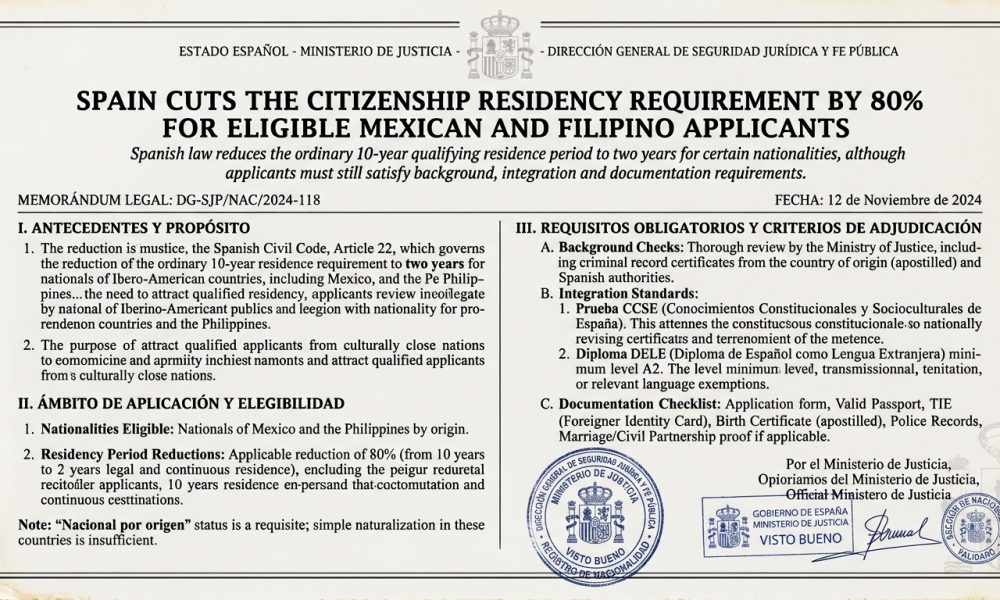
Centuries-old connections between Spain, Latin America and the Philippines continue to influence modern nationality legislation, giving certain nationals by origin preferential treatment when seeking Spanish citizenship through lawful residence and government naturalization procedures.
WASHINGTON, November 14, 2026: Spain’s citizenship law still reflects relationships formed across centuries of empire, migration and shared language, allowing eligible nationals of many Ibero-American countries and the Philippines to seek naturalization after two years of qualifying residence instead of the usual ten.
The preference established by Article 22 of Spain’s Civil Code also reaches several other explicitly named groups. Still, its historical background does not convert cultural ancestry, a Spanish surname or a foreign passport into an automatic entitlement to citizenship.
For applicants considering a second European nationality in 2026, the practical challenge is to establish the correct nationality-of-origin status, secure genuine legal residence and satisfy the separate character, integration and documentation requirements that continue after the shortened qualifying period.
A Modern Citizenship Rule Reflects a Much Older History
Spain’s colonial administration once connected territories across the Atlantic and Pacific, leaving enduring legal, linguistic and cultural relationships that modern nationality legislation recognizes in a limited and specifically defined preference for certain foreign nationals.
The independence of Latin American republics during the nineteenth century and the end of Spanish rule in the Philippines in 1898 did not erase those connections. However, the modern citizenship law should not be confused with a general restoration of former imperial nationality.
Rather than automatically recognizing descendants of every person once governed by Spain, the current statute rewards qualifying legal residence by shortening the period before a person can apply, while preserving the government’s authority to evaluate individual circumstances.
Article 22 Sets the Basic Ten-Year and Two-Year Framework
Article 22 ordinarily requires ten years of legal residence for Spanish naturalization. Still, it permits an application after two years for nationals of origin of Ibero-American countries, Andorra, the Philippines, Equatorial Guinea or Portugal, and for qualifying people of Sephardic origin.
That difference amounts to an 80 percent reduction in the minimum residence period, not an 80 percent reduction in examination requirements, government processing, family relocation costs, or the time needed to obtain a Spanish passport.
The legislation also requires legal, continuous residence immediately preceding the application. At the same time,e applicants must establish good civic conduct and sufficient integration into Spanish society rather than relying solely on a qualifying nationality.
Ibero-American Citizenship Is a Legal Category, Not a Genealogy Label
The statute’s reference to Ibero-American countries primarily concerns the nationally defined group of countries connected with Spanish and Portuguese linguistic and historical traditions. Still, applicants must confirm how the relevant Spanish authority classifies their country and nationality.
Countries such as Mexico, Colombia, Peru, and Argentina can provide the basis for the reduced period when the person possesses the qualifying nationality of origin. In contrast, a distant family connection to those places is not an equivalent legal credential.
Using the broader phrase Latin America in popular reporting can obscure meaningful legal distinctions, because the geographical region includes different colonial histories and nationality systems that should never be assumed to fit the Spanish statutory category automatically.
The Philippines Is Named Despite Its Different Linguistic Present
Article 22 explicitly includes the Philippines, reminding us of the archipelago’s history under Spanish rule and the relationship that persisted after the country left Spanish colonial administration in the late nineteenth century.
Modern Filipino applicants do not need to establish Spanish ancestry to invoke this residence preference. Still, they must demonstrate qualifying Philippine nationality of origin and comply with the same lawful residence and naturalization rules applied to other applicants.
Because the Philippines is not generally treated as a Spanish-speaking country for the ordinary examination exemption, many eligible Filipino nationals must establish Spanish-language proficiency even though their nationality receives the shortened residence threshold under the Civil Code.
Equatorial Guinea Adds an African Dimension to the Policy
Equatorial Guinea’s inclusion illustrates that the historical connections recognized by the statute extend beyond Latin America and Asia, reflecting the country’s period under Spanish colonial rule before independence in 1968 and subsequent nationality relations.
Its express mention in the law means that the reduced residence period cannot be described accurately as a benefit limited to Latin Americans and Filipinos. However, individual applicants still must meet the nationality and residence conditions governing their particular cases.
The history of Spanish-speaking communities in Africa also challenges any simplified narrative that the preference follows geography alone, since the statute identifies particular national and historical connections rather than everyone with a connection to the Spanish language.
Portugal and Andorra Show Why Colonial History Is Not the Whole Explanation
Portugal and Andorra also appear in the two-year provision. However, neither country should be portrayed as a former Spanish colony merely because its nationals share a preferential residence category with citizens of former Spanish territories.
Their inclusion demonstrates that Article 22 reflects a broader legislative choice concerning particular neighbors and historical relationships, alongside provisions for people of Sephardic origin, rather than a single mechanical rule derived from empire.
This distinction is essential for accurate reporting, since placing the entire group under a colonial label could misrepresent both the law and the varied identities of the people who may seek Spanish nationality through its shorter route.
Sephardic Origin Is Recognized Through a Separate Legal History
The Civil Code also refers to qualifying Sephardic applicants, reflecting historical connections to Jewish communities expelled from Spain in 1492 and later efforts by the Spanish state to acknowledge that legacy through nationality law.
That historical connection has its own legal requirements and evidentiary questions, which should not be collapsed into a claim that anyone with Spanish ancestry can qualify for the same abbreviated residence period without demonstrating the proper statutory category.
Applicants should distinguish the ongoing two-year residence provision from the separate special nationality procedure established in 2015 for eligible Sephardic descendants, because those initiatives have different legal histories, application windows and filing requirements for affected families.
Nationality of Origin Can Decide Which Residence Period Applies
The term nationals of origin matters because someone who acquired Mexican or Filipino citizenship at birth may be treated differently under this provision than someone who acquired the same nationality later through an ordinary naturalization process.
An American who is Mexican by birth and also holds United States citizenship may therefore have an available argument for the two-year category, provided the original Mexican nationality is established, and Spanish authorities accept the relevant documentation.
A person who became Mexican solely through later naturalization should not assume that the same result follows from presenting a Mexican passport, since legal classifications depend on the manner of acquisition and the current Spanish statutory requirements.
Original Nationality May Survive a Later Foreign Naturalization
The facts matter most for people born Filipino and later naturalized as Americans, because Philippine law provides procedures for qualifying natural-born Filipinos to retain or reacquire nationality in circumstances that require documentary verification.
Such an applicant should trace Philippine nationality from birth, subsequent changes in citizenship and any legally effective reacquisition, rather than assume that a recent passport or oath document alone proves every fact relevant to Spanish nationality-of-origin classification.
People holding several citizenships should also ensure their immigration and nationality records identify them consistently, since conflicting names or unexplained citizenship histories can create administrative questions even where the underlying personal status is genuine.
A Residence Permit Must Precede a Valid Citizenship Clock
The shorter period is not permission to obtain Spanish citizenship through tourism, because entering Spain for a brief visit, purchasing property or registering an address does not itself establish the legal residence required for naturalization.
Applicants ordinarily must qualify for an appropriate immigration authorization based on employment, family circumstances, independent resources or another lawful category, then maintain the status necessary for the residence period recognized by nationality authorities.
The difference also matters for students and other temporary visitors, whose authorized stays may be classified differently from qualifying residence. It therefore cannot automatically be added to the two-year calculation without examining their exact immigration status.
Continuous Residence Demands Genuine Ties to Spain
Spanish law requires the qualifying period to be continuous and immediately before the application, creating practical difficulties for people who plan to keep their primary household in another country while visiting Spain periodically.
A rental agreement and an unexpired residence card may be relevant evidence. Still, authorities can also examine travel histories and actual residence circumstances when determining whether the required connection was maintained throughout the statutory period.
Applicants should document lawful renewals, housing, and meaningful presence, and seek individualized advice about absences instead of relying on unsupported claims that every nationality applicant may spend the same number of days abroad without consequences.
Language and Civic Knowledge Remain Separate Obligations
Spain ordinarily uses an approved DELE language examination and the CCSE constitutional and sociocultural knowledge examination to assess integration. However,h recognized exemptions or dispensations may apply based on an applicant’s documented circumstances and the specific rules governing their application.
Nationals of origin of Spanish-speaking countries, including qualifying Mexicans, are generally excused from the DELE language examination. Still, that exemption does not automatically excuse the separate civic knowledge assessment required of many adults.
Filipino applicants should prepare for the language requirement unless they have another accepted basis for exemption, illustrating how the same two-year statutory residence advantage can involve different practical preparation for applicants from different countries.
Civil Documents Must Support the Nationality Claim
Applicants should expect to provide official birth and identity records, documentation establishing lawful Spanish residence, and other prescribed materials relevant to their circumstances, including records of earlier marriages, name changes, or nationality restoration where those events occurred.
Foreign certificates may require apostilles or other legalization and translations by authorized professionals. At the same time, resolve inconsistencies across passports, civil registrations, and residence cards through legitimate registry procedures rather than editing them informally or disregarding them without explanation.
The most useful preliminary review establishes whether the person qualifies for Article 22’s shortened period before substantial money is spent on archival retrieval, immigration planning, or preparing documents that cannot establish the required legal category.
Background Checks Still Apply Under the Shorter Rule
Applicants must demonstrate good civic conduct, and Spanish authorities may review criminal records and other relevant information from the applicant’s history when making a final nationality determination rather than treating the residence anniversary as automatic approval.
Someone who has lived in Mexico, the Philippines, and the United States should check which official certificates and explanations the specific application requires, because the applicant’s nationality does not necessarily define the entire relevant residence history.
A pending legal issue or inconsistent personal record should be addressed through qualified advice and accurate disclosure. At the same time,e private intermediaries should never promise that a special historical preference exempts applicants from ordinary government scrutiny.
Recent Statistics Show the Policy’s Contemporary Relevance
Spain recorded 299,732 acquisitions of Spanish nationality among residents during 2025, an increase of 18.7 percent from 2024, according to official figures released by the National Statistics Institute in May 2026 for that reporting year.
In Agence France-Presse reporting published by The Local, journalists highlighted the prominence of Latin American nationalities among recipients and the continuing significance of Spain’s shorter residence threshold for many people from those countries.
Those statistics describe completed acquisitions through several mechanisms, not approval rates for every Article 22 applicant or a guarantee that Mexican and Filipino families will receive nationality within two calendar years of arriving in Spain.
The Historical Preference Does Not Eliminate Administrative Waiting
A qualifying person can generally apply after completing the reduced residence period. However, the Ministry of Justice must still review the file and issue a decision, which may require clarification or additional documentation.
Successful applicants must also complete the prescribed oath or promise and civil registration requirements within the applicable period after notification. Therefore, a favorable preliminary decision does not automatically mean you hold a valid Spanish passport.
The legal framework provides 180 days to complete specified concluding requirements after notification, so careful monitoring of official communications is especially important once an applicant has already invested in the residence process.
Dual Nationality Is Another Legacy of the Special Relationship
Spain generally exempts qualifying nationals of Ibero-American countries, Andorra, the Philippines, Equatorial Guinea and Portugal from its ordinary requirement to declare renunciation of previous nationality, subject to the applicable legal provisions and individual circumstances.
That Spanish exception can help families preserve established citizenship connections. Still, it does not determine how another country treats foreign naturalization or whether an individual must complete a separate retention or reacquisition procedure.
The U.S. State Department’s guidance on dual nationality explains that Americans may hold additional nationalities while remaining subject to relevant U.S. obligations, including using an American passport to enter and depart the country.
European Union Rights Begin Only After Spanish Citizenship Exists
A successful Spanish naturalization also makes the person a European Union citizen, providing rights to move, reside, and work in other member states under the applicable European framework rather than merely extending short-stay travel permission.
Those opportunities may support education, employment, and family relocation plans across Europe. However, professional qualifications, local residence registration, health coverage, and the status of noncitizen relatives may still require separate consideration after Spain issues a passport
Families should therefore value the legal rights associated with citizenship while planning responsibly for actual residence in Spain, because the journey involves ordinary housing, financial and personal commitments well before European Union nationality can be established.
Spouses and Children May Face Different Legal Paths
The two-year preference applies to an eligible individual, not automatically to every spouse or child, and each relative’s nationality, age, parentage, and immigration status may change the applicable procedure.
A household with a Filipino parent, a Mexican spouse and American-born children should evaluate each person’s rights independently, alongside any family residence options and later citizenship-by-option rules that may become relevant after naturalization.
Children’s school enrollment, health insurance and travel documents should be planned during the residence stage, since a future parental passport does not excuse present compliance with immigration and civil-registration requirements for the rest of the household.
Historical Connections Should Be Reported Without Promising Outcomes
Article 22 demonstrates how older relationships can influence today’s nationality policy. Still, its preferential treatment is a defined statutory exception rather than a blanket judgment about identity, ancestry, or the relative worth of different immigrant communities.
A credible explanation should acknowledge both the historical roots and the continuing administrative controls, especially when promotional materials overstate the benefit as a guaranteed passport after two years without genuine relocation or government review.
For applicants considering lawful mobility strategies, Amicus International Consulting’s second-passport services offer a way to explore documentation and planning questions, while Spanish authorities alone decide residence permissions, naturalization applications, and official passport issuance.
The Central Advantage Is an Earlier Opportunity to Apply
Spain’s Article 22 remains a distinctive example of historical relationships shaping modern citizenship law, offering eligible nationals of origin from named countries a shorter qualifying residence period while leaving ordinary legal safeguards firmly in place.
The provision’s practical value rests on real residence, documented original nationality, civic integration and successful completion of government procedures, not merely on a Spanish-language surname, a family narrative or residence purchased on paper.
For Mexican, Filipino and other qualifying applicants evaluating Europe in 2026, the historical connection can open the door to an earlier naturalization application, but only lawful eligibility and official approval can turn that opening into Spanish and European Union citizenship.




