
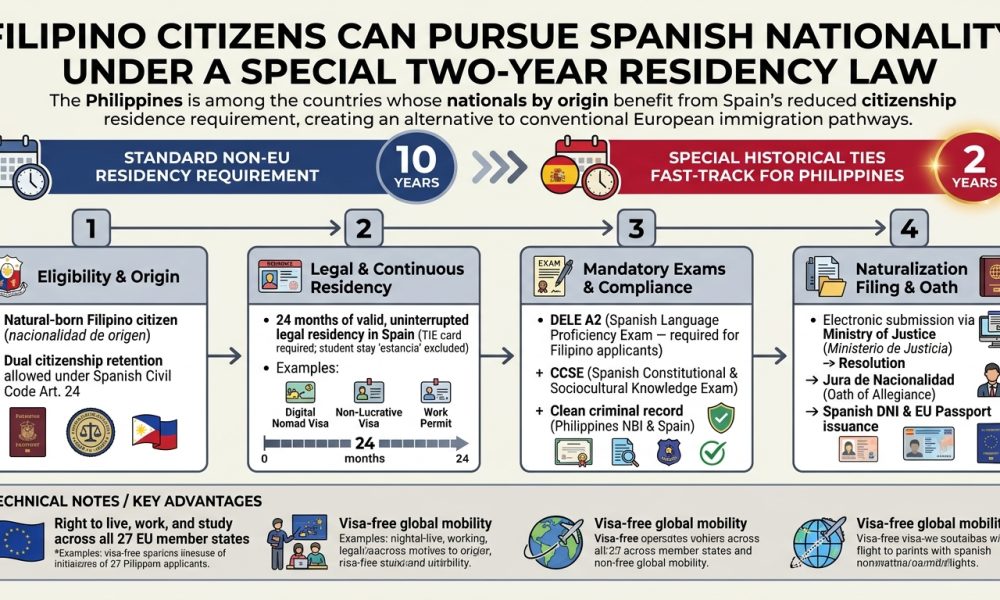
The Philippines is among the countries whose nationals by origin benefit from Spain’s reduced citizenship residence requirement, offering an alternative to conventional European immigration pathways while preserving key requirements involving immigration status, language proficiency, and official approval.
WASHINGTON, November 14, 2026: Filipino citizens considering a long-term future in Europe have a distinctive opportunity under Spanish nationality law, which allows eligible Philippine nationals by origin to apply for Spanish citizenship after two years of qualifying legal residence rather than the general ten-year period. The provision does not grant a passport immediately, excuse immigration formalities, or guarantee approval after two years, because naturalization remains subject to government review of residence continuity, identity, civic conduct, and integration. For families weighing an eventual European Union base, the key questions are how Philippine nationality was acquired, which Spanish residence authorization applies, and whether all administrative requirements can be met without disrupting work or family life.
A Historical Relationship Has a Modern Legal Consequence
Article 22 of Spain’s Civil Code sets the ordinary residence requirement for naturalization at ten years. Still, it reduces it to two years for nationals of origin of Ibero-American countries, Andorra, the Philippines, Equatorial Guinea and Portugal, as well as eligible people of Sephardic origin. The inclusion of the Philippines reflects the countries’ long historical relationship. Still, the statute creates a legal eligibility category rather than a blanket privilege allowing every Filipino passport holder to receive European citizenship without relocating. Spain’s public administration guidance, updated in April 2026, further confirms that legal residence must be continuous and immediately precede the application, and that applicants must also demonstrate good civic conduct and sufficient integration into Spanish society.
Nationality by Origin Is the First Question
The shortened period applies to Philippine nationals by origin, so it is necessary to distinguish people who acquired Philippine citizenship at birth from those who obtained it through ordinary naturalization later in life. Philippine nationality by birth may arise through a qualifying Filipino parent even when a child was born overseas, so a foreign birthplace should not automatically be taken as evidence that the applicant lacks original Philippine citizenship. Conversely, an individual who became Filipino only through naturalization should not assume that a newly issued Philippine passport satisfies Spain’s nationality-of-origin language, regardless of the document’s validity for international travel, even when both nationalities are legally documented.
Former Filipinos Who Reacquired Citizenship Need Individual Review
The Philippines’ Citizenship Retention and Reacquisition Act (RA 9225), commonly called the Citizenship Retention and Reacquisition Act, permits qualifying natural-born Filipinos who became foreign citizens to retain or reacquire Philippine citizenship by following the prescribed oath and administrative procedures. A former Filipino who regained nationality after becoming an American or another foreign citizen should establish the original birthright status and the legal history of reacquisition on the Spanish two-year provision. Because several countries’ nationality laws may apply to the same person, reacquisition should be reviewed alongside the birth certificate and existing passports rather than treated as automatic proof of how Spanish authorities will classify the applicant.
Residence Permission Must Come Before the Nationality Clock
A Philippine citizen ordinarily needs lawful Spanish immigration authorization before building a residence period that supports naturalization, and tourist visits, property ownership, or a local bank account do not independently establish that status. Residence may be available through an authorized work arrangement, qualifying family relationship, non-lucrative category, or another immigration route. Still, each option has distinct conditions to review before leaving the Philippines. Spanish government guidance distinguishes qualifying immigration residence permits from other authorized periods of stay, so applicants must verify when their residence legally began rather than adding every day spent physically in Spain to the two-year calculation.
Non-Lucrative Residence Requires Financial Preparation
A non-lucrative residence authorization may suit Filipinos with adequate savings or qualifying independent income, but it requires proof of financial means, appropriate insurance, and compliance with restrictions on working. People who intend to work for pay or do regular remote professional activity should not assume a non-lucrative residence permit authorizes those activities just because the income comes from an overseas company, without specific permission under Spanish immigration rules. Families should match the correct immigration category, financial obligations, and renewal requirements to their intended lifestyle, since obtaining an initial residence permit without maintaining lawful status can undermine a later citizenship strategy, including during the subsequent examination period.
Student Stays and Short Visits Create Different Issues
Enrollment at a Spanish university may offer educational opportunities. Still, a student authorization can be classified as a stay rather than residence for nationality purposes, making automatic inclusion in the two years unsafe. A Filipino graduate planning eventual naturalization should investigate whether and when a change to qualifying residence status is necessary, including the immigration requirements for employment after study, before arranging a permanent move or employment contract. Likewise, repeated visits under short-stay arrangements cannot simply be combined into two years of residence, because nationality law requires a legal residential connection immediately preceding the application rather than accumulated tourism, no matter how frequently those visits occur during a year.
Continuity Requires Genuine Residence, Not Only Paperwork
The legal requirement for continuous residence means families working across Manila, Madrid, and other cities should document their actual presence, authorized immigration status, and travel carefully rather than rely exclusively on an unexpired card. Prolonged absences or a pattern suggesting an applicant’s home remained predominantly elsewhere can raise questions during examination, even when a rental contract and municipal registration confirm Spain, particularly if travel records contradict the claimed residence. Because the circumstances of absences matter, advisers should avoid promising a universally safe number of days outside the country and instead review official guidance against each family’s residence history, supported by travel and immigration records.
Filipino Applicants Generally Must Demonstrate Spanish Proficiency
Spain’s standard integration procedure includes the DELE examination at level A2 or higher, designed to show basic Spanish-language competence, unless the applicant qualifies for a recognized exemption or already holds accepted proof, under the applicable examination regulations. Although the Philippines receives the preferential two-year nationality period, it is not generally included among the Spanish-speaking countries whose nationals by origin are automatically excused from the DELE language examination, despite the countries’ long cultural relationship. Filipinos familiar with Spanish vocabulary or family traditions should therefore plan formal language preparation rather than assume that colonial history, the presence of Spanish-derived words in Philippine languages, or personal conversational ability replaces the examination requirement.
A Separate Civics Examination Also Matters
Most adult applicants must also complete the CCSE examination administered by Instituto Cervantes, which addresses Spain’s constitutional arrangements, institutions, and social and cultural life rather than measuring conversational Spanish alone, under the ordinary adult examination requirements. Exemptions and accommodations may be available in particular documented circumstances, including some educational or disability-related situations. Still, applicants should obtain the required official recognition before relying on any dispensation, supported by records accepted under the applicable procedure. Completing examination preparation during the residence period can help prevent a missing certificate from becoming an avoidable obstacle when the applicant reaches the statutory two-year threshold and prepares the formal nationality filing, under the current filing guidelines.
Birth Records and Name Consistency Can Delay Applications
Philippine birth records, passports, marriage certificates, and Spanish residence documents should present a consistent identity, because differences in spelling, parental names, or dates can prompt officials to request additional evidence before proceeding during the formal nationality review process. Applicants may need an appropriately issued Philippine civil certificate, criminal-record documentation, and authenticated or translated records, depending on the Ministry of Justice requirements governing their individual circumstances and the relevant certification or legalization standards. Where names changed through marriage, court proceedings, or other legally recognized events, a complete chain of authentic supporting documents provides a stronger basis for review than informal explanations or altered certificates, especially across different national civil registry systems.
Good Civic Conduct Is More Than a Formal Declaration
Spanish naturalization law also requires applicants to demonstrate good civic conduct, including reviewing relevant criminal-record information and other materials that may bear on whether the legal standard has been satisfied in the applicant’s specific case. A Filipino applicant who has lived in the United States or several other countries should confirm which records are required and disclose relevant facts accurately rather than presume that one certificate from the Philippines covers every period of residence. Completing two years of lawful residence does not override this independent assessment, and professional assistance should focus on accurate documentation rather than promises that officials will disregard material adverse information during an official eligibility assessment.
A 2026 Fact-Check Challenged Misleading Claims
In September 2026, the Spanish news agency EFE debunked viral claims about mass citizenship grants to Filipinos, finding no evidence that Spain planned to naturalize three million Philippine nationals as an electoral measure. The agency explained that Filipino applicants remained subject to the existing two-year legal residence rule and ordinary nationality procedures, underscoring the difference between a longstanding statutory preference and an alleged new mass-approval program. Its reporting also cited an official population figure of approximately 37,000 Filipinos in Spain, which illustrates why sweeping social-media claims about millions of instant new citizens should not guide individual immigration decisions.
Government Approval May Take Longer Than Two Years
An eligible applicant reaches the legal threshold to file after completing two years of qualifying residence. However, the Ministry of Justice must still examine the application and issue a decision through its established process. Requests for updated evidence, record inconsistencies, and administrative backlogs can delay resolution beyond the residence anniversary, making the advertised two-year route an eligibility milestone rather than a guaranteed passport delivery schedule, even for otherwise eligible applicants. Applicants should budget for continued lawful residence and ordinary living expenses during processing, and avoid irreversible employment or travel commitments based on an expected approval date not confirmed by the responsible authority.
The Oath and Civil Registry Are Separate Final Steps
After a favorable decision, the applicant ordinarily must complete the required oath or promise of allegiance to the King and obedience to Spain’s Constitution and laws, together with the necessary civil registration, within the applicable legally prescribed period. Spanish legislation sets a 180-day deadline after notification to complete the relevant concluding requirements. Hence, monitoring official communications remains important even after a lengthy application has been approved and before the statutory period expires. Only after the nationality acquisition is properly completed and registered can the new citizen proceed to Spanish identity and passport documentation, which should not be conflated with an application receipt or preliminary eligibility opinion.
Spanish Law Offers Filipinos a Previous-Nationality Exception
Spain ordinarily requires many naturalization applicants to declare renunciation of their earlier nationality, but its Civil Code exempts qualifying nationals of the Philippines and other specified historically connected countries from that Spanish declaration. This exception can make Spanish citizenship attractive to Filipino families. However, the Spanish government’s position does not independently settle whether Philippine law treats foreign naturalization as affecting Philippine nationality, or determines the effect of later reacquisition. The Embassy in Madrid describes the retention and reacquisition of citizenship as applicable to qualifying natural-born Filipinos under Republic Act 9225, making Philippine legal advice and consular documentation relevant before assuming that both citizenships will remain effective automatically.
Americans of Philippine Origin May Have a Further Layer
Some prospective applicants are natural-born Filipinos who later acquired United States citizenship. In contrast, others obtained American citizenship at birth through a parent or birthplace and maintained a separate Philippine nationality claim, which requires separate documentation in each country. The United States State Department’s dual-nationality guidance explains that Americans can hold more than one citizenship and ordinarily must use a United States passport when entering or leaving the United States, including journeys involving another valid passport. Such applicants still need separate assessments of Spanish qualification, Philippine retention or reacquisition, and American reporting obligations, since a new European passport does not erase obligations owed under another country’s laws after acquiring Spanish citizenship.
Children and Spouses Need Their Own Legal Routes
A Filipino parent who eventually becomes Spanish does not automatically confer Spanish nationality on every spouse and child, because the family members’ birth dates, ages, residence histories, and legal relationships can trigger different immigration or nationality provisions. Some children may obtain nationality by option or through other procedures available after a parent’s naturalization. At the same time, spouses may need family residence arrangements or a qualifying residence history before naturalization becomes possible, subject to each applicable statutory requirement. Families should therefore examine school access, health care, employment permission and civil documentation for every household member rather than base the entire relocation plan on one adult’s shortened statutory eligibility period, when comparing different household citizenship outcomes.
A Spanish Passport Opens European Rights, Not Unlimited Exemptions
Once Spanish nationality is lawfully acquired, the individual also becomes a citizen of the European Union, bringing rights to move, reside and work in other member states under the conditions established by European legislation. This can expand opportunities for Filipino professionals, students, and families beyond Spain itself. However, professional licensing, residence registration, social benefits, and local administrative requirements may still need separate attention, even for fully documented Spanish nationals. The ability to live elsewhere in Europe is therefore a substantial potential benefit of successful naturalization. Still, it does not guarantee that the applicant or noncitizen relatives can disregard every destination country’s applicable procedures.
A Credible Plan Connects Immigration, Finance and Evidence
Before relocating, applicants should establish their Philippine nationality of origin, choose an immigration category that fits their intended activities, and calculate whether their savings or earnings can sustain actual residence throughout the application and processing periods. They should also map language preparation, exam dates, civil records, criminal-record requests, and family immigration requirements, ensuring they identify any documentary or financial issues before they threaten continuity of residence during the application and any subsequent review. People exploring lawful second-nationality strategies can consult Amicus International Consulting’s second-passport services for general planning context. At the same time, government agencies retain authority over all Spanish residence permissions, naturalization decisions, and official passports.
The Two-Year Advantage Requires a Real Commitment to Spain
For eligible Filipinos by origin, the special residence period is a meaningful legal advantage compared with the standard ten-year route. Still, it does not eliminate the need to live lawfully in Spain, satisfy examinations, and secure official approval. Applicants who document their original citizenship, maintain continuous residenc and preparere genuine evidence of integration can approach the process with realistiexpectations rather than relying ongn advertising that promises a European passport after a nominal two-year stay. As families evaluate second citizenship in 2026, the most defensible conclusion is that Spain offers a defined opportunity for qualifying Filipinos, while the route’s actual success depends on compliance with both immigration and nationality law.




