
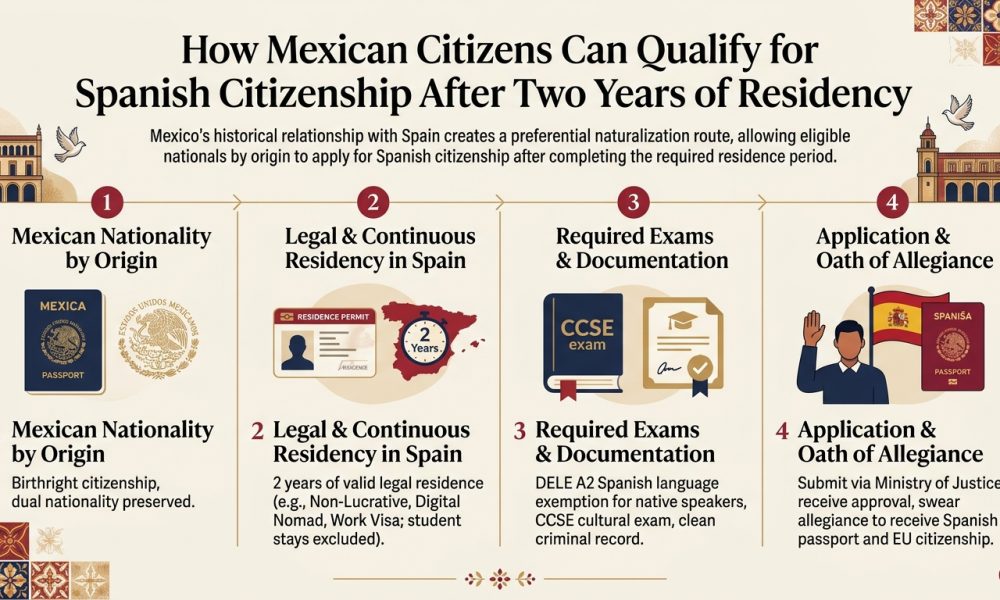
Mexico’s historical relationship with Spain creates a preferential naturalization route, allowing eligible nationals by origin to apply for Spanish citizenship after completing the required residence period.
WASHINGTON, November 14, 2026: Mexican citizens considering a permanent move to Spain may qualify to apply for Spanish nationality after two years of legal residence, a preferential period substantially shorter than the general ten-year requirement for many other foreign nationals. Rooted in the nationality provisions of Spain’s Civil Code and its historical relationship with Ibero-American countries, this pathway can ultimately provide a Spanish passport and European Union citizenship. Still, neither result follows automatically from holding a Mexican passport. Applicants must first prove qualifying Mexican nationality by origin, obtain an appropriate Spanish residence authorization, maintain the required continuous residence, and meet separate administrative standards before the government can issue a final naturalization decision.
Spain’s Civil Code Establishes the Two-Year Preference
Article 22 of Spain’s Civil Code generally requires ten years of lawful residence before an applicant can seek nationality through naturalization. Still, it reduces the qualifying period to two years for nationals of origin from Ibero-American countries and certain other specified categories. Mexico falls within that Ibero-American framework, alongside countries such as Colombia, Argentina, and Peru, reflecting a legally defined preference rather than a special passport-purchase arrangement or a guarantee based on cultural affinity. Spain’s Ministry of Justice specifies that residence must be legal, continuous,s and immediately preceding the application for nationality, and that the applicant must also demonstrate good civic conduct and adequate integration into Spanish society under the current legal framework.
Nationality by Origin Is Not the Same as Later Naturalization
The words nationals of origin are especially important for Americans who have acquired Mexican citizenship, because Spanish law does not simply promise the shorter waiting period to every individual presenting a current Mexican passport at a consular appointment. A person Mexican by birth, including someone who also holds American citizenship, may fit the relevant nationality category. In contrast, an American who became Mexican through subsequent naturalization cannot safely assume that the same exception applies. Birth certificates, civil registration records and official Mexican citizenship documentation may help establish the original status, particularly where an applicant has changed names, held multiple passports or reacquired nationality after an earlier legal event. A Mexican passport is strong evidence of present nationality. Still, the documented legal history of how that nationality was acquired remains essential when the Spanish authority evaluates a claim to the preferential two-year residence period.
The Two-Year Clock Depends on Genuine Legal Residence
The residence requirement does not ordinarily begin when a Mexican visitor enters Spain for a holiday, purchases an apartment, registers a local address, or receives a short-stay entry stamp, because each circumstance differs from holding qualifying legal residence under Spanish immigration law. Prospective applicants need a lawful immigration category appropriate to their financial situation or family circumstances, and they should verify the exact start date of qualifying residence using official documents issued by Spanish authorities. Spain’s official public administration guidance distinguishes residence permits from other kinds of authorized presence, including study-related stays, making it unsafe to count every period spent physically inside Spain toward the residence requirement for a nationality application. A person who has legally resided for two years can submit an application for citizenship consideration, but cannot assume the application will be decided, registered, and converted into a passport during that same period.
Non-Lucrative Residence Can Suit People With Independent Means
Mexico’s Spanish consular services describe a non-lucrative residence visa for people who can support themselves without working or engaging in professional activity, making it a viable residence category for retirees and others with sufficient independent resources. Applicants generally must document sufficient financial means, suitable health insurance, and any other immigration requirements applicable to the visa, while understanding that this residence authorization does not grant permission to work in Spain. Applicants who expect to conduct paid business or remote professional activity should consider a different authorization, where appropriate, rather than assuming that non-lucrative residence can be combined freely with employment from abroad under Spanish immigration rules. Applicants should verify the economic thresholds and supporting-document instructions for the specific year of application, since financial and immigration standards can change separately from the longstanding two-year citizenship provision in the Spanish Civil Code.
Work and Family Routes Require Their Own Eligibility Reviews
Other Mexican nationals may be eligible for residence tied to authorized employment, self-employment, or qualifying family relationships. Still, these routes impose their own conditions and should not be treated as interchangeable ways to obtain a guaranteed citizenship outcome. A residence permit obtained through a lawful employment route may provide access to work that a non-lucrative authorization does not, while family-based permissions require independently documented proof of the relevant relationship and immigration status. For a couple with children, the appropriate category must also address dependents’ legal ability to enter, remain in Spain, and access essential services. At the same time, the principal applicant builds the qualifying residence history. An immigration decision and a nationality decision remain separate government actions with distinct legal requirements and timelines, so advisers should explain the differences before a family commits to long-term housing, employment arrangements or school enrollment.
Extended Absences Can Undermine the Residence Timeline
The word continuous carries practical consequences for people whose work and family life span Mexico, the United States and Europe, since holding a valid residence card is not always sufficient to establish the required personal connection to Spain. Authorities can examine travel and residence histories when deciding whether an applicant satisfied the continuous and immediately preceding statutory period, and lengthy or repeated absences may create difficulties depending on their duration and context. Applicants should maintain accurate travel records, housing evidence, municipal registration, and documentation of lawful permit renewals, while avoiding unsupported claims that a single universal allowance for overseas travel applies regardless of the individual’s circumstances. The practical objective is to establish authentic, legally documented residence rather than create a paperwork address for a person who continues living primarily outside Spain while expecting Spanish nationality eligibility to accumulate automatically over time.
Mexican Applicants Generally Receive a Spanish-Language Test Exemption
Spain ordinarily tests naturalization applicants through a Spanish-language examination known as DELE, generally at level A2 or higher, together with a separate assessment of knowledge of Spanish constitutional principles and sociocultural institutions called CCSE. The Instituto Cervantes states that nationals of origin of Spanish-speaking countries are exempt from the DELE requirement, an important procedural advantage for qualifying Mexicans whose original nationality and accompanying documentation satisfy the prescribed conditions. That language exemption does not automatically eliminate the separate CCSE examination, which ordinarily remains applicable unless the applicant meets a recognized exemption or receives a formal dispensation through the Spanish government’s established procedures. Applicants should check examination dates, eligibility documents, and permitted exemptions well in advance, because a missing test certificate can delay an otherwise complete nationality submission even after the statutory residence period has been fulfilled.
The CCSE Examination Tests Familiarity With Spanish Institutions
The CCSE assessment covers Spain’s constitutional framework, social organization and cultural knowledge, requiring preparation that differs from ordinary conversational fluency and may be unfamiliar even to native Spanish speakers who have spent their lives in Mexico. The Instituto Cervantes publishes official preparation materials and administers examination sessions, allowing prospective applicants to study the required subjects while completing lawful residence rather than waiting until their eligibility date arrives. Where a candidate has a recognized educational qualification, disability-related accommodation, or another potentially applicable dispensation, the correct course is to use the official process rather than rely on an informal assurance that testing can be ignored. Passing or being formally exempted from the relevant examinations establishes only one component of the overall naturalization application, because the Spanish nationality authority must still review residence, identity, conduct, and all other statutory requirements.
Spain’s Latest Citizenship Figures Show the Scale of Demand
Spain’s National Statistics Institute reported that 299,732 people acquired Spanish nationality during the calendar year 2025, illustrating substantial demand across several acquisition procedures rather than counting only Mexican applicants using the shortened residence period. In a May 2026 Agence France-Presse report published by The Local, the news agency described the record annual total. It noted that Latin American nationals benefit from a shorter qualifying residence period than most other applicants. Those figures should not be interpreted as evidence that every applicant receives approval quickly, because statistical totals combine different personal circumstances and acquisition routes while saying little about the waiting period of an individual case. The published numbers also highlight why applicants should clearly distinguish eligibility to file from actual administrative completion, especially when making consequential financial or educational decisions that depend upon the date citizenship is finally recognized.
Identity, Birth and Criminal-Record Documents Need Attention
An application for Spanish nationality by residence generally requires proof of identity, lawful immigration history, a qualifying birth record and criminal-background documentation from relevant jurisdictions, together with the prescribed certificates showing compliance with examination and administrative requirements. Mexican applicants should ensure that names, birth dates, and parental details match across their Mexican records, Spanish residence documents, and any other citizenship passports, especially if an applicant also holds United States nationality. Foreign certificates may require apostilles or legalization and sworn translations when issued in another language, and the receiving authority can request further evidence if inconsistencies cast doubt on the identity or status described. Anyone who has previously lived in multiple countries should verify the precise criminal-record requirements of the current application procedure rather than assume that a certificate from Mexico alone will always satisfy the authorities.
Good Civic Conduct Remains an Independent Legal Test
Spanish nationality law requires good civic conduct in addition to the required residence period, meaning an application may face scrutiny of relevant criminal records and other legally significant information even when all residence documents appear complete. Applicants should provide complete and accurate disclosures and respond honestly to official requests, since withholding material information or attempting to substitute altered records can create legal problems far more serious than an ordinary administrative delay. An individual with an unresolved legal issue should seek advice from an appropriately qualified professional about its relevance to lawful residence and nationality eligibility, without assuming that the shortened route exempts them from character assessment. This Protection of the official decision-making process is equally important for applicants with straightforward histories, because consistent original documents and complete, verifiable explanations allow authorities to review the claim on its actual merits.
Dual American and Mexican Citizens Need an Additional Review
A person who holds United States citizenship alongside Mexican nationality by birth may be eligible to pursue Spain’s two-year route without automatically surrendering American citizenship. However, nationality recognition details and any Spanish declarations must be considered individually. The U.S. State Department’s guidance on dual nationality explains that Americans can hold another nationality and generally must use a U.S. passport when entering or departing the United States, regardless of additional citizenships. Spain generally exempts qualifying nationals of Ibero-American countries from its ordinary declaration renouncing a previous nationality. Still, a person who also holds American nationality should confirm how Spanish authorities will document the individual’s specific circumstances. Multiple passports also do not remove existing United States tax and reporting obligations or suspend the immigration, civil, and financial laws that apply in each jurisdiction where the person resides or holds citizenship.
Approval Still Requires an Oath and Civil Registration
After a favorable Spanish naturalization decision, applicants generally must complete the required oath or promise of allegiance and the associated civil-registration formalities before obtaining Spanish identity documents and a national passport. Spanish law sets 180 days after notification to complete the remaining requirements, so it’s important to monitor administrative communications and secure the appropriate appointment through the civil registry or an authorized notarial route. Because the timeline for examination and the schedule for final formalities differ, completing two years of residence cannot realistically be treated as a guaranteed date for when a Spanish passport will be delivered. Applicants should also check the final spelling and civil-registration details of their full legal names, because subsequent corrections can become more cumbersome once nationality has been recorded and new identity documents are being prepared.
The European Union Dimension Changes the Long-Term Calculation
Once Spanish nationality has been lawfully acquired and documented, the new citizen also holds European Union citizenship and may exercise relevant rights to move, live, and work in other member states under the applicable European legal framework. For Mexican families considering education for children, professional opportunities, or a long-term European base, those rights can matter more than comparing short-stay visa access between a Mexican passport and a Spanish one. However, residence registration, professional licensing, health coverage,e and other local requirements can still apply. At the same time, the noncitizen spouses and children may need to establish their own rights through family or immigration procedures rather than assuming immediate citizenship. A family should therefore evaluate the practical advantages through a realistic household-wide plan that considers employment, housing, schooling, health care and ongoing legal obligations rather than promises of unlimited access without any administrative conditions.
The Financial Commitment Extends Beyond the Two Years
A responsible budget should account for immigration applications, health insurance, housing, everyday living expenses, document authentication, examinations and possible legal assistance, with additional resources available if the nationality decision takes longer than anticipated. Retirement-age applicants should assess their pension or savings evidence and lawful activity restrictions. At the same time, professionals should verify that their intended residence category permits the work necessary to support the household throughout the process. A change in exchange rates or an unexpected residence-renewal issue can affect the family’s practical ability to remain in Spain, demonstrating why an accelerated nationality eligibility threshold does not make the move financially effortless. Applicants who rely on a commercial adviser should require a clear written explanation of which expenses relate to actual government procedures and which represent separate private professional services, without accepting guarantees of citizenship approval.
An Individualized Assessment Can Prevent Costly Misunderstandings
The strongest initial case review establishes whether the person is Mexican by origin, identifies an appropriate lawful Spanish residence category, and verifies the documentary history that will later support a nationality application once the required time has elapsed. Applicants comparing second citizenship strategies may use Amicus International Consulting’s second-passport services as a starting point for questions about lawful documentation and mobility planning, while recognizing that government offices exclusively control residence authorization, naturalization decisions, ss and passport issuance. Any credible adviser should distinguish a Mexican birthright citizenship claim from later naturalization, document the residence plan,n and explain the ongoing examination requirements without promising that a payment can replace years of physical residence. Families should also compare this option with other lawful routes available through ancestry, marriage, or employment, since a two-year filing threshold may not suit someone who cannot genuinely relocate to Spain.
Two Years Can Open the Door, but the Process Continues
Spain’s preferential route provides eligible Mexican nationals by origin with an unusually short statutory residence period for citizenship applications. Still, the benefit matters only when they meet the legal residence, continuity, identity, character, and integration requirements. The central lesson for Americans and Mexicans considering Spain in 2026 is that nationality by origin creates a possible procedural advantage, not an automatic European passport and not an exemption from ordinary government verification. Families that prepare documentation early, choose the right residence status, and build realistic budgets are better positioned to pursue Spanish citizenship lawfully while preserving flexibility if administrative processing continues after the second anniversary of residence.




