
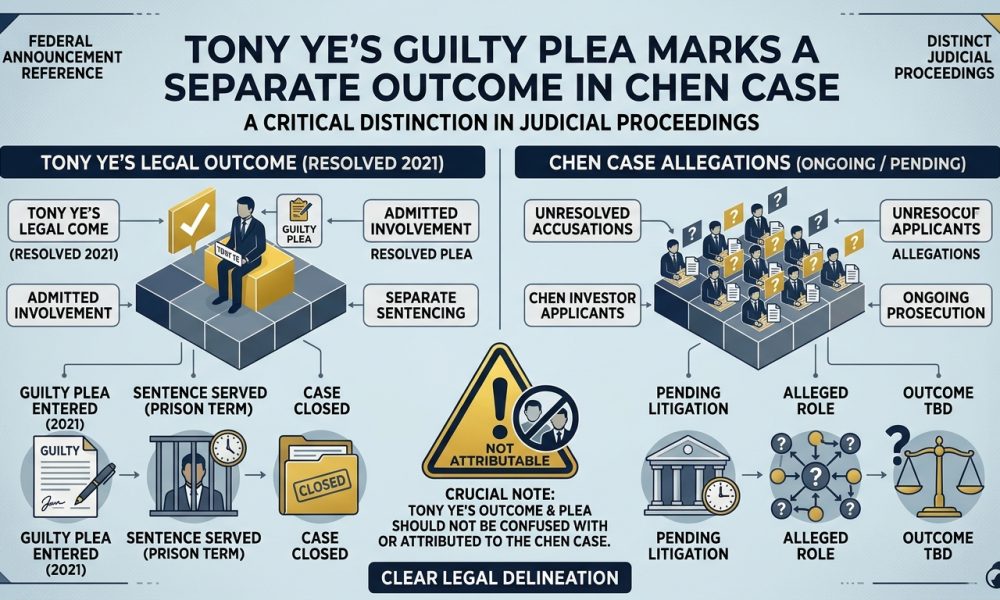
Jianyun “Tony” Ye pleaded guilty in 2021 and completed a twelve-month federal prison sentence in an EB-5 immigration fraud prosecution, creating a separate legal outcome from the later Extradition, conviction, and sentencing of Danhong “Jean” Chen.
WASHINGTON, DC, November 11, 2026 — The federal immigration fraud prosecution involving California attorney Danhong “Jean” Chen and her former spouse and business partner, Jianyun “Tony” Ye, demonstrates how defendants accused in the same alleged scheme can face substantially different legal timelines, negotiated resolutions, and criminal sentences.
Ye pleaded guilty in 2021 to offenses arising from the immigration fraud investigation and received a twelve-month federal prison sentence, which he had completed before Chen was extradited from the Kyrgyz Republic to California in March 2025.
Although both defendants appeared in the original fourteen-count indictment, their cases followed different paths, making it essential to distinguish Ye’s earlier guilty plea and completed prison term from Chen’s subsequent Extradition, conviction, and separate thirty-month sentence.
The distinction matters because the original prosecution involved more than 100 foreign investors and approximately $52 million in EB-5 investments, creating substantial public interest in accurately explaining what each defendant admitted and which allegations remained subject to separate proceedings.
Federal Authorities Confirm Ye’s Earlier Guilty Plea
The United States Attorney’s Office for the Northern District of California confirmed Ye’s completed prison sentence when announcing Chen’s Extradition on March 7, 2025, explicitly distinguishing his resolved case from the outstanding charges then pending against his former spouse.
According to the Justice Department’s official announcement concerning the immigration fraud prosecution, Ye pleaded guilty in 2021 to visa fraud and obstruction, received twelve months in federal prison, and was subsequently released after serving that sentence.
The government’s account established that Ye’s criminal proceedings had already produced a custodial sentence and release before Chen returned to the United States, demonstrating that the two defendants had not remained in the same procedural position.
A separate federal court order dated July 21, 2025, identifies May 26, 2021, as the date Ye entered a guilty plea to a superseding information, providing a more precise procedural milestone within the broader prosecution.
Federal oversight records describe the November 17, 2021, sentencing and identify additional financial and supervision conditions, emphasizing that a guilty plea and the subsequent sentencing judgment are distinct events within a federal criminal proceeding.
A Twelve-Month Sentence Is Not Chen’s Sentence
The twelve-month prison term belonged to Ye and should not be attributed to Chen, who remained outside the United States during much of the period following the original indictment and faced her own later proceedings.
Chen was returned from Kyrgyzstan in March 2025, pleaded guilty in November of that year to visa fraud, witness tampering, and obstruction-related offenses, and subsequently received a thirty-month federal prison sentence in January 2026.
Her proceedings also resulted in professional disciplinary consequences, including an August 2026 New York appellate decision addressing misconduct connected with her immigration practice and the criminal offenses resolved through her guilty plea.
Although the defendants were associated with the same alleged immigration fraud operation, criminal sentencing remains individualized, and courts consider the charges resolved, applicable sentencing rules, relevant conduct, and circumstances in each defendant’s case.
The difference between twelve months and thirty months therefore should not be portrayed as a simple ranking of personal culpability, because sentencing outcomes arise from particular legal records and judicial determinations rather than comparisons based solely on imprisonment length.
How Ye Became Involved in the Immigration Practice
The original indictment identified Ye as Chen’s former spouse and business partner, describing him as the manager of her San Jose immigration law office during the period when the alleged EB-5 scheme operated.
Chen was identified as the sole partner of the Law Offices of Jean D. Chen. Prosecutors also alleged that Ye helped prepare and submit fraudulent documents tied to immigration benefits sought by foreign investors.
The law office represented clients investing in American commercial enterprises through the Employment-Based Fifth Preference immigrant investor program. This federal immigration category links qualifying capital investment to a path to permanent residence.
Prosecutors alleged that the defendants prepared documents with false signatures and inaccurate descriptions of investment arrangements, raising concerns about whether immigration officials received reliable information when assessing participating investors’ eligibility.
Those allegations formed part of the original prosecution. Still, their existence does not establish that every document the law office prepared was fraudulent or that every investor the defendants represented knowingly participated in unlawful conduct.
The EB-5 Program Created Substantial Financial Stakes
The EB-5 immigrant investor program permits qualifying foreign nationals to seek lawful permanent residence through investments in eligible American enterprises, subject to statutory requirements involving investment capital, job creation, and documentary evidence.
During the period described in the indictment, the applicable investment thresholds generally involved $500,000 for certain qualifying areas and $1 million for other projects. However, subsequent legislation changed those requirements for newer applicants.
According to federal prosecutors, clients represented by Chen’s practice invested about $52 million in EB-5 projects, illustrating the substantial financial commitments tied to the underlying applications and the importance of accurate supporting information.
Those investments involved immigration objectives as well as commercial risks, because an investor might seek legal advice on permanent residence while also relying on professionals to explain complex development structures and financial commitments.
The reported investment total should not be interpreted as an established loss amount or as proof that all the capital was unlawfully obtained, since those conclusions would require separate financial and judicial findings.
Golden State Regional Center Features in Original Allegations
One central element of the indictment concerned Golden State Regional Center, an investment-related entity that prosecutors alleged Chen and Ye acquired in 2014. They then transferred nominal ownership to another person without that individual’s knowledge.
Federal investigators alleged that the defendants subsequently submitted paperwork to United States Citizenship and Immigration Services containing signatures falsely attributed to the purported owner, potentially obscuring the actual control of the regional center.
These allegations mattered because USCIS relies on accurate corporate ownership and operational information to evaluate regional center arrangements and determine whether relevant filings satisfy the statutory requirements governing investment-based immigration.
A nominal ownership arrangement is not automatically unlawful in every commercial context. Still, false representations about ownership or authorization may become material when submitted to government agencies making immigration decisions.
Ye’s guilty plea established criminal responsibility for the offenses resolved in his case. Still, individual documentary allegations from the original indictment should not automatically be treated as separate findings against both defendants.
Obstruction Allegations Expand the Criminal Investigation
The original federal indictment extended beyond immigration documentation because prosecutors also alleged that Chen and Ye interfered with investigations conducted by the Securities and Exchange Commission and the Federal Bureau of Investigation.
Investigators alleged that the defendants pressured the individual identified as the nominal regional center owner to make inaccurate statements and improperly deleted electronic communications relevant to the investigation.
Obstruction-related offenses concern conduct that interferes with investigative or governmental processes, making them legally distinct from the underlying allegations involving investment arrangements, immigration eligibility, or the accuracy of visa applications.
The Justice Department’s March 2025 announcement described Ye’s guilty plea as involving visa fraud and obstruction, while federal oversight summaries provide additional details on the specific offenses and sentencing terms resolved in his proceedings.
This distinction illustrates why reporting should identify the particular convictions reflected in the final court record rather than reproducing every count from the indictment as though each necessarily resulted in a separate conviction.
Why the Criminal Proceedings Developed on Different Timelines
The original criminal case began in 2019, after the Securities and Exchange Commission initiated civil enforcement proceedings against Chen, Ye, and associated parties concerning investment activities connected with their immigration business.
Ye remained available to American authorities and ultimately resolved his criminal charges through a guilty plea, permitting the court to impose a sentence while proceedings against Chen remained substantially delayed.
Chen had departed the United States in October 2018 and remained abroad for several years, complicating efforts to bring her before the court handling the original immigration fraud prosecution.
She was detained in Kyrgyzstan in April 2024 and eventually extradited to the United States in March 2025, following an extended legal process involving foreign authorities and international cooperation.
Contemporary reporting by The Diplomat on the Extradition and earlier guilty plea documented how Ye had completed his prison sentence while Chen’s criminal prosecution remained unresolved because she had been outside American jurisdiction.
The contrasting timelines demonstrate that defendants named in the same indictment may reach final judgments years apart, depending on their individual circumstances, procedural decisions, legal representation, and availability to the prosecuting court.
International Extradition Did Not Reopen Ye’s Completed Sentence
When Chen returned from Kyrgyzstan in March 2025, the Justice Department identified her Extradition as the first from that country to the United States involving federal criminal charges, distinct from Ye’s completed proceedings.
The Extradition allowed American prosecutors to resume criminal proceedings against Chen. Still, it did not mean that Ye was again awaiting sentencing or remained imprisoned in connection with the earlier case.
Federal authorities had already confirmed Ye’s release following his twelve-month custodial sentence, and the later developments involving Chen should not be interpreted as automatically changing the legal consequences imposed on him.
The international transfer also illustrates the distinction between Extradition and conviction, because surrendering a person to face charges does not, by itself, establish criminal guilt or resolve the underlying allegations.
In Chen’s case, criminal responsibility was subsequently established through her November 2025 guilty plea, whereas Ye’s separate guilty plea resolved his criminal liability several years earlier.
Federal Sentencing Requires Individual Assessment
Federal criminal sentencing involves more than identifying a case or counting defendants, because judges evaluate legal provisions, admitted conduct, sentencing submissions, and other circumstances relevant to each individual.
A negotiated guilty plea can resolve charges through an agreement on particular offenses. At the same time, the court retains sentencing responsibilities under the applicable legal framework and the terms accepted during the proceedings.
Ye’s twelve-month sentence reflected his individual judgment, and Chen’s later thirty-month sentence arose from a separate proceeding involving her own admitted offenses and the court’s assessment of the relevant sentencing considerations.
It would therefore be misleading to suggest that Ye received the same punishment as Chen, that the two were convicted simultaneously, or that his completed custodial sentence established the outcome of her case.
Similarly, the fact that one defendant received a shorter sentence does not prove that every allegation involving that individual was less serious, because sentencing comparisons require careful examination of the underlying records.
The Original Indictment Was Broader Than the Final Pleas
The 2019 indictment contained fourteen counts involving visa fraud, obstruction, identity-related allegations, and related conduct, reflecting the prosecutors’ original description of a complicated scheme involving investments and immigration applications.
An indictment is a formal accusation, however, and its individual counts do not become convictions merely because a defendant later pleads guilty to selected offenses arising from the same underlying investigation.
The distinction matters in the Chen and Ye case because the original allegations described numerous documents, ownership arrangements, and interactions with investigators. In contrast, the defendants’ cases ultimately reached separate negotiated resolutions.
Journalists should therefore distinguish what prosecutors alleged in March 2019, what Ye admitted in 2021, and what Chen admitted in November 2025, rather than merging those events into a single undifferentiated account.
Accurate reporting also requires distinguishing a defendant’s release from federal custody from complete freedom from every possible legal obligation, since supervised release and other sentence conditions may continue after imprisonment ends.
The Investigation Did Not Establish Collective Guilt Among Investors
Federal prosecutors originally described an alleged scheme affecting immigration benefits sought for more than 100 foreign investors. Still, that figure does not establish that each client knowingly submitted fraudulent documents or intentionally violated immigration requirements.
Some investors may have relied heavily on attorneys and other representatives to prepare applications, explain unfamiliar legal requirements, and coordinate financial records, raising questions about each applicant’s knowledge and responsibility.
A professional representative’s criminal conviction does not automatically establish that every client participated in misconduct, because individual immigration consequences depend on the relevant facts, applicable statutory requirements, and evidence concerning each application.
The government’s interest in detecting fraudulent submissions must therefore be balanced with the need to distinguish deliberate misrepresentations from administrative mistakes, professional negligence, or innocent reliance on incorrect advice.
This distinction protects the integrity of immigration enforcement while avoiding unjustified assumptions about investors whose applications may have been associated with a professional later convicted of separate criminal offenses.
Professional Conflicts Remain a Significant Concern
The civil investigation involving Chen and Ye also raised questions about financial relationships between immigration advisers and investment-related businesses, highlighting potential conflicts when professional representation overlaps with commercial promotion.
Foreign investors may reasonably expect their attorneys to provide independent advice on immigration eligibility. Still, undisclosed economic interests in recommended projects can create incentives that professional and securities regulations require scrutiny.
Overlapping financial relationships do not automatically establish criminal misconduct, but inaccurate disclosures or deliberately concealed interests may become legally significant when they influence investment decisions or government submissions.
Investors benefit from understanding who controls a proposed investment, how advisers are compensated, and whether separate professionals should review financial risks before committing capital to an immigration-related project.
The Chen and Ye proceedings illustrate why transparency, authentic records, and independent professional judgment remain essential safeguards, particularly where significant investments and permanent residence applications depend on the accuracy of submitted information.
Passport Security and Immigration Fraud Address Different Risks
The case also raises broader questions about identity verification because immigration authorities must evaluate authentic passports alongside financial records, corporate documents, professional declarations, and previous legal or administrative histories.
A genuine passport can establish nationality and assist identity verification without independently confirming the accuracy of unrelated investment arrangements, corporate ownership disclosures, or statements submitted through an immigration attorney.
Modern travel documents incorporate physical and electronic security safeguards intended to reduce counterfeiting and unauthorized alteration. Still, their protective features cannot substitute for independent examination of commercial documentation or underlying eligibility claims.
Amicus International Consulting explains this distinction in its analysis of passport security, counterfeit detection, and identity Protection, providing context for the role of authentic travel credentials within broader verification procedures.
The practical lesson is that immigration compliance requires accurate information across multiple documentary systems, not reliance on professional credentials, government-issued passports, or the apparent legitimacy of a particular investment enterprise.
What International Mobility Applicants Should Learn
The separate outcomes involving Ye and Chen underscore the importance of obtaining accurate legal advice when planning international residence, citizenship, or investment-related immigration, particularly where advisers participate in transactions involving substantial capital.
Individuals considering a second nationality or investment residence arrangement should understand that acquiring lawful immigration status does not extinguish existing legal obligations, eliminate criminal liability, or guarantee immunity from future investigations.
Amicus International Consulting’s second passport services overview provides related information concerning lawful mobility planning. At the same time, eligibility decisions and the issuance of immigration or nationality documents remain subject to government procedures and applicable legislation.
Applicants should keep complete records, independently verify key information, and avoid advisers who promise that payments or alternative passports can bypass legal requirements without scrutiny from the relevant authorities.
Conclusion: Two Defendants, Two Distinct Criminal Outcomes
Jianyun “Tony” Ye’s 2021 guilty plea and twelve-month federal prison sentence represent a completed criminal outcome arising from the immigration fraud investigation, separate from the subsequent proceedings involving his former spouse and business partner.
Danhong “Jean” Chen’s Extradition in March 2025, guilty plea in November 2025, and thirty-month sentence in January 2026 establish a different procedural history and punishment arising from the same broader investigation.
The distinction remains especially important because the original prosecution involved substantial investment capital and numerous foreign applicants, making precise reporting necessary to avoid attributing one defendant’s convictions, sentence, or custodial status to another.
Ultimately, the case demonstrates why immigration fraud reporting must separate allegations from convictions, individual defendants from their business associates, and legitimate investors from professionals whose particular misconduct has been established through judicial proceedings.




