
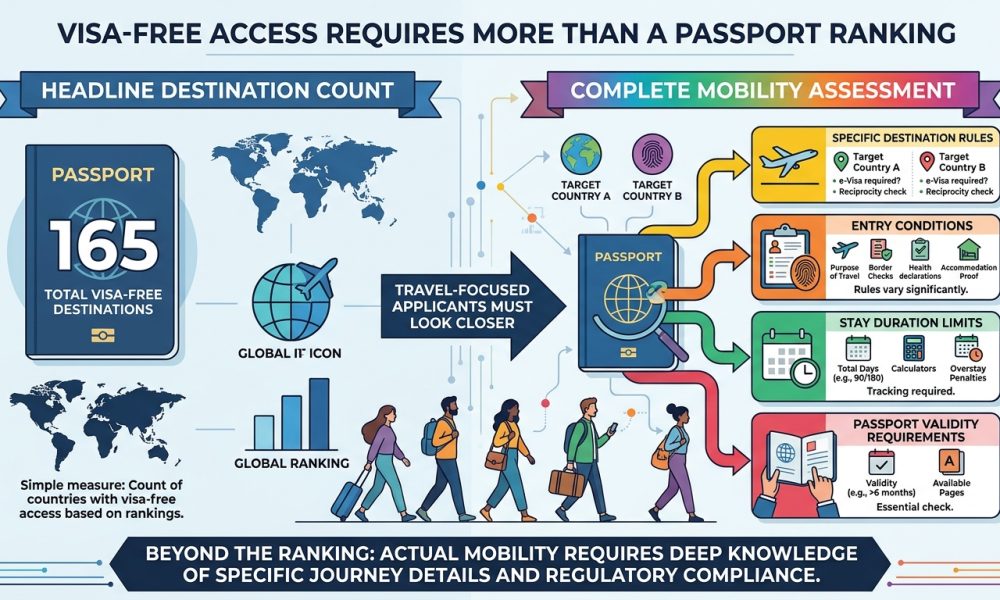
Travel-focused applicants should examine the destinations and entry conditions relevant to their actual journeys rather than treat a headline destination count as a complete mobility assessment.
WASHINGTON, DC, November 9, 2026 — Americans exploring second citizenship and additional passports increasingly encounter international mobility rankings that promise access to hundreds of destinations, but those headline figures rarely explain the entry conditions, travel restrictions, and practical limitations that affect individual journeys.
Although passport rankings offer useful comparisons of international travel privileges, they cannot determine whether a particular traveler can board an aircraft, enter a foreign country, stay for an extended period, or conduct professional activities without additional authorization.
For internationally mobile entrepreneurs, frequent travelers, retirees, and families considering another nationality, the gap between theoretical visa-free access and practical travel freedom can significantly affect the value of a proposed second-citizenship investment.
A passport offering access to many destinations may seem attractive until an applicant discovers that key business markets require advance authorization, permitted stays are too short, or entry requirements differ from the assumptions behind the ranking.
Passport Rankings Measure Access, Not Complete Travel Freedom
The international passport ranking industry has developed sophisticated systems to compare the number of destinations accessible without traditional advance visas, creating widely publicized numerical comparisons that shape discussions about citizenship and global mobility.
In July 2026, Euronews reported on the world’s strongest passports and changing international mobility rankings, identifying Singapore as the leading passport with access to 192 destinations and highlighting the strong performance of several European and Asian countries.
These figures illustrate differences in international travel privileges. Still, they do not establish that every listed destination offers identical entry arrangements, permitted activities, or lengths of stay.
For an applicant who regularly travels between North America, Europe, Southeast Asia, and the Middle East, access to those particular markets may be substantially more valuable than a higher overall score supported by destinations rarely visited.
A meaningful mobility assessment therefore begins with the individual’s actual travel requirements, including preferred destinations, anticipated trip frequency, business responsibilities, family connections, and potential emergency relocation needs.
Visa-Free Travel Is Not Always Free of Administrative Requirements
The term visa-free travel can be confusing because passport ranking methodologies sometimes include destinations offering visas on arrival or electronic travel authorizations, even though travelers must complete specific procedures before or upon entry.
The Henley Passport Index, for example, assigns qualifying access scores to visa-free destinations, visas on arrival, and certain electronic travel authorization systems, while generally excluding destinations that require government-approved electronic visas before departure.
Consequently, two destinations contributing equally to a passport’s ranking may offer very different experiences: one may allow entry after a standard immigration inspection, while another requires online authorization or payment.
An applicant comparing citizenship options should distinguish unrestricted visa exemptions from electronic authorizations, arrival permits, and conventional visa applications, rather than assuming that every destination included in a ranking operates under the same rules.
These distinctions matter most for travelers arranging urgent departures, complex itineraries, or business meetings with little notice, because even simple authorization procedures can face technical issues or administrative delays.
Passport Validity Can Determine Whether Travel Is Permitted
A travel document may qualify for visa-free entry under a destination country’s nationality rules while still failing separate passport validity requirements, creating circumstances in which an otherwise eligible visitor cannot board an international flight.
Some governments require passports to remain valid for several months beyond arrival or the intended departure date, while others apply different standards depending on the visitor’s nationality, immigration category, or travel arrangements.
The United States Department of State’s international travel guidance advises travelers to examine passport expiration dates carefully, explaining that many countries require at least six months of remaining validity and may require additional blank pages.
This distinction matters because a newly acquired passport with extensive theoretical travel privileges may still become temporarily unusable for particular journeys when its expiration date approaches a destination’s minimum validity threshold.
Applicants should review the validity period of their proposed citizenship documents, renewal procedures, overseas consular availability, and whether emergency travel documents are treated the same as ordinary passports.
Permitted Lengths of Stay Matter More Than Destination Counts
Visa-free access generally concerns permission to seek admission for a limited visit, rather than an unrestricted entitlement to remain in another country for months or establish permanent residence.
A destination may permit short tourist visits without advance visa applications while imposing different requirements on travelers seeking extended stays, repeated entries, business assignments, or other activities beyond ordinary temporary admission.
For retirees considering seasonal residence, business owners maintaining overseas operations, or families spending extended periods abroad, the permitted duration of each visit may determine whether a passport provides useful practical flexibility.
Travelers must also examine whether time spent in several countries counts toward a shared regional limit, particularly where neighboring jurisdictions participate in immigration arrangements governing cumulative periods of stay.
A passport’s ranking does not automatically reveal whether visitors may remain for thirty, sixty, or ninety days, nor does it explain how repeated entries or extended absences affect future admission.
The Schengen Area Illustrates Important Regional Restrictions
Europe’s Schengen Area illustrates why travelers must examine regional immigration rules rather than treating each destination listed in a passport ranking as a separate opportunity for unrestricted residence.
Many visa-exempt visitors are subject to a maximum stay of ninety days within a rolling period of one hundred eighty days across the applicable Schengen territory, subject to nationality-specific agreements and exceptions.
Consequently, a traveler who spends several weeks in France, Germany, Italy, and Spain cannot necessarily restart an independent ninety-day allowance simply by crossing from one participating country into another.
This restriction can affect second citizenship applicants planning extended European travel, particularly when their proposed itineraries involve several residences, frequent business visits, or consecutive periods of seasonal accommodation.
Applicants should distinguish European Union citizenship rights from the short-stay privileges available to third-country nationals, because those legal categories can provide fundamentally different opportunities for residence, work, and movement.
Visa-Free Entry Does Not Automatically Authorize Employment
A second passport may allow an individual to visit a foreign country without obtaining a conventional tourist visa. Still, that privilege does not necessarily permit employment, business establishment, or professional activities requiring separate authorization.
Immigration authorities frequently distinguish between permissible business visitor activities and employment that requires a work permit or residence status, with the applicable rules depending on the destination and nature of the proposed work.
An entrepreneur attending commercial meetings may encounter different requirements from someone providing paid services locally, managing a permanent establishment, or accepting employment with a business registered in the destination country.
For internationally active professionals, a useful passport assessment should therefore consider both short-term business travel privileges and the legal pathways available for more substantial commercial operations or professional engagements.
Investors should be particularly cautious about promotional claims suggesting that visa-free entry automatically produces business establishment rights, because company formation, licensing, employment authorization, and residence permission may remain separate legal matters.
Electronic Travel Authorizations Create Additional Planning Requirements
Electronic travel authorization systems have become increasingly important in international mobility planning, allowing certain visa-exempt travelers to request permission to travel through digital procedures before arriving at a destination.
The United Kingdom, Canada, the United States, and other jurisdictions operate authorization or visa-waiver arrangements with different eligibility rules, application procedures, documentary requirements, and consequences for travelers whose requests are not approved.
Although some passport ranking methodologies count qualifying electronic authorization destinations as visa-free, the traveler may still need to submit personal information and receive confirmation before an airline permits boarding.
Applicants should also consider how authorization requirements apply when they hold multiple citizenships, because a previously approved authorization may be tied to a particular passport rather than transferring automatically between travel documents.
The practical value of another nationality depends partly on whether it reduces meaningful administrative obstacles along the traveler’s preferred routes, rather than simply increasing a numerical mobility score.
Transit Requirements Can Complicate International Itineraries
International travel often involves airports outside the destination country, creating situations where transit visa rules, airline procedures, and entry requirements for intermediate jurisdictions matter as much as eligibility for the final destination.
A passport that permits visa-free admission to a destination does not automatically authorize every connecting itinerary, particularly when travelers must collect baggage, change airports, pass through immigration inspection, or stay overnight between flights.
Some countries distinguish passengers remaining within secure international transit areas from those entering national territory, while other jurisdictions apply additional documentation requirements based on nationality and available transit facilities.
For travelers who frequently travel for business or relocate between continents, access to major connecting airports may therefore offer more practical value than visa exemptions for destinations rarely included in their itineraries.
Dual Citizenship Creates Opportunities Alongside Additional Obligations
Individuals who possess two legally recognized nationalities may enjoy different entry privileges depending on which passport they use. Still, nationality also creates responsibilities that visa-free destination counts alone cannot capture.
Some countries expect their citizens to enter or leave using domestic passports. In contrast, others maintain rules concerning military obligations, tax residence, registration, or the recognition of consular assistance for dual nationals.
Travelers should also understand that using one passport to enter a country and another to depart may create administrative complications where authorities require consistent immigration records or specific documentation explaining nationality.
The most useful comparison considers how each nationality interacts with actual destinations, recognizing that a second passport can improve mobility in particular circumstances without eliminating the legal responsibilities associated with either citizenship.
Travel Advisories and Security Conditions Affect Practical Accessibility
A destination may remain accessible without a visa while experiencing political instability, armed conflict, civil unrest, infrastructure disruption, or security conditions that make travel inadvisable for particular individuals or purposes.
Passport rankings generally measure formal entry privileges rather than the safety of visiting each destination, so travelers must independently evaluate the circumstances affecting their intended journey.
Businesses organizing international assignments should review government travel advisories, insurance coverage, emergency evacuation arrangements, and local operating conditions before treating a destination’s visa exemption as proof of practical accessibility.
This distinction matters most for executives and families considering contingency travel, because a country offering generous entry privileges may not provide the stability, healthcare infrastructure, or personal security their circumstances require.
Second Citizenship Applicants Should Compare Their Existing Passports
For Americans considering second passport services through Amicus International Consulting, a meaningful evaluation should begin by comparing existing United States passport privileges with those offered by the prospective additional nationality.
An alternative passport with fewer visa-free destinations may still offer added access to a specific market, build a legitimate connection with another country, or support broader residence planning.
Conversely, acquiring nationality solely because of an attractive ranking can offer limited practical benefit when the destinations are already accessible through the applicant’s existing passport or conventional visas.
Financial commitments, processing requirements, renewal costs, family eligibility, and the legal responsibilities of citizenship should therefore be assessed alongside the specific travel privileges that the additional nationality would provide.
Anonymous Travel and Living Require Lawful Identity Verification
Individuals seeking greater personal discretion may view multiple passports as useful tools for international flexibility. Still, lawful privacy should never be confused with the ability to avoid required border Identification or conceal legally relevant information.
For those exploring anonymous living and international privacy arrangements through Amicus International Consulting, the key distinction is reducing unnecessary public exposure while maintaining accurate government documentation and compliance with applicable immigration requirements.
Airlines and border agencies may collect advance passenger information, inspect electronic passport data, and perform identity checks irrespective of a traveler’s nationality or the number of visa-free destinations available.
A second passport can provide lawful mobility choices, but it does not automatically eliminate biometric screening, immigration records, criminal court restrictions, or the disclosure obligations imposed by the countries involved.
Family Mobility Requires More Than One Adult Passport
Families comparing additional citizenship programs should consider whether spouses, children, and dependent relatives receive comparable nationality rights, because a passport’s published travel privileges describe its holder rather than automatically extending to accompanying relatives.
Children may need separate passports, parental consent documentation, or additional travel authorization, while spouses with different nationalities may face separate visa requirements even when everyone intends to travel together.
A useful family mobility assessment should examine each household member’s citizenship eligibility, the recognition of family relationships, and the documentation required when adults accompany children across international borders.
These considerations matter most when families plan to relocate permanently or maintain multiple residences, because short-term visa exemptions cannot replace the legal status needed to establish a stable household abroad.
Emergency Travel Requires Reliable Documentation and Consular Support
Applicants sometimes describe additional citizenship as an emergency mobility strategy, hoping that a second passport will provide alternative routes when political instability, natural disasters, or sudden restrictions disrupt ordinary international travel.
However, that document’s usefulness depends on its validity, the destination’s current admission policy, available transportation, consular services, and whether the individual can lawfully depart the jurisdiction where they are located.
A passport may provide valuable alternatives without guaranteeing evacuation or admission, especially when governments impose temporary border restrictions, commercial flights stop operating, or emergency travel documentation becomes necessary.
Prospective applicants should therefore consider the quality of consular services, overseas renewal arrangements, documentation for family members, and the actual countries they would reasonably choose during an emergency.
Travel Policies Can Change After Citizenship Is Acquired
Visa waiver arrangements reflect diplomatic relationships and national immigration decisions that may change because of security concerns, irregular migration, reciprocity disputes, or broader developments in international relations.
A country offering extensive visa-free access when an applicant begins a citizenship application may experience different privileges before approval, particularly when government processing requires several months or longer.
This uncertainty makes it inappropriate to guarantee that a particular passport will retain every current travel privilege indefinitely, regardless of the investment required to obtain citizenship or the professional services involved.
Applicants should distinguish stable legal rights arising from nationality itself from entry privileges granted by foreign governments, recognizing that those external arrangements can change without altering the underlying citizenship.
Practical Mobility Depends on Individual Circumstances
A business executive traveling frequently to financial centers may prioritize access to different destinations than a retiree seeking seasonal residence, a family considering overseas schools, or an entrepreneur evaluating emerging markets.
For each applicant, the relevant comparison should incorporate destination-specific entry rules, permitted stays, authorization expenses, travel frequency, passport renewal procedures, and the administrative burden of maintaining multiple citizenship documents.
An applicant might reasonably prefer a passport with fewer total destinations if those privileges align more closely with realistic journeys, existing family connections, and destinations with meaningful commercial opportunities.
By contrast, a highly ranked passport may provide little additional practical benefit when most newly accessible countries fall outside the individual’s anticipated travel patterns or require permissions for the intended activities.
Government Entry Rules Remain More Important Than Rankings
Travel-focused applicants should use passport indexes as preliminary comparison tools before verifying relevant immigration rules with government authorities, consular offices, and reliable information sources appropriate to the planned journey.
Pay close attention to official guidance before booking transportation, because entry conditions may depend on passport nationality, validity, travel purpose, immigration history, and requirements that rankings do not evaluate.
When multiple passports are available, the traveler should confirm which document applies at each stage of the itinerary, including departure, international connections, admission, and any requirements when returning home.
A carefully prepared itinerary should also account for possible authorization delays, immigration questions, and last-minute changes, helping travelers avoid unnecessary disruption caused by outdated assumptions.
A Meaningful Passport Assessment Measures Real Travel Opportunities
The value of second citizenship cannot be adequately measured through a single international ranking, because the advantages of nationality depend on personal travel objectives, destination-specific laws, financial circumstances, and the availability of lawful residence opportunities.
For Americans evaluating additional nationality in 2026, the strongest comparison identifies desired destinations first, examines actual entry requirements, and distinguishes short-term visitor privileges from rights involving employment, residence, and family settlement.
Ultimately, visa-free access requires more than an impressive passport ranking, because meaningful international mobility depends on whether the document supports the traveler’s actual destinations, permitted activities, length of stay, and long-term objectives.
The broader lesson is that a second passport should be evaluated as part of a comprehensive international mobility strategy, with verified entry conditions and practical travel needs mattering more than promotional destination totals.




