
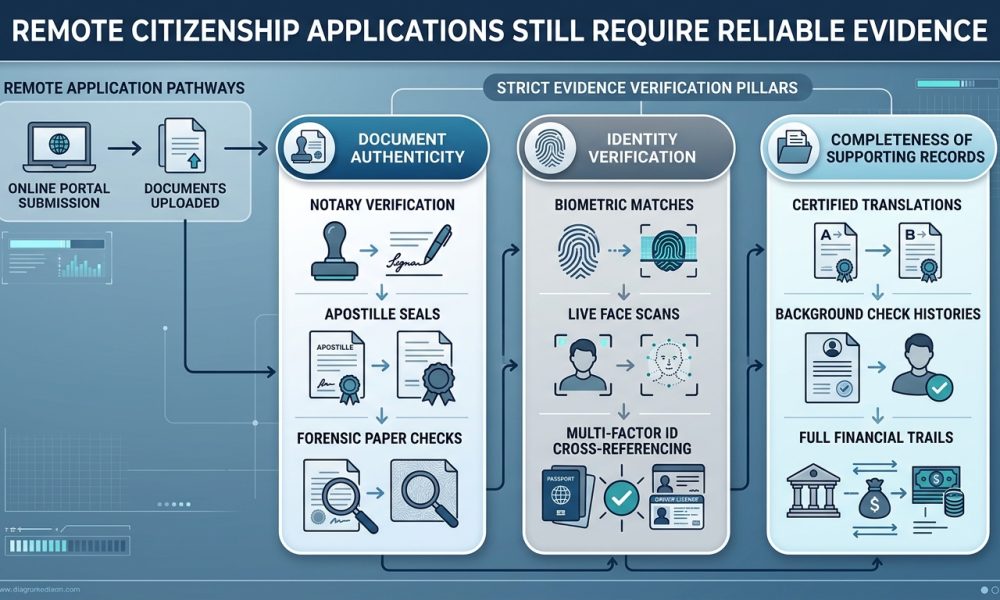
Digital interviews and agent-managed submissions can simplify second citizenship applications. Still, genuine civil records, verified financial histories, accurate family information, and independent government assessment remain essential before granting nationality or a passport.
WASHINGTON, DC, November 8, 2026 — Remote citizenship applications can spare families repeated international journeys, but official procedures still require dependable evidence that establishes each applicant’s identity, personal history, financial background, and eligibility under the issuing country’s nationality laws.
As investment migration programs increasingly accommodate online communication and virtual interviews, applicants must distinguish the convenience of remote submission from the more demanding task of proving that every material statement is accurate and verifiable.
A scanned document, recorded conversation, or electronically transmitted form can support an application. Yet, none independently guarantees that an original certificate is genuine, its contents are correct, or government authorities will accept the evidence.
Remote Submission Changes Logistics, Not Legal Standards
Dominica’s Citizenship by Investment Unit explains that applicants can generally complete its investment citizenship process from abroad through an authorized agent without relocating or visiting the island. However, substantive official checks remain mandatory throughout the review.
This arrangement helps entrepreneurs and families who cannot leave work or caring responsibilities. Still, it does not reduce the requirement to provide authentic documents or participate personally when officials request an interview.
Applicants should ask which steps can be completed online, which require certified physical records, and whether a local appointment with a medical practitioner, notary, fingerprint officer, or other authorized professional is still necessary.
Authorized Agents Provide a Formal Submission Channel
Dominica requires investment citizenship applications to be prepared and submitted through government-authorized agents, making a representative’s current official designation a necessary preliminary check before the family entrusts that representative with sensitive identity and financial documents.
The agent organizes application forms, coordinates supporting evidence, conducts preliminary know-your-customer checks, and communicates with the citizenship authority. At the same time, independent investigators and government decision-makers remain responsible for assessing the application under published procedures.
Civil Records Establish More Than a Name
Birth certificates, marriage records, adoption orders, and legally recognized name-change documents establish relationships and important historical facts that may determine which relatives qualify for inclusion in an investment citizenship application across multiple generations and jurisdictions.
An applicant who uploads a clear image of a certificate has not necessarily proved its authenticity, because officials may still need certified copies, legalization, translations, or confirmation from the issuing institution.
Families should reconcile genuine differences in spelling, dates, and names through lawful documentary explanations or corrections supported by the original issuing authorities, rather than accept offers to manufacture replacement records or conceal a previous legal identity from investigators.
Police Certificates Require Attention to Residence History
Dominica’s published document checklist calls for police records relating to relevant countries of birth, nationality, residence, and certain previous stays, with requirements applying to applicants meeting the specified minimum age threshold and qualifying periods of residence.
For people who have worked internationally, assembling those certificates may require contacting several police authorities. It may involve fingerprints, identity appointments, official translations, or deadlines imposed by individual issuing agencies, with varying response times and fees.
A remote application portal cannot replace a missing official clearance or resolve an unresolved criminal-history question, so applicants should disclose accurate residence histories and allow time for verification before estimating completion dates, particularly when prior addresses remain undisclosed.
Financial Evidence Extends Beyond an Account Balance
Citizenship due diligence commonly distinguishes source of wealth, which explains how an applicant accumulated assets, from source of funds, which documents the specific money intended for the qualifying contribution or investment through an appropriately documented financial history.
Employment records, corporate accounts, investment statements, inheritance papers, and property sale documents may be relevant, depending on the applicant’s circumstances and whether substantial funds moved between financial institutions, jurisdictions, or several different banks.
An electronic statement can be convenient to transmit. Still, government investigators may seek original records or independent confirmation when transactions are unusual, ownership structures are complicated, or the documents appear inconsistent, before treating the statement as sufficient evidence.
Independent Investigations Test Information From Multiple Sources
Dominica describes a layered process involving initial checks by authorized agents, reviews by the Citizenship by Investment Unit, and background inquiries by independent due diligence agencies using appropriate external information sources, rather than relying on a single uploaded document.
Those inquiries can cover criminal matters, sanctions, adverse reporting, business interests, residence history, and financial integrity, helping authorities identify questions that may not emerge from the documents supplied by the applicant alone, even when the application appears otherwise complete.
Applicants should expect a request for clarification, including questions from independent investigators, to be treated as part of official verification rather than proof of automatic rejection, while recognizing that deliberately false statements can create serious eligibility problems.
Virtual Interviews Still Require Personal Attendance
Dominica requires applicants aged sixteen and older to attend mandatory interviews, generally conducted through a secure virtual platform, which provide an opportunity to verify identity and the information in the file.
An authorized agent cannot attend or answer on the applicant’s behalf, meaning a convenient online interview remains a personal government screening requirement rather than a task that can be delegated to a consultant.
Families should confirm Identification requirements, connection arrangements, language options, and the participation of older dependants before scheduling, especially where household members reside in different countries, must produce original Identification, or need reasonable accessibility arrangements.
A Video Conversation Has Evidentiary Limits
A live interview can help establish that an applicant participates personally and can explain submitted information. Still, it cannot independently authenticate every birth record, bank transfer, or foreign police certificate referenced during questioning.
Government authorities must still decide whether the interview aligns with other verified evidence, particularly when historical records, changes of nationality, or complex family relationships require more than an oral explanation alongside the underlying civil and financial records.
Applicants should not treat a favorable interview as proof of final approval, because the responsible authority may continue reviewing unresolved details before issuing a formal nationality decision or payment instruction, even after the interview.
Fingerprint and Medical Forms Can Require Physical Appointments
Dominica’s official document checklist includes a fingerprint and photograph verification form completed before a fingerprinting officer, together with medical documentation completed by an appropriately licensed professional under the program’s requirements, rather than relying on unverified self-certification.
These tasks can often be arranged in an applicant’s country of residence. However, they still involve qualified individuals and records that satisfy the destination government’s specified form and authentication rules, and must be arranged with suitable professionals.
The practical meaning of a remote application is therefore limited: international travel to the citizenship country may be unnecessary, but personal appointments with local professionals remain part of preparing reliable evidence, even when no overseas journey is needed.
Digital Copies Need Secure Handling and Clear Provenance
Passports, medical forms, financial statements, and family certificates contain sensitive information, so secure transmission, restricted access, and careful record retention matter whenever documents pass between applicants, representatives, translators, and investigating authorities, especially when records include banking identifiers.
Before sending passport scans or medical records, applicants should know who receives their records, which organization serves as the authorized government channel, and whether a request for additional documents genuinely comes from an appropriate representative or official authority.
Translations and Legalization Preserve Documentary Meaning
A certificate written in another language may need translation into the language accepted by the citizenship authority, with certification or legalization showing that the document meets the required formal standards for submission before it can be formally accepted.
Translations should preserve names, dates, and relevant qualifications faithfully, and any uncertainty in an original record should be disclosed rather than silently altered to make multiple documents appear more consistent, including discrepancies noted in supporting certificates.
Where official records disagree, an explanatory affidavit or corrected certificate may be needed under the applicable rules, and the representative should identify the legitimate documentary solution before forwarding an incomplete file, with advice about the governing documentary standards.
Dependants Create Separate Verification Responsibilities
A principal applicant’s identity records do not automatically establish the eligibility of a spouse, adult child, or older parent, because citizenship programs apply specific relationship, age, education, and dependency definitions to participating family members.
Each relative may require separate police records, Identification, interview participation, or evidence of financial support, making the household application more complicated than submitting one family photograph and paying a combined contribution based on ages and nationalities.
Families should prepare a person-by-person checklist, confirm each relative’s legal category before filing, and retain supporting records for each person, especially when an adult child approaches an age threshold or lives independently in another country.
Application Completeness Influences Official Timetables
Dominica’s citizenship authority describes processing periods of approximately three to six months for many complete applications, while cautioning that enhanced checks, missing evidence, and requests for clarification can extend the period, including cases requiring exceptional verification.
An agent’s advertised timeframe may begin only after receiving an acceptable complete file, excluding weeks spent collecting police certificates, correcting civil records, or arranging medical and fingerprint appointments in other countries before the file is officially accepted.
Applicants planning work changes or international moves should ask when the quoted processing clock actually starts and distinguish preliminary approval from final naturalization, passport production, and physical delivery to each family member under separate government procedures.
Approval in Principle Does Not Finish Naturalization
Dominica’s published sequence places the main Economic Diversification Fund contribution, or completion of an approved property investment, after a favorable preliminary decision, with nationality documentation issued only after the remaining requirements are satisfied through the relevant official payment channel.
Payment evidence, approval correspondence, a certificate of naturalization, and an ordinary passport are different records serving different purposes, so no single milestone should be presented as unrestricted authority to travel, even if it appears in online portals.
Families should keep authentic copies of government communications and official receipts to verify that financial instructions come through authorized channels, rather than treating a private representative’s assurance as independent evidence of citizenship, including records of any requested corrections.
International Scrutiny Shows Why Screening Quality Matters
A December 2024 Reuters report on the European Union’s withdrawal of Vanuatu’s visa-free privileges described security concerns surrounding investor citizenship arrangements that had previously enabled foreign applicants to obtain nationality and travel documents.
The decision did not establish that every previously issued passport was fraudulent. Still, it demonstrated how foreign governments may react when they consider an investor citizenship program’s screening safeguards inadequate across the broader population of passport holders.
Applicants should therefore value a documented and credible review process alongside convenience, recognizing that weaker authentication can damage international confidence and affect visitor privileges that initially made the nationality attractive, while assessing the actual travel benefits offered.
Technical Passport Checks Answer Only Narrow Questions
Modern biometric passports may contain an electronic chip and digitally signed information that compatible readers can inspect. Still, successful verification does not establish that an applicant’s original family records were authentic or that citizenship remains valid.
Amicus International Consulting examines that distinction in its guide to scanning a passport’s NFC chip and understanding the results, separating electronic document checks from legal nationality determinations and current administrative status, and the evidence required for official review.
A passport can be genuine yet expired or canceled. At the same time, an unsuccessful smartphone scan may reflect technical limitations rather than fraud, making official verification essential when a document’s legal status matters.
Dual Nationality Does Not Remove Existing Obligations
The U.S. Department of State’s guidance on dual nationality explains that Americans may hold another citizenship while remaining subject to applicable U.S. legal obligations and passport requirements governing entry and departure.
Remote naturalization does not create an unrelated financial identity, eliminate existing tax reporting responsibilities, or excuse inaccurate statements to regulated banks and immigration authorities when applicants continue living or conducting business elsewhere, including when they apply remotely.
Professional Planning Should Audit Every Evidence Source
Families researching lawful second passport planning through Amicus International Consulting should start by mapping identity documents, former residences, financial sources, qualifying dependants, and the authority responsible for each required record before choosing a program or paying fees.
An effective preparation process distinguishes an original official record from a translation, scan, agent statement, or preliminary screening result, allowing the applicant to identify gaps before government submission and substantial nonrefundable payments, within the prescribed and verifiable evidentiary chain.
Professional assistance can coordinate proper preparation and reduce avoidable omissions. Still, the responsible government makes the final nationality determination, and no representative can lawfully replace the official verification process, even when every record is delivered electronically.
Reliable Evidence Is the Foundation of Remote Citizenship
Virtual communication is valuable for applicants living far from a citizenship country, but that convenience depends on maintaining rigorous standards for identity, family relationships, criminal history, and lawful financial resources.
Applicants who distinguish remote administration from remote proof can form more realistic expectations about interviews, document preparation, official review, and the separate steps required to receive citizenship recognition and a valid passport, in each country’s current administrative framework.
Ultimately, remote citizenship applications still require reliable evidence because technology can transmit information and support identity checks. Still, only authentic records, careful investigation, and lawful government decisions can establish a defensible basis for nationality.




