
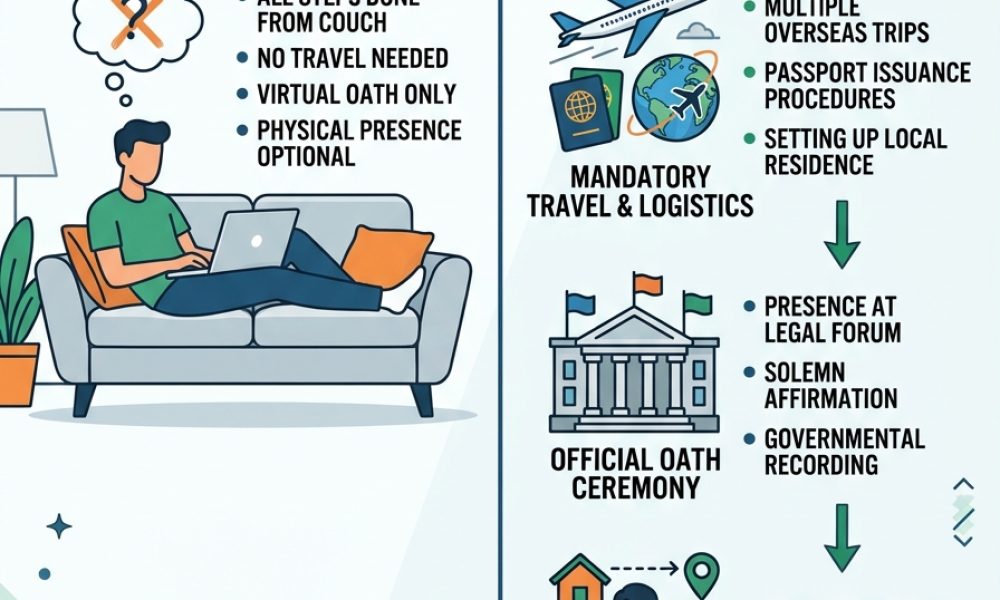
Applicants attracted by citizenship programs advertising little or no physical presence must distinguish residence obligations from mandatory interviews, sworn declarations, biometric enrollment, passport issuance, and later travel requirements before committing funds or arranging international relocation.
WASHINGTON, DC, November 8, 2026 — The promise of acquiring another nationality without relocating remains an important attraction of Caribbean citizenship-by-donation programs, but limited residence requirements do not necessarily mean every application stage can be completed remotely.
For business owners, retirees, and families with limited travel flexibility, the distinction between living in a country, visiting after naturalization, appearing for an interview, and satisfying an oath requirement can materially change a program’s practicality.
Current rules also demonstrate why applicants should examine each jurisdiction individually, since procedures may permit remote document preparation while preserving separate obligations involving identity verification, official ceremonies, biometric enrollment, or future passport renewal.
Residence and Physical Presence Are Different Legal Concepts
Residence usually concerns where an individual lives or maintains a qualifying legal connection. At the same time, a physical presence requirement may involve a brief visit that does not establish ordinary residence or permanent settlement under the applicable nationality statute.
Applicants should ask whether any requirement applies before filing, during government review, after citizenship is granted, or when a passport is renewed, because these stages create different obligations and possible deadlines under the current program regulations.
Antigua and Barbuda Has a Five-Day Requirement
Antigua and Barbuda requires investment citizens to spend at least five days in the country during the first five calendar years after acquiring citizenship, creating a limited but enforceable travel obligation for participating households.
Its official materials explain that failure to satisfy this obligation may lead to deprivation of citizenship, and applicants should not assume that a completed contribution protects them from consequences under the governing law.
The five days do not amount to a requirement to establish permanent residence. Still, they are a genuine travel commitment that should appear in every family timeline and post-approval budget for the relevant household members and children.
Passport Renewal Creates a Practical Checkpoint
Antigua and Barbuda’s passport guidance ties first passport renewal to evidence that the citizen completed the required five-day stay during the initial five-year period after acquiring citizenship, along with the required documentation supporting this condition.
Parents should also verify how the requirement applies to accompanying children and subsequently added relatives, because family schedules and individual citizenship dates can complicate a seemingly straightforward vacation plan in their individual post-approval documentation.
The Oath Can Be Taken Through Approved Remote Procedures
Antigua and Barbuda’s official oath application materials describe a process involving an authorized oath administrator, live audiovisual transmission to the citizenship authority, recorded identity verification, and submission of the prescribed forms with the appropriate government officials reviewing compliance.
That process can enable an applicant to complete the oath outside Antigua and Barbuda. Still, it requires compliance with formal witnessing and recording instructions rather than an informal video call arranged independently under the published government witnessing instructions.
Applicants should confirm the currently accepted procedure and its costs before scheduling, especially when overseas notaries, differences in local law, or technical problems could affect whether a declaration is accepted and any specific appointment arrangements.
Dominica Generally Requires No Relocation or Visit
Dominica’s citizenship authority states that applicants do not need to live in the country before or after obtaining nationality and generally do not need to visit as part of the investment citizenship application.
That arrangement can suit applicants who must continue working or caring for family elsewhere. Still, the absence of residence obligations does not eliminate documentation, background screening, government interviews, or final nationality formalities under the stated program requirements.
The country’s official process includes an oath of allegiance, which adults sign before an authorized witness, demonstrating why a no-travel policy should never be advertised as a process without personal legal responsibilities as part of the formal naturalization process.
Dominica’s Interviews Are Usually Virtual
Dominica requires applicants aged sixteen and older to complete an interview, usually conducted virtually, as part of the government’s screening process rather than as a substitute for other legal requirements for all covered participants in the application.
Families with several teenagers or adult dependants should confirm appointment arrangements and applicable charges for each person, particularly when relatives live in different time zones or have accessibility needs across the locations where they currently reside.
A Notarized Oath Is Still a Formal Legal Act
Dominica’s published application guidance provides that adult applicants sign an oath witnessed by a notary public or attorney. In contrast, parents sign on behalf of younger children, following the relevant official instructions for each person in the family application.
These procedures may be completed without establishing residence in Dominica. Still, the signatures, witness credentials, and delivery of acceptable originals or other prescribed materials remain essential to naturalization documentation under the relevant witnessing arrangements.
Citizenship recognition should therefore be confirmed through the government certificate rather than inferred from the date of an interview, the transfer of contribution funds, or a representative’s informal completion notice and supporting documents from the appropriate authorities.
St. Kitts and Nevis Also Advertises No Mandatory Residence
St. Kitts and Nevis states that its Sustainable Island State Contribution route has no mandatory travel or residence requirement, allowing applicants to pursue nationality while maintaining their ordinary homes and professional commitments overseas.
The Citizenship by Investment Unit nevertheless requires the principal applicant to attend an interview, which may be conducted virtually, in the federation, or at another location approved by the authorities as part of official due diligence.
Dependent applicants aged sixteen or older may also face interviews under applicable procedures, so confirm the actual travel commitment for each household member rather than inferring it from the brochure’s headline under the governing interview procedures.
Biometric Enrolment Is a Separate Practical Consideration
A September 2026 government brochure for St. Kitts and Nevis lists biometric enrolment as a distinct step after approval in principle and the qualifying investment, before completing the citizenship process, according to the current government application sequence.
This newer procedural description warrants direct confirmation of where enrolment can occur, which applicants must attend, and whether an approved overseas collection arrangement is available for the family concerned before relying on any remote processing promise.
Until the authority confirms those details, a claim of no mandatory residence should not be expanded into an unsupported guarantee that every identity check can be completed from an applicant’s living room for every participating family member.
Grenada’s Donation Route Requires Its Own Review
Grenada’s National Transformation Fund provides an investment citizenship pathway administered through authorized local agents, with prescribed identity, medical, police, and financial documentation reviewed before nationality can be granted within its official government assessment process.
The program does not require applicants to settle permanently in Grenada as a condition of applying through the fund. Still, applicants should verify current interview, witnessing, and passport procedures independently before deciding that all appointments are unnecessary.
Remote Processing Does Not Mean Delegating Every Responsibility
Authorized agents can collect documents, coordinate with government offices, arrange appointments, and transmit information. Still, applicants remain responsible for accurate disclosures and any personal appearances or declarations required by law for the principal applicant and eligible relatives.
No representative can lawfully impersonate an applicant during a required interview, manufacture an oath, or bypass biometric verification merely because the applicant has paid an approved government contribution or treat payment as a replacement for official attendance.
Document Preparation May Require Local Travel
Even where the citizenship authority permits remote filing, applicants may need to visit a police station, medical professional, notary, civil registry, or biometric collection provider in their present country of residence under the relevant documentary and verification procedures.
Foreign police certificates sometimes require fingerprint submissions or an identity appointment. At the same time, civil records from earlier countries of residence may require additional verification that an authorized immigration agent cannot perform independently while preparing the official application package.
Family Members Can Face Different Appointments
A principal applicant’s ability to complete an interview by video does not guarantee that every dependent follows the same procedures, because age thresholds, medical circumstances, and oath rules may differ across applicable family and age categories.
Parents should establish who must sign for younger children, which teenagers face interviews, and whether older relatives need independent identity verification before arranging a combined family application from different locations in accordance with each applicant’s circumstances.
When one household member cannot travel or attend a required appointment, the problem may delay individual documentation or disrupt the family’s plans, even when the principal applicant’s eligibility is undisputed under the relevant program rules for the household.
Travel Commitments Have Real Financial Costs
Antigua and Barbuda’s five-day requirement can involve airfare, accommodation, insurance, ground transportation, and time away from work, expenses that may become significant when several qualifying relatives must satisfy the obligation, particularly when more than one generation is included.
An elderly family member’s health needs or a child’s school schedule can make even a short visit difficult, so applicants should compare the travel requirement against their foreseeable circumstances before choosing a program.
A budget that accounts only for the contribution and government application fees may therefore understate the cost of maintaining compliance over several years after initial approval and passport issuance, as well as the longer-term obligations attached to citizenship.
Missing a Deadline Can Have Legal Consequences
The distinction between an optional visit and a prescribed presence condition is critical, because a statutory requirement can affect the continuation of citizenship or the handling of passport renewal applications under the governing citizenship law.
Applicants should not assume that private assurances of flexibility override legislation, particularly where the government explicitly identifies potential deprivation of citizenship for failing to complete its required visit even after a substantial contribution has been paid.
Changing European Policies Affect the Broader Decision
An October 29, 2026, Reuters report on European pressure affecting Caribbean citizenship programs described negotiations over the future of investor citizenship and the possibility of restrictions on visa-free travel arrangements affecting countries with investment citizenship programs.
The absence of residence requirements may be convenient. Still, practical mobility depends on destination-country rules that can evolve after the qualifying contribution becomes nonrefundable and long after the original application is approved.
A Passport Does Not Remove Other Countries’ Entry Rules
Citizenship can establish a right to live in the issuing country. Still, it does not automatically grant employment authorization or permanent residence in unrelated states that recognize the passport for short tourist visits.
A family hoping to use Caribbean nationality as a basis for relocation to Europe or Asia must review the destination’s visa and residence requirements rather than assume no-passport citizenship provides immigration permission elsewhere.
Americans Retain Specific Passport Obligations
The U.S. Department of State’s dual-nationality guidance explains that American citizens must enter and depart the United States using their American passports even when they lawfully hold another nationality under the applicable federal nationality rules.
Dual nationality also does not automatically end American tax obligations or other legal responsibilities, so receiving citizenship without visiting the issuing country should not be confused with changing tax residence or abandoning existing citizenship.
Applicants should obtain qualified advice before rearranging international financial affairs, particularly when their objectives involve trusts, businesses, property, or family members whose legal residence differs from the principal applicant’s in multiple countries and tax jurisdictions.
Passport Authentication Cannot Prove Presence Compliance.
A modern passport may carry electronic security information that compatible readers can authenticate. Still, a successful chip scan does not establish whether its owner completed a required visit or properly took an oath.
Amicus International Consulting’s guide to scanning passport NFC chips and interpreting the results distinguishes technical document checks from broader nationality and administrative questions that depend on government records and require separate authoritative evidence.
Citizens should preserve travel evidence, oath documentation, naturalization certificates, and official renewal correspondence separately, recognizing that electronic authenticity does not establish current compliance with every legal condition under the current legal framework governing citizenship.
A Detailed Application Plan Should Include Every Milestone
Families exploring second passport planning and mobility options through Amicus International Consulting should request an individualized schedule covering document preparation, interviews, biometric appointments, payment, oaths, naturalization, and subsequent passport issuance for every family member included in the plan.
The schedule should distinguish physical attendance from legal residence and specify which steps require personal participation, particularly where dependants are dispersed internationally or have limited ability to travel in the particular country concerned.
Professional coordination can clarify the process, but only the responsible government can grant citizenship, approve official remote arrangements, or decide whether an applicant has met mandatory procedural conditions under the issuing jurisdiction’s requirements.
The Right Choice Depends on More Than Avoiding Relocation
For an applicant seeking another nationality without changing employment or family residence, a program with no ongoing physical presence obligation may provide flexibility that outweighs a modest difference in the contribution threshold rather than short-term marketing considerations.
Another household may accept Antigua and Barbuda’s short visit requirement because it can combine compliance with a planned family trip, provided the financial and administrative obligations remain manageable after comparing the household’s actual financial commitments.
Ultimately, residence conditions matter in donation-based citizenship plans because applicants need to understand not only where they must live, but also where and when they must appear, sign, verify identity, and maintain their new status.




