
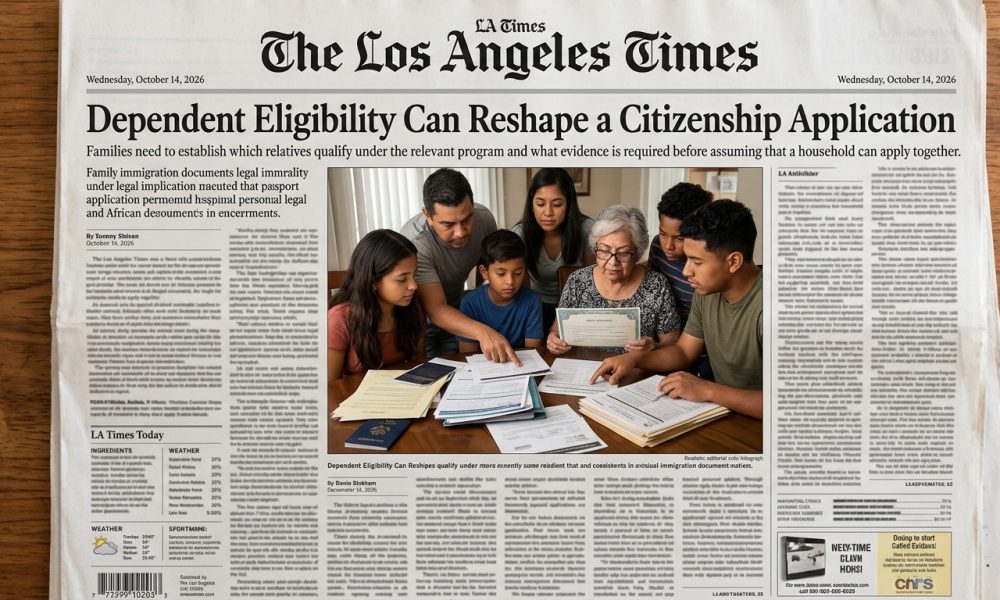
Spouses, children, parents, grandparents, and siblings may qualify differently across investment citizenship programs, making documentary proof, financial dependency, government screening, and the timing of family additions central to responsible second passport planning.
WASHINGTON, DC, November 8, 2026 — Families comparing citizenship-by-investment programs often start with the contribution advertised for four or more people, but the key question is whether every intended relative qualifies under the issuing country’s current legal definition of a dependent.
A household that appears straightforward on paper can become complicated when an adult child leaves education, a parent does not meet an age threshold, or an unmarried sibling qualifies in one jurisdiction but not another.
For applicants planning to relocate together, these differences can change the preferred country, government fees, documentation requirements, and the nationality’s eventual usefulness, even when the principal applicant easily meets the financial contribution threshold.
A Household Member Is Not Automatically a Qualifying Dependant
Citizenship programs define eligible relatives through legislation and administrative rules, not through a family’s informal understanding of who lives together, receives occasional support, or expects to participate in an overseas relocation within the program.
The principal applicant may be able to include a spouse and minor children while facing entirely different conditions for adult children, parents, grandparents, or siblings, especially when the program requires proof of continuing financial dependency.
Before calculating a household’s total contribution, applicants should prepare a complete family inventory recording each person’s relationship, age, marital status, nationality, education, residence, and financial circumstances, then compare that information against current government requirements.
Dominica Applies Specific Rules to Adult Children
Dominica generally recognizes a spouse and children younger than eighteen, while children aged eighteen through thirty may qualify if they attend a recognized institution of higher learning and receive full financial support from the applicant or spouse.
Its rules also address unmarried daughters younger than twenty-five who live with and receive full support from the applicant, as well as qualifying adult children with disabilities who depend on the relevant parent or spouse.
These categories cannot be reduced to a simple promise that every child younger than thirty qualifies, because university attendance, household arrangements, dependency, and other statutory conditions may matter in the actual application.
Parents and Grandparents Face Different Age Thresholds
Dominica’s published guidance generally requires qualifying parents or grandparents of the applicant or spouse to be older than sixty-five and substantially supported. At the same time, Antigua and Barbuda recognizes certain financially dependent older relatives beginning at fifty-five.
St. Kitts and Nevis also lists parents aged fifty-five or older who live with and are fully supported by the principal applicant, creating a material difference for a family whose parent lives independently elsewhere.
An applicant supporting a sixty-year-old parent should therefore review the relevant definition rather than assume the same relative would qualify across every Caribbean program simply because financial assistance is regularly provided under the rules in force.
Antigua and Barbuda Includes Some Sibling Categories
Antigua and Barbuda’s official citizenship guidance includes certain unmarried siblings of the principal applicant or spouse, a family category that can matter when adult brothers or sisters wish to obtain nationality through the same application.
A household seeking to include a sibling should confirm the applicable marital-status and documentary requirements, especially when advertising emphasizes the possibility of a large family application without explaining each person’s eligibility.
Grenada Has Its Own Approach to Extended Families
Grenada’s Investment Migration Agency describes dependants as potentially including spouses, children, parents, grandparents, and siblings, with its legislation imposing conditions on particular relatives rather than recognizing every extended family member automatically, under the official citizenship framework.
For example, published legislative provisions on sibling applications refer to qualifying brothers or sisters who are adults, unmarried, and without children, showing how a family relationship alone may be insufficient for inclusion under the governing statutory definition.
Grenada also publishes contribution exceptions and supplementary charges for certain siblings and younger parents or grandparents, making it important to distinguish the cost of including an eligible relative from the question of eligibility itself.
St. Kitts and Nevis Emphasizes Education and Support
The St. Kitts and Nevis Citizenship by Investment Unit lists children aged eighteen through thirty who attend a recognized secondary or tertiary institution full-time and receive full support from the principal applicant as potential dependants.
The same official guidance recognizes certain adult children with disabilities and qualifying parents aged fifty-five or older. Still, it does not include every adult sibling or independently employed child for families assembling supporting records.
Applicants comparing this jurisdiction with Antigua and Barbuda or Grenada should therefore focus on each family member’s qualifying category rather than assume that a larger initial contribution necessarily covers a wider selection of relatives.
Student Status Requires More Than a Verbal Assurance
When university attendance affects eligibility, authorities may need evidence of enrollment, the educational institution’s recognition, continuing attendance, and the financial support provided by the parent sponsoring the citizenship application, for an authorized official assessment.
A student taking an extended break, completing a degree, or earning enough income to become financially independent may face different questions than a younger sibling whose dependency is readily established through age under the government’s dependency criteria.
Before submitting a complete application, families should review the rules that apply when documents are filed and when government assessment continues, especially if graduation, employment, or a birthday could change the evidence available before a final decision.
Marriage and Relationship Evidence Can Be Decisive
A spouse’s inclusion ordinarily requires a legally recognized marriage and appropriate supporting records. At the same time, a partner in an informal relationship may not qualify merely because the couple has lived together for many years.
Previous marriages, divorces, adoption orders, guardianship arrangements, and surname changes can also affect how officials verify family relationships, especially when civil records originate in different countries or legal systems, throughout the application process.
The safest preparation involves authentic certificates and explanations linking the relevant records, rather than assuming an agent can substitute informal statements for documents required by a government’s nationality legislation in its current checklist.
Disability-Related Categories Require Careful Application
Several Caribbean programs recognize certain adult children with physical or mental disabilities under specific dependency provisions. However, legal requirements and acceptable medical or financial evidence differ by jurisdiction under their nationality regulations.
Families should avoid assuming that one diagnosis automatically qualifies a relative, because the assessment can also concern support arrangements, the parent’s relationship, and the precise wording of applicable statutory categories, before obtaining relevant professional advice.
A respectful application should provide only relevant, accurate evidence requested through authorized channels, while ensuring the family understands how eligibility decisions may affect long-term care and relocation arrangements through a documented lawful process.
Government Fees Change With the Ages of Dependants
Dominica publishes due diligence charges for qualifying dependants aged sixteen or older. Antigua and Barbuda uses several age-related categories, and Grenada publishes its own screening, processing, and interview fee arrangements under each country’s current schedule.
A family with two small children can consequently face different expenses from another family with teenagers, even where both receive the same advertised contribution quotation for a principal applicant and three dependants, once individual government charges are included.
Written estimates should identify every proposed participant and show the qualifying contribution separately from investigations, interviews, naturalization certificates, passport issuance, translations, and professional services, without relying on an unqualified family-of-four price, for all participating family members.
Missing Documents Can Alter the Processing Schedule
Adult relatives may need police certificates from previous countries of residence, educational records, proof of support, and documents establishing parentage or another legally recognized relationship, in addition to standard identity requirements, under the current national eligibility criteria.
Obtaining official documents from several jurisdictions can require certified translations, apostilles, replacement certificates, or corrections to historical civil records, all of which can extend preparation before the government accepts a complete submission, before a legally complete application can proceed.
An application is therefore not necessarily ready merely because the principal applicant has assembled a passport and financial statements, particularly when the citizenship outcome must accommodate multiple relatives with different histories, through the official citizenship authority.
Financial Sponsorship Can Require Additional Examination
A parent or other relative who provides the investment funds may need to demonstrate the lawful source of wealth and the precise origin of the contribution, especially when the principal applicant is not personally financing the transaction.
Authorities can also request evidence that dependent relatives receive meaningful support, making financial records relevant to both anti-money-laundering screening and the statutory definition of an eligible family member, where the relevant legal conditions apply.
Applicants should describe financial relationships accurately and distinguish an independent adult receiving occasional gifts from a dependent whose circumstances meet the rules, rather than presenting unsupported assertions of financial reliance or mischaracterizing their actual financial independence.
Adding Relatives Later Is Not Always Equivalent
St. Kitts and Nevis publishes post-citizenship addition procedures for certain new spouses, newborn children, and qualifying relatives who reach eligibility after the principal applicant acquires nationality, subject to specific fees and conditions, in accordance with published administrative provisions.
Its official guidance also cautions that dependants already eligible but omitted from the original application may not be able to use the same later-addition route and may instead require a separately sponsored application, under the detailed post-approval policy.
This distinction makes early household planning important, because postponing one relative’s inclusion for convenience or cost reasons may produce different procedures and expenses from applying together at the outset, throughout the family’s long-term planning.
Refusal or Delay Can Affect the Entire Family Plan
Each participating person may undergo background screening, and an unresolved identity question, missing record, or eligibility problem involving one relative can complicate the timetable for a household expecting simultaneous citizenship documentation during the official government review.
A refusal of one dependent does not automatically determine the outcome for everyone else. Still, it may require the family to reconsider the contribution structure and whether relocating together is feasible under the program’s decision procedures.
Applicants should ask authorized representatives how the specific government’s procedures address amendments, withdrawals, and individual decisions, rather than assume that all members are necessarily approved or refused as an inseparable group, at the start of the engagement.
Regional Scrutiny Makes Accurate Records More Important
An October 2026 Reuters report on European pressure affecting Caribbean citizenship programs described demands for tighter control of investment-linked nationality and uncertainty surrounding the future of valuable visa-free travel arrangements, as those programs face diplomatic scrutiny.
These developments do not mean that every existing citizenship is canceled. Still, they reinforce why governments and applicants have strong reasons to maintain reliable identity records and complete screening for every family participant.
Families should also distinguish the domestic rights associated with lawfully granted nationality from visitor privileges controlled by foreign governments, because changes in visa policy can affect whether a household’s anticipated travel benefits remain available.
Another Passport Does Not Automatically Cover Other Countries
The U.S. Department of State’s dual-nationality guidance explains that Americans with another nationality generally remain subject to applicable U.S. legal obligations, including passport requirements affecting entry and departure, under the applicable federal legal framework.
A Caribbean passport may provide rights in its issuing country without granting permanent residence or employment in unrelated destinations. At the same time, an adult relative who does not qualify for citizenship may require a separate visa.
Families should examine the actual destination of any planned relocation and each person’s immigration status, rather than treating a principal applicant’s nationality acquisition as unrestricted permission for the entire extended household to settle abroad.
Passport Verification Cannot Establish Family Eligibility.
Modern biometric passports contain electronic identity information and security features that compatible readers can examine. Still, a successful chip scan cannot establish whether an adult relative originally met the applicable dependency definition under the underlying nationality legislation.
Amicus International Consulting explains such distinctions in its guide to scanning a passport’s NFC chip and interpreting the results, separating technical authentication from the government’s legal determination of nationality, in an official identity-document examination.
Official certificates and citizenship records should therefore remain central to a family’s documentation, alongside current passport status and destination rules, rather than unsupported claims that electronic authentication resolves every administrative or immigration question.
Professional Advice Should Start With a Family Eligibility Map
Families researching lawful second passport planning through Amicus International Consulting should start with a person-by-person assessment of legal relationships, ages, financial support, education, and intended future residence before selecting a program, based on the citizenship program’s current criteria.
A credible written proposal should immediately explain who qualifies, which relatives require additional evidence, what each inclusion costs, and whether future additions are available under the governing regulations and current official eligibility rules.
Professional assistance can organize a legitimate application and clarify official instructions. Still, no private adviser can invent family relationships, waive government checks, or guarantee that every household member will receive citizenship.
The Full Household Outcome Matters More Than the Headline
A program with a lower contribution may prove unsuitable when a financially supported parent or adult sibling cannot qualify. At the same time, another jurisdiction’s more expensive route may accommodate the relevant family category, with independent government eligibility verification.
The comparison should also include document preparation, individual screening, future family additions, and residence rights, because a low initial price may not deliver the combined nationality outcome the household needs in each jurisdiction.
Ultimately, dependent eligibility can reshape a citizenship application because nationality laws evaluate individuals rather than an informal family grouping, making accurate relationships, verified evidence, and current government rules indispensable before any substantial payment.




