
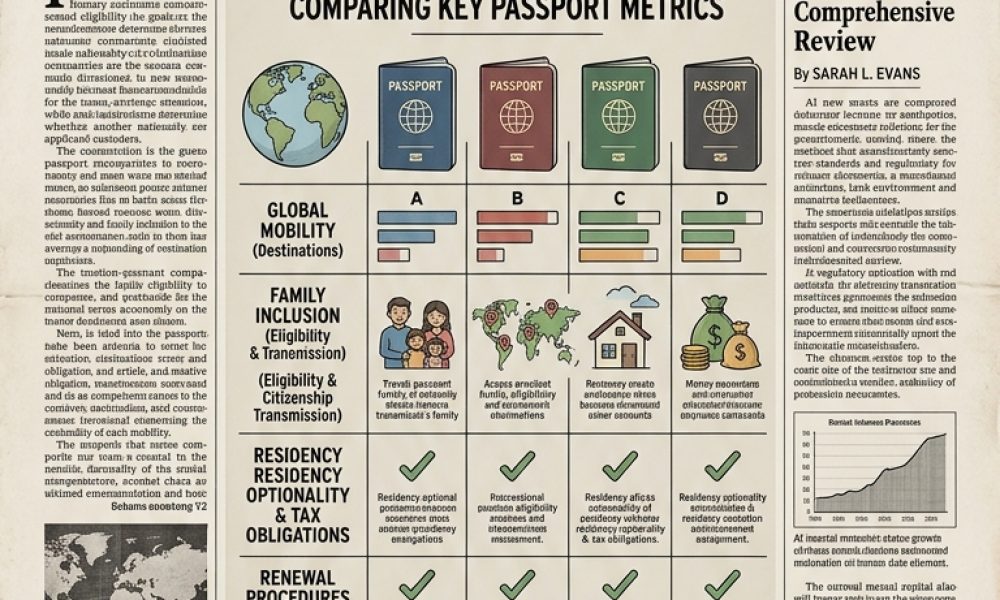
Passport rankings highlight how many destinations offer visas on arrival. Still, families evaluating second citizenship must also consider permanent residence, employment opportunities, dependent eligibility, government screening, financial responsibilities, and the practical value of another nationality.
WASHINGTON, DC, November 5, 2026 — International passport rankings have become influential marketing tools for second citizenship programs. Still, the number of destinations accessible without advance visas offers only part of the picture of what another nationality can provide to individuals and families.
For Americans considering ancestral citizenship, investment migration, or long-term relocation, the more consequential questions often involve where they can permanently reside, whether family members qualify, and which legal responsibilities accompany the new nationality.
A passport that offers broad tourist access may offer little help to an applicant whose main goal is to establish a family home, pursue employment, protect long-term mobility options, or arrange retirement in another country.
Passport Rankings Measure Travel Access Rather Than Overall Citizenship Value
Most international passport rankings evaluate how many destinations holders can visit without securing a conventional visa before departure, creating a useful numerical comparison for travelers but an incomplete one for prospective emigrants.
Someone who regularly attends international business meetings may value broader visa-free access. At the same time, a family seeking permanent residence should focus more on employment authorization, public services, schooling, and long-term settlement rights.
The distinction matters because visa-free travel generally covers short visits under specified conditions. In contrast, citizenship can establish broader rights within the issuing country that do not appear in ordinary destination counts.
The 2026 Rankings Highlight International Differences
A July 24, 2026, Euronews report examining the world’s strongest passports described Singapore’s leading position in the Henley Passport Index, alongside strong results for Japan, South Korea, the United Arab Emirates, and several European countries.
The July ranking placed Singapore at 192 destinations accessible without a prior visa, while Japan, South Korea, and the United Arab Emirates shared second position with access to 188 destinations.
Those figures demonstrate the considerable differences in international visitor privileges. Still, they do not establish that the highest-ranked passport is necessarily the most appropriate additional nationality for every prospective applicant.
A Highly Ranked Passport May Offer Limited New Benefits
An American already possessing extensive visa-free access may gain relatively few additional tourist destinations from certain second citizenships, even when the new nationality provides valuable rights to reside permanently in its issuing country.
The practical benefit may therefore arise from legal residence, employment opportunities, family connections, or future contingency planning rather than a dramatic improvement in the number of countries available for short visits.
Applicants should compare the destinations that matter to them rather than relying exclusively on total scores, especially when most additional destinations are unlikely to feature in their professional or personal travel plans.
Permanent Residence Can Be More Important Than Tourist Access
Citizenship ordinarily establishes a legal relationship with the issuing country that can include the right to live and work there without maintaining the temporary residence permission required of foreign nationals.
For families considering international relocation, that enduring right may be more valuable than access to several additional tourist destinations, especially when household decisions involve employment, accommodation, education, and healthcare.
A person choosing between nationality programs should therefore distinguish the rights available in the issuing country from visa-waiver arrangements governing unrelated destinations, because those benefits serve fundamentally different objectives.
Regional Rights Can Expand the Practical Comparison
Citizenship in a European Union member state generally provides rights associated with European Union law, including the ability to live and work in other member states subject to applicable conditions and administrative requirements.
Those regional opportunities can be particularly significant for professionals and families seeking access to multiple European labor markets, even when a competing passport offers a similar number of visa-free tourist destinations.
However, applicants must review the specific nationality and applicable regional arrangements, since citizenship in a European country outside the European Union does not automatically grant identical freedom of movement rights.
Ancestral Citizenship May Provide a Different Financial Opportunity
Individuals with qualifying parents or grandparents may have citizenship rights through descent, potentially offering a route that avoids the substantial government contributions associated with citizenship-by-investment programs.
Nevertheless, eligibility depends on the relevant country’s nationality legislation, family history, and documentary evidence establishing the legal relationship between the qualifying ancestor and the applicant.
A lower-cost ancestral pathway may offer considerable long-term value, but families should account for record searches, citizenship recognition, official certificates, passport issuance, and any limitations affecting future generations.
Family Eligibility Changes the Value of a Second Nationality
A passport may seem attractive for one applicant. Still, its usefulness can change considerably when a spouse, children, or dependent relatives cannot obtain equivalent citizenship or residence authorization.
Some nationality laws allow children to acquire citizenship through qualifying parents, while others impose registration requirements, generational limits, or conditions tied to parental residence and the timing of birth.
A realistic family comparison should identify every household member’s legal position separately, rather than assuming an approved principal applicant automatically provides permanent relocation rights to the entire family.
Spouses May Need Separate Immigration Permission
Marriage to a citizen does not necessarily confer immediate nationality, and a foreign spouse may require sponsorship, permanent residence approval, or another immigration pathway before establishing a lawful home abroad.
These applications can require evidence of the relationship, financial support, background checks, and government processing, making the spouse’s position an important factor when comparing possible second-citizenship destinations.
Applicants should also examine employment authorization for accompanying partners, particularly when the household depends on two incomes or when professional qualifications must be recognized after arrival in the destination country.
Future Generations Deserve Their Own Assessment
Citizenship transmission rules can affect the children and grandchildren of today’s applicants, making long-term family planning another consideration that a passport’s position in an international ranking cannot capture.
Some countries distinguish children born domestically from those born abroad, while others require registration, substantial parental residence, or additional evidence before recognizing nationality in successive overseas generations.
Families should review those rules before committing substantial resources, especially when preserving future mobility options for descendants is a principal reason for pursuing an additional citizenship.
Government Approval Remains Central to Investment Programs
Citizenship-by-investment programs can offer lawful nationality routes where governments have established appropriate legislation, but applications remain subject to official eligibility requirements, financial commitments, background investigations, and administrative approval.
A commercial advertisement describing extensive travel privileges does not establish that an applicant will qualify, because authorized government departments remain responsible for evaluating identity, financial history, and applicable conditions.
Prospective investors should verify official program status, approved representatives, screening requirements, and all government charges rather than treating a passport ranking as evidence that a commercial offer is trustworthy.
The Real Cost Extends Beyond the Main Contribution
An investment citizenship quotation may include a substantial qualifying contribution while excluding professional services, due diligence, dependent charges, passport applications, translation, and other administrative expenses that affect the complete budget.
Ancestral citizenship may avoid a large investment but still require extensive genealogical research, official records, and legal advice, particularly when earlier family documents contain inconsistencies or missing information.
Comparisons should therefore reflect total costs for every participating family member, together with realistic processing expectations and the financial consequences of refusal, delay, or changes in program requirements.
Tax Responsibilities Do Not Disappear With Another Passport
Obtaining another citizenship does not automatically change an individual’s tax residence, eliminate previous financial reporting responsibilities, or create a separate financial identity recognized by regulated institutions.
The U.S. Department of State’s official dual-nationality guidance explains that American dual nationals generally retain legal responsibilities in both countries, including obligations tied to American nationality.
Applicants maintaining businesses, retirement accounts, investments, or overseas property should examine taxation and financial reporting separately from citizenship acquisition, particularly when the proposed relocation may create additional obligations.
International Banking Requires Its Own Eligibility Review
Some citizenship advertisements emphasize improved banking access, but regulated financial institutions generally assess residency, identity, source of wealth, tax information, and customer suitability rather than approving accounts solely because someone possesses another passport.
A newly acquired nationality may provide acceptable Identification, but it does not guarantee financial privacy, credit approval, or access to every service banks offer in the issuing country.
Applicants should consider their legitimate financial objectives and obtain qualified advice before assuming that a passport with strong travel privileges necessarily provides superior banking arrangements or asset Protection.
Passport Security Is Different From Citizenship Rights
Modern biometric passports include electronic security features that help compatible systems verify identity information and assess cryptographic protections, supporting document inspection without independently establishing every legal right the traveler holds.
Amicus International Consulting explains these distinctions in its guide on scanning a passport’s NFC chip and understanding the results, separating electronic authentication from administrative validity and broader nationality questions.
A successfully authenticated passport may still be expired, canceled, or unsuitable for particular travel arrangements, showing why technical document checks cannot replace current official guidance on entry or residence rights.
Dual Nationals Must Follow Country-Specific Travel Rules
Different countries may require their own citizens to present national passports when entering or departing, meaning multiple travel documents do not allow unrestricted substitution on every international journey.
American dual nationals must use United States passports for entry and departure, while the rules of another country of citizenship may create separate documentary obligations at its borders.
Applicants should review these practical requirements before travel, especially when itineraries involve multiple airlines, transit countries, or family members with different citizenship combinations and passport validity dates.
Consular Protection Can Differ for Dual Citizens
Another nationality does not necessarily increase diplomatic Protection in every circumstance, because a country may treat its dual citizen primarily as a domestic national. At the same time, the individual is present within its territory.
This can affect access to assistance from another country’s consular representatives, particularly during legal disputes, detention, or emergencies where local authorities apply their own nationality laws.
Applicants should therefore investigate the responsibilities and possible restrictions associated with each citizenship, rather than assuming that holding additional passports automatically produces greater Protection in every jurisdiction.
Residence Planning Requires Practical Research
A family planning to relocate should research housing, employment, education, healthcare, insurance, and community arrangements before choosing another nationality, because citizenship alone cannot build a sustainable household overseas.
The destination’s language, local infrastructure, professional licensing requirements, and cost of living may determine whether relocation is successful, even when the passport provides impressive international travel privileges.
An extended lawful trial visit can help families evaluate everyday conditions more realistically than tourism marketing, particularly when the proposed destination has unfamiliar administrative systems or significant regional differences.
Political and Economic Changes Can Alter Passport Benefits
Visa-waiver agreements, immigration rules, and international relationships can change, meaning a passport’s ranking should be understood as a measure of access at a particular time rather than a permanent guarantee.
A nationality that provides extensive visitor privileges today may later face revised authorization requirements, while enduring domestic citizenship rights could remain valuable despite changes affecting entry into third countries.
Families should therefore weigh long-term legal stability and practical residence opportunities alongside current travel scores, especially when another citizenship forms part of a strategy spanning several generations.
Privacy Claims Require Careful Examination
Some second-passport marketing links additional nationality to discretion or international privacy, but genuine citizenship does not remove standard border Identification, banking compliance, or legally required disclosure procedures.
Lawful privacy planning may involve secure communications, careful management of sensitive records, and appropriate professional assistance, while remaining consistent with government identity verification and financial reporting obligations.
Applicants should question claims suggesting that another passport creates an unrelated identity or eliminates established legal history, because those promises confuse legitimate nationality rights with misrepresentation and possible fraud.
Applicants Need a Personal Measure of Passport Value
The most useful comparison begins with identifying the applicant’s actual goals, whether those involve frequent business travel, permanent residence, family security, retirement, employment, or preserving options during future instability.
A nationality that meets those objectives may provide greater practical value than a higher-ranked passport whose additional destinations are irrelevant to the applicant’s circumstances or whose acquisition requirements impose disproportionate costs.
Each choice should be examined against official eligibility rules, household needs, ongoing responsibilities, and the realistic opportunities available after citizenship is legally established and the relevant documents are issued.
Destination Counts Are Only the Beginning
Passport rankings offer a useful starting point for global mobility. Still, they do not measure family eligibility, citizenship transmission, residence rights, healthcare access, financial responsibilities, or a destination’s practical suitability.
For prospective applicants, a well-informed decision requires comparing the complete legal and personal consequences of another nationality rather than treating the number of visa-free destinations as the decisive measure.
Ultimately, second passport comparisons need more than destination counts because the true usefulness of citizenship depends on how effectively its rights, responsibilities, costs, and long-term opportunities align with the applicant’s individual and family objectives.




