
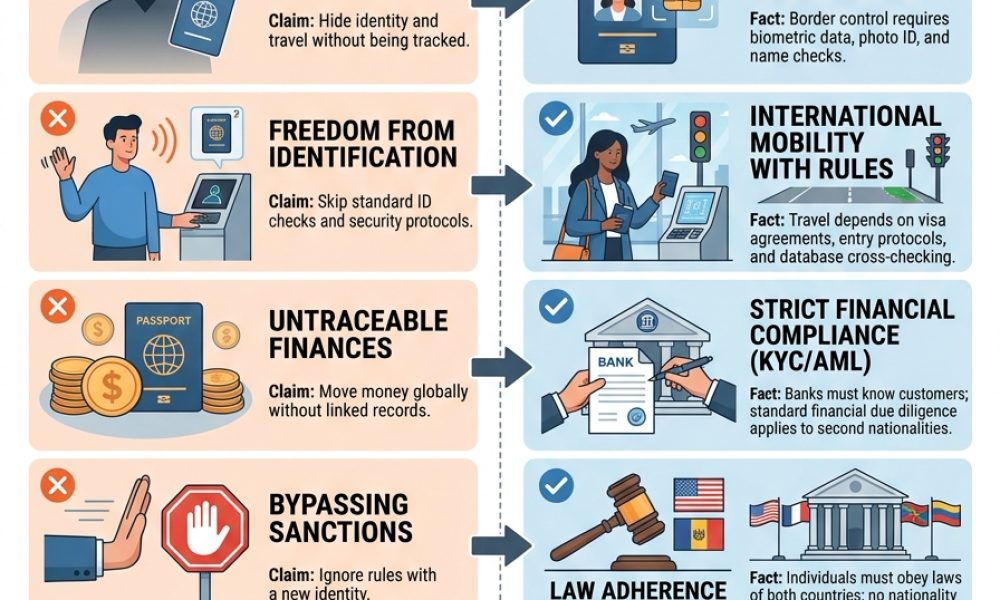
Second citizenship can support lawful mobility and personal privacy. Still, advertisements promising anonymous international travel deserve careful examination because passports, airline manifests, biometric procedures, and financial Identification rules remain important features of modern border systems.
WASHINGTON, DC, November 5, 2026 — Second passport advertisements increasingly appeal to travelers seeking discretion, personal security, and the freedom to relocate, but claims that another nationality permits anonymous border crossings can obscure the Identification requirements airlines and immigration authorities enforce.
For business owners, public figures, families concerned about personal safety, and individuals seeking a quieter life overseas, lawful privacy may be a valuable objective. Yet, it differs fundamentally from concealing identity from officials authorized to inspect travel documents.
An additional citizenship can establish residence rights and different travel permission. Still, it does not create an unrelated personal history, erase existing government records, or guarantee entry without verifying the traveler and their documentation.
Privacy and Anonymity Are Not Interchangeable
Privacy during travel can involve limiting unnecessary public exposure, selecting discreet accommodation, protecting booking information, and controlling the circulation of personal details without misrepresenting identity to a government agency or regulated service provider.
Anonymity, by contrast, suggests that the person’s identity cannot be determined, a claim difficult to reconcile with international aviation procedures that routinely require passport particulars, passenger information, and documentary confirmation before an aircraft departs.
Consumers should ask what a service actually protects, who receives their information, and whether advertised anonymity merely describes reduced publicity rather than exemption from lawful Identification checks at borders, hotels, or banks across multiple international travel systems.
An Additional Passport Does Not Remove Border Screening
Citizenship determines a person’s legal relationship with a country. At the same time, a passport provides evidence of identity and nationality for travel, making it inaccurate to describe a government-issued second passport as permission to cross borders without Identification.
Different passports may offer different visa privileges and residence rights. Still, immigration authorities can examine travelers under applicable law, including questions about their itinerary, admissibility, documentation, and purpose of entry.
A traveler with two authentic passports should therefore treat each as a legitimate document serving defined legal purposes, not as a way to become invisible to international transport operators or public authorities.
Recent Reporting Describes Expanding Biometric Controls
An October 2025 Reuters report on expanded United States border facial recognition described rules broadening biometric collection for foreign nationals entering or leaving the country, alongside debate about privacy protections and the reliability of automated Identification.
The report highlighted the government’s stated interest in identifying overstays and document fraud. At the same time, privacy advocates raised questions about surveillance, retention, accuracy, oversight, and the consequences of expanding biometric checks across more transportation settings.
These developments show why advertisements promising travel without scrutiny should be assessed against current border practices, rather than relying on older assumptions about how far international movements can remain unrecorded in today’s border operations.
A passport acquired through descent may be especially useful when it grants a genuine right to live in an ancestral country. Still, that citizenship does not remove routine booking records, passport inspections, or Identification duties outside that country.
Airlines Collect Information Before Passengers Arrive
International carriers commonly transmit advance passenger information drawn from travel documents to relevant governments, meaning Identification procedures often begin well before an aircraft reaches the destination or a traveler encounters an immigration officer.
Ticket reservations, check-in procedures, passport inspection, and passenger manifests can involve different organizations, each handling identifying information for operational, legal, or security purposes under the rules that apply to the international journey and the countries involved.
Travelers seeking legitimate confidentiality should examine provider privacy policies and data-sharing practices. Still, they should not assume that a private booking arrangement eliminates mandatory transmission of identity information to border authorities during international journeys involving several jurisdictions.
Facial Comparison Creates Another Verification Layer
United States Customs and Border Protection describes facial comparison as a tool for checking whether a traveler matches photographs associated with passports, visas, or previous government encounters, rather than treating a passport number alone as sufficient Identification.
The agency’s official explanation of its biometric travel procedures identifies circumstances in which border personnel or travel partners may capture photographs, subject to the applicable rules and procedures governing different categories of travelers.
Biometric systems raise legitimate questions about notice, retention, accuracy, and available alternatives. Still, their existence makes it especially difficult to substantiate claims that a new passport guarantees untraceable international movement during inspections at international transportation facilities.
Facial Recognition Has Limitations and Safeguards
Automated comparison is not infallible, and outcomes can depend on image quality, technical performance, and the processes used when the system cannot confidently match a traveler to available government photographs at busy international border checkpoints.
Officials may perform manual inspection or additional checks where an automated result is inconclusive, so a marketing claim that biometric screening always identifies everyone perfectly would be as misleading as a promise that screening never occurs.
Individuals concerned about privacy should consult the rules governing the specific country and inspection system, including any applicable alternatives, rather than assuming procedures are identical for citizens and foreign nationals before planning their next overseas journey.
Second Citizenship Can Provide Genuine Mobility Benefits
For qualifying applicants, another nationality can offer lawful residence, employment opportunities, and easier short-term travel to certain destinations, particularly where citizenship provides rights unavailable through an ordinary visitor visa as part of legitimate international relocation planning.
These benefits can matter for families considering overseas relocation or professionals whose work requires repeated international travel. Still, the exact advantages depend on the issuing country and the destination’s current rules.
A responsible citizenship comparison should emphasize verified entry privileges and residence rights while acknowledging that additional nationalities may also bring duties, documentation requirements, and restrictions that vary by jurisdiction, traveler, and destination.
Some applicants also compare investor citizenship routes, which can involve substantial government contributions and multiple background investigations. Still, neither the payment amount nor nationality approval exempts travelers from travel Identification in another sovereign country.
Visa-Free Travel Is Not Travel Without Identity
Visa waivers can remove the requirement to obtain a conventional visa before a visit. Still, they do not eliminate passports, entry conditions, airline checks, or immigration officials’ authority to examine travelers.
A dual national entering a third country under one passport’s visitor privileges may still need an electronic authorization, proof of onward travel, or separate permission for activities extending beyond temporary tourism, depending on the destination and the visitor’s actual purpose of entry.
Marketing materials should clearly distinguish visa-free access from anonymous entry, since those ideas describe entirely different legal circumstances and can lead consumers to make costly decisions based on exaggerated expectations in regulated cross-border travel settings.
Legal Name Changes Preserve Historical Continuity
A person may lawfully change a name through authorized court or administrative procedures. Still, the new name does not automatically cancel earlier records, remove legal obligations, or establish a fictitious birthplace or family history.
Government applications and regulated financial services may require disclosure of previous names when those details are material, meaning privacy planning should focus on lawful handling of sensitive information rather than intentionally inconsistent Identification.
Treat offers to manufacture unrelated identities or supporting documents as potential fraud risks, especially when a promoter claims payment can guarantee a complete break from authentic civil and immigration records.
Passport Chips Authenticate Narrow Technical Features
Electronic passports contain contactless chips that store specific identity information and security data, allowing compatible readers to verify certain electronic characteristics without independently confirming every aspect of the booklet’s administrative status at international border inspection checkpoints.
Amicus International Consulting’s guide to scanning a passport NFC chip explains the difference between reading stored information, authenticating digital signatures, and the separate question of confirming whether an issuing authority currently recognizes a particular document for international travel.
A successful chip scan cannot prove that a passport has not been canceled or that the holder may enter any destination, and it certainly does not establish the absence of government identity records.
Commercial Anonymity Claims Need Specific Evidence
A provider advertising anonymous travel should explain whether its offering involves confidential itinerary management, private transportation, secure communications, or another lawful service, because each has different practical and regulatory limitations under the applicable legal framework.
Statements suggesting that a second nationality prevents border agencies from identifying an individual require scrutiny, since passport issuance and international arrival procedures necessarily involve official identity records, documentary checks, and important legal obligations.
Consumers should request written descriptions of the service, its limitations, applicable law, and payment terms before accepting sweeping assurances that sound more like promises of evasion than legitimate travel planning when preparing for travel internationally.
Private Aviation Still Operates Under Border Rules
Chartered aircraft can offer scheduling flexibility, controlled passenger environments, and greater discretion than crowded commercial terminals. Still, international private flights remain subject to applicable customs, immigration, aviation, and reporting requirements for passengers undertaking international journeys.
Operators and passengers may need to provide identifying information, obtain permissions, and comply with departure or arrival procedures, irrespective of whether the cabin is privately occupied or the journey is arranged through a concierge.
The appropriate benefit to advertise is control over certain logistics and public exposure, not the ability to bypass sovereign borders or conceal travelers from authorities empowered to inspect them in any country visited.
Hotels and Financial Institutions Also Verify Identity
Depending on national and local rules, hotels may request government Identification and maintain guest registers. At the same time, banks commonly apply customer Identification, beneficial ownership, and source-of-funds requirements before providing regulated services when travelers arrive from another country.
Another passport can serve as authentic Identification, but it does not automatically exempt its holder from these procedures or ensure that previous citizenships and financial relationships may be withheld when disclosure is legally required.
Travelers seeking greater privacy can look for clear data-handling policies and appropriate professional assistance, while recognizing that legitimate confidentiality is not equivalent to providing incomplete or false information to regulated organizations during normal international travel.
Family Travel Complicates Promises of Complete Discretion
Households moving abroad must consider the nationality, passport validity, residence rights, and documentary needs of every member, because one parent’s additional citizenship does not necessarily authorize a spouse or adult child to settle.
Children may require birth records, custody documentation, or consent for international travel, and those requirements cannot be dismissed merely because a family understandably wishes to keep its movements private from unnecessary public attention or avoid unnecessary publicity.
An effective family mobility plan emphasizes lawful travel permissions and secure record-keeping, especially when younger or vulnerable relatives depend on accurate documents for school enrollment, healthcare, and daily life during a lengthy international relocation.
Families should be especially cautious when a provider markets privacy as a guarantee against recognition by acquaintances, financial institutions, or governments, since no responsible adviser can control every independent record, inspection decision, or disclosure law in each jurisdiction.
Safety Concerns May Justify Legitimate Privacy Measures
People facing harassment or credible personal threats may have sound reasons to minimize publicity, manage digital exposure, and investigate lawful relocation, including appropriate protective arrangements supported by qualified advisers before making substantial international relocation commitments.
These circumstances deserve careful attention, but a passport marketed as a replacement identity cannot remove the need to comply with immigration rules or substitute for available judicial Protection, professional safety planning, and emergency assistance where appropriate under local law.
Privacy planning should also consider secure communications, accommodation access, reliable transportation, and destination-specific risks, rather than treating a citizenship document as a complete personal-security solution and as a substitute for international travel compliance duties.
Applicants Should Evaluate Their Own Legal Obligations
Dual nationals may remain subject to the laws of both countries of citizenship, including passport-use requirements and certain legal responsibilities, and another nationality does not automatically remove obligations incurred elsewhere throughout the period of dual nationality.
Accurate disclosure matters most when an applicant has ongoing court matters, unresolved financial obligations, or restrictions on departure, because misrepresentation can create new consequences instead of solving the original problem.
Qualified counsel can explain the governing requirements and available lawful options. At the same time, responsible travel advisers should avoid suggesting that a passport permits someone to disregard a valid legal process when advising clients about international mobility.
Verifiable Government Procedures Matter More Than Promises
A legitimate citizenship application should identify the issuing government’s authority, the applicable eligibility basis, official documentation, and the procedures by which nationality and any passport will ultimately be recognized before any substantial funds are transferred.
Applicants may pursue citizenship through descent, residence-based naturalization, or an authorized investment route where available. Still, those processes remain subject to their own laws and cannot be replaced by a private declaration of identity.
Independent confirmation of government requirements can help distinguish credible professional assistance from advertisements offering guaranteed approvals, secret documents, or freedom from screening without any identifiable statutory basis before a consumer agrees to payment.
A Useful Privacy Strategy Is Honest About Its Limits
Thoughtful international mobility planning can combine lawful second citizenship, careful itinerary management, reliable documentation, and selective disclosure of personal information when no legitimate business or legal purpose requires wider circulation for travelers with different individual circumstances.
The strongest arrangements identify the authorities that must receive information, the private organizations involved, and the choices available to reduce unnecessary exposure without interfering with mandatory government screening, withholding legally required disclosures, or falsifying any official identity or financial records.
Ultimately, anonymous travel claims deserve scrutiny because genuine privacy can coexist with lawful international mobility, while promises that a second passport makes someone unidentifiable confuse legitimate citizenship rights with obligations that remain in force at modern borders.




