
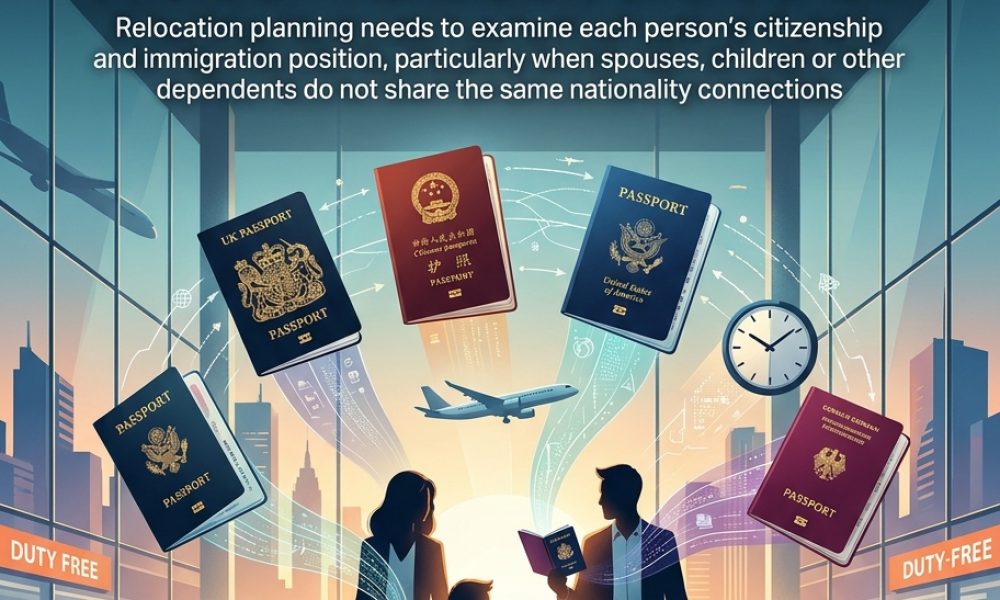
Second citizenship can offer valuable residence and mobility rights. Still, spouses, children, aging parents, and other dependents may require different legal permissions, evidence, and arrangements before a family can relocate together.
WASHINGTON, DC, November 4, 2026 — Families investigating second citizenship frequently discover that one person’s new passport does not settle the immigration position of everyone in the household, particularly when spouses, children, and dependent relatives have different nationalities or legal relationships.
An ancestral citizenship claim may establish a permanent right to live in another country for one applicant. In contrast, the applicant’s spouse remains a foreign national who must qualify under family sponsorship, residence, or another authorized immigration category.
The difference can complicate relocation schedules, school admissions, employment decisions, and housing commitments, making individual status assessments more valuable than treating an entire family as automatically protected by its principal applicant’s additional passport.
Nationality Belongs to Individuals, Not Entire Households
Citizenship is a legal relationship between a person and a country, and one adult’s acquisition of citizenship generally does not automatically transfer the same nationality to a spouse, adult child, parent, or other relative.
Some children may inherit citizenship automatically under specific birth or descent laws. In contrast, spouses ordinarily require separate immigration procedures, and other relatives may face additional restrictions involving age, dependency, financial support, or medical needs.
A practical family plan begins by listing every intended traveler and determining each person’s existing citizenships, immigration history, passports, and potential residence rights before assuming one approved nationality application resolves the whole household’s circumstances.
Canadian Descent Reform Demonstrates the Generational Differences
A Reuters report on increased American interest in Canadian citizenship by descent described a rise in applications following Canada’s December 2025 reforms, as Americans examined ancestral connections that could establish citizenship rights for themselves and their families.
Canada’s revised legislation recognizes certain descendants born abroad before December 15, 2025, who were previously restricted, while qualifying later births beyond the first generation can require a Canadian parent’s substantial physical connection to Canada.
That distinction means siblings or successive generations may face different evidentiary questions, and obtaining official citizenship proof for one parent should never be mistaken for a final determination covering every existing or future child.
Spouses Often Require Their Own Residence Pathway
Marriage to a citizen does not ordinarily confer immediate citizenship in Canada, and many other countries similarly distinguish a citizen’s rights from the foreign spouse’s eligibility to immigrate, remain, or eventually naturalize through applicable procedures.
A Canadian citizen may be able to sponsor an eligible spouse or partner for permanent residence. Still, the application requires compliance with applicable relationship, admissibility, financial, and procedural rules, not merely presenting the citizen’s Canadian passport.
Families considering an international move should evaluate whether the spouse may work while an application is pending, which residence documents are needed, and whether travel outside the destination could affect any pending process.
Adult Children May Not Qualify as Dependents
A child’s age can significantly change the available immigration pathway, especially when a family’s dependent-child category excludes older applicants who are financially independent or no longer meet statutory definitions governing sponsorship.
An adult son or daughter who shares a parent’s ancestral connection may qualify for citizenship on their own. Still, an adult child without that connection may need employment, educational, family, or other residence authorization under applicable laws.
Parents should review those distinctions before paying for a family relocation package, because the ability to sponsor younger children does not mean every adult family member can move on identical terms during relocation.
Children Born Abroad Need Their Own Citizenship Review
A child born outside a parent’s country of citizenship may inherit nationality automatically, acquire it only after registration, or fail to qualify under specific restrictions on transmission across multiple overseas generations.
Under Canada’s rules effective December 15, 2025, certain children born abroad to Canadian parents also born abroad depend on whether the parent accumulated at least 1,095 qualifying days of physical presence in Canada beforehand.
A family planning another birth overseas should therefore confirm the applicable rules before relying on inheritance of citizenship, because a parent’s newly recognized status does not necessarily guarantee automatic nationality for every future descendant.
Adoption Can Involve a Different Citizenship Procedure
Adopted children deserve an individualized assessment because several nationality systems distinguish citizenship acquired automatically by birth from a direct citizenship grant or separate registration available after a qualifying international adoption under specific legal provisions.
Canada’s reformed descent framework addresses certain adopted children. However, official guidance still distinguishes their direct grant process from the automatic citizenship rules that may apply to children born to Canadian parents abroad.
Families should keep authentic adoption judgments, birth documentation, and evidence of legal parental relationships, especially when international adoption recognition or the date of adoption determines which government procedure applies.
Custody and Travel Consent Remain Separate Questions
Even when a child has a valid second passport, a proposed international move may require attention to custody arrangements, consent from another legal parent, or restrictions contained in an existing court order governing relocation.
The U.S. Department of State’s guidance on children traveling internationally explains that some destinations require parental permission documentation and that children with dual nationality may face additional passport and entry requirements when crossing borders.
Parents should not interpret possession of another nationality as automatic authorization to relocate a child permanently, particularly when temporary holiday consent and a change of habitual residence raise different legal questions in family law.
Older Parents May Face Narrower Sponsorship Options
An applicant hoping to relocate with an elderly parent should review the destination’s family reunification categories before assuming citizenship permits unrestricted admission of every close relative under ordinary immigration rules for foreign dependents.
Some countries offer specific parent or dependent-relative pathways. In contrast, others require evidence of exceptional dependency, adequate financial resources, medical coverage, or the absence of available care in the relative’s existing country.
These conditions can make multigenerational relocation substantially more complex than moving a couple with young children, especially when aging relatives depend on familiar medical providers, prescription arrangements, or accessible housing in their community.
Different Passports Can Produce Different Entry Requirements
A household may contain one citizen entitled to enter and reside indefinitely, a spouse who requires immigration permission, and children whose citizenship documents have never been formally issued despite a potential entitlement.
Airlines and border authorities assess travelers individually, so the principal applicant’s valid second passport cannot replace a dependent’s expired passport, missing visa, incomplete citizenship proof, or other required entry documentation.
Before purchasing tickets, families should identify which passport each person will use, confirm any transit authorization, and examine whether pending residence applications allow the accompanying relatives to enter on the intended date.
Employment Rights Do Not Automatically Extend to Partners
A citizen’s unrestricted ability to work in the destination does not necessarily authorize employment by a foreign spouse, who may need a specific residence status or work permit before accepting a job.
When two incomes support the family’s budget, uncertainty about the partner’s employment eligibility can affect housing affordability, insurance arrangements, school choices, and the household’s ability to withstand administrative delays or unexpected expenses.
Employers may also require locally recognized credentials, background screening, or professional registration, so evaluate legal work authorization and practical eligibility for a particular occupation as distinct issues before departure.
School Enrollment Depends on Local Rules and Records
Children moving abroad may need evidence of legal residence, age, vaccination history, educational attainment, and a local address before admission, even when one parent already holds citizenship in the destination country.
Public school eligibility and tuition arrangements can vary with local law, residence, and the child’s own immigration status. In contrast, international schools may have independent admissions schedules and substantial fees for expatriate families.
Parents should investigate these requirements before selecting permanent housing, because an otherwise suitable neighborhood may not provide the appropriate educational opportunities or support services for every child in the household.
Healthcare Coverage May Begin at Different Times
A newly arrived citizen, permanent resident, and temporary family member may face different public healthcare eligibility or waiting arrangements, depending on the destination’s rules and the household’s registration status or insurance arrangements.
Families should verify insurance needs for each person rather than assuming a single citizenship document activates comprehensive medical coverage, especially when an accompanying relative needs ongoing treatment or expensive prescription medication overseas.
Temporary travel insurance may not cover long-term residence or preexisting conditions adequately, making independent health planning especially important where one family member’s immigration application remains under review after the others arrive.
Housing and Banking Require More Than Citizenship Evidence
Landlords and financial institutions may ask for individual Identification, immigration status, income records, and other documents, so an approved passport does not automatically establish a family’s ability to rent suitable accommodation or open accounts.
Couples should clarify whose employment income supports rental applications, whether both adults may sign local agreements, and how household funds will remain available if a dependent’s immigration process takes longer than expected.
These preparations also help distinguish legitimate financial privacy from unsupported promises that acquiring a second nationality automatically removes disclosure obligations or provides an unrelated financial identity for every family member.
A Passport’s Electronic Features Do Not Establish Family Rights
Biometric passports can contain electronic data and cryptographic protections used during identity-document checks. Still, successful chip authentication does not independently prove that a spouse, child, or dependent qualifies for immigration benefits.
Amicus International Consulting explains the distinction in its guide on scanning a passport’s NFC chip and interpreting the results, emphasizing how technical document verification differs from official citizenship and immigration determinations.
A passport may be technically authentic while a family member still needs separate residence authorization, parental consent, or a citizenship certificate, so electronic inspection should not replace review of the governing legal rules.
Families Should Coordinate Application Timing Carefully
Nationality recognition, spouse sponsorship, dependent residence applications, and passport issuance can follow different administrative timelines, so coordinated planning is necessary when a household hopes to depart together rather than in stages.
A family may face practical difficulties if one member receives approval months before another, especially after employment ends, property is sold, or children are withdrawn from their current schools.
A realistic plan should identify which permissions must be granted before travel, which activities can occur after arrival, and what temporary arrangements are possible when official decisions do not arrive at the same time.
Unexpected Separation Requires Contingency Arrangements
Families facing urgent relocation should recognize that having one citizen eligible for immediate entry does not guarantee admission of accompanying relatives who lack the necessary permission under applicable immigration rules.
Households can reduce uncertainty by keeping lawful Identification documents accessible, maintaining suitable financial reserves, and understanding the procedures available when a relative experiences an unexpected travel or application delay.
When personal safety or urgent Protection is involved, evaluate immigration and humanitarian options independently, rather than assuming a second passport held by one family member automatically resolves others’ circumstances.
Legal Advice Must Match Each Person’s Circumstances
Nationality lawyers, licensed immigration professionals, and other qualified advisers may assist different family members, particularly where citizenship by descent, sponsorship, international adoption, or custody issues arise together.
The principal applicant’s approval is useful evidence of that person’s status. Still, it should not replace individualized decisions about a partner’s eligibility, a child’s nationality, or an older relative’s permitted residence category.
Responsible professional coordination includes written explanations of application requirements, government charges, required documents, and realistic timelines, without implying that private advisers can guarantee admission or waive mandatory statutory conditions.
Family Readiness Depends on Every Member’s Legal Position
A complete international relocation strategy begins by identifying each household member’s nationality and applicable immigration pathway, then matching those legal possibilities with employment, schooling, housing, and healthcare arrangements.
Citizenship can provide a durable foundation for the person who holds it, but relocation success depends on whether accompanying relatives can lawfully join that person and establish ordinary lives.
Ultimately, a second passport does not settle every family member’s status because nationality rights are personal, immigration categories differ, and the family’s ability to relocate together depends on separately verified permissions and coordinated preparation.




