
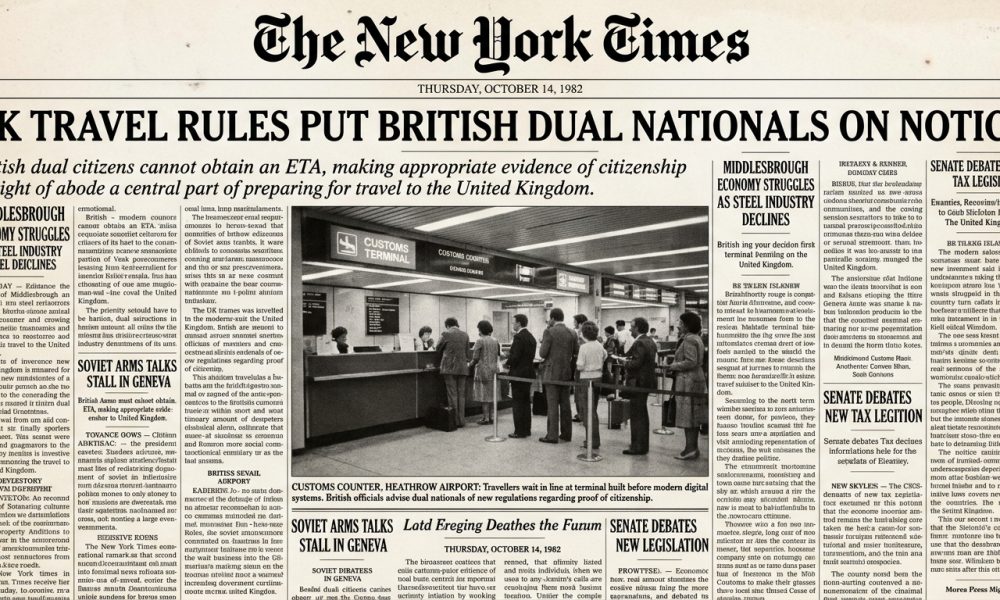
British dual citizens cannot obtain a UK electronic travel authorization, making valid British or Irish passports and recognized proof of right of abode essential for travelers who might otherwise expect to board using another nationality’s passport alone.
WASHINGTON, DC, November 4, 2026 — British dual nationals preparing to travel to the United Kingdom face stricter documentary scrutiny after the enforcement of electronic travel authorization checks, creating potential difficulties for people who hold British citizenship but normally travel on foreign passports.
The key distinction is that British citizenship gives you the right to enter the country. At the same time, airlines and other transport providers still require acceptable documentation to verify that right before allowing an international journey to begin.
For British-American, British-Canadian, and British-Australian families, the practical solution usually involves traveling with a valid British passport or an appropriately documented foreign passport, rather than purchasing the electronic authorization available to many other foreign visitors.
ETA Enforcement Changed the Practical Boarding Experience
The United Kingdom began enforcing its electronic travel authorization requirements for relevant non-visa visitors on February 25, 2026, bringing carrier checks into sharper focus after a phased introduction of the digital permission system.
A Reuters report on the United Kingdom’s February 2026 travel-permit enforcement explained that travelers from numerous visa-exempt countries would need an appropriate ETA or other accepted documentation before airlines allowed them to board.
British and Irish citizens are exempt from the ETA requirement. Still, that exemption creates a separate documentation problem for some dual nationals whose foreign passport does not independently demonstrate the citizenship that British authorities recognize.
British Citizens Are Not Eligible for an ETA
The official distinction is not merely that British dual nationals may choose to skip an ETA, because the electronic authorization is intended for qualifying foreign visitors, not people who already possess British citizenship.
A dual national cannot safely resolve a missing British passport by applying as an American, Canadian, or Australian visitor, because British nationality makes that person ineligible for the UK’s electronic travel authorization scheme.
Before purchasing tickets, travel arrangements must instead reflect the traveler’s actual legal status, even when the foreign passport used for reservations belongs to a country whose other citizens routinely obtain ETAs for short visits.
The Right of Abode Explains the Underlying Legal Position
British citizens possess the right of abode in the United Kingdom, which generally means they may enter, reside, and work without the ordinary immigration restrictions imposed on foreign nationals seeking permission to remain.
That legal right exists independently of whether a valid British passport has been issued. However, the person claiming it must still provide acceptable evidence when authorities or carriers assess the documents presented for travel.
Some Commonwealth citizens also retain right of abode under historically defined provisions, although membership in the Commonwealth or possession of an indefinite residence permit does not by itself establish this particular legal status.
Recognized Documents Provide the Main Travel Routes
Current British government guidance identifies a valid British passport, a valid Irish passport, or another valid passport accompanied by a certificate of entitlement confirming right of abode as the principal routes available to affected dual nationals.
A British-American traveler with both current passports can generally use the British passport to demonstrate British status. In contrast, the American passport remains relevant to the separate entry and departure requirements imposed by the United States.
Someone who chooses, for practical or personal reasons, to travel using only another nationality’s passport must determine whether a certificate of entitlement is appropriate and ensure the necessary digital documentation is properly linked to that passport.
Certificates of Entitlement Became Digital in 2026
From February 26, 2026, new certificates of entitlement have been issued as digital records rather than traditional stickers placed inside foreign passports, changing the administrative steps required for travelers who select this option.
The digital certificate is linked to a valid foreign passport through the relevant United Kingdom immigration account, so inaccurate passport details matter when airlines and immigration systems verify a passenger’s right to travel.
If the foreign passport is renewed or personal details change, update account information according to official instructions rather than assuming the existing digital record automatically follows a replacement document without further action.
A Certificate Confirms an Existing Right Rather Than Creating One
A certificate of entitlement does not confer British citizenship, provide a temporary visa, or make an otherwise ineligible foreign national entitled to live indefinitely in the United Kingdom without immigration restrictions.
Applicants must already possess a legally established and currently applicable right of abode and present documentation establishing that entitlement. At the same time, the Home Office evaluates the evidence according to the legal basis asserted in the certificate application.
For some recurring journeys, the certificate can help an eligible dual national continue using a foreign passport. Still, its cost and administrative requirements should be weighed against applying for a British passport.
A Valid British Passport May Be the Simpler Option
For many British dual nationals, obtaining or renewing a British passport is more straightforward than pursuing a certificate of entitlement, especially when the traveler expects to visit the United Kingdom regularly over several years.
Unlike an ordinary passport renewal, the certificate route has its own government fee and evidentiary requirements, and applicants generally cannot hold a valid British passport and a certificate of entitlement simultaneously for the same status.
Before committing to either procedure, an individual should therefore compare the available official routes before paying substantial fees, particularly where the immediate problem involves an expired British passport rather than uncertainty about underlying nationality.
Carrier Checks Can Prevent Boarding Before Arrival
For passengers who cannot establish the required status, the most immediate practical risk is refused boarding by an airline, ferry, or international train operator, because transport providers check travel documentation before passengers reach a British immigration officer at the border.
For example, a person may genuinely possess British citizenship by birth or descent but still face disruption when a carrier cannot verify that status through the documents or digital permission information presented at check-in.
For dual-national travelers, this problem shows why a legal right of entry and proof acceptable for international travel must be considered separately, particularly when families book expensive journeys or travel for urgent reasons.
Expired British Passports Are Not Guaranteed Substitutes
Under a limited exception in current policy, British guidance permits carriers some discretion to accept an expired British passport issued in 1989 or later when it accompanies a valid passport from an ETA-eligible nationality and identifying details match.
For affected travelers, that accommodation is discretionary rather than an entitlement to board, meaning individual transport providers may decline to rely on the expired document despite the passenger’s confidence in their British nationality.
As a matter of practical risk management, travelers should not build essential plans around the expectation that a carrier will exercise discretion, especially where missed flights, onward connections, or family obligations could make a refusal particularly disruptive.
Irish Dual Nationals Occupy a Distinct Position
Irish citizens are also exempt from obtaining a British ETA, and a valid Irish passport is recognized as an acceptable travel document under current guidance for British and Irish dual nationals.
The distinction between these passport types reflects the specific legal arrangements associated with Irish citizenship. It should not be generalized to every European nationality held alongside British citizenship, regardless of existing travel privileges.
For travel under the current enforcement framework, a British-French or British-German citizen relying on a non-British passport must examine the documentation rules for that combination rather than assuming an ordinary European passport provides the same exemption.
Children Need Their Own Evidence of Status
During preparations for international travel, families sometimes discover that a child acquired British citizenship automatically at birth even though the child has never received a British passport and normally travels using the nationality of another parent.
Because British nationality can exist without a previously issued passport, parents should establish each child’s status before arranging travel and obtain an appropriate document rather than applying for an ETA on the child’s behalf.
The rules also differ by parental citizenship, birthplace, and historical nationality law, so avoid assuming every child in a family has the same citizenship or travel documentation.
Naturalization Changes the Traveler’s Documentation Category
For instance, a foreign national who previously visited Britain using an ETA may become ineligible for that authorization after acquiring British citizenship through naturalization or registration, even if their foreign passport remains valid.
Once they obtain nationality, the newly recognized citizen must document their British status through an accepted route, rather than continuing to rely on visitor permission that no longer reflects their legal status.
In a narrowly defined situation, certain people who acquired citizenship after holding status under the EU Settlement Scheme may qualify for specific alternative documentation arrangements. Still, they should check current official guidance before departure.
American Dual Nationals Have Separate United States Obligations
The U.S. Department of State’s guidance concerning dual nationality explains that American citizens must enter and depart the United States on American passports, including those who also possess British citizenship or another nationality.
Depending on the route and carrier, a British-American traveler may need an American passport for U.S. travel requirements and a British passport or accepted right-of-abode evidence for the British portion of the journey.
When planning a complete round-trip journey, neither government’s rules automatically replace the other’s, so carry the documents needed for the entire itinerary rather than only the arrival procedures at one destination.
Passport Authentication Does Not Independently Prove Nationality
Modern biometric passports incorporate electronic chips and cryptographic protections that help compatible systems assess stored identity information. Still, a successful technical check does not replace the government’s determination of nationality or right of abode.
For passport holders evaluating electronic document checks, Amicus International Consulting explains these distinctions in its guide to scanning a passport’s NFC chip and understanding the results, noting that electronic authentication and legal immigration status must be assessed separately.
Even when inspection technology works correctly, a valid foreign passport may pass electronic integrity checks. At the same time, its holder still needs recognized evidence of British citizenship, showing that passport authenticity and permission to board are separate questions.
Unexpected Travel May Require Additional Preparation
Families dealing with unexpected bereavement, funerals, urgent medical situations, or unexpected overseas work obligations can encounter particular difficulty when a British passport has expired, and a certificate of entitlement has not been obtained.
Even for longstanding British citizens, access to emergency British travel documents or other exceptional arrangements depends on applicable official rules, and travelers should not assume urgency alone guarantees issuance or acceptance before departure.
As a basic precaution for an upcoming journey, checking passport validity and citizenship documents well before travel provides greater practical security than trying to resolve unresolved nationality evidence at an airport counter as a flight approaches.
Digital Border Systems Increase the Importance of Accurate Records
As border enforcement becomes increasingly digitized, the United Kingdom’s wider shift toward electronic immigration records gives travelers more reason to keep passport details, names, and identity information accurate in official accounts and applications.
Even a minor discrepancy between a current foreign passport and the information linked to a digital certificate may complicate automated verification, even if the person still has the underlying legal right of abode.
Before booking travel and after each renewal, regularly reviewing the documents used for international travel can reduce preventable delays, particularly for dual nationals who renew passports through different governments or change names following marriage or other lawful events.
British Status and Foreign Visitor Permission Must Remain Distinct
The ETA system screens qualifying foreign visitors before travel. In contrast, British citizenship ordinarily gives its holder an existing right of abode, evidenced through a different set of documents.
When making travel reservations, confusing those categories can produce avoidable mistakes, including unnecessary visitor applications, reliance on an ineligible ETA, or assumptions that a foreign passport alone will satisfy a transport provider’s documentation requirements.
The most reliable approach begins with establishing whether the person is British, identifying the corresponding proof of nationality or right of abode, and confirming that the documents will be accepted for the intended journey.
A documentation review should also account for the length of the journey, the validity of every passport, and the circumstances of connecting flights, because each transport provider may need to establish eligibility before carrying passengers onward.
Documentation Planning Protects the Right to Travel
To avoid preventable disruption, British dual nationals should review their citizenship status and current passports before arranging international journeys, especially when family members hold different nationalities or have never applied for British travel documents.
Depending on the person’s actual citizenship, a valid British passport, an accepted Irish passport, or a properly linked certificate of entitlement can provide the necessary evidence. Still, this does not mean guaranteed boarding rights.
Ultimately, UK travel rules put British dual nationals on notice: an ETA exemption does not eliminate documentary checks, and lawful citizenship must be supported by the evidence required for reliable international travel.




