
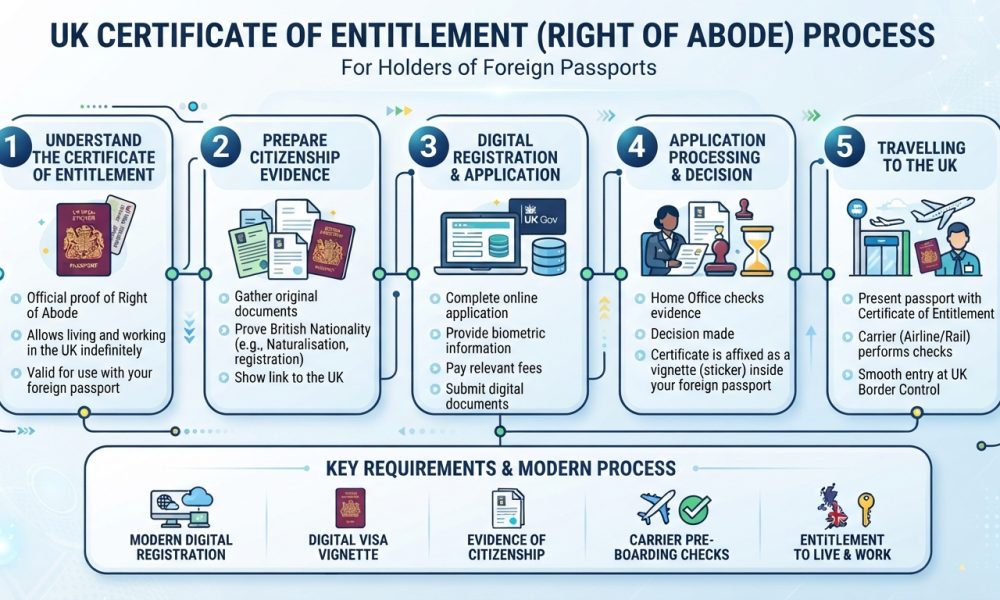
An official certificate of entitlement can establish an eligible person’s right to live and work in the United Kingdom while travelling on a valid foreign passport. However, digital registration, citizenship evidence, and new carrier checks create important practical requirements.
WASHINGTON, DC, November 3, 2026 — British dual nationals traveling with American, Canadian, Australian, or other foreign passports face renewed questions about how to demonstrate their right to enter the United Kingdom following stricter carrier checks introduced earlier this year.
A certificate of entitlement to the right of abode provides a recognized alternative to traveling on a British passport. Still, it does not create citizenship, grant a temporary visa, or eliminate the need to establish existing legal eligibility.
The distinction matters since February 2026, when Britain began enforcing electronic travel authorization checks and changed newly issued certificates of entitlement from physical passport stickers to digital records linked to valid foreign travel documents.
The Right of Abode Is a Legal Status, Not a Travel Visa
The legal position must be established before choosing a document, because a successful application for a certificate does not create a right of abode, and it cannot be inferred solely from a family connection, former residence, or eligibility for a visitor exemption.
The right of abode means that qualifying individuals can enter, live, and work in the United Kingdom without ordinary immigration restrictions. However, they must still demonstrate that right through documentation accepted by British authorities and transport providers.
All British citizens possess the right of abode. In contrast, certain Commonwealth citizens retain that status through historically defined legal provisions, making the qualifying population broader than British passport holders but considerably narrower than ordinary foreign visitors.
A certificate of entitlement serves as official evidence of an existing right, so paying its application fee cannot transform an ineligible foreign citizen into a British national or provide unrestricted residence to someone without qualifying status.
British Dual Nationals Face a Distinct Boarding Requirement
The United Kingdom’s enhanced electronic travel authorization enforcement, implemented on February 25, 2026, created practical difficulties for British citizens who routinely entered on another country’s passport without carrying a current British travel document.
Because British citizens are not eligible for the electronic travel authorization issued to qualifying foreign visitors, airlines and other carriers may require an appropriate British passport or recognized certificate before allowing the passenger to board.
A February 25 Sky News report on dual nationals facing travel disruption described the documentation requirements and the possibility of refused boarding for affected travelers, emphasizing the difference between citizenship rights and proof acceptable to carriers.
Digital Certificates Replaced Newly Issued Passport Stickers
From February 26, 2026, successful applications have resulted in digital certificates rather than the traditional vignette stickers placed inside foreign passports. This change makes account management and accurate passport linkage essential for travel.
The certificate holder must establish access through the United Kingdom Visas and Immigration digital account system and associate the certificate with the valid foreign passport intended for travel, allowing relevant status information to be checked electronically.
Older valid certificate stickers remain relevant under applicable transitional provisions. Still, a traveler with a new digital certificate should not expect a new physical endorsement to appear in the passport after approval, which is especially important for applicants familiar with the older sticker-based process.
The Certificate Is Linked to Another Valid Passport
An eligible British-American dual national may use an American passport linked to a digital certificate to demonstrate British right of abode, provided the passport details are correctly recorded, and all applicable travel documentation requirements are met.
When the foreign passport expires or is replaced, the certificate holder must update the associated digital immigration account with the new passport particulars rather than assuming that the earlier electronic association transfers automatically after renewal.
Current British guidance indicates that the digital certificate itself does not expire. However,h it must remain linked to the traveler’s current passport and the account must reflect required changes in identifying information throughout the certificate holder’s travel history.
A Valid British Passport and Certificate Cannot Be Held Together.
An important limitation is that applicants cannot generally hold a valid British citizen passport and a certificate of entitlement simultaneously, because the certificate is designed for qualifying people proving their status through another travel document.
Someone choosing the certificate route while holding a current British passport must surrender that passport through the appropriate official procedure, rather than assuming both forms of evidence can remain active.
Travelers should assess whether a standard British passport is more convenient before paying for a certificate, particularly where the intended purpose is ordinary travel rather than the continued use of an existing foreign passport.
The Application Fee Makes the Choice Financially Significant
Official documentation costs can influence family decisions when several eligible relatives travel together, especially where one person already possesses a British passport. At the same time, another person may need to establish status before obtaining either a passport or a certificate of entitlement.
The current published application fee for a certificate of entitlement is £589, a substantial expense that makes comparing the official passport route with the certificate route worthwhile before committing to a particular approach.
A certificate may still be relevant when an eligible individual prefers to travel with a foreign passport and has circumstances that make the authorized alternative suitable, provided those preferences do not conflict with official eligibility rules.
The fee should not be confused with a citizenship application payment, since applicants must already have the right of abode and must submit evidence of that status to the responsible authority before an application can be granted.
Applicants Must Establish Their Existing Entitlement
British Home Office guidance identifies the certificate as available to British citizens using foreign passports and certain Commonwealth citizens who independently hold the right of abode, subject to applicable eligibility exclusions and documentary requirements.
Supporting materials can include a valid passport, photographs, relevant birth or nationality records, and evidence connecting earlier and current names where marriage, adoption, or another recognized change affects official documents presented during the application process.
An applicant who cannot establish British citizenship or another qualifying basis for right of abode does not acquire eligibility merely by maintaining a British family connection or previously having visited the United Kingdom without difficulty.
British Citizenship by Descent Requires Separate Legal Assessment
A person born overseas to a British parent may automatically possess British citizenship in certain circumstances. Still, nationality transmission depends on the parent’s status, the applicant’s birthplace, and the legislation in force when the relevant birth occurred.
Families should distinguish proof of nationality already held from an application to register or naturalize as a British citizen, because a certificate of entitlement cannot replace the separate legal processes required to acquire citizenship.
Where older birth certificates, parental records, or historical nationality provisions introduce uncertainty, an individualized eligibility review is more reliable than assuming a British-born grandparent automatically creates an unrestricted right of abode under modern British nationality legislation.
Commonwealth Right of Abode Has Historical Limits
Certain Commonwealth citizens may hold the right of abode through provisions preserved from earlier British immigration legislation. Still, this entitlement is not a general benefit available to every citizen of a Commonwealth member country.
Relevant cases can involve historical residence, citizenship connections, and family circumstances under specific rules, so accurately identifying the legal basis is essential before applying for official confirmation through the appropriate Home Office procedure.
Applicants should not confuse Commonwealth membership, permanent residence, indefinite leave to remain, or the right of abode, because each represents a different legal classification with potentially different documents and immigration consequences for the person concerned.
Airline Checks Can Matter Before Border Inspection
Travelers who book connecting flights should also consider the requirements of transit countries, because a certificate establishing British right of abode addresses British immigration status rather than replacing foreign visas, transit permissions, or passport rules applied elsewhere.
Airlines, ferries, and international train operators must check relevant travel permissions before carrying passengers to Britain, meaning a person with genuine British nationality may encounter boarding difficulties if satisfactory proof is unavailable at the time of carrier inspection.
An airline’s inability to confirm a traveler’s status does not necessarily mean the individual has lost British citizenship. Still, it can interrupt a journey before a Border Force officer has an opportunity to assess the claim.
Government guidance allows certain temporary carrier discretion for expired British passports issued in 1989 or later, alongside matching valid foreign passports. Still, that possibility should not be treated as guaranteed boarding authorization.
An ETA Is Not an Alternative for British Citizens
The electronic travel authorization system primarily concerns qualifying non-British visitors who otherwise travel without a conventional visa, not British citizens, whose right of abode exempts them from that immigration permission.
British dual nationals therefore should not attempt to solve documentary problems simply by purchasing an ETA against their other nationality, because British citizenship makes them ineligible for that authorization under the current framework.
Irish citizens also benefit from distinct exemptions, so people holding British and Irish nationality may face travel arrangements different from those affecting British-American or British-Australian dual nationals using only their foreign passports for travel.
Americans Must Also Respect United States Passport Rules
An American holding British citizenship and travelling with a United States passport linked to a British certificate must still comply with the separate obligations imposed by American authorities when entering or departing the United States.
The U.S. Department of State’s official dual nationality guidance explains that American citizens generally must use valid United States passports to enter and leave, even when they hold another nationality and have documents establishing foreign residence rights.
British and American documentation requirements should therefore be considered together when planning an international journey, rather than assuming that the proof accepted for entering Britain automatically satisfies the rules governing departure from another country.
Family Members May Need Different Documentation
A parent arranging an international journey should review the legal status of accompanying children independently, because a British birth certificate or family relationship may not establish that a child has the same nationality or right of abode as the adult.
A British citizen parent may qualify for a certificate. In contrast, a spouse who lacks British nationality requires immigration permission, so it is important to assess each accompanying family member rather than treating household travel as one application.
Children born abroad can have nationality circumstances different from those of their parents or siblings, particularly where citizenship transmission, registration, adoption, and historical legal provisions affect the right of abode and accompanying documentary requirements.
Families should confirm documentation for every traveler before buying nonrefundable tickets, including current passport validity, proof of any claimed citizenship, and permission for individuals who do not personally hold the right of abode.
Long-Term Residence Rights Should Not Be Confused With Naturalization
A certificate of entitlement confirms freedom from ordinary United Kingdom immigration restrictions for a person who already has the right of abode, which differs from residence permits granted to qualifying foreign nationals under ordinary immigration control.
A person with indefinite leave to remain may possess substantial domestic residence rights without necessarily having the right of abode. At the same time, naturalization can require a separate application and official approval before British citizenship is acquired.
Commercial migration descriptions should clearly distinguish these categories, since holding a long-term visa or settlement status does not automatically establish eligibility for a certificate reserved for people with the qualifying legal right.
Digital Authentication and Legal Status Are Separate Matters
Modern passports often contain electronic chips and cryptographic protections that verify identity information. Still, those features cannot independently prove British citizenship, establish the right of abode under immigration law, or determine a traveler’s actual immigration status.
Amicus International Consulting discusses these distinctions in its guide on how to scan a passport’s NFC chip and understand the results, explaining why successful electronic passport authentication should not be confused with a government decision on legal status.
A valid foreign passport can carry authentic electronic information. At the same time, its holder still needs a correctly linked certificate to demonstrate British right of abode, underscoring the separate functions of document security and immigration records.
Practical Preparation Can Reduce Preventable Travel Disruption
Although a digital certificate offers an enduring record, its usefulness depends on accurate online information and carrier recognition, so it makes sense to confirm the linked passport details and follow current government instructions before departing for a major family event.
People considering the certificate route should verify eligibility, compare official costs, prepare authentic evidence, and ensure the resulting digital record is linked to the correct foreign passport before scheduling international travel, especially when booking nonrefundable transportation.
Travelers should also review account details after passport renewal, legal name changes, or corrections to personal particulars, because discrepancies can complicate carrier checks even when the underlying right of abode continues without interruption.
Where travel is urgent, a prospective applicant should consider official passport options and realistic processing times rather than assuming a certificate can be obtained instantly or relying on discretionary carrier accommodations outside the traveler’s control.
The Certificate Provides Evidence Rather Than New Citizenship
The certificate of entitlement remains a legitimate alternative for qualifying British dual nationals and certain Commonwealth citizens. Still, its main purpose is to document an existing right rather than create nationality through a simplified administrative process.
Britain’s digital border changes have made that distinction more visible, especially for people accustomed to traveling on foreign passports who previously encountered fewer carrier checks before reaching immigration control at the border
Ultimately, a right of abode certificate offers another UK travel route when existing entitlement is properly established and linked to a valid foreign passport. At the same time, accurate documentation and realistic planning remain essential to avoid disruption.




