
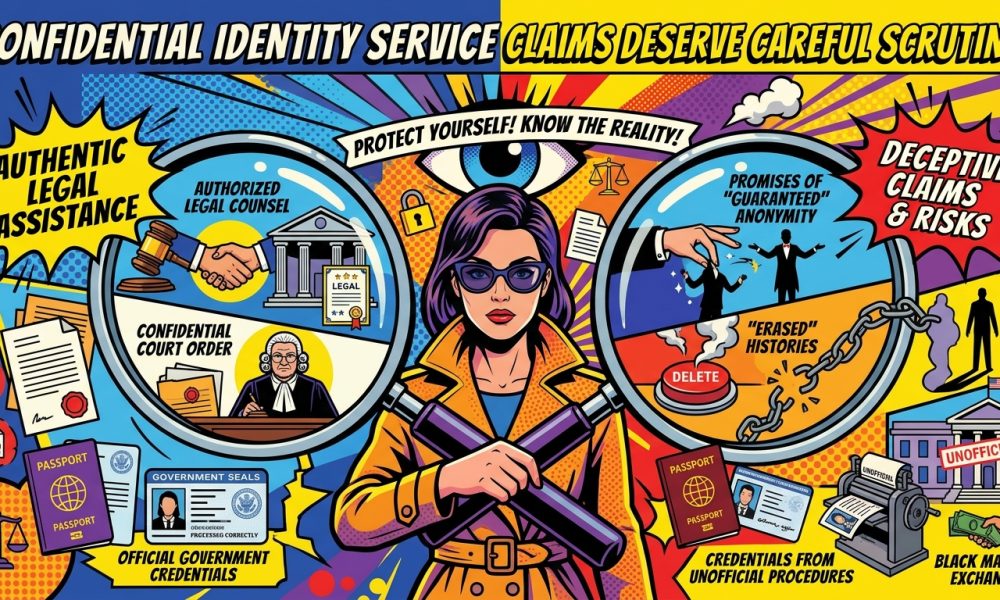
People seeking confidential legal name changes, identity theft Protection, personal safety, or international relocation should distinguish authorized legal assistance from commercial promises of guaranteed anonymity, permanently erased financial histories, or government Identification documents issued outside established official procedures.
WASHINGTON, DC, October 29, 2026 — Americans seeking greater personal privacy through confidential legal name changes, replacement Identification documents, address Protection programs, and specialized identity services face an expanding marketplace where legitimate professional assistance can be hard to distinguish from exaggerated promises of complete anonymity or permanent separation from historical records.
For survivors of domestic violence, stalking, financial impersonation, harassment, and other serious personal threats, the appeal of establishing safer personal circumstances can be substantial, particularly when existing names, residential addresses, financial information, and online records create continuing concerns about unwanted Identification.
However, services that advertise guaranteed anonymity, the complete disappearance of past financial histories, or access to government credentials through undisclosed administrative channels deserve scrutiny because legally recognized identity changes generally require established procedures, accurate supporting documentation, and approval from authorized institutions.
The key issue is that commercial providers often bundle legal name changes, international relocation, second citizenship, financial privacy planning, and identity Protection into expensive packages that appear comprehensive without clearly explaining the independent legal requirements governing each service.
Although legitimate privacy consulting can help individuals understand available protections and coordinate appropriate professional assistance, no private provider can responsibly guarantee that every government agency, financial institution, public database, or authorized investigative authority will permanently lose access to historical identifying information.
Confidential Identity Services Operate Within Defined Legal Boundaries
A confidential legal name change ordinarily involves a judicial or administrative procedure that legally recognizes a new name, potentially with restrictions on public access to specified records when applicable legislation permits additional Protection.
These procedures differ significantly from commercial identity Protection services, which may focus on monitoring compromised information, assisting with financial fraud disputes, reducing unnecessary online exposure, or coordinating communications with institutions holding sensitive personal records.
A consultant may legitimately explain administrative requirements, organize documentation, and arrange referrals to qualified professionals. Still, legal representation and specialized immigration advice may require professional authorization, depending on the jurisdiction and the nature of the assistance.
Consumers should therefore distinguish assistance with navigating official procedures from claims that a private company possesses independent authority to create citizenship, alter government records, issue passports, or override Identification requirements established by law.
A commercially attractive service description does not establish legal authority, so it’s important to identify which government agency controls each requested outcome and which properly qualified professional is responsible for providing regulated advice.
Government Credentials Must Originate Through Authorized Procedures
Passports, citizenship certificates, driver’s licenses, birth records, and other government Identification documents carry legal significance because their issuance depends on statutory authority, established administrative systems, and the recognition of relevant personal circumstances under applicable law.
A private consultancy may help eligible applicants prepare submissions or coordinate with authorized professionals. Still, it cannot independently confer nationality, create a legally recognized birth history, or guarantee the issuance of official Identification credentials.
Applicants should be especially cautious when a provider claims passports or other documents can be obtained without the eligibility assessments, identity checks, or government procedures ordinarily required for the requested credentiaAtdocument’st’s security featurean official-looking format, or information consistent with a government Identification templadooes not independently establish that the relevant authority lawfully issued it.
When questions arise about issuance, verification should rely on appropriate government channels and legally recognized procedures rather than relying solely on statements from the commercial provider responsible for arranging the document.
Federal Authorities Warn Against Unauthorized Immigration Assistance
The United States government has repeatedly warned consumers that immigration consultants and document-preparation businesses may misrepresent their qualifications, especially when they promise guaranteed application outcomes or claim privileged access to government immigration systems.
U.S. Citizenship and Immigration Services guidance on avoiding immigration scams emphasizes the importance of getting legal advice from authorized professionals and recognizing misleading claims about special government relationships, faster processing, or guaranteed immigration benefits.
In the American immigration system, individualized legal advice and representation generally require an appropriately licensed attorney or an accredited representative associated with a Department of Justice-recognized organization, subject to the applicable regulatory framework.
. Still, other providers may offer administrative assistance and routine document preparation services that should not be presented as regulated legal advice when the individual or organization lacks the necessary professional authority.
For consumers buying international citizenship or relocation packages, these distinctions show why professional credentials, written agreements, and verification of the issuing authority should be part of the evaluation before making substantial payments.
Promises of Guaranteed Anonymity Can Misrepresent Legal Protections
The concept of anonymity is frequently used in commercial privacy advertising. Yet, it can describe very different objectives, from reduced public visibility to confidentiality in specific legal proceedings or restrictions on disclosing residential information.
A confidential name change may limit public access to specified judicial records. At the same time, an address confidentiality program may permit eligible participants to use substitute mailing information under conditions established by the relevant jurisdiction.
Neither arrangement necessarily prevents financial institutions, government agencies, or courts from maintaining historical records where applicable laws permit or require the preservation of information necessary for legitimate administrative or legal purposes.
Individuals should therefore question promotional statements suggesting that an approved name change automatically eliminates previous identities from banking systems, credit reporting databases, tax records, professional licensing files, or historical government documentation.
A more accurate description of confidentiality distinguishes Protection against unnecessary public disclosure from the continuing responsibilities of institutions authorized to verify identity, preserve records, and investigate legally relevant transactions.
Digital Erasure Claims Face Important Practical Limitations
Commercial identity services sometimes promise to permanently remove previous names, residential addresses, employment histories, and online references from the internet, despite the decentralized nature of digital information and historical recordkeeping.
A May 2026 CalMatters report documented ongoing difficulties consumers face when trying to remove personal information from data brokers, even after investigations and regulatory attention prompted several companies to improve access to privacy controls.
An earlier WIRED investigation into data brokers hiding their opt-out pages from search results described how dozens of companies made privacy instructions hard to find, illustrating the practical challenges consumers face when trying to exercise legally available deletion rights.
These findings show why removing information from one commercial database does not automatically eliminate copies held by other organizations, especially when historical data continues to circulate through independent sources.
Consumers evaluating digital privacy packages should consequently seek clear explanations of which information holders are covered, what removal procedures are available, and whether continuing monitoring or additional requests may be necessary.
Credit Histories Generally Continue After Legal Name Changes
A legally approved name change does not ordinarily create a new credit identity, eliminate existing financial obligations, or erase legitimate historical payment information associated with the individual under the Fair Credit Reporting Act and other applicable laws.
Financial institutions and consumer reporting companies may keep previous names, residential information, account histories, and other identifying details to maintain accurate records and distinguish individuals with similar personal information.
The Federal Trade Commission has specifically warned consumers about credit repair businesses promising entirely new financial identities or the disappearance of unfavorable credit histories through alternative Identification numbers and misleading documentation.
These arrangements can expose consumers to serious legal and financial consequences when they involve stolen identifying information, false credit applications, or improperly obtained numbers presented as substitutes for legitimate personal identifiers.
Individuals experiencing actual identity theft should instead pursue appropriate correction procedures for fraudulent accounts and inaccurate records, rather than assuming that changing their names will automatically produce an unrelated financial history.
Identity Theft Recovery and Confidential Name Changes Serve Different Purposes
Identity theft recovery focuses on correcting unauthorized financial transactions, challenging fraudulent accounts, protecting compromised information, and restoring accurate records when another individual improperly uses personal identifying details.
Confidentiality and Protection: Harassment and PTO abuse: individuals may require both forms of assistance, particularly when domestic violence or coercive control has involved financial impersonation, unauthorized borrowing, or the misuse of personal information by another person.
Nevertheless, the procedures remain separate because a court-approved name change does not, by itself, establish that disputed debts resulted from identity theft or that consumer reporting companies must remove otherwise accurate records.
Responsible service providers should explain the applicable remedies individually and identify qualified professionals when legal representation, financial dispute resolution, or specialized victim assistance falls outside their own authority.
Social Security Number Claims Require Particular Caution
The Social Security Administration generally updates the name associated with an existing Social Security number following a qualifying legal name change, preserving administrative continuity across employment, taxation, benefits, and other systems that rely on federal Identification records.
Although the agency may issue a different number in limited circumstances involving persistent identity theft consequences, harassment, abuse, or life endangerment, these determinations require specific evidence and meet eligibility requirements.
A commercial provider cannot guarantee another Social Security number simply because a customer purchases a confidential identity package or obtains a court order recognizing a new legal name.
Consumers should also distinguish a properly authorized replacement number from alternative identifiers promoted as substitutes for Social Security information when accurate personal Identification is legally required.
Misrepresenting identifying numbers on financial applications can have consequences beyond the individual’s underlying privacy concerns, making accurate official guidance essential before attempting significant changes to federal Identification records.
Passport Authentication Does Not Establish Lawful Issuance by Itself
Modern biometric passports include electronic identity information and cryptographic security mechanisms intended to support document authentication, but a successful electronic chip operation does not, by itself, resolve every question about legal issuance or nationality.
A compatible passport-reading application may retrieve electronically stored particulars and perform selected security checks, helping establish whether particular information appears consistent with the document’s electronic protections and the relevant verification data.
Amicus International Consulting explains how to scan a passport’s NFC chip and interpret the results, distinguishing between reading passport information and interpreting authentication outcomes.
However, a successful electronic authentication result does not independently establish that a passport remains valid for travel, that the holder satisfies every citizenship requirement, or that unrelated civil registration records have been lawfully created.
Consumers should therefore distinguish technical document authentication from confirmation of official issuance and legal status, particularly when commercial providers present electronic scanning results as conclusive proof of every aspect of an identity arrangement.
Banking Anonymity Requires Separate Legal Analysis
International banking institutions maintain customer Identification, anti-money-laundering, beneficial ownership, and financial reporting obligations that may require detailed information concerning an account holder’s actual identity and the origin of substantial assets.
An individual obtaining a second passport or a confidential legal name change may still need to disclose relevant citizenships, tax residences, financial relationships, and historical identifying information when applicable banking regulations require it.
Similarly, establishing a company, family trust, or overseas holding structure does not automatically prevent an institution from identifying individuals exercising ownership or control over the financial relationship.
A legitimate privacy arrangement can reduce unnecessary public exposure while preserving mandatory disclosures to authorized institutions, making it essential to distinguish lawful confidentiality from promises that regulators or tax authorities cannot obtain relevant information.
Claims that a new identity document guarantees unrestricted international banking access or permanently prevents financial reporting should therefore be carefully scrutinized before customers rely on them when transferring substantial assets.
Confidentiality Agreements Cannot Override Mandatory Disclosure Rules.
Some identity and privacy service providers offer nondisclosure agreements to protect sensitive client information, set confidentiality expectations, and limit unnecessary sharing of personal records with unrelated commercial parties.
Such agreements can serve legitimate contractual purposes, but they do not automatically create attorney-client privilege or override lawful disclosure obligations that apply to financial institutions, government agencies, and professional service providers.
The distinction matters most when several organizations participate in an international identity arrangement, including document coordinators, legal advisers, financial institutions, trustees, translators, and immigration professionals operating under different confidentiality requirements.
Clients should understand which organizations receive their information, how documents are stored and transferred, whether subcontractors participate, and what limitations apply to promises concerning secure communications and information retention.
A responsible confidentiality agreement should describe enforceable obligations accurately rather than implying that contractual language can prevent every authorized government inquiry or eliminate legally mandated recordkeeping.
Claims of Special Government Connections Need Verification
Commercial providers occasionally promote access to unnamed government officials, privileged administrative channels, or special relationships allegedly capable of securing identity documents more quickly than ordinary official procedures permit.
Exercise particular caution when a provider refuses to identify the lawful issuing authority, explain the applicable eligibility requirements, or provide a verifiable account of the government process through which the requested credential will be obtained.
Legitimate expedited procedures may exist for certain government services, but their availability depends on official rules and authorized administrative decisions, not on an unrestricted private ability to alter government records.
Consumers should also distinguish legitimate professional relationships with government agencies from unsupported assurances that officials can issue citizenship documents, birth registrations, or passports without satisfying applicable legal requirements.
Where a provider claims unusual guarantees of results, independent verification of official procedures and professional authority matters, as consumers entrust sensitive Identification information.
Substantial Advance Fees Create Additional Consumer Risks
Identity and international relocation services may involve significant professional fees, government charges, translation expenses, document preparation costs, and other legitimate expenditures depending on the complexity of the client’s circumstances.
However, high prices alone do not establish legal authority or service reliability, so it’s essential to confirm what the quote covers and whether promised outcomes remain subject to independent government decisions.
A written agreement should identify the services included, the professionals responsible, applicable milestones, additional charges, and the circumstances under which payments may become refundable or nonrefundable.
Customers should also determine whether they pay government application fees directly to the relevant authority or through an intermediary, particularly when a provider requests substantial transfers before official eligibility assessments occur.
Reviewing these arrangements is not meant to presume that expensive professional services are improper, but to ensure clients understand their contractual rights and the limitations on promised results.
Victim Advocates Can Help Identify Appropriate Services
Individuals pursuing confidential identity changes because of domestic violence, stalking, harassment, or other threats may benefit from victim advocacy organizations familiar with local legal procedures and available confidentiality protections.
Advocates can help explain general application requirements, locate qualified legal professionals, identify available financial assistance, and coordinate services when multiple government departments maintain records that require separate attention.
Their involvement can also help vulnerable consumers assess whether commercial services accurately describe legally available protections or rely on unrealistic promises about permanent anonymity and deleting historical records.
Nevertheless, victim advocacy and legal representation remain distinct activities, so complex questions about sealed court records, statutory eligibility, or disputed financial obligations may require an appropriately qualified attorney.
Coordinated assistance can help applicants pursue legitimate Protection without becoming dependent on a single commercial provider claiming authority over every aspect of personal Identification and financial privacy.
International Citizenship Services Require Independent Verification
Second citizenship can offer meaningful benefits for international mobility, residence opportunities, family planning, and business continuity. Still, you must obtain another nationality through legal procedures.
Eligibility and a country’s requirements depend on ancestry, marriage, residence, naturalization, investment, or other statutory criteria, and documentation and government review requirements vary substantially by citizenship pathway.
A private company can help prepare and coordinate a lawful application. Still, it cannot independently guarantee nationality where the relevant government retains authority to determine whether an applicant satisfies its legal requirements.
Consumers should be cautious when promotional materials suggest that another passport automatically creates a completely unrelated identity, eliminates previous citizenship obligations, or removes existing financial and legal histories.
Holding multiple lawful nationalities generally does not erase prior records or prevent authorized institutions from examining relevant historical information when immigration, banking, taxation, or other laws require accurate disclosure.
Identity Record Continuity Remains Important
Government Identification systems often retain historical information because legal name changes, replacement documents, and other administrative corrections generally concern the same person rather than creating an unrelated individual.
Historical continuity can be necessary to confirm prior education, employment, citizenship, professional qualifications, property ownership, financial obligations, and other legally significant relationships established before an identity document was updated.
Confidentiality protections may restrict public disclosure of selected information while preserving access for authorized purposes, depending on the governing legislation and the terms of any applicable judicial order.
Services promising that every historical connection will disappear should therefore explain how those claims relate to lawful government record retention and the individual’s continuing rights and obligations.
A legally defensible identity transition prioritizes accurate documentation and legitimate privacy protections over fabricated records or representations that existing legal responsibilities have ceased without a legal basis.
Digital Privacy Protection Requires Realistic Expectations
People-search services, commercial databases, public information repositories, and search engines can retain historical identifying details long after an individual updates government records or secures a confidential legal name change.
Depending on applicable law, individuals may have the right to request correction, deletion, restriction, or other treatment of certain information, but those rights are subject to jurisdictional limitations and exceptions.
Removing an online search result does not necessarily eliminate the original record, while successfully deleting information from one provider may not affect copies retained by unrelated organizations.
Privacy services should therefore describe the scope of their work, identify the categories of records they address, and avoid guaranteeing permanent removal from every digital system.
For individuals facing serious personal safety concerns, ongoing privacy planning may be appropriate. Still, decisions should reflect the circumstances and advice of qualified professionals rather than blanket promises of complete digital invisibility.
Professional Boundaries Matter in Combined Identity Packages
Comprehensive identity services frequently combine administrative assistance, legal name change coordination, immigration planning, document verification, financial introductions, and privacy consulting into a single commercial offering.
These activities may require different qualifications and authorizations, so it’s important to clarify which services are performed directly and which involve independent lawyers, accountants, licensed financial professionals, or government officials.
A document coordinator may help organize supporting records without authority to provide individualized legal advice, and a financial introduction does not guarantee acceptance by a regulated banking institution.
Clients should understand whether a provider receives referral compensation, which professional provides regulated advice, and who controls decisions affecting citizenship, taxation, or financial account approval.
Clearly defined responsibilities can support legitimate service coordination while reducing the risk that administrative assistance will be mistaken for government authority or an enforceable guarantee of a particular legal outcome.
Consumer Protection Begins With Verifiable Claims
Individuals evaluating confidential identity services should check whether promised outcomes trace to actual statutes, official government procedures, recognized professional qualifications, and written contractual responsibilities.
A provider offering a lawful name change service should be able to explain the general process and identify the appropriate legal authority without claiming that court requirements can be bypassed.
Similarly, an organization arranging passport or citizenship applications should distinguish official government issuance from private preparation services and avoid suggesting that document appearance alone proves lawful possession.
Assess promises involving financial anonymity, erased credit records, or permanent deletion of historical records against applicable consumer Protection laws and the independent obligations of institutions maintaining those records.
The strongest evidence of professional reliability is not the confidence of the promotional language, but the consistency between the services described, the provider’s actual authority, and the requirements established by law.
Legitimate Confidentiality Planning Remains Valuable
Misleading commercial claims do not diminish the importance of lawful confidentiality services for individuals facing serious threats, persistent identity misuse, or other circumstances where unnecessary disclosure creates meaningful personal risks.
Confidential court proceedings, address Protection programs, accurate Identification updates, financial security measures, and lawful data removal requests can all serve legitimate purposes when applied under appropriate legal and administrative frameworks.
Evaluate these measures by their specific protections rather than presenting them as a universal mechanism for eliminating historical identity information or avoiding legally required disclosures.
For internationally mobile individuals, accurate citizenship documentation and carefully coordinated relocation planning can provide additional choices without requiring false statements about previous names, tax obligations, financial records, or government Identification histories.
Professional assistance is most valuable when it clarifies options, identifies their limitations, and helps clients make informed decisions about privacy, mobility, financial security, and ongoing legal responsibilities.
The Future of Confidential Identity Services Depends on Transparency
Growing demand for personal privacy, identity theft Protection, and international mobility creates opportunities for qualified professionals who can coordinate complex administrative procedures while respecting the authority of courts, government agencies, and regulated institutions.
However, commercial promises of guaranteed anonymity, erased histories, or unofficial government credentials can undermine consumer confidence when they fail to distinguish legitimate confidentiality arrangements from outcomes that no private provider can lawfully guarantee.
For survivors seeking Protection, misleading representations can extend beyond financial loss, potentially compromising personal information, delaying legal remedies, and undermining confidence in arrangements that fail to deliver the advertised safeguards.
Responsible providers should therefore explain eligibility requirements, identify authorized professionals, provide accurate contractual terms, and describe the difference between reducing public exposure and eliminating historical information from government or commercial systems.
Ultimately, confidential identity service claims deserve scrutiny because meaningful privacy Protection depends on lawful procedures, authentic documentation, appropriate professional assistance, and realistic expectations, not promises that an individual can purchase complete anonymity or an entirely erased personal history.




