
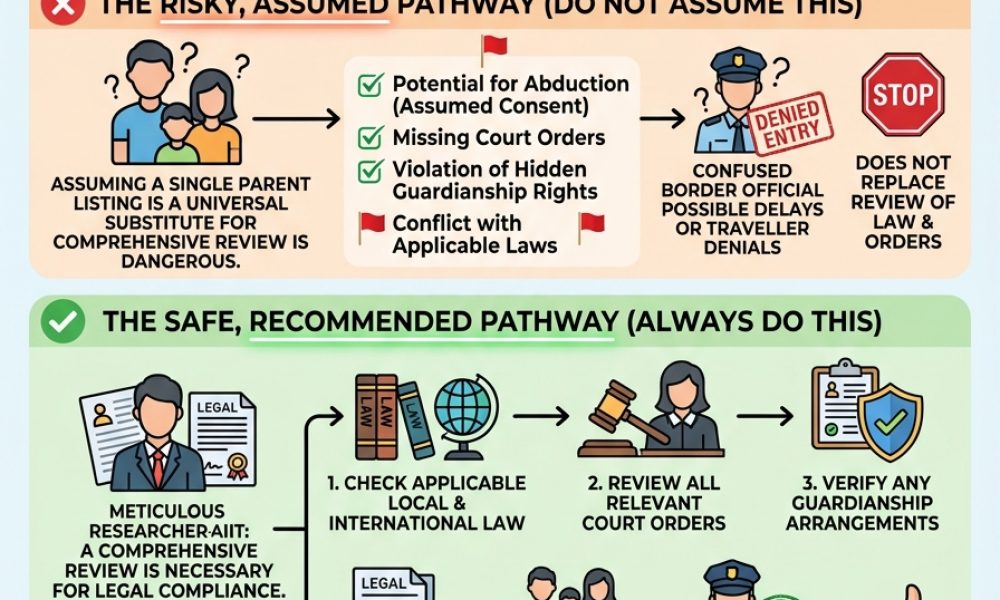
A birth certificate naming one parent can provide important evidence for a child’s travel arrangements. Still, its significance depends on the applicable rules, the purpose for which it is presented, and any later guardianship or court arrangements.
WASHINGTON, DC, October 16, 2026: A birth certificate listing one parent may help establish the documentary basis for a child’s passport Application or international journey, but families should not treat that record as a universal answer to questions about current legal authority.
The distinction matters because passport issuance, parental responsibility and permission for a particular trip involve related but separate assessments, each potentially requiring Information beyond the names appearing on a birth certificate issued earlier in the child’s life.
For parents planning overseas travel, the practical task is to determine what the certificate establishes, identify any other legally relevant arrangements, and assemble the documents required for the journey without assuming every country follows the same rules.
A Single Recorded Parent Can Be Important Evidence
The StateDepartment’ss passport guidance for children younger than 16 identifies a certified birth certificate listing the applicant as the only parent as a relevant document when one parent has sole legal custody or is the child’s only parent or guardian.
That provision gives the record a specific role within the American passport Application process. Still, it should be described accurately as an Application requirement rather than expanded into a guarantee that the resulting passport authorizes every proposed international journey.
A parent relying on that option should review the complete Application instructions and provide truthful Information about the child’s circumstances, particularly if a later order or guardianship arrangement affects who may act on the child’s behalf.
The appropriate conclusion is therefore narrower than saying that one name always eliminates further questions, because the certificate must be considered within the process being followed and alongside any other documents or legal obligations relevant to the family.
Parentage and Guardianship Require Separate Attention
British Columbia’s official guidance explains that guardianship depends on family circumstances, agreements, and court orders, showing why courts should not determine responsibility for care and decision-making solely by counting names on a birth certificate.
This distinction becomes especially important when a child’s circumstances have changed since birth, including when a court has appointed a guardian or issued orders allocating parental responsibilities that must be considered before arranging international travel.
A hypothetical certificate might name one parent, while a later court order gives another person legally relevant responsibilities, making the earlier record useful evidence of parentage without fully reflecting thechild’ss current arrangements.
Parents should explain that history when seeking advice, allowing a qualified professional to assess the governing law and current documents rather than answering an abstract question about whether a single entry automatically establishes exclusive authority for travel.
Canadian Passport Guidance Requires Current Legal Documents
Canada’s child passport documentation requirements distinguish proof of parentage from documents on custody, decision-making responsibility, and mobility, and require relevant legal records with provisions that remain in force when those arrangements apply to the child’s circumstances.
The guidance also explains that additional documents may be needed to understand operative provisions, such as an earlier order referenced by a later one, demonstrating why submitting only the newest page or the birth certificate can leave important context missing.
For a family organizing an Application, a useful preparation step is to identify which records establish parentage and which explain current authority, then verify that the submission includes the materials the passport office requires for that situation.
If the instructions seem hard to apply to a family with only one recorded parent, the applicant should ask the issuing authority about the specific circumstances rather than invent Information or assume a general instruction covers every exception.
Check Which Birth Record Is Being Presented
Document terminology can create confusion, so parents should confirm that the record they intend to use contains the parentage Information required for its intended purpose rather than assuming that every document called a birth certificate presents identical details.
A practical inquiry to the issuing registry can identify the available certificate formats and explain the intended use, helping the family request an appropriate record without guessing whether a shorter extract contains all the Information an authority expects.
This distinction is especially useful when a parent says a certificate shows only one name, because the receiving authority may need to know whether that statement refers to the recorded parentage or simply what the document displays.
Families should also check whether their copy reflects any official amendments, and ask the registry about replacement or correction procedures when needed instead of relying on an older version whose relationship to the current registration is unclear.
Later Orders Can Change the Questions That Matter.
When reviewing travel authority, a family should gather any relevant later court orders, guardianship documents, or agreements before relying on the birth record, particularly when those documents address the child’s residence, decision-making responsibility, passport, or movement outside a specified area.
The review should focus on what remains legally effective, because the date printed on a document does not by itself explain whether its provisions continue to apply or have been modified by a subsequent decision affecting the child.
For example, a hypothetical travel restriction could require separate attention even when the accompanying parent is the only person identified on the birth certificate, making the proposed destination and travel dates important parts of the legal assessment.
A concise consultation request should therefore describe the actual journey and provide all relevant records, giving the adviser a concrete question about the proposed arrangements rather than asking whether one parent’s name generally permits overseas travel.
Passport Issuance and Permission to Travel Are Different
Receiving a passport resolves an important document requirement. Still, parents should separately review whether the proposed trip complies with applicable parenting arrangements, since an identity document does not explain every condition governing the child’s departure or return.
This distinction also applies to an existing passport issued before later family proceedings, so it makes sense to review current arrangements rather than assume that possession of the booklet confirms all subsequent legal questions have already been settled.
A preparation record can keep passport validity, parental authority, required supporting documents, and itinerary compliance separate, allowing the family to identify the precise unresolved issue instead of describing the whole process as simply obtaining permission. When an official accepts a certificate for a passport Application, that acceptance should be understood within the scope of the Application, not as proof that another authority has approved every destination or travel arrangement.
Consent Questions Depend on Who Holds Relevant Authority
Canadian travel guidance recommends consent documentation from people with decision-making responsibility who are not accompanying the child, while explaining that a consent letter is not legally required in Canada and may nevertheless be requested during international travel.
For a family with one recorded parent, the practical question is whether anyone else currently has authority relevant to the journey, rather than assuming a second signature must always exist or that additional authorization can never matter.
If no second parent or guardian has relevant authority under the applicable arrangements, the family should ask how to demonstrate that position with appropriate records, avoiding unnecessary paperwork that incorrectly suggests another person has a role they do not hold.
If another person has relevant authority, families should not use their absence from the birth certificate to disregard the applicable arrangements, and they should resolve uncertainty through advice before travel plans depend on a particular interpretation.
Foreign Requirements Need Their Own Review
Canadian guidance warns that countries have their own entry and exit requirements for children, meaning families should check the rules for their destinations rather than assuming that documents accepted at home will answer every question abroad.
A useful inquiry describes the child’s nationality, the accompanying adult, the single-parent birth record, and any relevant legal arrangements, allowing the destination’s consular authority to identify the documentary requirements that apply to that specific travel situation.
Parents should include transit locations and the return journey in their preparation, especially when an itinerary involves more than one country or when the accompanying adult changes at different stages of the trip.
Written guidance can help organize the travel packet. Still, families should read its scope carefully and avoid treating an answer about one country’s entry requirements as confirmation that another country’s departure rules or a court order have been satisfied.
Travel With Another Adult Changes the Documentary Task
When the child travels with a grandparent, relative, family friend, or organized group, the documents may need to explain that adult’s role, as well as the authority of the parent who approved the journey and provided the supporting records.
A birth certificate naming one parent can help identify the relevant parentage relationship. Still, it does not by itself explain why an unrelated accompanying adult is taking the child abroad or what travel arrangements the parent has authorized.
For planning purposes, the parent can describe the full itinerary, accompanying adults, and handover arrangements when seeking guidance, especially if the child will travel alone for part of the route or return with a different person.
A caregiver should also distinguish permission to accompany the child from broader legal responsibilities, and ask about any separate requirements for medical decisions or other foreseeable needs rather than assuming one travel document covers every situation during the visit.
Names, Translations and Document Formats Need Checking: Identify differences between the parent’s current name and the name on the child’s birth certificate early, so the family can ask which supporting records are needed to explain the relationship for the relevant Application or journey clearly.
When documents are in another language, parents should confirm the receiving authority’s translation requirements before purchasing services, and identify the document’s issuing country, intended use, and available format. Hence, the response addresses the actual record being presented.
The same approach applies to certification or Authentication, because a family should establish which formalities a particular authority requires instead of assuming every overseas use calls for the same stamps, signatures, or additional procedures.
If the certificate contains an apparent error, contact the issuing registry to correct it, preserving the integrity of the official record rather than editing a scan or adding informal explanations directly to the document.
Passport Technology Cannot Determine Family Authority.
Amicus InternationalConsulting’ss guide to scanning a passport’s NFC chip and understanding the results distinguishes between reading passport Information and evaluating Authentication results, giving context for families who use smartphone apps as part of their travel document preparation.
A successful scan cannot determine whether another guardian exists, interpret a custody order or establish that the accompanying adult has permission for a particular journey, because those questions require Information beyond the electronic identity data being examined.
Parents can therefore keep technical passport checks separate from the legal review, directing document concerns to the issuing authority while asking an appropriately qualified adviser about unresolved questions concerning parentage, guardianship or restrictions affecting the child’s travel.
The same restraint applies to electronic backups, which can help families retrieve Information but should not be assumed to replace any original or certified record required by a passport office, transport provider or authority reviewing the journey.
Prepare an Accurate Explanation of the Family’s Circumstances
A useful travel packet should let the accompanying adult explain the child’s identity, the relevant parentage relationship, and any current legal arrangements without expecting an official to infer the entire situation from one entry on a certificate.
That preparation should remain proportionate, with the family gathering documents needed for the journey and protecting sensitive Information rather than sharing complete personal histories with every service provider involved in transportation, accommodation, or routine travel planning.
Parents can also prepare children for ordinary travel questions in an age-appropriate way, while retaining responsibility for explaining the paperwork and avoiding any expectation that the child must resolve uncertainty about legal relationships or documentary requirements.
A birth certificate naming one parent can be valuable evidence. Still, the strongest preparation links that record to the applicable law, current arrangements, and destination requirements so the family can demonstrate authority accurately throughout the intended journey.




