
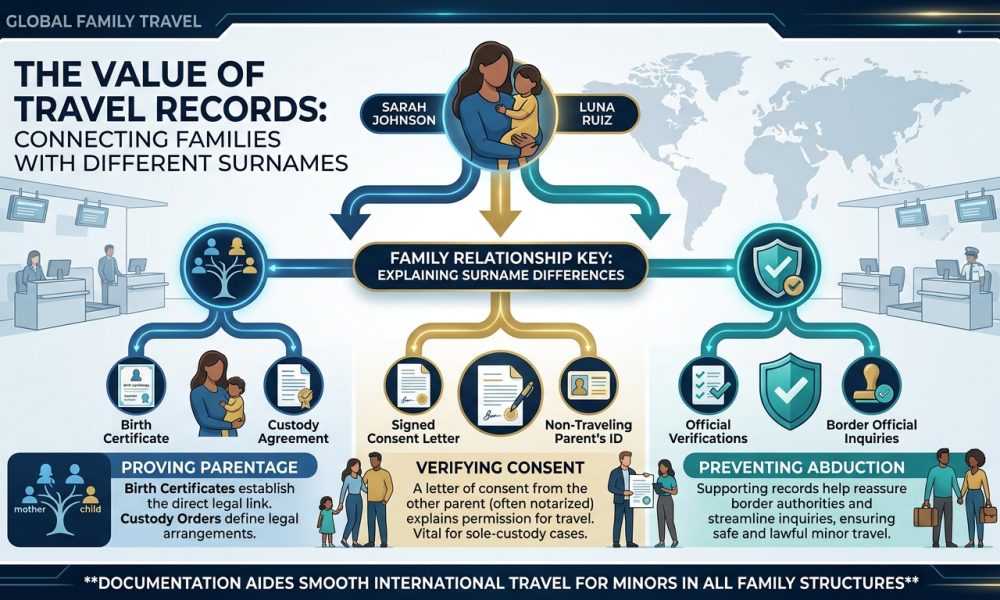
Birth certificates and other supporting documents can help explain a family relationship when a child and accompanying parent use different last names.
WASHINGTON, DC, October 14, 2026 — Parents traveling internationally with children who have different surnames may face additional questions during immigration examinations, not because the difference necessarily indicates an Identification problem, but because passports do not always include enough Information to establish the relationship between a child and an accompanying adult.
Government travel guidance from Canada and the United Kingdom recognizes that legitimate family relationships frequently involve different last names, reflecting marriage, divorce, remarriage, adoption, cultural naming conventions, and other circumstances that can affect how individuals are identified in official documents.
Although an authentic passport establishes key Information about the holder’s identity and nationality, immigration authorities may request birth certificates, marriage certificates, adoption records, or other supporting documents when they need additional evidence linking a child to the adult responsible for their international journey.
These documentary questions are particularly relevant to families with multiple citizenships, parents who have changed their names, children traveling under shared parenting arrangements, and households whose legal relationships cannot be readily understood from the names printed inside their passports.
The distinction illustrates a broader principle of international travel security: accurate identity verification and proof of family relationships serve complementary purposes, but authorities must avoid treating legitimate differences in surnames as evidence of wrongdoing.
Different Surnames Are Common in Modern Families
Family names can differ for numerous legitimate reasons, and immigration authorities increasingly encounter households whose Identification documents do not follow traditional naming patterns in which parents and children share one surname.
Marriage and remarriage often create these differences because one parent may adopt a new surname. At the same time, the child keeps the name recorded at birth or established through an earlier family relationship.
Divorce can create similar circumstances, particularly when a parent resumes a previous surname without changing the child’s registered name, leaving both individuals with valid Identification documents showing different last names.
International families may also follow naming traditions that include multiple family names, paternal and maternal surnames, patronymics, or culturally specific naming structures that differ from the conventions used by immigration authorities elsewhere.
Adoption, guardianship, and other legally recognized family arrangements can create additional variations, especially when changes in parental responsibilities do not immediately update the child’s passport or civil registration records.
These differences are not inherently suspicious, but they may require supporting Information when border officials cannot establish the accompanying adult’s relationship to the child through the passports presented during examination.
The United Kingdom Specifically Addresses Different Family Names
United Kingdom immigration guidance expressly recognizes that adults traveling with children may be questioned about their relationship when their surnames differ, reflecting the government’s responsibility to examine relevant circumstances while safeguarding the welfare of minors.
According to the United Kingdom government’s official guidance on entering the country with children, travelers may be asked to show their relationship to an accompanying child, particularly when the adult does not appear to be the child’s parent.
The guidance identifies birth certificates, adoption certificates, marriage certificates, and divorce documents as examples of records that can help establish family relationships or explain why a parent’s surname differs from the child’s.
Where the accompanying adult is not the child’s parent, officials may also request a letter from the legally responsible parent authorizing the journey and providing Information that allows authorities to verify the arrangement.
Importantly, the guidance does not require parents and children to share surnames, nor does it suggest that different last names automatically prevent lawful entry into the country.
Instead, the government recognizes that supporting documents can resolve legitimate Identification questions when ordinary passport Information does not explain the relationship between the people traveling together.
Birth Certificates Provide an Official Connection Between Parent and Child
Birth certificates can play an important role in international family travel because they generally record details concerning a child’s birth and, depending on the jurisdiction and certificate format, identify the parents recognized within the original civil registration process.
When a child and accompanying parent have different surnames, the certificate may demonstrate that the adult identified in the parent’s passport is also recorded as a parent in the child’s official birth Information.
This evidence can be particularly useful where a parent’s name remains unchanged from the birth registration, allowing immigration officials to establish the relationship without requiring extensive additional documentation.
However, birth certificates do not always fully explain when a parent has later changed their name, so a marriage certificate, legal name-change certificate, or other supporting record may be relevant.
The documents can therefore work together: one establishes parentage, and another explains why the parent’s current identity document shows a different surname from the original registration.
The objective is to provide a clear documentary connection between the individuals without requiring their current Identification documents to display identical family names.
Marriage Certificates Can Explain Changes in a Parent’s Surname
Marriage can result in a parent adopting a spouse’s surname. At the same time, a child may continue using the family name registered before the marriage, creating a common documentary difference that may become relevant during international travel.
A marriage certificate can help establish the connection between the parent’s previous and current surnames, particularly when the child’s birth certificate identifies the parent under the earlier name.
For example, a parent may have a passport issued under a married surname. At the same time, the child’s birth certificate may record the parent’s maiden name, creating an apparent inconsistency that the marriage record readily explains.
When multiple name changes occur, authorities may need more than one document to understand the sequence, especially when earlier marriages, legal changes, or different national registration procedures are involved.
Such records should not be interpreted as evidence that the family relationship is unusual or legally questionable, since surname changes are a routine feature of civil registration systems.
Supporting documentation provides an official explanation connecting records created at different points in the parent’s life.
Divorce and Remarriage Can Create Additional Documentation Questions
Divorce and remarriage may create further differences between family surnames, especially when children retain the names used before their parents separated and one or both adults adopt different names.
A divorced parent who resumes a former surname may face questions when traveling with a child whose passport still shows the surname from the parent’s previous marriage.
Similarly, a parent who remarries may begin using a new surname. At the same time, the child retains the other parent’s name, so ordinary travel documents do not immediately show their relationship.
Birth certificates and relevant name-change records may clarify these circumstances. At the same time, parenting agreements or court orders may be necessary when authorities also need evidence of decision-making responsibility or travel authorization.
The distinction matters because explaining a surname difference does not necessarily establish that the accompanying adult has unrestricted legal authority to travel internationally with the child.
Immigration officials may therefore examine both the family relationship and the relevant permission for the journey, depending on the destination’s requirements and the circumstances presented.
Canada Recommends Supporting Documents for Children Traveling Internationally
Canadian government guidance recognizes the importance of carrying supporting Identification when children travel internationally, particularly where officials may need additional Information about citizenship, parentage, guardianship, or parental decision-making responsibilities.
The Government of Canada’s guidance on travel documents for children identifies birth certificates, parental consent letters, and relevant legal records as documents that may be needed depending on the child’s circumstances and international itinerary.
Although Canada does not require every parent traveling with a child to present a birth certificate, the document may provide useful supporting evidence when the relationship is not immediately apparent.
The government also distinguishes proof of family relationships from parental consent, recognizing that a birth certificate can identify parents without establishing that every person holding decision-making responsibility has authorized a particular journey.
For families with different surnames, this distinction matters because the records explaining the relationship may differ from those needed to show compliance with parenting arrangements.
Canadian guidance therefore supports preparation while leaving families responsible for verifying the specific documentation requirements imposed by their destination countries.
A Consent Letter Addresses Permission Rather Than Family Names
Parental consent letters serve a different function from birth certificates or marriage records because they generally establish that an individual with relevant decision-making responsibility has authorized a child’s international journey.
Where a parent travels without another person with parental responsibilities, a consent letter may show that the absent individual has agreed to the destination, travel dates, and accompanying arrangements.
A surname difference does not automatically create a legal requirement for such a letter. Still, the document may become relevant where a country’s rules or the family’s parenting arrangements require authorization.
The child may therefore carry a birth certificate establishing parentage, a marriage certificate explaining the parent’s current surname, and a consent letter addressing permission from another legally responsible individual.
Each record answers a different question, so it’s important to distinguish proof of relationship from proof of authorization, rather than treating all supporting documents as interchangeable.
This separation helps families understand why officials may request additional Information even when a passport and birth certificate already establish the travelers’ identities.
Mexico’s Child Passports Provide Additional Family Identification
Mexico’s electronic passport system offers another way to establish family relationships because passports issued to minors include identifying Information about parents or legally recognized guardians in the physical booklet.
This additional Information can give immigration officials a reference linking the child to adults associated with passport issuance, which may help when an accompanying parent has a different surname.
Amicus International Consulting examined this approach in Mexico’s Children’s Passports Include Parents’ Photos to Strengthen Travel Security, explaining how parental photographs and identifying particulars complement conventional passport Authentication features.
The Information may help authorities recognize family relationships without immediately consulting separate civil registration records, although acceptance of these details depends on the requirements and procedures of the examining jurisdiction.
However, a parental photograph or name recorded in the passport does not, by itself, establish that the accompanying adult currently holds all relevant guardianship rights or has obtained the necessary authorization for the journey.
Mexico’s approach demonstrates how passport design can supplement family Identification while preserving the separate legal functions of birth certificates, consent letters, and court orders.
Adoptive Families May Rely on Different Official Records
Adoption can create legally recognized parental relationships that differ from the information in a child’s original birth registration, which may require additional explanation on travel documents.
Depending on the jurisdiction, an adoption may result in an amended birth certificate identifying the adoptive parents or a separate court order establishing the legally recognized relationship.
When the child’s passport and the adoptive parent’s Identification show different surnames, these records can help establish the connection and show that the family relationship arose through lawful procedures.
International adoption cases may involve documentation issued by several governments, creating additional considerations concerning document recognition, translation, and the legal effect of foreign adoption orders.
Immigration officials should distinguish these legitimate arrangements from document inconsistencies that warrant further examination, recognizing that adoption can produce valid Identification records with different names and historical details.
The objective is to identify legally established relationships without requiring families to conform to assumptions that every parent-child relationship must be reflected through identical surnames.
Single-Parent Families May Have Different Identification Records
Single-parent households may have Identification documents that record parental Information differently, particularly when the child was registered at birth with one parent or when the other parent’s involvement changed over time.
Some national passport systems allow certain applications to proceed without identifying both parents, reflecting circumstances involving abandonment, unmarried parents, guardianship arrangements, or judicial decisions about the child’s legal status.
Therefore, a passport lacking a parent’s name should not automatically be interpreted as incomplete documentation or as evidence that the accompanying adult lacks a legitimate relationship with the child.
Birth certificates, guardianship records, or other legally recognized documents may provide relevant Information where authorities need clarification concerning the child’s registered parentage.
However, the required documents depend on the family’s circumstances because a single parent may have exclusive decision-making responsibility or share legal responsibilities with another individual.
International travel examinations should therefore focus on evidence relevant to the journey rather than assuming all children must have records showing the same family structure.
Cultural Naming Conventions Require Careful Interpretation
International naming conventions vary significantly, creating legitimate differences between surnames recorded in passports, civil registration documents, and family records issued by different countries.
Some cultures traditionally combine paternal and maternal family names. In contrast, others use patronymics, multiple surnames, or naming arrangements that don’t follow the Western Convention of a single inherited family name.
Parents may also maintain their original surnames after marriage, resulting in children whose registered names contain only one parent’s surname or a combination that differs from both adults’ Identification documents.
When officials review these records internationally, they may encounter unfamiliar naming structures that require explanation but do not necessarily indicate contradictory identity Information.
An appropriate birth certificate or family registration record can help clarify the legal relationship without requiring the individuals involved to change their names or obtain unnecessary replacement passports.
Recognizing different naming systems supports accurate immigration examination while reducing the risk that ordinary cultural practices will be mistaken for documentation problems.
Dual Citizenship Can Produce Different Naming Records
Children with more than one nationality may hold passports issued by governments with different naming conventions, transliteration procedures, and civil registration rules, creating variations in how their personal and family names appear.
One country may record multiple family names, while another uses a shortened or differently formatted version, which can raise questions when officials compare documents issued by different authorities.
A child’s birth certificate may also come from a country other than the one issuing the passport, so officials may need to understand that the documents were created under different administrative systems.
These variations do not automatically create an identity discrepancy, although families may need supporting records that connect the Information when the differences are material to an immigration examination.
Parents should also recognize that dual nationality can create separate entry and departure requirements, particularly where a country requires its citizens to use national passports.
Multiple valid passports therefore do not eliminate the value of civil registration records that explain family relationships and relevant differences in personal names.
Court Orders Can Address Legal Authority When Family Records Are Insufficient
A birth certificate may establish parentage, but it does not necessarily demonstrate that the identified parent currently possesses the legal authority required for every international journey.
When parents share decision-making responsibility or operate under judicially established arrangements, a court order may clarify whether the accompanying adult needs another individual’s consent to travel.
These records can become particularly important after divorce, separation, or guardianship proceedings, when the child’s original birth registration may no longer describe the allocation of legal responsibilities.
An order on residential arrangements does not automatically grant unrestricted travel authority, so you must review the specific provisions and applicable legislation.
Families should therefore distinguish evidence explaining a surname difference from legal documents determining who may authorize international movement.
The relevant records may overlap in a particular case, but evaluate each based on the legal Information it establishes rather than its general appearance or title.
Airline Document Checks May Raise Additional Questions
Airlines examine passports and other travel documents before international transportation to help determine whether passengers appear to meet the requirements set by destination governments and the carrier’s operational procedures.
When children and accompanying adults have different surnames, airline personnel may request additional Information where the applicable requirements or circumstances make proof of relationship relevant.
However, such requests do not necessarily indicate that the child’s passport is invalid or that a different family surname prevents lawful international travel.
A birth certificate or another relevant document may resolve the question, although acceptance depends on the destination’s rules and the type of evidence required.
Airline checks also differ from government immigration decisions, since border officials can examine the child’s circumstances and request appropriate documentation under applicable law.
Families can reduce uncertainty by reviewing carrier instructions and official government guidance before departure, particularly when their itinerary involves several countries or complex family arrangements.
Electronic Passport Checks Cannot Establish Family Relationships.
Modern electronic passports use contactless chips, digitally signed Information, and biometric Identification features to authenticate travel documents and compare them with recorded identities.
These technologies can help determine whether protected passport Information has been altered and whether the document belongs to the person presenting it.
However, successful electronic Authentication does not independently establish that an accompanying adult is the child’s parent, especially when the verified data does not include parental Information.
Similarly, a successful facial comparison between a child and a passport photograph cannot demonstrate the legal relationship between that child and another traveler.
Family registration documents, birth certificates, and other official records may therefore remain relevant even where both travelers possess authentic electronic passports.
The distinction illustrates why advanced passport security technology complements civil registration systems rather than replacing the documentary evidence sometimes needed to establish family relationships.
Translations and Certified Documents May Be Relevant Internationally
Families with birth certificates, marriage records, or court orders issued in a language unfamiliar to destination authorities may face additional requirements for translation or document Authentication.
Some jurisdictions accept ordinary supporting documents, while others require certified translations, apostilles, legalization, or other formal procedures depending on the record and its intended legal use.
These requirements matter most for families whose children were born abroad or whose parents changed their names through marriages registered in another country.
A document establishing the correct family relationship may still require additional formalities before a government procedure accepts it.
However, families should not assume every international journey requires certified translations or legalized documents, since many destinations do not require them for routine travel examinations.
The best approach is to verify the relevant jurisdiction’s rules and prepare documents proportionate to the legal questions likely to arise.
Supporting Records Should Be Handled With Appropriate Privacy Safeguards
Birth certificates, marriage records, adoption documents, and court orders can contain sensitive personal Information about children and their families, so handle them carefully when submitting records during international travel.
These documents may reveal previous names, parental relationships, legal disputes, or other details beyond those required for ordinary passport Identification.
If officials legitimately require supporting records, families should present appropriate evidence and avoid unnecessary disclosure to unrelated commercial organizations or unfamiliar online services.
Parents should also exercise caution when sending document images through messaging apps or email, especially when complete records include Information about children and other family members.
Additional documentation requirements do not eliminate the importance of data Protection, since reliable identity verification should remain consistent with reasonable safeguards against unnecessary collection and retention.
Families can therefore benefit from organizing relevant records securely while determining which documents are actually necessary for the intended journey.
Preparation Can Reduce Unnecessary Border Delays
Families traveling internationally with different surnames should understand which official records establish the relationship between the child and accompanying adult, particularly where that connection is not apparent from their passports.
A birth certificate may clarify the relationship when the parent’s current name matches the registration Information, while a marriage certificate or name-change record may explain later differences.
Adoption records, guardianship orders, and parenting agreements may be relevant when legal relationships or decision-making responsibilities require further explanation.
The documents appropriate for one family may differ from those needed by another, so review the destination’s requirements rather than assuming every surname difference creates identical obligations.
Parents should also distinguish recommended supporting documentation from legally mandatory requirements, since government guidance may encourage preparation without imposing universal documentary conditions.
Addressing these issues in advance can help legitimate travelers anticipate questions and support the child Protection responsibilities immigration authorities exercise.
Conclusion: Different Surnames Do Not Mean Different Family Rights
Different family surnames are a common and legitimate feature of modern international travel, reflecting changes in marital status, adoption, cultural naming conventions, dual nationality, and other circumstances affecting official Identification documents.
Birth certificates and supporting records can help establish parent-child relationships when passports lack sufficient family Information, giving immigration authorities a clearer understanding of the individuals traveling together.
Marriage certificates, adoption orders, guardianship records, and parental consent letters may serve additional purposes depending on the circumstances, but their legal functions should not be confused or treated as interchangeable.
Government guidance from Canada and the United Kingdom demonstrates that documentary preparation can help resolve legitimate questions without implying that parents and children must share surnames or that every difference automatically requires additional inspection.
Ultimately, effective international child travel security depends on recognizing valid family relationships, understanding the different purposes of official records, and ensuring that documentation requirements protect children without unnecessarily disrupting lawful family mobility.




