
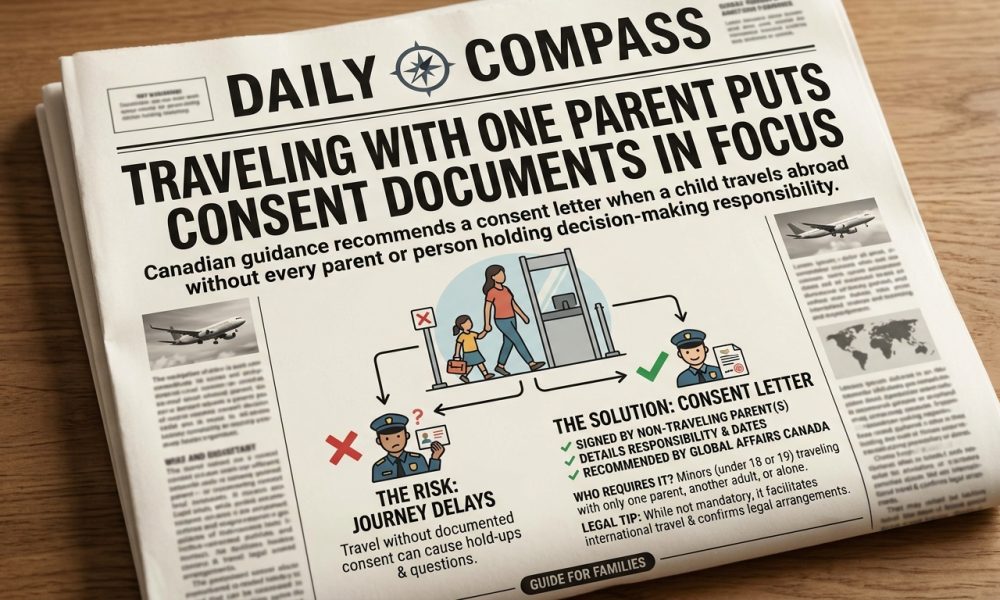
Canadian guidance recommends a consent letter when a child travels abroad without both parents or the person with decision-making responsibility.
WASHINGTON, DC, October 14, 2026 — Canadian families traveling internationally with children are reminded of an important distinction between having valid passports and showing parental permission, as federal travel guidance recommends carrying a signed consent letter when a minor travels abroad without every parent or other person exercising legal decision-making responsibility.
The recommendation applies to a wide range of family circumstances, including children traveling with one parent, grandparents, other relatives, school groups, or unrelated adults, reflecting the government’s recognition that international travel documentation must sometimes establish more than identity and nationality.
Although Canadian law does not require children to carry parental consent letters when leaving the country, immigration officials, airline representatives, and foreign border authorities may request additional evidence about a child’s travel arrangements or an absent parent’s authorization.
The distinction matters most for separated and divorced parents, families sharing guardianship responsibilities, and children with multiple nationalities, because the legal authority governing an international journey may differ from the Information recorded when the child’s passport was originally issued.
Canada’s approach illustrates a broader international principle of child Protection, recognizing that reliable passport Identification and lawful parental authorization serve different functions while supporting the safe movement of minors across international borders.
Canada Recommends Consent Letters for Children Traveling Abroad
The Government of Canada recommends that children traveling outside the country without one or more parents, or other individuals with decision-making responsibility, carry written permission from those not accompanying them, regardless of whether the child holds Canadian citizenship or another immigration status.
According to the Government of Canada’s official guidance on consent letters for children traveling abroad, the document provides evidence that the absent parent or legally responsible individual has authorized the child’s journey. However, Canadian law does not universally require its presentation.
This distinction matters because some families mistakenly treat the recommendation as a mandatory Canadian departure requirement. In contrast, others assume that a valid passport eliminates any need to carry supporting parental documentation.
Canadian authorities explain that they may request a consent letter when a child enters or departs a foreign country, during airline document checks, or upon returning to Canada, even when the underlying journey is legitimate.
The absence of a letter does not automatically establish unlawful travel. Still, officials may ask additional questions, seek clarification from an absent parent, or examine evidence before deciding the journey satisfies the requirements.
Families should therefore view the recommendation as a practical documentary safeguard intended to reduce uncertainty during international travel, rather than assuming every child leaving Canada is subject to the same statutory consent procedure.
The Recommendation Covers More Than Traditional Two-Parent Families
Canada’s current guidance uses the concept of decision-making responsibility to describe the individuals whose authorization may be relevant, recognizing that parental rights and responsibilities can differ considerably between families and legal arrangements.
Decision-making responsibility generally concerns the authority to make significant decisions affecting a child’s well-being. However, the exact meaning and allocation of these responsibilities depend on applicable legislation, parenting agreements, and judicial orders.
For married or common-law parents who both exercise relevant responsibilities, the government recommends that a parent traveling alone with the child carry the other parent’s consent, regardless of whether the adults remain in the same household.
Separated and divorced parents may face comparable recommendations, particularly when both retain legally recognized authority over important decisions concerning the child or when parenting arrangements impose conditions on international travel.
The guidance also recognizes legal guardians, tutors, and other individuals exercising decision-making responsibility, ensuring that its recommendations are not limited to biological parents or families with conventional parental arrangements.
By focusing on legal responsibility rather than simply the number of parental names appearing in a passport, Canada acknowledges that child travel authorization must reflect actual family circumstances.
A Valid Canadian Passport Does Not Establish Every Travel Permission
Canadian children traveling internationally generally require valid passports, which provide standardized evidence of nationality and identity and allow immigration authorities to examine the traveler’s document Information under internationally recognized procedures.
A passport also contains security features intended to support document Authentication, including identifying details, photographs, and, in modern electronic passports, digitally protected information accessible through compatible inspection systems.
However, issuing a passport does not necessarily mean that every subsequent international journey has been approved by all individuals whose legal responsibilities may be relevant at the time of departure.
Family circumstances can change after passport issuance through separation, divorce, guardianship proceedings, or other legally recognized developments, potentially affecting who has the authority to make decisions about the child’s international movement.
An accompanying parent may therefore hold the child’s valid passport while still needing to consider an existing parenting agreement, applicable court order, or the destination country’s consent requirements.
The passport establishes key facts about the child, while a consent letter addresses permission for a specific journey, making the two documents complementary rather than interchangeable.
Consent Letters Should Identify the Child and Travel Arrangements
Canadian guidance explains that a consent letter should provide enough Information for officials to understand which child is traveling, which adults have relevant decision-making responsibility, and the circumstances under which permission is granted.
The document ordinarily identifies the child, provides contact Information for the relevant parents or guardians, and records the accompanying adult’s name, address, relationship to the child, and, where applicable, contact details.
It should also explain the destination and expected duration of the journey, including the intended departure and return dates, allowing an examiner to determine whether the authorization corresponds to the travel arrangements being undertaken.
When multiple children from the same family travel together, Canadian guidance allows them to be listed in one consent letter. However, separate documents may be preferable when their itineraries or accompanying adults differ.
These details reduce uncertainty when officials need clarification, particularly if a child travels under a shared parenting arrangement or with an adult whose relationship is not immediately apparent.
The objective is to record specific travel authorization in a form that can be understood and examined without requiring a passport, and that functions as a comprehensive statement of parental rights.
Original Signatures and Notarization Can Strengthen Credibility
The Government of Canada recommends carrying an original signed consent letter because border officials may question the Authenticity of photocopies or electronic versions, particularly when they cannot readily establish whether the absent parent provided authorization.
Although Canada does not impose a universal legal requirement that consent letters be notarized, federal guidance strongly recommends having a notary public witness the signature to reduce the possibility of questions concerning its Authenticity.
An adult witness may be acceptable under the general Canadian recommendation. Still, notarization can provide an additional level of documentary assurance when families expect to encounter foreign authorities with more demanding verification procedures.
Parents living outside Canada can also arrange to have their signatures witnessed abroad, including through an appropriate Canadian consular office where the relevant service is available, and applicable fees are paid.
Digital signatures may be accepted in some circumstances, although Canadian guidance continues to favor original signed documents because acceptance of electronic authorization can vary between jurisdictions and examining authorities.
Families should therefore distinguish Canadian recommendations from mandatory requirements established by destination governments, some of which may specify particular forms, notarization procedures, or Authentication standards for parental consent documents.
A Consent Letter Remains Relevant for Short Cross-Border Trips
Canadian guidance explicitly extends its consent letter recommendation to international border crossings involving brief visits, including day trips between Canada and the United States, rather than limiting the advice to extended overseas travel.
This distinction matters because families sometimes assume parental authorization documents matter only when children travel by air or stay outside Canada for several days or weeks.
A child crossing the land border with one parent may still face questions about the absent parent, especially when the journey requires officials to confirm that the accompanying adult has appropriate authority.
The recommendation therefore applies whether the family travels by automobile, commercial aircraft, rail, or another means of transportation, although the documentary requirements depend on the relevant jurisdiction.
Canadian border officials retain authority to examine the circumstances of a child’s entry into Canada, while United States authorities separately apply American entry requirements and any relevant child Protection procedures.
A consent letter can provide useful supporting Information during these examinations, even though its possession does not guarantee admission or eliminate the possibility of additional questions from immigration officers.
Separated and Divorced Parents Face Additional Considerations
Parents who have separated or divorced may still share decision-making responsibility for their children, so it’s important to distinguish the child’s residential arrangements from the legal authority required for international travel.
A parenting agreement may allow one parent to make certain decisions independently while preserving the other parent’s rights regarding relocation, international travel, or major changes affecting the child’s residence.
Other arrangements may give one parent sole decision-making responsibility, although Canadian guidance still recommends carrying a consent letter from the other parent whenever possible and safe.
This recommendation reflects practical concerns because airline representatives and border officials may not immediately understand the legal effect of a parenting agreement or know whether the relevant responsibilities have changed.
Families should also carry copies of applicable court orders or parenting arrangements, especially when those documents explain why another parent’s consent isn’t needed or set specific conditions for international travel.
If a dispute exists over authority, professional legal advice may be appropriate before departure, since a passport or consent letter cannot override a binding judicial restriction.
Sole Decision-Making Responsibility Does Not Eliminate Every Documentary Question
An individual with sole decision-making responsibility may have the legal authority to authorize a child’s travel without another parent’s agreement, depending on applicable legislation and any restrictions in the relevant parenting order.
However, foreign immigration authorities may not immediately recognize the legal effect of Canadian family law terminology, especially where their domestic procedures use different concepts of custody, guardianship, or parental authority.
A certified or otherwise appropriate copy of the relevant court order may therefore help establish the accompanying parent’s authority, particularly where another parent’s consent cannot be obtained or is not legally required.
Canadian guidance also recommends obtaining a consent letter from the other parent when possible and safe, even where an agreement or order allows one parent to make travel decisions independently.
This recommendation does not create new legal rights for a parent who does not have them, because the allocation of authority still depends on applicable law and judicial decisions.
Instead, supporting documents can help officials understand the legal circumstances underlying a journey and distinguish lawful travel arrangements from situations that require further examination.
Unavailable Parents and Difficult Family Circumstances Require Individual Assessment
Canadian authorities recognize that obtaining parental consent may be difficult or unsafe in some circumstances, including situations involving family violence, prolonged estrangement, detention, or an absent parent whose location is unknown.
The government advises families to consider legal assistance where consent cannot reasonably be obtained, particularly when a parenting agreement or judicial order does not clearly resolve the authority required for international travel.
An unavailable parent may retain legal decision-making responsibility even if they are outside Canada or difficult to contact, so physical absence alone is insufficient to determine whether consent is legally required.
Conversely, a valid court order may establish that another individual’s agreement is not required, allowing the traveling parent to rely on documentary evidence of the authority already recognized under applicable law.
These circumstances show why a standardized consent letter recommendation cannot replace an individualized review of family responsibilities, especially when safety concerns or unresolved judicial disputes affect the adults involved.
The objective remains protecting the child’s interests while recognizing that lawful family arrangements may involve circumstances in which obtaining another parent’s signature is neither feasible nor appropriate.
Death Certificates Can Explain the Absence of Parental Consent
Where one parent has died, Canadian guidance recommends carrying a copy of the deceased parent’s death certificate when the surviving parent possesses sole decision-making responsibility and accompanies the child internationally.
The document provides an official explanation for the absence of that parent’s authorization, helping immigration officials distinguish bereavement from circumstances where consent may still be expected from another legally responsible individual.
When the child travels alone, Canadian guidance recommends a consent letter from the surviving parent together with a copy of the death certificate, creating a clearer record of the authority supporting the journey.
The circumstances may be more complicated where another individual has subsequently obtained guardianship or decision-making responsibility, requiring consideration of additional records establishing the current legal arrangements.
A death certificate does not independently determine every guardianship question, but it can provide relevant evidence when read alongside existing civil registration records and applicable legal documents.
This illustrates how supporting paperwork can address a specific question concerning parental authorization without changing the passport’s primary function as an international identity and nationality document.
Children Traveling With Grandparents or Other Relatives
Canadian consent letter guidance also applies to children traveling with grandparents, siblings, aunts, uncles, family friends, or other adults who do not necessarily possess legal decision-making responsibility.
These journeys may be entirely legitimate, but the accompanying adult’s family relationship does not automatically establish that the child’s parents or guardians have authorized international travel.
A properly prepared consent letter can identify the adult responsible for accompanying the child and demonstrate that the relevant individuals have approved the proposed destination and travel period.
Birth certificates, guardianship documents, or other records may provide additional evidence where authorities need to understand how the accompanying adult is connected to the child.
However, a grandparent or other relative supervising a holiday does not automatically acquire the broader parental responsibilities associated with legal guardianship merely because written permission has been granted for the journey.
The letter therefore documents authorization for a defined travel arrangement while preserving the distinction between temporary supervision and ongoing legal decision-making responsibility.
School Groups and Organized Activities Also Require Attention
Children participating in international school excursions, athletic competitions, cultural exchanges, or organized community activities may travel under the supervision of teachers, coaches, and other responsible adults rather than their parents.
Canadian guidance recommends consent letters in these situations because accompanying adults may need to show that the legally responsible parents or guardians have approved participation in the international activity.
Group organizers commonly collect parental contact Information, emergency details, and relevant travel authorization documents before departure, but these administrative procedures must align with the destination country’s requirements.
When children travel separately for part of an itinerary, separate consent letters may be preferable because the accompanying adults, destinations, or dates may not remain the same throughout the journey.
Airlines and transportation providers may impose additional procedures concerning group travel and unaccompanied minors, creating obligations that operate separately from government immigration requirements.
Effective preparation requires organizers to understand these different responsibilities and ensure the children have valid travel documents and appropriate authorization for their intended international activities.
Foreign Governments May Impose Different Consent Requirements
Canada’s recommendation does not set the documentary rules for other countries, since foreign governments can set their own entry, departure, and parental authorization requirements for visiting children.
Some countries require notarized parental consent documents, while others prescribe specific government forms, accept judicial orders, or apply different rules depending on the child’s nationality and the accompanying adult’s legal relationship.
These variations matter because a child may leave Canada without needing a consent letter yet face additional documentary requirements upon arrival or before departure from another jurisdiction.
The U.S. Department of State’s guidance on international travel with minors similarly explains that certain countries require written or notarized authorization from a non-traveling parent, even though the United States does not generally require evidence of both parents’ permission for international travel.
Parents should therefore review the destination’s current entry and exit requirements rather than assuming Canadian recommendations fully explain the applicable foreign rules.
The distinction matters most when international itineraries involve several countries, because transit, destination, and return procedures may each introduce different documentary requirements.
Dual Citizenship Can Complicate Parental Consent Procedures
Children with Canadian citizenship and another nationality may face additional travel considerations because the second country may recognize them as its citizens and apply its domestic entry or departure requirements.
These rules may differ from Canadian recommendations concerning consent letters, particularly where the other jurisdiction requires its citizens to use national passports or imposes specific restrictions on minors departing the country.
A child who enters another country using that country’s passport may therefore be subject to documentation requirements not apparent from the Canadian passport or the consent letter carried by the accompanying parent.
The complexity increases when parents have different citizenships, live in different countries, or are subject to parenting orders issued by courts outside the jurisdiction being visited.
Canadian authorities recommend reviewing the destination country’s rules and, where necessary, contacting its diplomatic representatives to determine which documents are appropriate for children with multiple nationalities.
Multiple citizenship does not automatically eliminate parental authorization obligations, making it important to distinguish lawful passport use from the separate legal requirements governing a child’s international movement.
Mexico’s Child Passports Provide Additional Parental Information
Mexico’s electronic passport system offers a relevant comparison because passports issued to minors incorporate additional identifying Information concerning parents or legally recognized guardians, creating a documentary reference that may assist authorities during international travel examinations.
The inclusion of parental photographs and identifying particulars can help connect the child’s official travel identity with Information concerning the adults associated with passport issuance, complementing the document’s physical and electronic security features.
Amicus International Consulting examined these developments in Mexico’s Children’s Passports Include Parents’ Photos to Strengthen Travel Security, explaining how family Identification Information can supplement conventional passport details during examinations involving minors.
However, identifying an adult in a child’s passport does not, by itself, establish that another parent has approved a particular international journey or that applicable parenting arrangements have been met.
Canada’s consent letter recommendation demonstrates this distinction by addressing authorization for a specific journey, rather than relying solely on the parental Identification Information recorded when the passport was issued.
The two approaches therefore illustrate complementary elements of child travel security, with passport Information supporting identity examination and consent documentation clarifying the legal permission for international movement.
Electronic Passport Authentication Cannot Establish Parental Permission.
Modern electronic passports contain sophisticated security features to strengthen identity verification, including contactless integrated circuits, digitally signed Information, and biometric data linked to the legitimate document holder.
These technologies allow compatible inspection systems to examine electronically stored Information and perform Authentication procedures that can help detect unauthorized alterations or inconsistencies affecting the passport’s recorded identity data.
However, successful electronic Authentication does not establish that an absent parent has consented to the child’s journey, because parental authorization concerns legal relationships and circumstances that passport chip verification does not ordinarily determine.
Similarly, a successful facial comparison between a child and the passport photograph can help establish that the document belongs to the individual presenting it without determining whether the accompanying parent has unrestricted travel authority.
The distinction explains why governments may recommend additional documents even when a child possesses a genuine electronic passport that passes appropriate Authentication checks.
Effective child travel security therefore depends on combining reliable identity verification with relevant legal documentation, rather than expecting passport technology to resolve questions about guardianship, parental rights, or travel consent.
Consent Letters Are Helpful but Cannot Prevent Every Child Protection Problem.
Canadian guidance acknowledges that a signed consent letter cannot guarantee the prevention of international parental child abduction or ensure that a child will return to Canada following an authorized journey.
The document shows that permission was given under specific circumstances. Still, it does not, on its own, prevent an accompanying adult from violating the agreed travel arrangements or retaining the child abroad.
Parents concerned about unauthorized relocation or international retention may therefore need appropriate legal advice and judicial Protection rather than relying exclusively on the existence or absence of a consent letter.
A further limitation arises because authorities cannot necessarily examine every departing traveler individually, meaning that documentary recommendations should not be interpreted as a comprehensive system for preventing every unauthorized international movement.
These limitations reinforce the distinction between practical documentary precautions and the broader legal measures available under domestic family law and international child Protection arrangements.
A consent letter remains useful because it can clarify lawful travel authorization. Still, it should not replace judicial orders or other protections when serious legal concerns exist.
Practical Preparation Reduces International Travel Disruptions
Families preparing international journeys should review the child’s travel documents, including the passport, any relevant birth certificate, and documents establishing parental responsibilities or an accompanying adult’s authority.
When Canadian guidance recommends a consent letter, preparing it before departure lets responsible adults identify the travel dates, destination, accompanying person, and relevant parental or guardianship authorization.
Parents should also consider whether an original signature, notarial witnessing, or supporting judicial documentation may be useful, especially when traveling to countries with more demanding documentary procedures.
The appropriate records depend on the child’s circumstances, because a family traveling under shared decision-making arrangements may require different evidence from one relying on a court order establishing exclusive authority.
Canadian government guidance should be considered alongside destination-specific immigration requirements and airline procedures to ensure families understand which documents are recommended and which are legally mandatory.
Careful preparation supports legitimate family mobility while reducing avoidable uncertainty concerning parental consent, identity verification, and the Protection of children during international travel.
Conclusion: A Consent Letter Connects Identity With Travel Authorization
Canada’s recommendation that children carry consent letters when traveling abroad without every parent or person exercising decision-making responsibility illustrates the distinction between possessing valid travel Identification and demonstrating permission for a particular international journey.
The country’s approach recognizes that passports establish identity and nationality. At the same time, consent letters and supporting legal records can help clarify parental authorization, guardianship responsibilities, and the circumstances under which a minor is traveling.
Although Canadian law does not universally require consent letters, foreign governments and transportation operators may request supporting documentation, so separated families, international households, and children traveling with other adults should prepare in advance.
The recommendation also shows that child travel security relies on legal safeguards that electronic passport Authentication, biometric verification, or additional parental photographs in official travel documents cannot replace.
Ultimately, international family travel depends on understanding the separate roles of passports, parental Identification, consent declarations, and judicial arrangements, ensuring children can travel legitimately while respecting relevant parental responsibilities and child Protection requirements.




