
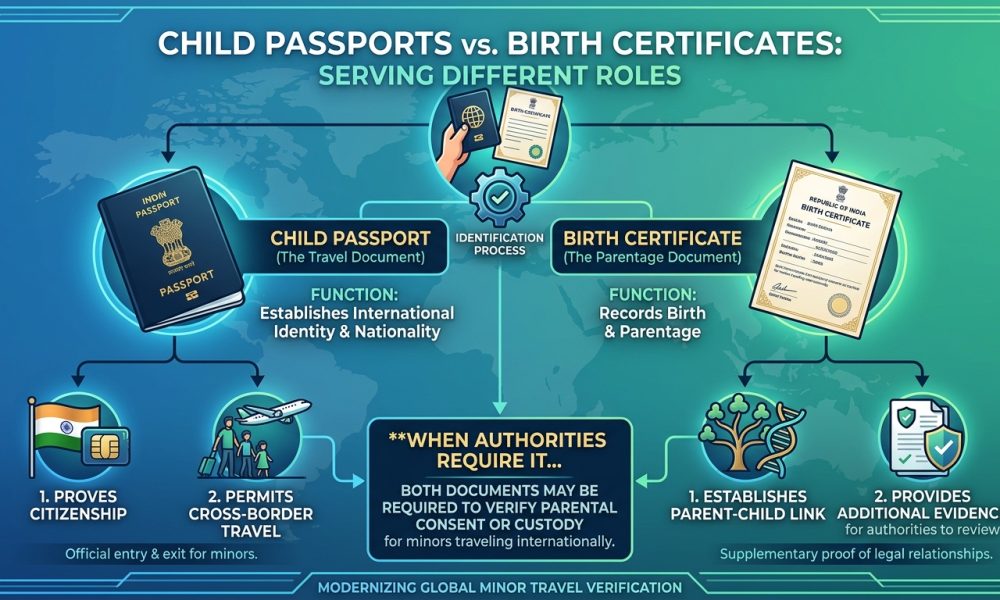
A passport establishes travel identity and nationality, while a birth certificate can provide additional evidence of parentage when authorities require it.
WASHINGTON, DC, October 14, 2026 — Passports and birth certificates serve different but complementary functions within international child travel procedures, with passports establishing the holder’s identity and nationality for international travel while birth certificates provide civil registration Information that may help authorities determine parentage, family relationships, and eligibility for additional legal protections.
As governments modernize electronic passports and introduce additional family Identification features, the distinction between these documents has become increasingly important for immigration officials, airlines, and parents navigating international travel requirements involving minors.
Although a valid passport generally provides the principal Identification needed for international movement, it does not necessarily establish the relationship between a child and an accompanying adult, particularly where parental names are absent, or family circumstances involve adoption, separation, guardianship, or different surnames.
Birth certificates can help address these questions by recording Information associated with a child’s birth registration, including tparents’names ohere rhe issuing jurisdiction. However, the precise content and legal significance of these records vary by country.
Understanding the separate purposes of these documents helps families prepare more effectively for international travel and helps authorities distinguish identity verification from parental Identification, legal guardianship, and the consent requirements that may apply when children travel across borders.
A Passport Establishes International Travel Identity
A passport is an official document issued by a competent government authority that identifies its holder as a person entitled to use the document for international travel and establishes the nationality recorded by the issuing country.
Modern passports typically include the holder’s name, photograph, date of birth, nationality, passport number, issuing authority, and validity Information, allowing immigration officers and transportation operators to conduct standardized checks across national jurisdictions.
These details help determine whether the passport belongs to the individual presenting it and whether the document satisfies relevant travel requirements, including validity periods, nationality-based entry conditions, and applicable visa obligations.
For children, the passport performs the same fundamental Identification function. However, some countries may require additional issuance procedures involving parents or legal guardians because minors generally cannot independently meet every administrative requirement.
An authentic passport can therefore establish important Information about the child’s identity and nationality without necessarily explaining who exercises parental authority, who authorized a particular international journey, or whether the accompanying adult possesses legal guardianship.
This distinction matters because the legal authority to obtain a passport and the authority to travel internationally with a child are related but separate questions governed by different national laws.
A Birth Certificate Records Civil Registration and Parentage
A birth certificate is a civil registration document issued by an authorized government body that records Information concerning a person’s birth, ordinarily including the date and place of birth and other details required under the relevant jurisdiction’s registration system.
Depending on national legislation and the type of certificate issued, the document may also identify the child’s mother, father, or legally recognized parents, creating an official record that can help establish family relationships.
Unlike a passport, a birth certificate is generally not intended to function as an internationally standardized travel document because it typically lacks the security features, machine-readable Information, and travel-validity characteristics associated with passports.
Nevertheless, birth certificates often support passport applications because they can provide evidence of birth circumstances, recorded parentage, and potential nationality entitlements, particularly when citizenship depends on descent or place of birth.
The document may also become relevant during international travel when authorities need to understand the relationship between a child and an accompanying adult whose parental status is not evident from the passport.
Its principal contribution is therefore evidentiary rather than operational, supplying official civil registration Information that may complement the identity and nationality details recorded inside an internationally recognized passport.
Why Both Documents May Be Needed During International Travel
A child traveling internationally may have a valid passport yet still be asked to provide a birth certificate or equivalent parentage document, especially when immigration regulations require additional evidence of the relationship between the minor and an accompanying adult.
Such requests do not necessarily indicate a problem with the passport, because officials may already be satisfied that the document is genuine while seeking Information addressing a different legal or administrative question.
For example, a parent traveling with a child whose surname differs from their own may find that the child’s passport establishes identity but provides limited Information explaining the relationship between the two travelers.
A birth certificate identifying the relevant parent can help clarify this relationship, although adoption documentation, guardianship records, or other legally recognized documents may be more appropriate in particular family circumstances.
The Government of Canada’s official guidance for minor children entering Canada distinguishes the child’s passport from supporting documents such as birth certificates and authorization letters, depending on whether the child travels alone, with one parent, or with another adult.
This separation shows that additional documentation requirements aren’t necessarily duplicative, because different records may address identity, parentage, and permission to travel in the same immigration examination.
Parental Names Are Not Included in Every Child’s Passport
Passport designs vary considerably between countries, with some governments recording parental names or guardianship Information inside the booklet while others concentrate primarily on the child’s personal Identification and nationality.
These differences reflect national administrative decisions concerning passport personalization, privacy, civil registration systems, and the Information considered necessary for international travel Identification.
A passport that does not display both parents’ names should therefore not automatically be regarded as incomplete, because many legitimate travel documents are issued without including comprehensive family Information.
Similarly, including parental details does not necessarily mean the individuals identified retain all relevant legal responsibility for the child, particularly when family circumstances have changed after passport issuance.
Governments may also recognize exceptions for single parents, adoption, guardianship, or judicial decisions, so it is inappropriate to assume all minor passport holders must present documents reflecting identical family relationships.
Reliable Identification requires reference to the applicable issuing authority’s specifications and legal procedures, not assumptions about what parental names should appear in a particular country’s passports.
Mexico Adds Parental Information to Children’s Electronic Passports
Mexico provides an important example of a government incorporating additional family Identification Information into modern travel documents, including parental or guardian photographs and identifying particulars within electronic passports issued to minors.
The design provides a supplementary reference for authorities examining a child’s passport, allowing certain Information about the adults connected with the original Application to be reviewed without immediately requiring a separate civil registration document.
Amicus International Consulting examined this development in Mexico’s Children’s Passports Include Parents’ Photos to Strengthen Travel Security, explaining how the additional Information complements the country’s electronic passport modernization and broader child Identification safeguards.
However, a parental photograph or name inside the passport does not make the document a universally accepted birth certificate or establish legal authorization for every international journey.
Foreign immigration authorities may have specific requirements for acceptable evidence of parentage, and a passport’s additional Information may be subject to the destination’s rules.
Mexico’s approach nevertheless demonstrates how passport design can incorporate family Identification features that may reduce uncertainty during some examinations while preserving the different legal functions of passports, birth certificates, and consent documents.
South Africa Recognizes Equivalent Evidence of Parentage
South Africa offers a particularly relevant example of how immigration authorities distinguish passports from birth certificates while recognizing that certain official documents can contain overlapping family Identification Information.
Under earlier child travel documentation requirements, South African authorities recognized passports containing parents’ identifying particulars as potentially acceptable evidence of parentage, allowing an appropriate passport to substitute for a separate unabridged birth certificate in relevant circumstances.
Subsequent changes introduced in November 2019 removed routine birth certificate and consent letter requirements for many foreign children entering or departing South Africa. However, separate safeguards continued for South African minors and unaccompanied foreign children.
The distinction matters because South Africa’s child travel procedures have evolved, so the requirements applying to a South African citizen may differ substantially from those affecting a foreign visitor.
Where parental Identification remains legally relevant, authorities may examine the Information already recorded in an appropriate passport rather than requiring a document that merely reproduces substantially equivalent family details.
However, proof of parentage remains distinct from consent to travel, and accepting one document to identify parents does not necessarily eliminate other legal obligations affecting a minor’s journey.
Canada Distinguishes Supporting Identification From Travel Authorization
Canadian child travel guidance recognizes that passports, birth certificates, parenting orders, and consent letters provide different forms of Information, allowing authorities to assess identity, family relationships, and travel based on the circumstances of the journey.
A Canadian child traveling internationally generally needs a valid Canadian passport, while supporting documents may be needed if the child travels with one parent, another relative, a legal guardian, or an unrelated accompanying adult.
A birth certificate may help identify the parents recorded in the child’s civil registration Information. At the same time, a parenting order can establish legally recognized responsibilities that may differ from those apparent in the original birth record.
According to the Government of Canada’s guidance concerning consent letters for children traveling abroad, such letters are recommended when children travel without one or more individuals exercising decision-making responsibility, even though Canadian law does not universally require them.
This distinction shows why a birth certificate cannot automatically replace a consent letter, since the former generally proves parentage while the latter authorizes a specific international trip.
For families, understanding these functions reduces confusion when preparing documents and helps ensure immigration officers receive records relevant to the legal questions they are examining.
Birth Certificates Do Not Automatically Establish Citizenship
Although birth certificates often provide important evidence for determining citizenship, having a birth certificate issued in a particular country does not automatically establish nationality under that country’s laws.
Citizenship rules vary significantly across jurisdictions, with some countries recognizing nationality by birth within their territory and others emphasizing parental citizenship, legal descent, or additional statutory conditions.
A child born abroad to citizens of another country may have a foreign birth certificate yet qualify for citizenship through descent, subject to registration requirements or other provisions in the relevant nationality legislation.
Conversely, a child born within a country may not automatically acquire its nationality if domestic legislation bases citizenship on place of birth or creates exceptions tied to the parents’ immigration or diplomatic status.
Passport-issuing authorities therefore evaluate the applicable nationality laws and supporting records before issuing travel documents, rather than treating every birth certificate as independent, conclusive evidence of citizenship.
The distinction matters most for children with multiple nationality claims, since different governments may have issued their birth records, citizenship certificates, and passports for different legal purposes.
Adoption Can Change the Relevant Parental Records
Children adopted through legally recognized procedures may have original birth records containing Information that differs from the parental details in later documents, creating situations that require careful interpretation during international travel.
Depending on the jurisdiction, adoption may result in amended civil registration records, new birth certificates, or separate adoption orders establishing the legal relationship between the child and the adoptive parents.
A passport issued after adoption may reflect the child’s legally recognized name and current Identification particulars. At the same time, an earlier birth certificate may no longer provide the most appropriate evidence of the applicable parental relationship.
These differences should not automatically be treated as suspicious, because they can result from lawful adoption procedures and government decisions concerning the confidentiality and recording of family Information.
Where immigration authorities require proof of parentage, adoptive families may need to present an amended birth certificate, adoption order, or another officially recognized document establishing the relevant legal relationship.
Understanding each record’s specific function is especially important in international adoption cases, where documents from several countries may need to be considered together.
Single-Parent Families May Have Different Documentary Circumstances
Single-parent households show why a child’s passport and birth certificate must be evaluated under the applicable issuing rules, not on the assumption that every official record must identify two participating parents.
In some jurisdictions, a child’s birth registration may contain Information concerning only one parent, while passport regulations may separately recognize circumstances involving abandonment, unavailable parents, or exclusive legal guardianship.
Other countries may collect Information about both parents during the Application process while permitting authorized administrative or judicial procedures to omit certain identifying details from the completed passport.
These differences mean that an absent parental name does not necessarily indicate inaccurate Identification, incomplete registration, or an improperly issued passport, provided the document complies with the issuing authority’s requirements.
When proof of travel authorization is required, the responsible adult may need supporting evidence explaining the applicable parental responsibilities, such as a judicial order or another legally recognized declaration.
The objective should remain accurate documentation of the child’s identity and family circumstances without imposing assumptions that exclude legitimate single-parent arrangements from ordinary international travel procedures.
Different Surnames Do Not Automatically Indicate an Identity Problem
Parents and children may have different surnames for many legitimate reasons, including marriage, divorce, remarriage, adoption, cultural naming conventions, and individual decisions about registering family names.
A passport comparison may therefore identify travelers without immediately explaining their relationship, especially when the issuing government includes corporate parent names in the child’s travel document.
A birth certificate or equivalent official record may help clarify the connection. At the same time, additional name-change documentation can become relevant when a parent’s current Identification differs from the name recorded at the child’s birth.
However, a surname difference alone should not be interpreted as evidence of unlawful travel, since family relationships frequently involve naming arrangements that differ from those anticipated by standardized administrative forms.
Immigration authorities must distinguish genuine inconsistencies requiring clarification from ordinary variations in naming practices, using relevant documentary evidence rather than assumptions about how parents and children should be identified.
Families in these circumstances can benefit from reviewing supporting records before travel, especially where the destination has specific documentary requirements for minors accompanied by adults with different surnames.
Electronic Passport Verification Does Not Establish Parentage
Electronic passports incorporate technologies intended to improve document Authentication, including embedded contactless chips, digitally signed identity data, and biometric Information supporting comparisons between the passport holder and the recorded identity.
These technologies can strengthen confidence that electronically stored Information originates from an authorized issuing authority and has not been altered, subject to the capabilities of the inspection system and the Authentication procedures performed.
However, successfully authenticating a passport chip does not independently establish biological parentage, current guardianship rights, or consent to travel, because these matters generally depend on separate civil registration and legal records.
A successful facial comparison similarly supports verifying the passport holder’s identity without determining whether an accompanying adult has the parental responsibilities required for the journey.
Even where a passport includes parental Information, authorities must distinguish between verifying the Authenticity of that Information and determining whether it establishes the legal relationship relevant to a particular immigration requirement.
Modern passport technology therefore complements civil registration systems without replacing the documentary and legal processes needed to assess parentage, guardianship, and authorization for international travel.
Privacy Matters When Handling Children’s Identity Documents
Birth certificates and passports contain sensitive personal Information. Still, the details they disclose can differ considerably, so families should handle them carefully when submitting documents to airlines, government agencies, or other organizations.
A birth certificate identifying parents may reveal family relationships and historical registration Information beyond what routine identity verification requires. At the same time, passports may contain photographs, document numbers, and other Information relevant to international travel.
When supporting documentation is necessary, organizations should limit collection and retention to Information required for legitimate operational or legal purposes, especially when processing documents belonging to children.
Parents should exercise caution when transmitting copies through unsecured communication channels or uploading complete documents to unfamiliar services, since unnecessary disclosure can expose personal Information concerning both children and their families.
These considerations do not diminish the value of supporting documents, but they emphasize that additional verification requirements should be accompanied by appropriate procedures for protecting the Information collected.
The broader challenge is to maintain reliable identity and family-relationship verification while avoiding unnecessary exposure of sensitive records during routine international travel arrangements.
International Travel Requires Documents Serving Different Legal Purposes
The documents relevant to a child’s international journey may include a passport, birth certificate, citizenship certificate, parental consent letter, adoption order, guardianship decision, or other official record, depending on the countries and circumstances involved.
Assess each document based on the Information it establishes, since nationality, identity, parentage, guardianship, and travel authorization raise distinct legal questions that a single record may not answer
A valid passport may satisfy the principal Identification requirement while an additional document establishes the accompanying adult’s relationship to the child or confirms permission from another individual exercising parental responsibilities.
Conversely, a birth certificate may provide sufficient parentage Information without establishing that a particular journey complies with an existing custody agreement or court order restricting international travel.
Government requirements also change, so it’s important to distinguish current procedures from older guidance that may no longer accurately describe the documents required for a particular nationality or destination.
For internationally mobile families, careful preparation means understanding each document’s purpose and identifying which records are legally required, rather than simply assembling the largest possible collection of paperwork.
Conclusion: Different Documents Provide Different Forms of Protection
Passports and birth certificates remain essential components of international identity administration. Still, their distinct functions explain why governments may require both documents when examining a child’s nationality, family relationships, and circumstances surrounding international travel.
A passport provides standardized Identification supporting international movement, while a birth certificate supplies civil registration Information that may establish recorded parentage and contribute evidence relevant to citizenship or family relationships.
Neither document automatically establishes every legal permission associated with a child’s journey, since guardianship responsibilities, parental consent, and judicial restrictions may require additional records and separate consideration under applicable law.
Mexico’s inclusion of parental Information in children’s electronic passports, South Africa’s recognition of equivalent evidence of parentage, and Canada’s guidance concerning supporting travel documents demonstrate how different national systems address these complementary Identification requirements.
Ultimately, effective child travel security depends on understanding what each official document establishes, recognizing legitimate differences between family circumstances, and ensuring that international travel procedures protect minors without unnecessarily complicating lawful family mobility.




