
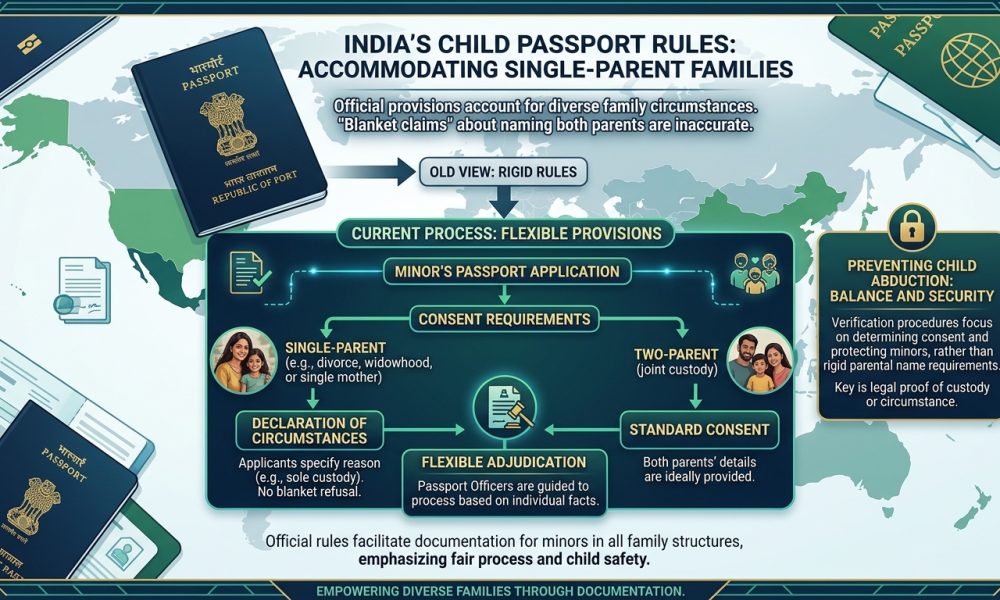
Official provisions accommodate specific family circumstances, so blanket claims that every minor’s passport must name both parents are inaccurate.
WASHINGTON, DC, October 14, 2026 — India’s passport regulations recognize the increasingly diverse legal and family circumstances surrounding children by allowing certain minors to obtain passports without identifying both parents, reflecting an administrative approach that distinguishes biological parentage, legal guardianship, parental consent, and the Information ultimately printed in an official travel document.
The provisions, administered through India’s Ministry of External Affairs and its Passport Seva system, challenge the widespread assumption that every child’s passport Application must identify both biological parents or that the absence of a father’s or mother’s name necessarily indicates an incomplete or improperly issued document.
India’s framework is particularly significant for single mothers, single fathers, divorced parents, legally separated families, abandoned children, and minors whose guardianship arrangements involve circumstances that cannot be accurately represented through traditional assumptions about two-parent households.
By recognizing these differences, Indian passport authorities have established procedures intended to accommodate legitimate applications while maintaining documentary safeguards, allowing the issuing authority to distinguish ordinary parental participation from circumstances requiring additional declarations, judicial evidence, or administrative examination.
The regulations also illustrate a broader international development in passport security, where governments increasingly recognize that reliable identity documentation must reflect legally recognized family relationships without automatically requiring every child’s travel document to display identical parental Information.
India Changed Its Passport Application Requirements for Single Parents
India’s Ministry of External Affairs introduced key changes to passport Application procedures after an interministerial review involving officials responsible for foreign affairs and the welfare of women and children, addressing administrative difficulties single-parent families face.
The changes allowed applicants to provide the name of a father, mother, or legal guardian rather than automatically requiring both parental names, creating an administrative pathway for qualifying families whose circumstances made conventional parental declarations inappropriate or unnecessarily burdensome.
According to the Government of India’s official Passport Seva guidance on special cases involving minors, the Application system allows applicants to identify one parent or legal guardian, and certain circumstances may justify issuing a passport without printing the other parent’s name.
This adjustment was especially important because the previous administrative assumptions could create difficulties for single parents who exercised responsibility for their children but were unable or unwilling to provide Information about an absent parent.
The reform did not eliminate all parental Identification requirements or establish an unrestricted right to remove another parent’s name, since passport authorities continue to distinguish between different legal relationships and the circumstances surrounding each Application.
Instead, India introduced a more flexible process that acknowledges family diversity while preserving the issuing authority’s responsibility to examine relevant evidence, apply established passport regulations, and consider judicial decisions where disputes remain unresolved.
Single Mothers Can Apply Without Automatically Naming the Father
One of the most significant features of India’s passport framework concerns unmarried single mothers, particularly those raising children without the participation of the biological father or where Information about the father is unavailable or legally unnecessary for the Application.
Official Passport Seva provisions recognize circumstances in which an unmarried single parent can apply for a child’s passport without including the other parent’s name, subject to the applicable declarations and supporting Information required by the passport authority.
These procedures matter because requiring an unmarried mother to identify an absent father in every case could create unnecessary administrative barriers for children whose nationality and identity can otherwise be established through legitimate government records.
The guidance also recognizes circumstances involving abandonment, absence of communication, or the termination of a parental relationship. However, the legal implications depend on the evidence presented and the specific provisions governing the Application.
Importantly, omitting a parental name from a passport should not be confused with a judicial determination that the absent individual has no parental rights, since passport personalization and legal parentage remain separate matters.
India’s approach therefore allows certain children to obtain essential international identity documents without forcing every applicant into an identical family structure, while retaining safeguards against misleading declarations or unauthorized applications.
Single Fathers Receive Recognition Under Comparable Provisions
Although discussion of single-parent passport applications often focuses on unmarried mothers, India’s administrative framework also recognizes circumstances where fathers independently exercise responsibility for their children and must obtain travel documentation without the biological mother’s participation.
The Ministry of External Affairs guidance provides that procedures applicable to single mothers may also apply, with necessary modifications, where an Indian father establishes that the biological mother has abandoned the child or where comparable recognized circumstances exist.
This recognition reflects an important principle of administrative fairness because the ability to obtain Identification for a minor should depend on lawful parental authority and applicable evidence rather than assumptions that one particular parent must always control the Application.
Nevertheless, a father seeking to proceed without the mother’s participation may still need to provide declarations, court documentation, or other supporting evidence, depending on whether parental responsibilities remain shared or are subject to judicial determination.
The rules therefore accommodate single-father households without creating an automatic exemption from consent requirements, ensuring that an alternative Application procedure does not independently extinguish another parent’s existing legal rights.
For international mobility professionals, this distinction reinforces the importance of examining each child’s legal circumstances rather than treating the presence or absence of one parental name as proof of the applicant’s full guardianship.
Divorce Does Not Automatically Remove a Parent’s Name
Indian passport procedures distinguish between unmarried single-parent situations and those involving previously married parents, particularly when divorce, separation, or ongoing custody disputes affect the Information supplied during the child’s Application.
Where a child was born to married parents, official guidance generally requires relevant Information concerning both parents to be furnished during the Application process, even when one parent exercises physical custody following separation or divorce.
This requirement reflects the distinction between the dissolution of a marriage and the continuing legal relationship between a child and a biological parent, which may remain relevant despite changes in the parents’ personal circumstances.
However, the Information collected during the Application should not automatically be equated with what is ultimately printed in the passport, since India’s rules recognize particular circumstances in which a parental name may be omitted.
Judicial determinations, administrative instructions, and evidence of abandonment can become relevant when passport authorities consider whether the omission is justified, especially where one parent contests the removal or maintains legally recognized responsibilities.
As a result, neither divorce alone nor exclusive physical custody should be treated as a universal guarantee that a child’s passport can be issued without identifying the other parent.
Parental Consent and Parental Names Are Different Questions
A central feature of India’s passport system is the distinction between the Information that appears in a child’s passport and the authorization required before the government can issue it, since the two questions involve different legal considerations.
A passport may contain Information about both parents even when only one parent completes the Application under an authorized procedure. At the same time, certain exceptional circumstances may permit omission of one parent’s name without eliminating other documentary requirements.
For ordinary minor passport applications, India uses Annexure D as a parental or guardian declaration, generally supporting applications where the required consent has been obtained and the child’s circumstances do not require an exceptional procedure.
Where one parent cannot obtain the other parent’s consent, the Application may instead involve Annexure C, a declaration explaining why consent is unavailable and the circumstances under which the responsible authority may consider the Application.
These documents showdocuments show that a parent’s participation in passport issuance and the decision to print that parent’s name are assessed separately, preventing the Application process from being reduced to a simple requirement that every passport display two names.
The distinction also matters after issuance, because a valid passport does not automatically establish unrestricted permission to relocate a child internationally or disregard court orders governing custody, guardianship, or foreign travel.
Annexure C Provides a Procedure When Consent Is Unavailable
India’s Annexure C establishes a formal declaration procedure for situations in which a parent or guardian seeks a minor’s passport without obtaining the consent of another parent, subject to the particular reasons and evidence specified by the government.
The official Annexure C declaration published by Passport Seva identifies circumstances including parental residence abroad, international travel, divorce, judicial separation, pending court proceedings, abandonment, and situations involving an unreasonable refusal or inability to provide consent.
The declaration requires the applicant to explain the relevant circumstances and, where applicable, provide supporting documentation, allowing the passport issuing authority to assess whether the Application can proceed without the other parent’s participation.
However, Annexure C should not be interpreted as automatic approval whenever one parent refuses consent, since the applicable rules distinguish different legal circumstances and preserve the authority to request additional documents or consider existing judicial restrictions.
The declaration also distinguishes the absence of consent from naming parents in the passport, emphasizing that permission to proceed with issuance does not necessarily determine which parental particulars must appear in the completed document.
Consequently, applicants must address both the legal requirements for obtaining the passport and any separate request to exclude a parent’s identifying Information.
Court Orders Remain Important in Custody Disputes
Indian passport authorities may encounter applications involving contested custody arrangements, pending divorce proceedings, or judicial restrictions concerning a child’s international movement, requiring careful consideration of the legal orders governing parental responsibilities.
Where a court has awarded exclusive custody without visitation rights to the other parent, official guidance recognizes circumstances in which the custodial parent may apply without obtaining ordinary consent from the noncustodial parent, provided the required evidence is submitted.
The situation can be more complicated when proceedings remain pending or a court order specifically restricts passport issuance, because the administrative authority cannot simply disregard a legally binding prohibition based on a parent’s declaration.
India’s published procedures therefore recognize judicial permissions and certified court orders as relevant evidence. At the same time, the exact requirements depend on the nature of the dispute, existing custody arrangements, and applicable administrative instructions.
These safeguards also protect against the mistaken assumption that a parent exercising daily responsibility for a child necessarily possesses exclusive legal authority over all international travel decisions, particularly where another parent retains recognized rights.
The resulting framework seeks to balance a child’s access to Identification with the legal protections associated with guardianship, parental responsibilities, and judicial oversight of contested family arrangements.
Indian Courts Have Examined Requests to Omit Parental Names
Disputes over including or excluding parental names have also reached Indian courts, showing that passport Identification requirements can raise legal questions about family relationships, administrative discretion, and children’s individual circumstances.
In April 2026, the Delhi High Court directed passport authorities in a particular case to issue a minor’s passport without the father’s name after examining the family’s specific circumstances and earlier judicial decisions on comparable requests.
The decision reflected a fact-specific assessment rather than a declaration that every divorced or separated parent may automatically remove the other parent’s name, reinforcing the importance of distinguishing administrative flexibility from unrestricted discretion.
A further Rajasthan High Court ruling in September 2026 considered a dispute over renewing a passport previously issued without the father’s name, examining applicable passport instructions and the legal significance of the child’s established family circumstances.
Together, these judicial developments illustrate how administrative guidance and individual court decisions interact when authorities determine whether a particular child’s passport should include or exclude identifying Information concerning a biological parent.
They also show that the appearance of a passport cannot be reliably evaluated through generalized assumptions about family structure, because lawful documents may reflect exceptions recognized by government procedures or judicial decisions.
Abandonment and Estrangement Create Distinct Administrative Circumstances
India’s passport rules recognize that parental relationships may break down in ways that leave one parent solely responsible for raising a child, including circumstances involving abandonment, prolonged absence, or the deliberate termination of communication.
When the nonparticipating parent’s whereabouts are unknown, or consent cannot reasonably be obtained, the relevant declaration process lets the applicant explain the circumstances and provide evidence supporting the passport issuance request.
This accommodation matters because an inflexible requirement for both parents to appear or consent could prevent children from obtaining Identification when one parent has effectively withdrawn from family responsibilities.
Nevertheless, the government must distinguish between genuine abandonment and unresolved parental disputes, since an applicant’s assertion that another parent is unavailable does not necessarily mean the individual has no relevant legal rights.
The available procedure therefore emphasizes accurate declarations, supporting documents, and official assessment, rather than allowing applicants to exclude parental participation merely by describing the family relationship as difficult or inactive.
For children, this means they may still be able to obtain legitimate identity documents even when family circumstances prevent cooperation between the adults originally responsible for their care.
Legal Guardians Can Apply Under Recognized Conditions
India also provides procedures for minors whose legal care is exercised by individuals other than their biological parents, recognizing that adoption, guardianship orders, and other lawful arrangements may change the identity of the adult authorized to apply.
A legally appointed guardian may be required to produce a certified court order or other documentation establishing authority to act on the minor’s behalf, in addition to the ordinary evidence of nationality and identity.
Such procedures are particularly relevant where parents have died, are unavailable, or no longer exercise legal responsibility for the child, making it necessary to distinguish recognized guardianship from informal caregiving arrangements.
The presence of a guardian’s name in Application records or the use of guardianship documentation does not automatically mean the government has erased biological parentage, since civil registration and passport issuance serve different administrative purposes.
Instead, the passport authority evaluates the legal basis on which the guardian may submit the Application, ensuring the process remains tied to recognized authority rather than relying solely on possession of the child’s documents.
This distinction matters especially during international travel because immigration authorities may request additional evidence linking the accompanying adult to the minor when the relationship isn’t apparent from the passport.
Adoption and Stepparent Identification Require Supporting Evidence
Families formed through adoption or remarriage may encounter additional questions concerning the parental Information included in a child’s passport, particularly where official records identify biological parents. At the same time, a different adult exercises recognized parental responsibilities.
Indian passport guidance addresses particular circumstances involving requests to identify stepparents, allowing passport authorities to consider legally relevant records and supporting evidence rather than treating remarriage alone as sufficient justification for replacing an existing parental name.
Adoption cases may require separate documentation establishing the child’s legal relationship with adoptive parents, so the Application must reflect recognized parentage rather than merely reproduce biological Information from earlier records.
The relevant procedures protect the integrity of government Identification by ensuring that changes to parental particulars are supported by lawful documentation, rather than allowing applicants to substitute names without establishing a legal basis.
These requirements also emphasize why passport Information should not be interpreted as a complete family history, because the printed details may reflect current legal relationships established through adoption, guardianship, or other officially recognized processes.
For internationally mobile families, understanding how civil registration, adoption records, guardianship documentation, and passport personalization relate can help prevent misunderstandings when authorities review documents issued under different national legal systems.
Passport Identification Must Reflect Legal Circumstances
A child’s passport design can communicate key Information about the issuing government’s Identification procedures. Still, it cannot independently describe every legal relationship, custody arrangement, or parental responsibility associated with the document holder.
India’s framework illustrates this limitation by allowing certain passports to omit one parent’s name while maintaining separate requirements for consent, legal guardianship, and the documentary evidence required during the Application process.
A border officer examining an Indian child’s passport should therefore avoid assuming that a missing parental name indicates an irregular document, because the omission may result from an officially recognized administrative or judicial procedure.
Likewise, the presence of both parental names does not necessarily establish that both individuals currently exercise equal guardianship rights, since custody orders and family circumstances may have changed after the passport was issued.
Reliable interpretation requires officials to distinguish the passport’s function as an identity and nationality document from the separate legal evidence that may be necessary to establish authorization for a particular international journey.
This distinction matters more as governments develop more sophisticated travel documents while preserving different national approaches to recording parental Information and legally recognized family relationships.
Mexico Provides a Different Model of Parental Identification
India’s approach becomes particularly instructive when compared with Mexico’s electronic passports for minors, which incorporate additional parental or guardian Identification Information inside the booklet as part of the country’s modernized travel document design.
Mexico’s system illustrates an alternative administrative choice, emphasizing the inclusion of identifying Information about responsible adults. At the same time, India’s single-parent provisions recognize circumstances where omitting a parent’s name may be appropriate.
Amicus International Consulting examined the Mexican approach in Mexico’s Children’s Passports Include Parents’ Photos to Strengthen Travel Security, explaining how parental photographs and accompanying identity Information can provide additional references when authorities examine documents issued to minors.
The comparison shows that governments can improve child passport reliability in different ways, including additional family Identification features, flexible rules on parental names, and separate administrative procedures for obtaining legally required consent.
Neither model should beally establishestablishesriority of including or excluding parental Information; the usefulness of each approach depends on its legal context, implementation, privacy protections, and supporting safeguards.
The broader lesson is that passport security depends on accurate, legally authorized documentation rather than a universal requirement that every child’s passport display the same number of parental names.
Privacy and Family Circumstances Affect Passport Design
Passport applications often contain sensitive Information about family relationships, including divorce, abandonment, adoption, guardianship disputes, and circumstances that applicants may reasonably wish to keep outside the ordinary examination of their international travel documents.
India’s provisions allowing certain parental names to be omitted from passports show how governments can separate Information required for administrative examination from the identifying details that must remain visible throughout the document’s validity.
This distinction can have practical privacy implications because passports are frequently inspected by airlines, accommodation providers, immigration officials, and other organizations whose legitimate identity verification needs may not require comprehensive Information about a child’s family history.
At the same time, the government must preserve reliable records and documentation supporting passport issuance, ensuring administrative flexibility does not undermine identity-verification integrity or conceal legally significant Information from competent authorities.
The relevant policy challenge is therefore to balance the child’s access to an accurate passport with appropriate Protection of family Information, while maintaining procedures that prevent unauthorized applications or misleading changes to official records.
India’s framework illustrates how the presentation of Information inside a passport can differ from the supporting evidence retained during issuance, allowing governments to address family circumstances without abandoning administrative accountability.
A Valid Passport Does Not Automatically Establish Travel Consent
An important distinction remains between obtaining a child’s passport and establishing permission for a particular international journey, because the legal authority required to issue a document may differ from the authority required to relocate or travel with the child.
India’s procedures for exceptional passport applications should therefore not be interpreted as permission to disregard custody orders, international parental responsibilities, or destination-specific consent requirements that may apply when the minor subsequently travels abroad.
A passport issued under Annexure C may be valid for international Identification while the child’s departure or relocation remains subject to separate legal considerations, particularly where a family court has imposed restrictions concerning international movement.
Similarly, removing a parent’s name from the document does not necessarily eliminate that individual’s rights under family law, since passport personalization alone cannot replace a judicial determination concerning guardianship or parental responsibilities.
Parents considering international travel should therefore distinguish the documentation needed to obtain a passport from any additional authorization courts, foreign immigration authorities, or other relevant legal frameworks may require.
This distinction protects both legitimate travel and parental rights by preventing a passport’s physical appearance from being treated as conclusive evidence of every legal permission associated with the child.
International Border Authorities Must Recognize Different Passport Formats
Children traveling internationally may carry passports issued under national systems that record parental Information differently, so immigration officers should understand that variations in document content do not necessarily indicate fraud or administrative irregularity.
An Indian passport listing only one parent’s name may be lawful under the applicable rules, just as a Mexican child passport with additional parental photographs may reflect the officially prescribed design adopted by that government.
These differences show why document Authenticity should be assessed using recognized issuing-authority specifications, electronic and physical security features, and relevant supporting evidence rather than assumptions about how family Information must appear.
Border authorities may also need to distinguish Identification questions from requests for proof of parentage or parental consent, since each inquiry can require different Information regardless of how extensively the passport records family relationships.
Where supporting documents are necessary, officials should consider the records accepted under the relevant jurisdiction’s laws, including birth certificates, guardianship decisions, adoption documentation, consent declarations, and other officially recognized evidence.
Accurate recognition of these differences supports legitimate international travel while preserving immigration authorities’ ability to investigate discrepancies that raise genuine concerns about identity, authorization, or the Protection of minors.
India’s Approach Reflects the Importance of Administrative Flexibility
India’s single-parent passport provisions show how a government can maintain standardized identity documentation while recognizing that family relationships don’t always fit the assumptions embedded in traditional Application forms and administrative procedures.
By allowing certain applications to proceed with one parent or legal guardian identified, the country has created additional pathways for children whose legitimate documentation needs might otherwise be complicated by abandonment, separation, or disputed family circumstances.
The system still imposes important limitations, particularly when married parents, ongoing litigation, or existing custody orders raise legal questions that the applicant’s preference alone cannot resolve.
Recent judicial decisions further reinforce the need for individualized assessment, showing that disputes over parental names may depend on the specific facts, established legal rights, and applicable government instructions governing each Application.
For governments reviewing their own passport procedures, India’s experience illustrates the potential benefits of separating identity verification, parental Identification, and legal consent into distinct administrative considerations supported by appropriate evidence.
For families, the practical lesson is equally important: understanding the available exceptions can prevent the mistaken assumption that a child must always identify both parents before obtaining an internationally recognized travel document.
A Broader International Standard for Child Passport Identification
India’s child passport framework underscores an increasingly important principle of international identity administration: legally valid passports must accurately reflect authorized Information without requiring every minor to belong to an identical family structure.
Its provisions for single mothers, single fathers, legal guardians, divorced parents, and other exceptional circumstances demonstrate that parental Identification rules can accommodate legitimate differences while preserving documentary verification and judicial oversight where necessary.
The government’s distinction between consent to issue a passport and the parental names displayed inside the document also reminds us that identity records cannot independently determine every legal relationship or permission governing international travel.
As countries continue modernizing passports and strengthening safeguards for minors, India’s approach offers a relevant example of how administrative systems can combine standardized Identification with procedures that recognize individual family circumstances.
Ultimately, reliable child passport security depends not on requiring both parents’ names on every document, but on ensuring each passport is issued through lawful procedures, contains accurate, authorized Information, and is supported by the legal safeguards needed to protect children during international travel.




