
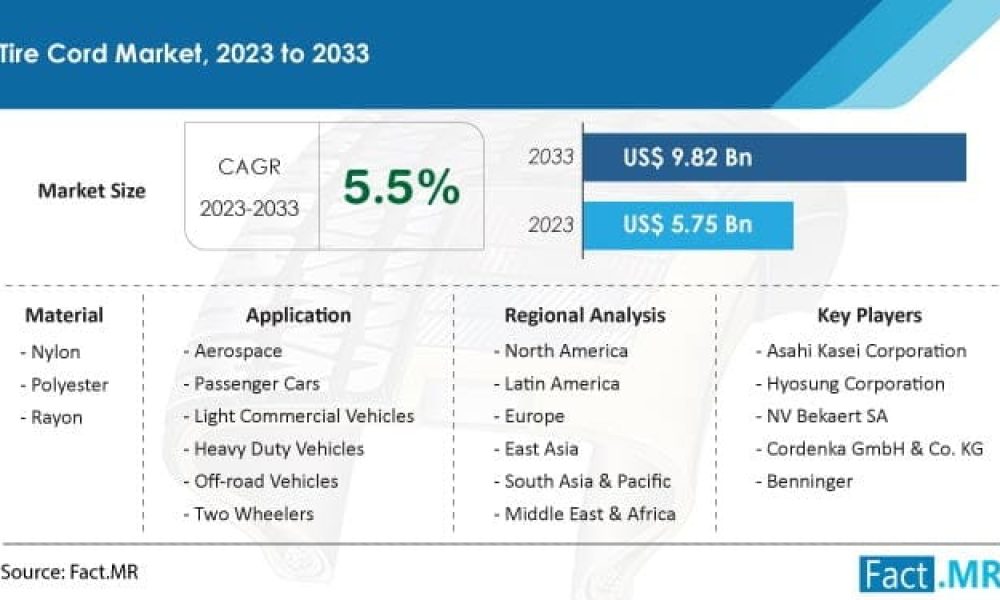
According to the most recent findings from Fact.MR, a leading market research and competitive intelligence provider, the global tire cord market has reached a valuation of $5.75 billion in 2023. Projections indicate a steady growth trajectory with a Compound Annual Growth Rate (CAGR) of 5.5% anticipated from 2023 to 2033.
Tire cords play a pivotal role in the tire manufacturing sector, serving as essential reinforcements that enable tires to withstand diverse forces and uphold structural integrity. Typically crafted from high-strength materials such as polyester, nylon, or rayon, tire cords are seamlessly integrated into the tire’s composition to enhance its overall performance, durability, and safety.
Download a Sample Copy of This Report:
https://www.factmr.com/connectus/sample?flag=S&rep_id=8853
Tires witness constant and repetitive stress during their lifetime, especially in commercial applications such as aircraft, agricultural, and truck tires. The ability of nylon to withstand repeated loading and unloading cycles without experiencing material degradation makes it an ideal choice for tire reinforcement. This fatigue resistance aids in maintaining the tire’s structural integrity and performance over a longer period, reducing the need for frequent replacements and contributing to cost savings for vehicle owners.
Current Industry Trends in the Tire Cord Sector:
- Sustainability and Eco-Friendly Practices: A noteworthy trend in the tire cord industry is the increasing focus on sustainability. Tire manufacturers are actively exploring eco-friendly materials and adopting environmentally conscious manufacturing processes to mitigate their carbon footprint. This involves the development of tire cords using recycled materials and the integration of sustainable practices across the entire supply chain.
- Advanced Materials: Ongoing research and development endeavors have led to the incorporation of advanced materials in tire cord production. The adoption of high-performance fibers and composite materials is on the rise, offering superior strength, durability, and reduced weight. These advancements contribute not only to enhanced tire performance but also to improved fuel efficiency in vehicles.
- Digitalization and Industry 4.0: Similar to various other industries, the tire cord sector is embracing digitalization and Industry 4.0 technologies. This involves leveraging data analytics, automation, and AI-driven quality control systems to enhance production efficiency and minimize waste. The integration of these technologies is shaping a more streamlined and technologically advanced manufacturing landscape.
- Global Supply Chain Challenges: The tire cord industry, like many others, has encountered significant challenges in its global supply chain, primarily attributable to the disruptions caused by the COVID-19 pandemic. Issues such as interruptions in the supply of raw materials, transportation bottlenecks, and labor shortages have had substantial impacts on both production and distribution within the industry. Navigating and mitigating these challenges remains a priority for stakeholders in the tire cord market.
Key Takeaways from Market Study
- The global tire cord market is projected to reach US$ 9.82 billion by 2033.
- The United States market for tire cords is experiencing healthy growth due to increasing demand for high-strength tires in luxury cars.
- Demand for nylon tire cords is estimated to rise at a CAGR of 6% from 2023 to 2033.
- The market for tire cords in Japan is forecasted to expand at a CAGR of 3.5% through 2033.
- Sales of tire cords in Germany are set to rise at a CAGR of 4% over the next 10 years.
“Tire cords with embedded sensors are being developed to enable real-time data collection, enhancing passenger safety on roads,” says a Fact.MR analyst.
Key Companies Profiled in this report
- Asahi Kasei Corporation
- Hyosung Corporation
- Kolon Industries, Inc.
- NV Bekaert SA
- Century Enka Ltd.
- Indorama Ventures Public Company Limited
- Cordenka GmbH & Co. KG
- Formosa Taffeta Co., Ltd.
- KISWIRE Ltd.
- C. A. Litzler Co., Inc.
- Jiangsu Xingda Steel Cord Co., Ltd.
- JSC Grodno Azot – Khimvolokno Plant
- Kordsa Teknik Tekstil A.S.
- Benninger
Competitive Analysis
Manufacturers are heavily investing in research and development efforts to explore innovative materials for tire cord production. The incorporation of high-strength fibers such as aramid and carbon in tire cords is gaining traction due to their superior properties, including low weight, high modulus, and excellent heat resistance.
- Cordenka GmbH & Co. KG is a specialist in the production of industrial rayon, including tire cord fabrics. Rayon tire cord fabrics are used primarily in bias-ply tires, where they provide strength and stability. Cordenka’s tire cord fabrics are well-regarded for their reliability and performance in various tire applications.
Get Customization on this Report for Specific Research Solutions:
https://www.factmr.com/connectus/sample?flag=RC&rep_id=8853
Industry News:
several noteworthy events and developments were making headlines in the tire cord industry.
- Investments in Sustainable Tire Cord Materials: Major tire manufacturers and cord producers were investing in sustainable tire cord materials. This included exploring the use of bio-based materials, recycled fibers, and advanced recycling processes. These efforts were in line with the automotive industry’s broader push towards reducing environmental impact.
- Rising Demand for Reinforcement Materials: The tire cord market was experiencing increased demand due to the growth of the global automotive industry. Emerging markets, such as India and China, were showing robust growth in vehicle production, leading to a surge in demand for tire cord materials.
- Tariffs and Trade Disputes: Tariffs and trade tensions were causing uncertainty in the tire cord market. Disputes between major economies like the United States, China, and the European Union were affecting the cost and availability of key raw materials, impacting the global tire cord supply chain.
- Technological Advancements: Tire cord production was becoming more technology-intensive. New manufacturing processes, such as dip-coating and precision winding, were being employed to enhance the quality and consistency of tire cord products.
More Valuable Insights on Offer
Fact.MR, in its new offering, presents an unbiased analysis of the global tire cord market, presenting historical demand data (2018 to 2022) and forecast statistics for the period (2023 to 2033).
The study divulges essential insights into the market based on material (nylon, polyester, rayon), tire type (radial tires, biased tires), and application (aerospace, passenger cars, light commercial vehicles, heavy duty vehicles, off-road vehicles, two wheelers), and across five major regions of the world (North America, Europe, Asia Pacific, Latin America, and MEA).
Contact:
US Sales Office:
11140 Rockville Pike
Suite 400
Rockville, MD 20852
United States
Tel: +1 (628) 251-1583
E-Mail: [email protected]




