
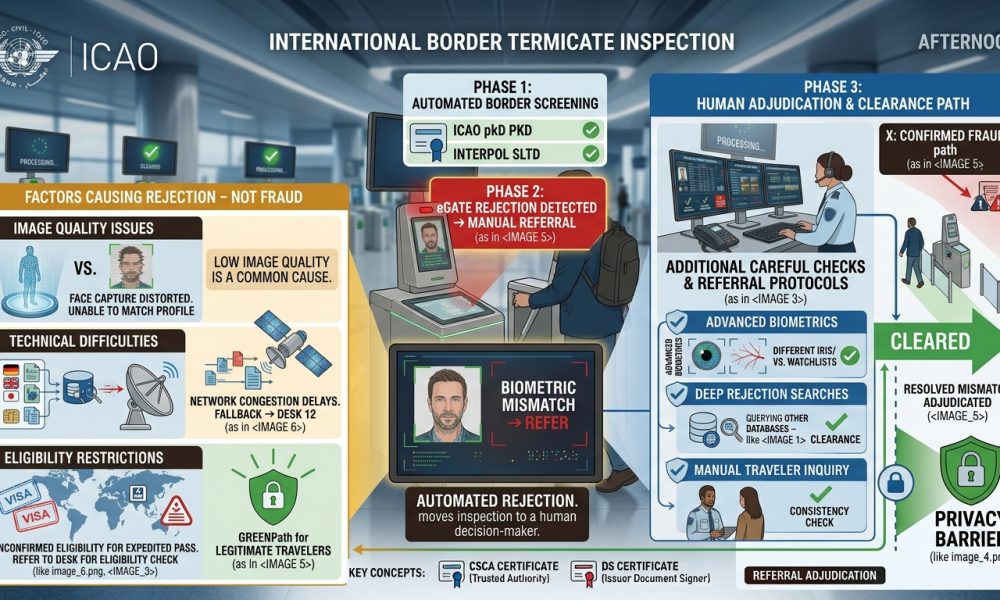
Image quality, technical issues, and eligibility restrictions can disrupt automated processing for eligible travelers.
WASHINGTON, DC, October 11, 2026 — As international airports expand automated passport control and biometric border inspection, travelers increasingly rely on electronic gates to verify their identities, authenticate travel documents, and complete immigration procedures without undergoing a conventional face-to-face examination.
Although these systems generally process eligible passengers efficiently, an automated gate may occasionally reject a traveler or refer the individual to an immigration officer, even when the passport is genuine and the person satisfies the relevant entry requirements.
Such interruptions can result from facial recognition difficulties, electronic chip communication problems, document positioning errors, immigration status discrepancies, or technical failures affecting the government systems responsible for processing international arrivals.
This distinction matters because an unsuccessful automated inspection does not, by itself, establish counterfeit documentation, identity fraud, criminal activity, or an adverse security record associated with the passenger presenting the travel document.
Understanding the limitations of automated border technology can help travelers distinguish routine processing difficulties from genuine document security concerns while recognizing why immigration authorities continue to maintain procedures for human examination.
Automated Border Gates Perform Several Independent Checks
Modern automated border control systems commonly combine electronic passport reading, biometric facial comparison, eligibility assessment, and connections to authorized government Information systems, allowing different aspects of identity and immigration processing to occur within a single passenger interaction.
A conventional eGate may begin by reading the passport’s machine-readable zone, establishing communication with its contactless electronic chip, and retrieving the identifying Information needed to support document Authentication and facial comparison.
The equipment may subsequently capture a live photograph, compare it with an official reference Image, and evaluate relevant eligibility conditions before determining whether the traveler can proceed through the automated checkpoint.
Depending on the country, additional government systems may provide Information on electronic immigration permissions, document status, or other legally required screening that affects whether automated clearance can be completed.
An interruption involving any required component can prevent the gate from opening. Still, the visible result does not necessarily reveal whether the underlying problem concerns the passport, the traveler, or the equipment.
British Border Authorities Identify Several Routine Causes
The United Kingdom provides a clear explanation of why automated passport processing sometimes fails, distinguishing routine technical issues and eligibility questions from circumstances that require further identity or security checks.
According to UK Border Force guidance on problems with ePassport gates, updated July 28, 2026, passengers may be referred for Identification errors, damaged passport chips, digital permission problems, equipment faults, or mistakes when presenting their documents.
The guidance also identifies circumstances involving nationality verification, immigration eligibility, and safeguarding responsibilities, including situations where officers need to establish the relationship between a child and accompanying adults.
These official explanations show that the same visible rejection can stem from substantially different circumstances, many of which are unrelated to document counterfeiting or deliberate identity misrepresentation.
British authorities also say operational security considerations may prevent officers from disclosing every reason for an unsuccessful automated inspection, so it’s inappropriate to infer a particular database alert from the gate’s response.
Poor Image Quality Can Interrupt Facial Recognition
Automated passport gates frequently use one-to-one facial verification, comparing a live photograph of the traveler with the reference Image stored in the electronic passport or another approved government identity record.
The recognition software analyzes mathematical facial characteristics and calculates a similarity score, which must meet the system’s established operating requirements for the biometric comparison to be accepted.
Image quality can influence this process because unfavorable lighting, Camera positioning, motion, reflections, or partially obscured facial features may reduce the Information available to the recognition algorithm.
A legitimate passport holder may therefore receive an unsuccessful biometric result even though the passport photograph accurately represents the traveler and the underlying identity record contains no discrepancy.
These limitations explain why border systems require additional verification procedures, particularly when photographic conditions prevent automated equipment from obtaining a sufficiently reliable comparison.
NIST Research Explains the Importance of Image Quality
The United States National Institute of Standards and Technology has examined how facial Image quality affects recognition performance, including photographs captured under conditions that differ from carefully controlled identity document photography.
Its Face Analysis Technology Evaluation research on Image quality, updated in September 2026, evaluates algorithms that assess whether facial photographs contain characteristics likely to influence recognition performance during identity comparisons.
The research considers factors such as illumination, facial positioning, and Image resolution, while distinguishing between photographs that appear suitable for comparison and those likely to produce unreliable recognition results.
These findings reinforce the importance of Camera quality and appropriate Image acquisition procedures, particularly when airport systems must accommodate passengers with different physical characteristics and varying familiarity with automated inspection equipment.
Therefore, interpret a rejected facial comparison within the limitations of biometric technology rather than treating it as independent evidence that the traveler presented a fraudulent passport.
Appearance Changes Can Affect a Genuine Passport Holder
Passport photographs often remain in use for several years, during which the holder’s appearance may change through aging, hairstyle adjustments, facial hair, weight variation, or other ordinary physical developments.
Modern facial recognition systems are designed to tolerate some variation between photographs. Still, substantial appearance differences combined with imperfect Image quality can reduce the confidence of an automated comparison.
A traveler who looks noticeably different from an older passport photograph may therefore require an officer to assess the identity relationship, even when the underlying document was lawfully issued and remains valid.
The officer can examine the printed portrait, consider the passenger’s current appearance, and review relevant identity Information that may not have been adequately represented in the automated comparison.
Such examinations form part of normal identity verification procedures and should not automatically be associated with counterfeit documents or attempts to impersonate another individual.
False Non-Matches Are a Recognized Biometric Limitation
Biometric recognition systems can produce false non-matches, which occur when photographs of the same individual fail to satisfy the algorithm’s required similarity threshold despite representing the legitimate identity holder.
These outcomes differ from false matches, where the software incorrectly considers photographs of different individuals sufficiently similar, creating a separate security concern involving an erroneous identity association.
Border authorities must consider both error types when configuring automated systems because stricter comparison thresholds can reduce incorrect acceptances while increasing the risk of rejecting legitimate travelers.
The appropriate threshold depends on the technology, the operational environment, the available reference images, and the procedures used when a biometric comparison cannot be completed successfully.
Consequently, an unsuccessful facial recognition result is not equivalent to a finding of identity fraud, since the algorithm may simply lack sufficient confidence to authorize the automated processing step.
Passport Positioning Can Cause Reading Errors
Before an electronic passport can be authenticated, inspection equipment must obtain suitable Information from the document, often starting with the machine-readable zone in its Identification page.
Improper positioning, protective passport covers, incomplete insertion, or movement during scanning can interfere with the optical reading process, preventing the system from acquiring the expected document Information.
The United Kingdom specifically identifies user-related positioning problems as reasons an eGate may not complete processing, showing that ordinary handling errors can cause a rejection without any underlying document defect.
Travelers can resolve these issues by following the displayed instructions or getting help from airport personnel, but they should always follow the procedures established at that checkpoint.
A scanning failure therefore does not independently establish that the passport’s printed Information is counterfeit or that its embedded electronic components have been altered.
Electronic Passport Chips Can Develop Technical Problems
Modern biometric passports contain contactless integrated circuits that store protected identity Information and communicate with compatible readers through radio-frequency technology, allowing inspection systems to retrieve and authenticate electronic records.
Although these chips are designed for routine international use, physical damage, document deterioration, or technical faults can occasionally interfere with reliable communication between the passport and inspection equipment.
An electronic passport may look intact while the reader cannot complete the required communication session, requiring an officer to evaluate the document through additional authorized procedures.
A damaged or unreadable chip does not automatically prove fraudulent manufacturing, because legitimate passports can experience electronic component failures or physical wear during their authorized period of use.
However, an unreadable chip also does not automatically establish that the document satisfies all entry requirements, since the border authority must determine whether sufficient alternative verification is available.
Cryptographic Authentication Can Remain Incomplete
Electronic passport verification involves more than retrieving data from a contactless chip, because compatible inspection systems can also evaluate digital signatures that protect the Authenticity and integrity of the stored identity Information.
The International Civil Aviation Organization establishes technical standards for these procedures, allowing receiving governments to verify whether protected electronic data originated from a recognized issuing authority and remains unchanged.
However, completing this verification requires appropriate government signing certificates and compatible inspection infrastructure, which may not always be available for every foreign document presented at a particular checkpoint.
An inspection system may therefore return an incomplete Authentication result because the necessary certificate resources are unavailable, even when the passport was legitimately issued by its government.
The distinction between Authentication failure and incomplete Authentication is important, because a system that lacks the Information needed to finish a verification procedure has not necessarily detected altered or counterfeit data.
ICAO Recognizes Different Verification Outcomes
ICAO guidance on electronic passport validation and inspection requirements explains that border systems must interpret Authentication results based on the technical checks completed and the national procedures governing their use.
Its framework distinguishes successful Authentication from unsuccessful or incomplete outcomes, recognizing that countries operate different inspection environments and may possess different collections of trusted verification certificates.
When a system cannot complete its intended Authentication procedure, the receiving authority must decide how to display the result and which additional examination procedures are appropriate.
These distinctions demonstrate that electronic verification is not simply a universal pass-or-fail Judgment concerning whether a travel document is genuine, because technical limitations can affect the completeness of the available evidence.
For travelers, a failed electronic reading should therefore be understood as a reason for further assessment rather than automatic confirmation that the passport contains fraudulent Information.
Digital Immigration Permissions Create Additional Complications
Even when an eGate successfully authenticates a passport and completes facial comparison, the system may require Information concerning the traveler’s immigration status or electronic permission to enter the destination country.
The United Kingdom increasingly relies on electronic travel authorizations, digital immigration status records, and eVisas associated with individual travel documents or government identity accounts.
A traveler may encounter automated processing difficulties when the relevant permission is missing, expired, or not appropriately associated with the passport being presented at the checkpoint.
These circumstances may require an immigration officer to review the relevant Information before determining whether the traveler satisfies the legal requirements governing entry.
The difficulty concerns the availability or validity of immigration Information, not necessarily that the passport itself is fraudulent or that its biometric identity records have been altered.
Automated Gate Eligibility Differs Between Travelers
Not every passenger with a biometric passport can use every automated border gate, because national authorities set rules based on nationality, age, immigration status, and specific travel document categories.
Some countries allow selected foreign nationals to use their automated facilities, while others reserve specific processing routes for citizens, permanent residents, or travelers in approved border facilitation programs.
Canada illustrates eligibility distinctions: its automated arrival facilities accommodate specified categories of travelers while requiring others to complete inspection directly with border services officers.
Children, individuals using certain travel documents, and passengers requiring specialized immigration processing may be directed toward alternative procedures even when their identity documents are legitimate.
An unsuccessful attempt to use an ineligible automated lane therefore reflects a processing restriction rather than evidence that the traveler has presented a counterfeit passport.
Canada Uses Different Automated Processing Arrangements
Canadian airports employ primary inspection kiosks and selected eGate facilities that support identity verification and customs declaration procedures. However, the equipment and processing arrangements differ from some conventional European automated border gates.
At participating Canadian airports, travelers generally scan the relevant travel document, complete the required declaration, and undergo associated identity processing before continuing through the established arrival inspection procedure.
Certain passenger categories must proceed directly to an officer, while others may need assistance when the equipment cannot complete the electronic session.
These operational differences show why the term eGate does not necessarily describe the same technical or legal process in every country using automated border technology.
A processing interruption at one airport may therefore involve different systems and requirements from an apparently similar rejection at another international checkpoint.
Technical Outages Can Affect Multiple Travelers
Automated border processing depends on interconnected equipment, software, telecommunications infrastructure, and government Information systems that must operate reliably for routine electronic inspections to proceed.
A disruption affecting these services may prevent multiple passengers from completing automated processing, even when their passports, biometric Information, and immigration permissions remain entirely valid.
Canadian authorities have established procedures to redirect passengers to officers when primary inspection kiosks experience technical outages, underscoring the importance of maintaining manual processing capabilities alongside electronic systems.
The Canada Border Services Agency also experienced significant Information technology interruptions during September and October 2025, illustrating how government processing disruptions can affect passenger services without indicating individual document fraud.
Such incidents reinforce the need to distinguish technical infrastructure failures from concerns associated with particular travelers or the validity of their identity documents.
A Referral Does Not Reveal Which Check Failed
When an automated border gate directs a passenger to an officer, the equipment may provide only a general instruction rather than identifying the precise technical or administrative condition responsible for interrupting processing.
The same visible response can result from insufficient biometric similarity, an unreadable document, a missing digital permission, or another condition requiring further assessment by authorized border personnel.
Government security policies may also restrict disclosure of certain screening Information, so travelers should not interpret a generic referral message as proof of a watchlist or criminal record match.
An officer may be able to clarify the issue or complete additional verification, although the Information disclosed will depend on applicable legal requirements and the circumstances of the inspection.
The essential point is that the gate could not complete its automated procedure, not that it necessarily identified deception or an unlawful travel document.
Human Examination Remains an Essential Safeguard
Border officers can evaluate circumstances that automated systems cannot fully resolve, including unusual appearance differences, administrative record discrepancies, and situations requiring examination of additional supporting documents.
The officer may inspect physical passport security features, review relevant electronic Information, consult authorized government records, or assess immigration permissions according to the applicable national legal framework.
This examination allows authorities to determine whether the interruption is a routine technical issue or requires a more substantive investigation.
Human involvement also provides an opportunity to distinguish legitimate travelers from records or circumstances that an automated system may have interpreted incompletely or incorrectly.
However, manual inspection remains subject to government procedures and legal safeguards, rather than granting officials unrestricted authority to conclude unsupported by relevant evidence.
Secondary Inspection Does Not Equal Criminal Investigation
Some automated referrals may lead to secondary inspection, where officers conduct additional identity, document, customs, or immigration examinations that were not completed during the initial electronic process.
Secondary inspection can involve routine administrative activities, including clarifying travel purposes, reviewing required documentation, or resolving differences between the passport and government immigration records.
The procedure does not automatically establish that authorities suspect the traveler of committing a criminal offense, because legitimate passengers may require additional examination for entirely ordinary reasons.
A formal refusal of admission or enforcement action involves separate legal considerations that cannot be inferred merely from an unsuccessful automated gate transaction.
Understanding this distinction helps prevent confusion between routine border administration and legally consequential decisions requiring an appropriate factual and statutory basis.
Watchlist Checks Are Separate From Document Authentication
Government border systems may consult authorized immigration or law enforcement Information when evaluating travelers, but these searches serve a different function than the electronic Authentication of passport data.
A genuine passport may pass its cryptographic verification while a separate government record requires examination, just as an electronic Authentication failure may occur without any adverse record involving the traveler.
An automated referral therefore cannot establish which database checks were performed or whether any specific security Information contributed to the outcome.
Where a possible database match requires attention, authorized officers may need to confirm identifying Information and determine the legal significance of the relevant record before making consequential decisions.
These safeguards matter because name similarities, administrative errors, and outdated Information can produce uncertain results that require careful verification rather than automatic conclusions about individual wrongdoing.
Travelers Should Follow Official Processing Instructions
When an automated gate cannot complete processing, travelers should follow the instructions displayed by the equipment and the directions provided by authorized airport or immigration personnel.
Depending on the circumstances, the appropriate procedure may involve repeating a permitted document scan, adjusting Camera positioning, or proceeding directly to a staffed inspection checkpoint.
Travelers should not repeatedly try to force access through a gate or assume that moving to another automated machine will necessarily resolve a problem that requires government examination.
Where immigration permissions or identity records require clarification, the relevant officer can determine the next authorized processing step according to the procedures established by the country of arrival.
Cooperating with the standard inspection process helps ensure that officers can address technical or administrative questions without confusing an incomplete automated transaction with a final immigration decision.
Accurate Travel Records Can Reduce Administrative Problems
Travelers can avoid certain processing difficulties by ensuring their passports remain valid and that required electronic travel permissions match the documents they intend to present.
Replacing a passport may require updates to associated immigration records, electronic travel authorizations, or residence permissions, depending on the destination country’s official administrative procedures.
Incorrect passport numbers, outdated digital status Information, or inconsistent identity details can create discrepancies that automated systems cannot always reconcile without human assistance.
Nevertheless, accurate records cannot guarantee successful eGate processing, because technical faults and limitations in biometric comparison may still interrupt an otherwise legitimate border crossing.
The practical objective is to reduce avoidable administrative uncertainty while recognizing that automated inspection remains subject to the operational and legal requirements established by the responsible border authority.
The Future of eGate Processing Requires Reliable Exceptions.
Governments continue developing contactless identity systems, improved biometric recognition technology, and digital travel credentials intended to simplify routine airport inspection and reduce repeated presentation of physical documents.
These innovations may improve processing efficiency for eligible passengers, but they will also require dependable procedures to address incomplete digital records, failed identity comparisons, and technical failures.
As more border functions become automated, the ability to distinguish genuine security concerns from equipment faults or administrative discrepancies will remain essential to maintaining reliable and proportionate inspection procedures.
Authorities must therefore continue investing in system testing, accurate data management, officer training, and appropriate alternative processing arrangements rather than assuming that improved technology will eliminate every possible rejection.
Effective automation depends not only on how many passengers the system successfully processes but also on how fairly and accurately it handles legitimate travelers whose circumstances require additional verification.
An Automated Rejection Is Not a Finding of Fraud
An airport eGate rejection establishes only that the automated system could not complete the required processing under its operating conditions, leaving the underlying cause to be determined through appropriate technical or official examination.
The interruption may involve ordinary Camera difficulties, insufficient biometric similarity, an unreadable electronic chip, incorrect document positioning, immigration permission discrepancies, or temporary failures affecting connected government infrastructure.
Although genuine document fraud and identity concerns may also require additional inspection, those possibilities do not justify treating every unsuccessful automated transaction as evidence of wrongdoing.
For legitimate travelers, the appropriate distinction is between an incomplete electronic verification and a confirmed legal or document security problem, which requires additional evidence and assessment by competent authorities.
Ultimately, an eGate rejection does not automatically indicate passport fraud, because modern border systems depend on multiple technical and administrative processes that can fail or require human review even when a traveler possesses a genuine document.




