
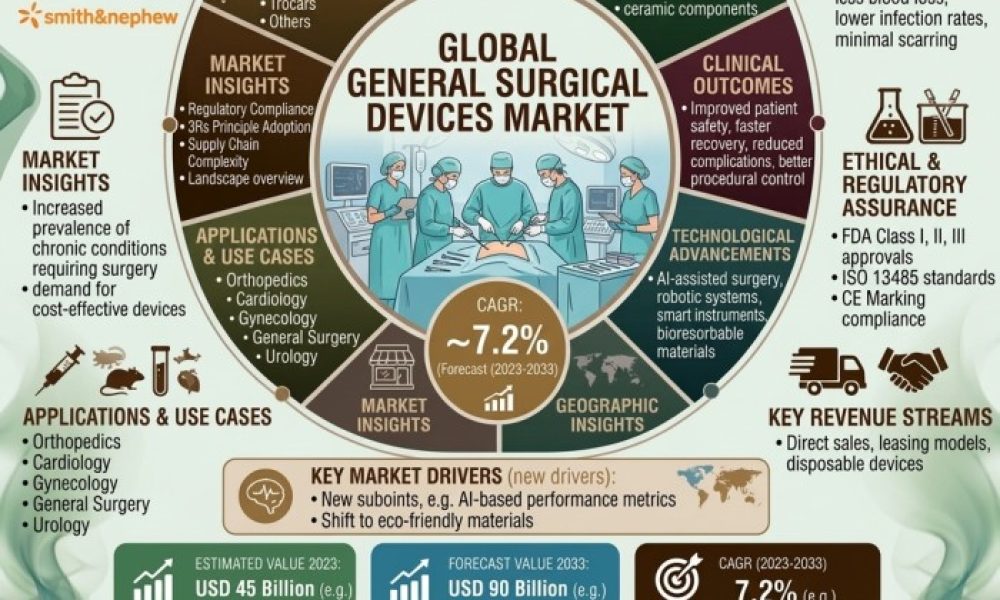
Rising surgical volumes, minimally invasive procedures and the migration of lower-acuity cases to ambulatory settings are reshaping purchasing priorities, according to Fact.MR.
NEWARK, Del., October 8, 2026: The global general surgical devices market is projected to grow from USD 21.5 billion in 2026 to USD 39.8 billion by 2036, advancing at a 6.3% CAGR during the forecast period, according to Fact.MR. The market is expected to create an incremental opportunity of USD 18.3 billion between 2026 and 2036.
The strongest demand signals are coming from higher surgical volumes, wider adoption of minimally invasive and energy-based techniques, and the transfer of selected procedures from hospitals to ambulatory surgical centers. The report identifies rising procedure volumes linked to ageing populations and chronic disease as the largest driver, with an estimated +1.9% impact on CAGR. The shift toward minimally invasive and energy-based techniques contributes an estimated +1.4%.
Get detailed market forecasts, competitive benchmarking, and pricing trends:
Regulatory and purchasing conditions are shaping demand
The report’s source base includes the Centers for Medicare & Medicaid Services’ Calendar Year 2026 Hospital Outpatient Prospective Payment System (OPPS) and Ambulatory Surgical Center Final Rule (CMS-1834-FC), dated November 21, 2025. It also cites Germany’s Bundeskabinett beschließt Krankenhausreform, dated May 15, 2024, reflecting hospital-sector reform considerations relevant to mature European markets.
These developments sit alongside tighter purchasing scrutiny. Group purchasing organizations and hospital value-analysis committees are increasing pricing pressure, while regulatory and quality-compliance costs remain a restraint for manufacturers. Supply-chain disruption and product recall risk also remain constraints on market expansion.
Where growth is fastest
- Ireland — 7.9% CAGR: Ireland records the fastest growth among the countries analyzed, supported by its medical-technology manufacturing base, export supply and investment in production capacity.
- South Korea — 7.5% CAGR: Hospital capacity expansion, domestic medical-device production and strong uptake of minimally invasive techniques support demand.
- United States — 6.9% CAGR: High procedure volumes and the continued expansion of ambulatory surgery support demand for handheld, laparoscopic and closure devices.
- Spain — 6.0% CAGR: Public-system demand, elective surgery capacity and efforts to reduce waiting lists underpin purchasing.
- Switzerland — 5.6% CAGR: Specialized hospitals, high healthcare spending and precision manufacturing support demand for advanced laparoscopic and orthopedic instruments.
- Germany — 4.8% CAGR: Germany remains a large, mature market, but cost controls, pricing discipline and structural hospital reform moderate growth.
What leads the market
- Handheld devices — 32.5% share in 2026: Scalpels, forceps, scissors, retractors, needle holders and clamps remain core surgical tools, supporting recurring replacement and replenishment demand.
- Orthopedic surgery — 28.4% share in 2026: Joint replacement, trauma, spine and sports medicine procedures require extensive instrument sets and supporting closure and energy devices.
- Hospitals — 58.4% share in 2026: Hospitals account for the largest share because inpatient, emergency and complex procedures remain concentrated in these facilities, with purchasing often managed through centralized supply-chain teams and group contracts.
The hurdle
Pricing pressure is the most immediate commercial restraint. The report estimates a -0.8% impact on CAGR from group purchasing and value-analysis committee pressure. Regulatory and quality-compliance costs contribute a further -0.6%, while supply-chain disruption and product recall risk represent a -0.4% impact.
For manufacturers, this means product differentiation increasingly needs to be demonstrated through procedure-level economics, supply reliability and operating-room performance rather than unit price alone.
Recent developments and competitive activity
The report’s bibliography cites several recent company developments. Medtronic plc reported its fiscal 2026 fourth-quarter and full-year results on June 3, 2026, while Smith+Nephew reported its fourth-quarter and full-year 2025 results on March 2, 2026. Boston Scientific announced its fourth-quarter and full-year 2025 results on February 4, 2026. These sources form part of the evidence base used in the report’s competitive and market assessment.
Key companies profiled include Medtronic PLC; Johnson and Johnson Services Inc.; Stryker Corporation; B. Braun Melsungen AG; Boston Scientific Corporation; Smith and Nephew plc; Zimmer Biomet Holdings Inc.; Becton, Dickinson and Company; and Conmed Corporation. Medtronic holds an estimated 10% share, according to Fact.MR.
Analyst perspective
Fact.MR Principal Consultant Shambhu Nath Jha said, “Over the coming years, surgical device purchasing will continue to shift from unit price toward procedure-level value.” The report continues the quotation by noting that hospitals will increasingly evaluate instrument performance, sterility assurance, supply reliability and cost together, while handheld instruments are expected to remain the volume foundation and laparoscopic and energy platforms to increase procedure value.
What this means for hospital procurement and device manufacturers
- Evaluate products at procedure level. Buyers should compare total cost per case, replacement cycles, operating-room requirements and supply reliability instead of relying solely on unit price.
- Prepare for different purchasing models. Hospitals remain the largest end user, but ambulatory surgical centers and clinics are expanding. Compact, procedure-specific kits and flexible commercial terms may become more relevant in these settings.
- Build portfolios around changing surgical techniques. The report identifies compatibility with robotic and digital surgery platforms as a long-term opportunity, while reusable and reprocessed device programs could support demand in Europe and North America.
Fact.MR’s General Surgical Devices Market report covers product types including handheld, laparoscopic, electrosurgical and wound closure devices; applications including orthopedic, cardiovascular, neurological and gynecological surgery; end users including hospitals, ambulatory surgical centers and clinics; and six profiled countries.
Explore More Related Studies Published by Fact.MR Research
Marzipan Market: https://www.newstrail.com/marzipan-market-set-to-hit-usd-2-4-billion-by-2036-france-cagr-3-9-japan-cagr-3-9/
Pygeum Bark Extract Market: https://www.newstrail.com/pygeum-bark-extract-market-to-reach-usd-595-7-million-by-2036-germany-cagr-8-2-brazil-cagr-7-5/
About Fact.MR
Fact.MR is a market research and consulting firm providing syndicated research, customized research, investment research, and market intelligence across a broad range of industries. Its research coverage includes food and beverage, healthcare, pharmaceuticals, biotechnology, consumer products, chemicals and materials, technology, industrial goods, and packaging.
Fact.MR provides market intelligence designed to help organizations understand market dynamics, emerging opportunities, competitive developments, and changing industry requirements.
Media Contact
Fact.MR
Email: [email protected]
Phone: +1 (628) 251-1583
Website: www.factmr.com



