
Oral Clinical Nutritional Supplement Market Support Needs and Demand for Convenient Formats
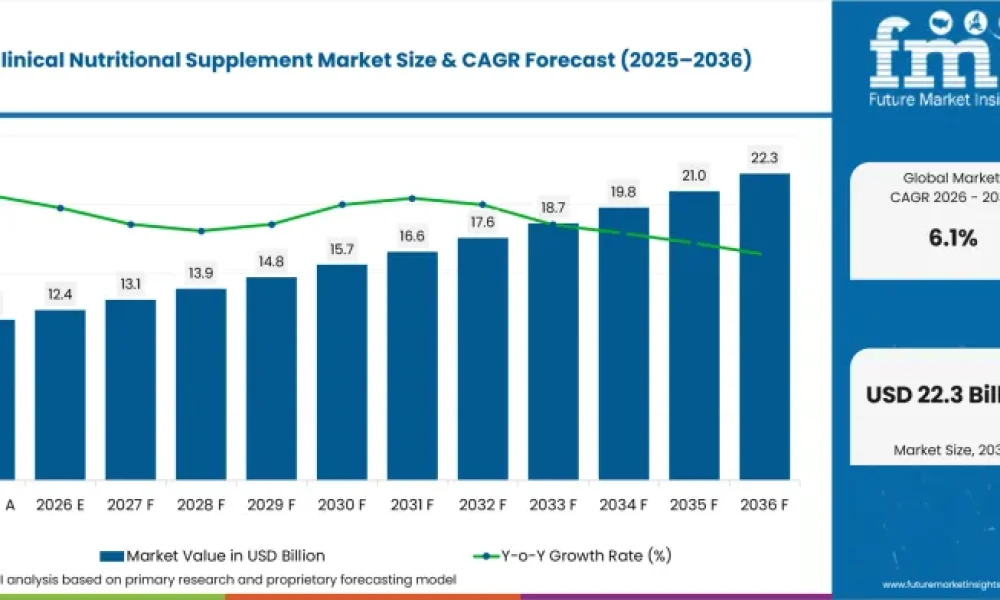
NEWARK, Del., October 8, 2026. — The global oral clinical nutritional supplement market is estimated at USD 12.4 billion in 2026 and is projected to reach USD 22.3 billion by 2036, expanding at a CAGR of 6.1% from 2026 to 2036, according to Future Market Insights (FMI).
The market is being shaped by increasing identification of inadequate nutritional intake and the continued use of oral nutrition when patients cannot meet nutritional requirements through regular food but remain able to consume nutrition orally. Familiar formats can also support longer-term use, including after hospital discharge or recovery from an acute nutrition episode.
Aging populations strengthen the need for accessible oral nutrition
Demographic changes are influencing the scale and channel mix of oral clinical nutritional supplement demand. The Office for National Statistics estimated in July 2026 that people aged 65 years and older represented 19.1% of England’s population and 22.2% of Wales’ population at mid-2025.
FMI says older population groups can increase the number of nutrition-assessment episodes, but identifying clinical need does not automatically translate into repeat household demand. Classification, payment and special-diet rules can determine whether patients gain continued access to oral nutritional supplements through clinical and community channels.
👉 Get Detailed Market Forecasts, Competitive Benchmarking & Pricing Trends: https://www.futuremarketinsights.com/reports/sample/rep-gb-9486
What is shaping demand
- Standard formula — 67.9% share in 2026: Broad nutrient coverage makes standard formulas suitable for routine oral nutritional support before condition-specific nutrition becomes necessary.
- General well-being — 22.7% share in 2026: Nutritional risk can emerge before a disease-specific formula is required, supporting demand for products positioned around broader nutritional support.
- Liquid — 49.0% share in 2026: Ready-to-consume dosing can reduce preparation requirements and simplify intake monitoring.
- Repeat use: Sustained demand depends partly on whether patients can tolerate the nutrient density, taste and serving format over longer periods.
The hurdle
Reimbursement, classification and tolerability can determine whether clinical need becomes repeat demand. FMI says oral nutritional supplements may be identified as necessary by clinicians and caregivers, but access and purchasing patterns can vary according to payment rules, special-diet classifications and community-supply routes.
Sensory fatigue can also affect repeat use. Products therefore need to balance nutrient density with a format and taste profile that patients can sustain over time.
For full coverage of the Oral Clinical Nutritional Supplement Market, including forecasts by product type, indication, form, region and country, visit the FMI report: https://www.futuremarketinsights.com/reports/oral-clinical-nutrition-supplements-market
Market dynamics
The market is seeing continued reliance on established oral nutrition brands across clinical and community settings. Abbott reported in July 2025 that strong demand for Ensure and Glucerna contributed to more than 6% organic growth in its adult nutrition business, highlighting the role of established brands in adult nutrition.
The market is also influenced by the transition from acute care to longer-term nutritional support. Patients may continue supplementation after hospital discharge or during recovery, creating opportunities for products that can fit community and household consumption routines.
FMI identifies Abbott Laboratories, Danone S.A., Nestlé Health Science, Fresenius Kabi, Kate Farms, Medtrition, Inc., Ajinomoto Co., Inc., and Meiji Co., Ltd. among the key players in the Oral Clinical Nutritional Supplement Market.
Analyst perspective
“Oral nutrition earns repeat revenue if a formulation provides sufficient nutrients in a serving patients can sustain. Commercial evaluation should test nutrient density and taste alongside reimbursement fit plus continuity outside acute care. Appetite-management trends visible in GLP-1 meal replacement products also make portion size and protein density more relevant to adult-nutrition design.”— Nandini Roy Choudhury, Principal Consultant, Future Market Insights.
What this means for clinical nutrition manufacturers and brands
- Balance nutrient density with tolerability. Products need to provide sufficient nutrition in serving sizes that patients can sustain during longer periods of use.
- Design for continuity beyond hospitals. Community and household use can extend demand after acute nutrition episodes, making convenient formats important for continued supplementation.
- Account for reimbursement and classification rules. Local payment structures and special-diet policies can influence whether identified nutritional need translates into recurring demand.
- Prioritize ready-to-consume formats. Liquid products can reduce preparation requirements and simplify intake monitoring, supporting their leading position by form.
- Build products around broader nutrition needs. Standard formulas and general-well-being applications can address nutritional support before more condition-specific interventions become necessary.
About Future Market Insights
Future Market Insights, Inc. (FMI) is an ESOMAR-certified market research and consulting firm headquartered in Delaware, USA, with offices in the United Kingdom, the United Arab Emirates and India. FMI delivers syndicated and custom research across food and beverage, healthcare, chemicals, technology, packaging, consumer goods and industrial sectors.
For Press & Corporate Inquiries
Rahul Singh
AVP – Marketing and Growth Strategy
Future Market Insights, Inc.
+91 8600020075
For Sales: [email protected]
For Media: [email protected]
For Web: https://www.futuremarketinsights.com/



