
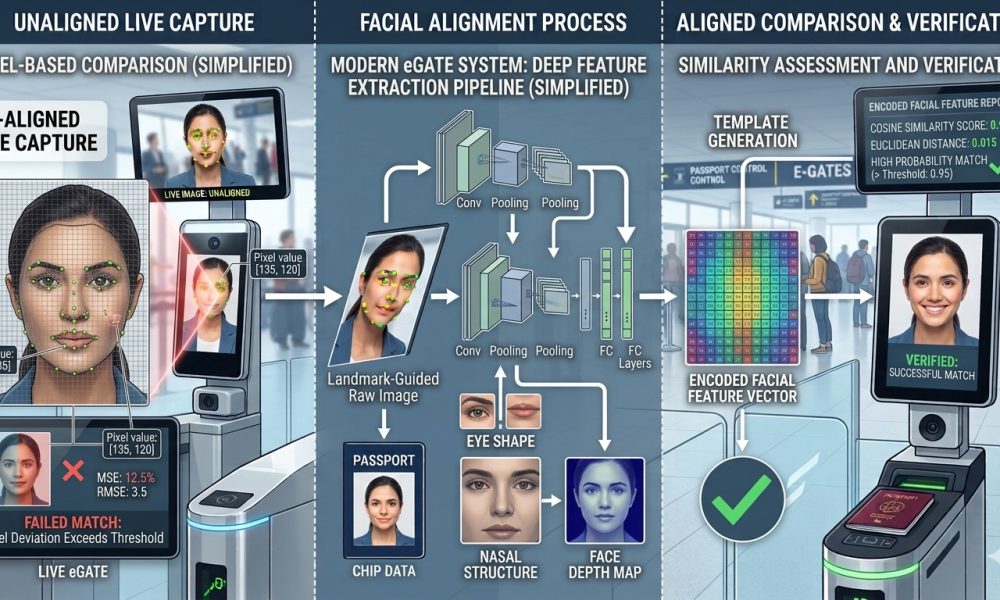
Modern systems analyze learned visual features to assess whether two photographs likely show the same person, allowing automated border technology to compare travelers with trusted reference images even when lighting, positioning, cameras, expressions, and other photographic conditions differ substantially.
WASHINGTON, DC, October 6, 2026 — When a traveler looks toward a Camera at an automated airport border gate, the facial recognition system does not normally determine identity by checking whether individual pixels in the live photograph appear in the same locations as pixels contained within the traveler’s passport portrait.
Such a method would perform poorly because even two photographs taken seconds apart can contain very different pixel values when the subject moves slightly, the lighting changes, the Camera position shifts, or the person adopts a different facial expression during the second capture.
Modern facial recognition systems instead analyze patterns and learned visual characteristics in facial images, converting relevant information into mathematical representations that let software assess whether two photographs are sufficiently similar to be consistent with the same individual.
That approach has become fundamental to automated border control because passport photographs and live airport images are normally captured months or years apart, using different cameras and environmental conditions that make direct pixel-by-pixel comparison impractical for reliable identity verification.
Pixels Record an Image, Not an Identity
A digital photograph consists fundamentally of pixels containing information about color, brightness, and position. Still, those individual values describe how a particular scene appeared to a particular Camera at a particular moment rather than providing a permanent description of the person being photographed.
If a traveler moves only a few centimeters closer to an airport Camera, for example, the face can occupy a noticeably larger area of the Image, meaning thousands of individual pixels may change even though the person’s actual identity remains completely unchanged.
Differences become even greater when one Image comes from a carefully controlled passport enrollment photograph, and another comes from an airport environment where lighting, Camera optics, facial expression, posture, and Background conditions can never be reproduced with perfect consistency.
A recognition system designed around exact pixel correspondence would therefore risk treating routine photographic variation as evidence that two images depict different people, making the approach unsuitable for practical border operations involving millions of legitimate travelers captured under constantly changing conditions.
The Same Face Can Produce Very Different Pixel Patterns
Consider a passport photograph taken against a neutral Background with carefully controlled lighting, followed several years later by a live airport photograph taken under artificial terminal illumination, with the traveler standing at a slightly different angle from the inspection Camera.
Although a human observer may immediately recognize both photographs as depicting the same individual, the actual arrangement of brightness values, shadows, facial contours, and other pixel-level information can differ substantially between the two images.
Hair may be shorter, facial hair may have appeared or disappeared, glasses may have changed, skin may show normal aging, and the traveler may hold their head differently, creating additional variation that makes direct photographic correspondence even less useful.
Modern recognition systems must therefore identify information that remains sufficiently stable across these changes, allowing the software to separate identity-related characteristics from variations caused mainly by photography, environment, aging, or normal changes in personal appearance.
Machine Learning Changed the Way Faces Are Compared
Earlier facial recognition approaches often depended heavily on explicitly designed measurements and statistical techniques. Meanwhile, newer generations increasingly use machine-learning models that learn complex visual representations from large collections of facial images during algorithm development.
The National Institute of Standards and Technology’s facial recognition research has documented major improvements with modern machine-learning architectures, while also emphasizing that performance can vary considerably across algorithms and operating conditions.
Instead of requiring engineers to define every facial characteristic manually, a trained model can learn which visual patterns provide useful information for distinguishing identities across photographs with different poses, lighting conditions, expressions, and Image quality.
The resulting recognition process therefore goes far beyond checking individual pixels because the software analyzes relationships distributed throughout the face and transforms those patterns into mathematical representations designed specifically to support biometric comparison.
Learned Features Represent Patterns Across the Face
The phrase “learned features” refers to visual information that a recognition model learns during training to distinguish facial identities. However, these features should not necessarily be interpreted as simple measurements that correspond directly to obvious anatomical landmarks.
Some useful information may relate indirectly to visible structures around the eyes, nose, mouth, cheekbones, and overall facial geometry. In contrast, other information may be distributed across complex Image patterns that cannot be translated easily into ordinary human descriptions.
Modern models can combine large numbers of these signals into a representation that preserves information useful for recognition while becoming less sensitive to variations that should not determine identity, such as modest changes in lighting or Image framing.
This mathematical abstraction is one reason contemporary systems can compare photographs captured under different circumstances without requiring the images to look identical at the individual pixel level.
Facial Alignment Usually Comes First
Before the recognition model generates its final representation, software commonly detects the face. It applies processing intended to place the captured facial region into a more consistent orientation suitable for automated analysis.
Landmarks or other geometric information can help estimate where key facial regions appear, allowing the software to compensate for manageable differences in position, scale, and head angle before later recognition stages begin.
A traveler standing slightly left of center, for example, should not generate a weaker identity comparison merely because the passport portrait positioned the face precisely within the middle of the original enrollment photograph.
Alignment reduces these unnecessary geometric differences, helping ensure learned recognition features are extracted from images already prepared for meaningful comparison.
Normalization Does Not Make Two Photographs Identical
Image normalization can reposition, resize, or adjust the orientation of a detected face. Still, it does not make two photographs identical or eliminate every environmental and appearance difference between them.
Instead, normalization removes some of the simplest sources of variation, allowing the recognition model to concentrate upon more meaningful information rather than wasting computational effort interpreting differences caused mainly by framing or Camera geometry.
Lighting, aging, expression, hairstyle, facial hair, and Image quality can remain different after alignment, requiring the recognition algorithm itself to tolerate those variations when generating and comparing biometric representations.
The effectiveness of this process depends heavily on both Image quality and algorithm performance, because normalization cannot recover facial information the Camera never captured clearly in the first place.
Recognition Systems Create Mathematical Representations
After preparing the face, modern recognition software typically converts relevant visual information into a set of numerical values that represent characteristics the model considers useful for distinguishing that facial identity from others.
These mathematical representations are sometimes called templates, embeddings, or feature vectors. However, terminology varies among systems and should not be interpreted as meaning that every recognition platform uses an identical representation or mathematical structure.
The key idea is that the original photograph becomes the input from which the algorithm derives a compact numerical description suitable for automated comparison, rather than remaining a conventional picture viewed directly by the system.
The live airport photograph and the trusted reference Image can each generate their own mathematical representations, allowing the recognition engine to compare those numerical forms rather than demanding direct correspondence between individual pixels.
The Representation Is Not Simply a Smaller Photograph
A facial template should not be understood as a miniature version of the original photograph because its purpose is not necessarily to preserve everything a person could visually observe in the source Image.
Background scenery, clothing, and unrelated terminal objects may provide little useful information for identity verification. At the same time,e patterns associated with facial structure receive much greater importance within the recognition model’s mathematical representation.
Contemporary systems can encode identity-related information across many numerical dimensions, creating representations whose individual values may not correspond neatly with easily described characteristics such as eye spacing, nose width, or face shape.
This distributed numerical approach lets the algorithm represent complex relationships that would be difficult for developers to express through a small set of manually defined measurements.
Similarity Replaces Exact Correspondence
Once the software generates numerical representations from both photographs, it can calculate how closely those representations correspond according to the mathematical method used by the recognition algorithm.
The purpose is not to establish that every value is identical, because legitimate photographs of the same person will still vary, but to determine whether the representations are sufficiently similar to support the hypothesis that both images belong to one individual.
A resulting similarity score can then be evaluated against an operational threshold selected for the particular Application, allowing the system to determine whether automated processing can continue or whether further examination may be necessary.
That comparison illustrates why modern facial recognition should be understood as a statistical or mathematical assessment of similarity rather than a literal determination that two digital photographs contain matching pixels.
Similarity Scores Need Careful Interpretation
A facial recognition similarity score should not automatically be described as a percentage probability that the traveler is who the passport claims, because algorithm scores usually operate within system-specific mathematical scales whose interpretation depends upon testing and configured thresholds.
The responsible authority sets operational criteria for what level of similarity is sufficient for a particular workflow, considering acceptable false-match and false-non-match risks alongside the broader security architecture around the comparison.
A stricter threshold may reduce the possibility that two different people are accepted incorrectly. Still, it can also increase the number of legitimate travelers whose photographs fail automated comparison and consequently require additional processing.
Threshold selection therefore represents a risk-management decision rather than a purely mathematical issue, particularly in border environments where both security and efficient movement of legitimate passengers remain important operational objectives.
Verification Usually Asks One Specific Question
When an automated eGate compares a live traveler with the portrait associated with the passport being presented, the primary biometric task can operate as one-to-one verification rather than searching an unlimited population for an unknown person.
The essential question becomes whether the live facial representation corresponds sufficiently with the reference representation connected to the claimed identity, creating a more narrowly defined comparison than attempting to identify someone among millions of unrelated candidates.
The International Civil Aviation Organization’s border control guidance describes biometric verification involving live traveler samples and facial images associated with electronic machine-readable travel documents as an important component of automated border processing.
One-to-one verification should therefore be distinguished from one-to-many Identification, where software compares a photograph against a larger database to determine whether any enrolled candidate appears sufficiently similar.
One-to-Many Identification Is a Different Task
One-to-many Identification requires a system to compare a submitted facial representation against numerous stored references, potentially producing candidates whose similarity scores meet requirements established for the particular search environment.
This search task introduces different performance considerations because increasing the number of potential candidates can affect how thresholds, false matches, and ranking decisions are evaluated within the broader Application.
An airport containing facial recognition cameras should therefore not automatically be assumed to perform unrestricted one-to-many Identification, because different processing points can use facial technology for substantially different verification, Identification or passenger-facilitation purposes.
Understanding this distinction prevents misleading descriptions that suggest every biometric airport interaction involves searching atraveler’ss face against a massive government database, when some implementations instead conduct a direct comparison with one expected identity.
Passport Portraits Provide Strong Reference Images
International passport photograph requirements aim to produce clear facial reference images because the portrait must remain useful for both traditional human inspection and increasingly common automated biometric comparison throughout the document’s life.
A strong reference photograph gives recognition algorithms a better foundation because the enrollment Image normally provides controlled positioning, clear visibility, and sufficient resolution, reducing uncertainty on at least one side of the comparison.
The live airport photograph may contain substantially more variation, but modern algorithms are designed to determine whether useful identity characteristics remain consistent after appropriate Image preparation and feature extraction.
This arrangement allows an eGate to compare a traveler appearing under contemporary airport conditions with an identity Image originally captured under controlled enrollment requirements years earlier.
Aging Demonstrates Why Pixel Matching Would Fail
A passport issued for a lengthy validity period can contain a portrait captured many years before the traveler arrives at a particular border inspection point. During this time, normal aging can alter several visible aspects of the face.
Skin texture changes, hairlines shift, facial hair appears or disappears, and weight changes can alter apparent facial shape, so the current Camera Image will never reproduce the original passport portrait pixel for pixel.
Recognition algorithms therefore seek patterns persistent enough to support comparison despite reasonable aging. However, long intervals can still make recognition harder, depending on the quality of both photographs and the system’s capabilities.
This ability to tolerate legitimate appearance change represents one of the clearest reasons modern facial recognition must operate through learned representations rather than simple direct Image correspondence.
Lighting Can Transform Pixel Values Instantly
Even when a person’s appearance has not changed, lighting can alter thousands of pixels across the face because brighter illumination, shadows, and different color temperatures affect the visual information recorded by a Camera sensor.
An airport Camera positioned beneath overhead terminal lighting may capture shadows that never appeared during passport enrollment. In contrast, differences in exposure and Camera processing can alter brightness and contrast across the face.
A recognition system must therefore distinguish between lighting-induced patterns and identity-related patterns, requiring algorithms that remain sufficiently robust when environmental conditions alter the raw photographic appearance.
Learned representations offer one mechanism for addressing this problem because the system attempts to preserve identity-relevant information while reducing sensitivity to Image variations encountered during ordinary operation.
Camera Differences Also Change the Image
The Camera used to create a passport enrollment portrait may differ substantially from equipment installed at an automated airport gate, producing differences in resolution, lens characteristics, sharpening, exposure, and other properties that affect the final digital Image
Even cameras operating in the same terminal can produce slightly different results depending on positioning and configuration, so reliable recognition technology must accommodate reasonable differences among capture devices without automatically treating them as identity inconsistencies.
Direct pixel comparison would perform particularly poorly across different cameras because sensor and image-processing variations could change substantial portions of the photograph even when the subject remains completely identical.
Feature-based facial recognition reduces this dependency by analyzing learned patterns extracted from the facial Image rather than requiring every Camera’s output to remain visually identical at the raw pixel level.
Expression Creates Another Layer of Variation
A neutral passport portrait and a live airport Image can differ because a traveler smiles slightly, tightens facial muscles, speaks during capture, or produces another expression that changes the visible relationship among parts of the face.
These changes can affect the mouth, cheeks, and areas around the eyes, creating pixel differences that can undermine Image matching even when the traveler’s identity has clearly remained unchanged.
Recognition algorithms must therefore tolerate reasonable expression variation while still preserving enough discriminative information to distinguish different individuals whose faces may share some broadly similar characteristics.
The challenge again shows that facial verification involves identifying stable patterns beneath normal visual variation rather than reproducing an enrollment photograph exactly during every subsequent identity check.
Image Quality Still Places Limits on Recognition
Advanced feature extraction cannot overcome every capture problem because facial recognition requires enough usable visual information for the model to generate a meaningful representation.
Severe blur, very low resolution, extreme head rotation, or substantial obstruction can remove important facial information, leaving the algorithm with insufficient evidence to make a dependable comparison.
When that occurs, a system may reject the photograph, request another capture, or route the traveler toward another inspection procedure rather than attempting to produce an identity decision from unsuitable input.
Improving recognition technology therefore does not eliminate the importance of Camera placement, lighting, image-quality assessment, and clear traveler instructions within the operational design of an automated border facility.
Masks and Obstructions Illustrate the Importance of Visible Information
Anything covering significant portions of the face can limit the information available to a recognition algorithm because the model cannot analyze characteristics that remain completely hidden from the Camera.
Modern systems may retain useful performance when some facial regions are unavailable, depending upon the algorithm and circumstances, but recognition generally becomes more challenging as important visual information disappears.
This limitation does not mean the algorithm searches for a fixed list of visible measurements because contemporary models can distribute recognition information across many regions and learned characteristics throughout the face.
Instead, obstruction reduces the amount or quality of evidence available to the model, potentially weakening the resulting representation or lowering the similarity produced during comparison.
Learned Features Are Not Secret Identity Codes
Descriptions of facial recognition sometimes create the impression that every human face has a unique numerical code waiting to be discovered. Still, biometric representations are generated by specific algorithms using mathematical models designed for recognition.
Different recognition systems can analyze the same photograph and produce different representations because their architectures, training data, and feature-extraction methods may not operate identically.
The resulting values therefore belong to the computational system rather than representing a universal sequence of numbers inherently embedded within aperson’ss face.
What matters operationally is whether representations produced by the same compatible recognition framework allow sufficiently reliable comparisons between photographs of the same individual and sufficiently clear separation between photographs belonging to different people.
The Algorithm Learns Which Patterns Matter
During machine-learning development, a facial recognition model can analyze many examples and adjust its internal mathematical parameters so images of the same identity tend to produce more similar representations than images of different identities.
Engineers do not necessarily instruct the model explicitly that one particular wrinkle, eyebrow shape, or distance measurement deserves a fixed numerical importance across every person and every photographic condition.
Instead, training lets the model discover statistical patterns that improve its ability to distinguish identities across the types of images and conditions represented during development and evaluation.
This learning approach has driven major improvements in facial recognition. Still, it also creates ongoing requirements for rigorous testing because algorithm performance can vary by Image quality, demographic characteristics, capture conditions, and operational configuration.
Performance Must Be Measured, Not Assumed. Sophisticated machine learning does not guarantee that every recognition product performs equally well because algorithms can differ substantially in accuracy even when their marketing descriptions use similar terminology.
Independent evaluations remain important because testing can reveal differences in false-match rates, false-non-match rates, and performance across different Image conditions that may not be apparent from simplified descriptions of the underlying technology.
Operational organizations must also consider whether laboratory results closely match their intended environment, because an airport with moving travelers and varied cameras presents different challenges from a controlled collection of standardized portrait images.
Reliable border use therefore depends on a combination of capable algorithms, appropriate cameras, strong reference images, carefully selected thresholds, and procedures for handling cases that automation cannot resolve confidently.
The eGate Does Not Rely on Facial Recognition Alone
Facial comparison is only one component of an automated border process because an eGate can also read travel document information, communicate with authorized systems, and evaluate additional requirements established by the responsible border authority.
Electronic passport processing may include cryptographic Authentication intended to help determine whether protected chip data possesses expected security characteristics associated with legitimate issuance and whether relevant information remains unaltered.
Facial recognition answers a different question by checking whether the person at the gate matches an authorized facial reference, meaning successful document Authentication does not, by itself, establish that the presenter is the legitimate passport holder.
Combining these functions provides stronger verification than relying exclusively upon either the travel document or the face because each mechanism addresses a different potential weakness within the identity examination process.
Chip Authentication and Face Matching Should Not Be Confused
A passport’s electronic chip contains protected information associated with the document. At the same time, facial recognition software analyzes images to determine whether the live traveler appears biometrically consistent with the identity represented by that document.
Authenticating electronic information therefore concerns the integrity and origin of digital passport data, whereas matching facial representations concerns the relationship between the person physically present and the trusted identity reference available to the border system.
Amicus International Consulting has previously explained these complementary mechanisms in its guide to modern passport security and identity verification, which examines how physical, electronic, and biometric safeguards contribute different layers to contemporary travel-document assessment.
Understanding these distinctions helps travelers see why a successful NFC passport scan, successful facial comparison, and successful border clearance are separate events rather than interchangeable forms of verification.
A Strong Facial Match Does Not Authenticate the Booklet
Two photographs can correspond strongly even when another aspect of the travel document requires additional examination, because facial recognition primarily evaluates the relationship between images rather than conducting a comprehensive forensic assessment of the passport itself.
Physical examination can address printing, materials, and security features. At the same time, electronic Authentication can evaluate digital information, and separate database processes can determine whether the document or traveler appears in authorized government records.
The facial recognition component determines whether the person presenting the identity matches the associated reference portrait through the biometric system’s mathematical comparison.
This separation of responsibilities explains why modern border controls use multiple complementary technologies rather than relying on a single biometric score to answer every question about identity, document Authenticity, and admissibility.
A Failed Automated Match Does Not Prove Impersonation
Because facial recognition operates under real-world photographic conditions, legitimate travelers can occasionally produce comparison results below the automatic acceptance threshold despite presenting genuine documents.
Poor lighting, movement, substantial aging, unusual positioning, temporary appearance changes, or limitations in either the reference or live image can lead to an unsuccessful automated result without indicating deliberate fraud.
Operational systems therefore require procedures to resolve uncertain comparisons, which may involve another photograph, examination by an officer, or additional checks appropriate to the particular border authority.
These procedures reflect the probabilistic nature of biometric comparison because responsible implementations recognize that automated recognition provides powerful evidence while remaining subject to measurable error and capture limitations.
Human Vision and Machine Recognition Work Differently
People often recognize familiar faces quickly without consciously identifying exactly which characteristics produced that recognition. At the same time, machine systems rely upon mathematical models trained to extract and compare patterns from digital images.
Both approaches can tolerate substantial visual variation, but the internal processes differ considerably because computers must convert photographic information into numerical representations suitable for systematic calculation.
A human officer may notice immediately that hairstyle or lighting changed dramatically between two photographs, while a recognition model addresses those differences through learned feature extraction and mathematical similarity.
Neither process should be simplified to pixel comparison because both human and modern machine recognition depend on higher-level patterns that remain meaningful even when an Image’s raw appearance changes substantially.
The Final Decision Depends on More Than the Photograph
After an algorithm produces a similarity score, the wider border system still determines how that information contributes to the traveler’s processing according to procedures established by the relevant government authority.
A strong comparison may allow an automated gate to continue when all other required conditions are met. At the same time, a weak or inconclusive result can lead to further examination rather than an immediate identity conclusion.
Other checks may operate separately from facial recognition, meaning a successful biometric comparison does not necessarily guarantee admission or departure when immigration, document or security requirements remain unresolved.
The Camera therefore represents the visible portion of a much larger processing environment in which biometric comparison supports one question among several that border authorities may need to answer.
eGate Technology Turns Visual Information Into Mathematical Evidence
The traveler experiences facial recognition as a brief encounter with a Camera. Yet, the system can perform a sequence involving Image acquisition, face detection, alignment, quality evaluation, feature extraction, mathematical representation, and similarity calculation before returning an operational result.
Each stage addresses a separate technical problem, from obtaining a usable Image to determining whether the resulting representations match strongly enough for the configured workflow.
Pixel values remain necessary because they form the original digital photograph, but modern recognition technology does not treat exact pixel correspondence as the definition of identity.
Instead, the system extracts increasingly abstract information from those pixels until it reaches a representation designed specifically to preserve characteristics useful for distinguishing one face from another.
Learned Representations Make Long-Term Comparison Possible
The ability to compare learned visual features helps explain how automated systems can examine a current traveler against a passport portrait created many years earlier without requiring the person to recreate the exact original photograph.
Normal aging, new hairstyles, different cameras, different lighting, and modest expression differences can alter thousands of pixels while leaving enough underlying facial information for a capable recognition system to produce a useful match.
That resilience has helped facial recognition become increasingly practical for automated border control, particularly when paired with standardized passport portraits and carefully designed live-image capture systems.
Performance nevertheless depends on algorithm quality and operating conditions, making continued evaluation essential as governments and technology providers expand biometric processing across different parts of the international travel environment.
Modern Facial Recognition Looks for Correspondence Beneath the Photograph
The central principle behind modern eGate facial recognition is not that two photographs must look digitally identical, but that the software must determine whether learned patterns in those images provide sufficient evidence of a common identity.
Pixels provide the raw material for that process, while alignment, machine learning, feature extraction, and mathematical comparison progressively transform the images into information better suited for reliable biometric assessment.
This distinction explains how modern recognition systems can tolerate photographic differences that would make direct pixel matching impossible, while still identifying meaningful correspondence between a current traveler and a trusted passport portrait.
For passengers moving through an automated airport gate, the process may seem to involve nothing more than briefly looking toward a Camera, but behind that moment lies a computational system designed to recognize identity despite the many ways photographs of the same human face can differ.




